← Blog · 📝 Article · 30 July 2026
Betfair in-play delay: pre-race lay strategies for UK bettors

The Betfair in-play delay is a mandatory queuing pause applied to every order you submit once a market goes live. Reacting to something you see on screen is almost always a losing strategy because of it. The Gambling Commission recognises that operators set these delays differently depending on event characteristics and data-source latency. In practice, the delay ranges from 1–12 seconds depending on the sport and market type.
The TL;DR for lay bettors:
- Never enter a reactive lay immediately after a visible catalyst on screen.
- Favour pre-race statistical signals placed before the off — where the delay is irrelevant.
- Size every position assuming several ticks of slippage caused by the delay window.
- Wait 5–10 seconds after a market re-opens before hedging.
Donkeyradar publishes time-stamped pre-race lay signals with a verified strike rate above 85%, specifically so you can build a workflow that treats the delay as a non-issue rather than an obstacle.
Table of Contents
- How Betfair’s in-play delay actually works
- What the delay means in practice for your lay bets
- Four rules to stop the delay costing you money
- How to use pre-race signals so the delay becomes irrelevant
- Pre-lay checklist: timing, fees, and UK notes
- Why Donkeyradar suits UK lay bettors dealing with Betfair’s delay
- Key takeaways
- Why pre-race signals beat live-reacting strategies
- Ready-made pre-race lay signals from Donkeyradar
- Further reading and primary sources
How Betfair’s in-play delay actually works
When you click to place, edit, or cancel a bet on an in-play market, your action enters a timed queue. The matching engine only attempts to match your order after that window expires. This is the betDelay field exposed in the listMarketBook API response and the Exchange Stream API. The delay exists primarily to compensate for transmission lag so that participants with faster data feeds cannot systematically exploit slower ones.
This is entirely separate from two other latency sources that confuse many bettors. Betfair Live Video typically runs 2–5 seconds behind the actual event, sometimes longer. Physical network latency for UK home broadband commonly adds 20–40ms round-trip, versus 2–5ms for a datacentre connection. Neither of those figures is the dominant factor for retail bettors. The betting delay queue is.
| Sport / Market | Typical bet delay | Video stream lag | Net slippage risk |
|---|---|---|---|
| Horse racing (in-running) | ~8 seconds | 2–5 seconds | High |
| Football (European leagues) | 5 seconds* | 2–5 seconds | Medium |
| Tennis | ~1 second | 2–5 seconds | Lower |
| Greyhounds | ~1 second | 2–5 seconds | Lower |
*Betfair reduced many European football markets from 12 seconds to 5 seconds in recent seasons.
The delay applies to every action: place, edit, and cancel. The moment you submit, the clock starts.
What the delay means in practice for your lay bets
Three outcomes are possible when your in-play lay order enters the queue. It matches at a worse price because the market has moved against you during the window. It matches at a better price if the market moved in your favour. Or it does not fill at all because the price has moved beyond your limit. For reactive lays triggered by something you just saw, the first outcome is by far the most common.
Stop-loss strategies are particularly vulnerable because the delay applies to cancellations and edits too. You cannot pull an order faster than the queue allows. In a volatile in-play window, a stop that should have triggered at 4.0 may execute at 6.0 or not at all.
Hedging during a suspension compounds the problem. Attempting to hedge the moment a market re-opens is a common novice error; the first few seconds after re-open are typically the most chaotic for pricing. Experienced traders wait 5–10 seconds for prices to stabilise before placing a hedge.
There are limited opportunities where the delay matters less: passive limit orders placed in quiet phases, pre-positioned lays entered before the off, and markets with shorter betDelay values such as tennis or greyhounds.
Pro Tip: Check the betDelay field in the Exchange Stream API’s market definition before trading any in-play market. A value of 1 indicates passive-bet-delay logic, which allows unmatched orders to bypass the standard queue in certain conditions. This was initially rolled out for tennis and baseball markets.
Four rules to stop the delay costing you money
These rules replace reactive instincts with a structured approach.
-
Never enter a reactive lay immediately after a visible catalyst. By the time you see the event on screen and click, the market has already repriced. Pre-positioning before the off is the only reliable alternative.
-
Size positions assuming delay slippage. For horse racing in-running (~8s delay), build in several ticks of adverse movement when calculating your liability. For tennis (~1s), the margin is smaller but still real.
-
Prefer shorter-delay markets for execution-dependent strategies. If your approach depends on precise in-play entry, tennis and greyhound markets offer meaningfully lower delay exposure than horse racing in-running.
-
Use passive limit orders and cancel unmatched orders proactively. Place your lay at a limit price ahead of the anticipated move. If the market passes through without filling, cancel promptly rather than leaving a stale order exposed.
Pro Tip: Set a ‘cancel if unmatched after X seconds’ rule in your trading software. Leaving an unmatched in-play lay order open invites a fill at a price that no longer reflects your original reasoning.
Retail bettors cannot match bot execution speed. Choosing strategies where delay impact is minimal is the practical response, not trying to click faster.
How to use pre-race signals so the delay becomes irrelevant
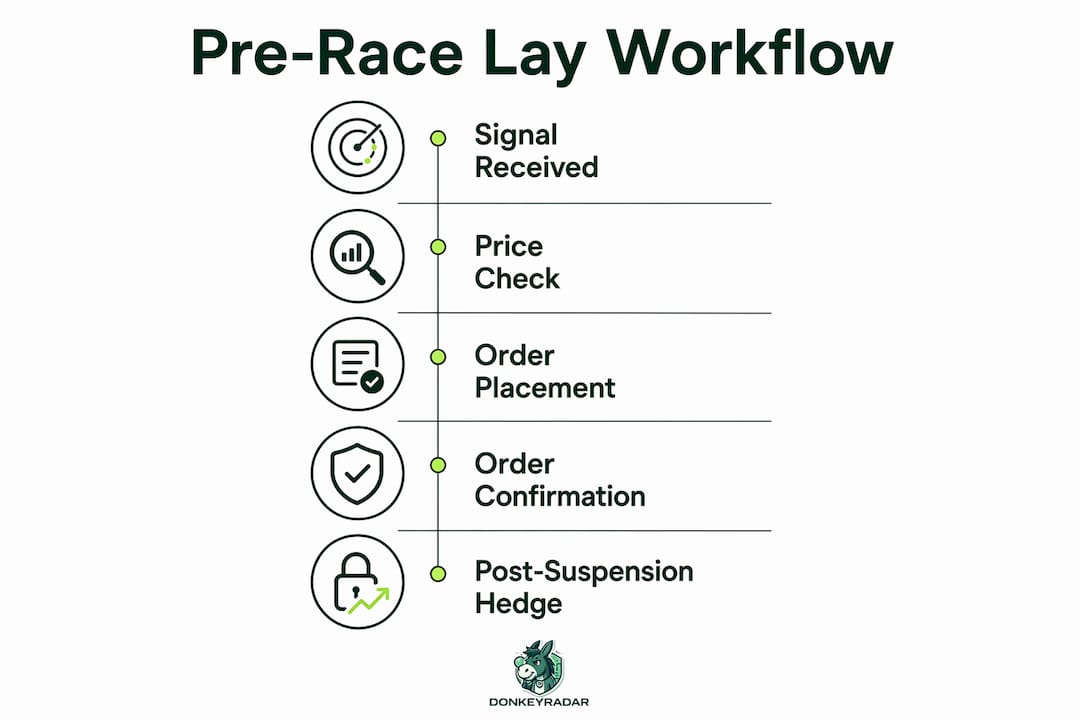
Pre-race lay signals sidestep the in-play delay entirely. Your order is placed before the market goes in-running, so the queuing model never applies to your entry. Here is a practical workflow for UK races.

T−30 minutes: Receive the signal. Check the horse’s current exchange price against the signal’s recommended lay range. Confirm your staking tier and calculate maximum liability.
T−5 minutes: Place a passive limit lay order at or near the current best available price. The market is still pre-race, so no delay applies. Monitor for significant market moves that would invalidate the signal.
T−1 minute: Confirm the order is still live and unmatched orders are within your acceptable range. Cancel any order that has drifted significantly beyond your intended price.
Post-suspension (5–10 seconds after re-open): If you need to hedge, wait for prices to stabilise before acting. This is the only point at which the in-play delay affects your workflow, and only for the hedge leg.
For a signal product to support this workflow reliably, it needs time-stamped publication before the race, verified public results, direct Betfair Exchange links, and clear staking tier grading. These features let you act on the signal with confidence and audit performance over time.
Pro Tip: Signals published after the off are useless for this workflow. Always check the publication timestamp before acting. If a provider cannot show you a time-stamped, pre-race record, treat their results as unverified.
Verified, time-stamped results are the single most important trust signal when evaluating any lay signal service.
Pre-lay checklist: timing, fees, and UK notes
Timing checklist:
- Receive and review signal at T−30 minutes or earlier.
- Place passive limit lay order no later than T−5 minutes.
- Cancel unmatched orders at T−1 minute if price has moved beyond your range.
- Wait 5–10 seconds post-suspension before placing any hedge.
Costs to factor in:
| Cost item | Typical value | Notes |
|---|---|---|
| Betfair commission | 2% standard | Applied to net winnings on each market |
| Premium charge | Variable | Applies to consistently profitable accounts |
| Unmatched order cost | — | No charge, but ties up bankroll |
UK-specific notes:
- The Gambling Commission’s in-play betting guidance sets consumer protection standards that operators must follow, including delay transparency.
- Betting profits in the UK are tax-free for individual bettors. This applies to lay betting winnings on Betfair.
- Commission eats into P&L on every winning lay. Factor it into your staking calculations before placing, not after.
Why Donkeyradar suits UK lay bettors dealing with Betfair’s delay
Donkeyradar is built around the pre-race workflow described above. Its algorithm processes historical strike rates and live market prices to identify the statistically weakest runner in UK, Australian, and US races, publishing signals before the off with a verified strike rate above 85%.
Key features that map directly to the workflow:
- Time-stamped signals published prior to each race, so you can verify publication time independently.
- Direct Betfair Exchange links in the dashboard, reducing the steps between signal receipt and order placement.
- Staking tier grading on every signal, so you size positions consistently rather than guessing.
- Real-time alerts via email and Telegram, meaning you receive signals at T−30 minutes or earlier without monitoring a dashboard continuously.
- Public verified results history, so you can audit the strike rate before committing capital.
- API access for traders who want to integrate signals into their own software or automate order placement.
Pro Tip: Use Donkeyradar’s direct Betfair links to open the correct market immediately. Navigating manually to the right race under time pressure is a common source of errors at T−5 minutes.
For a full step-by-step guide to placing lay bets using these signals, the how to lay a horse on Betfair guide walks through each stage of the process.
Key takeaways
The Betfair in-play delay makes reactive lay betting a structurally losing approach for retail bettors; pre-race statistical signals are the practical alternative.
| Point | Details |
|---|---|
| Delay range is 1–12 seconds | Horse racing in-running commonly sees ~8s; tennis and greyhounds run at ~1s. Football markets were reduced from 12s to 5s in recent seasons. |
| Video lag compounds the problem | Betfair Live Video runs 2–5 seconds behind the event, making visible reactions even later. |
| Pre-race signals bypass the queue | Orders placed before the off are never subject to the in-play queuing model. |
| Wait 5–10s before hedging | Post-suspension pricing is unstable; waiting reduces execution slippage on the hedge leg. |
| Donkeyradar for pre-race signals | Time-stamped signals, verified 85%+ strike rate, and direct Betfair links support the full workflow. |
Why pre-race signals beat live-reacting strategies
The conventional wisdom in lay betting circles is that sharper execution solves the delay problem. It does not. Even a datacentre connection running at 2–5ms cannot overcome a mandatory 8-second queue on horse racing in-running markets. The delay is not a technical inconvenience; it is a structural feature of how the exchange operates.
What actually produces a consistent edge is deciding before the race which horse is the weakest runner, placing the lay at a fair price pre-race, and letting the market do the work. Experienced traders have observed this for years: pre-positioning rather than reacting is the only approach that does not depend on being faster than the market. You cannot be. The discipline required is straightforward: follow the signal, size the position correctly, and do not deviate because of something you see on a delayed video stream.
Ready-made pre-race lay signals from Donkeyradar
If you want to put this workflow into practice without building your own signal system, Donkeyradar gives you time-stamped pre-race lay signals for UK, Australian, and US races, published before every race with direct Betfair Exchange links and staking tier grading.
The free tier delivers daily lay signals so you can test the workflow with a small bank before committing to a paid subscription. Premium subscribers get real-time Telegram and email alerts, full results history, and API access for software integration. Every result is publicly tracked and verified, so the 85%+ strike rate is not a marketing claim; it is an auditable record.
Start with the lay betting strategy guide to understand the methodology, then check today’s signals at Donkeyradar’s daily signals page to see the workflow in action.
Further reading and primary sources
- In-play or in-running betting — Gambling Commission: The UK regulator’s guidance on operator obligations and consumer protection for in-play markets.
- Why do you have a delay on placing bets on a market that is in-play — Betfair Developer Program: Technical explanation of the betDelay field and the 1–12 second range across market types.
- Betfair Live Video — support.betfair.com: Confirms the 2–5 second video stream delay and its implications for in-play decision-making.
- Betfair Exchange September Newsletter — bet delays reduced in European football: Documents the reduction from 12s to 5s for many European football leagues and explains passive-bet-delay logic.
- Delays in-play trading: Betfair reality — BetfairSquare: Practitioner analysis of how the delay affects stop losses, order edits, and retail execution.
- Betfair in-play automation, latency and execution — Trinity Logic: Technical breakdown of network latency versus bet delay, with guidance on post-suspension hedging timing.