← Blog · 📝 Article · 1 August 2026
BSP vs SP: which starting price wins for lay bettors?

For UK lay bettors, BSP usually delivers better net value than the industry starting price. Sporting Life analysis puts the average BSP advantage at around 10% before commission, and Donkeyradar’s verified weekly results consistently show that lay signals executed at BSP outperform SP-settled equivalents across liquid UK markets.
The short version: use BSP as your default in mainstream UK races, understand the commission maths, and know the handful of situations where SP or a Best Odds Guaranteed fixed price can flip the result. The rest of this article explains exactly when and why.
Table of Contents
- How do BSP and industry SP actually compare?
- How Betfair calculates the BSP
- How the industry SP is determined at racecourses
- What the BSP vs SP difference means in practice for lay bettors
- When can industry SP outperform BSP?
- Practical workflow: using BSP and SP in a lay-betting system
- What Donkeyradar’s verified results show about BSP
- How to interpret BSP vs SP statistics without being misled
- Key takeaways
- Why the conventional wisdom on BSP gets oversimplified
- Try Donkeyradar’s lay signals free
- Further reading and primary sources
How do BSP and industry SP actually compare?
The table below sets out the key differences across the dimensions that matter most to lay bettors.
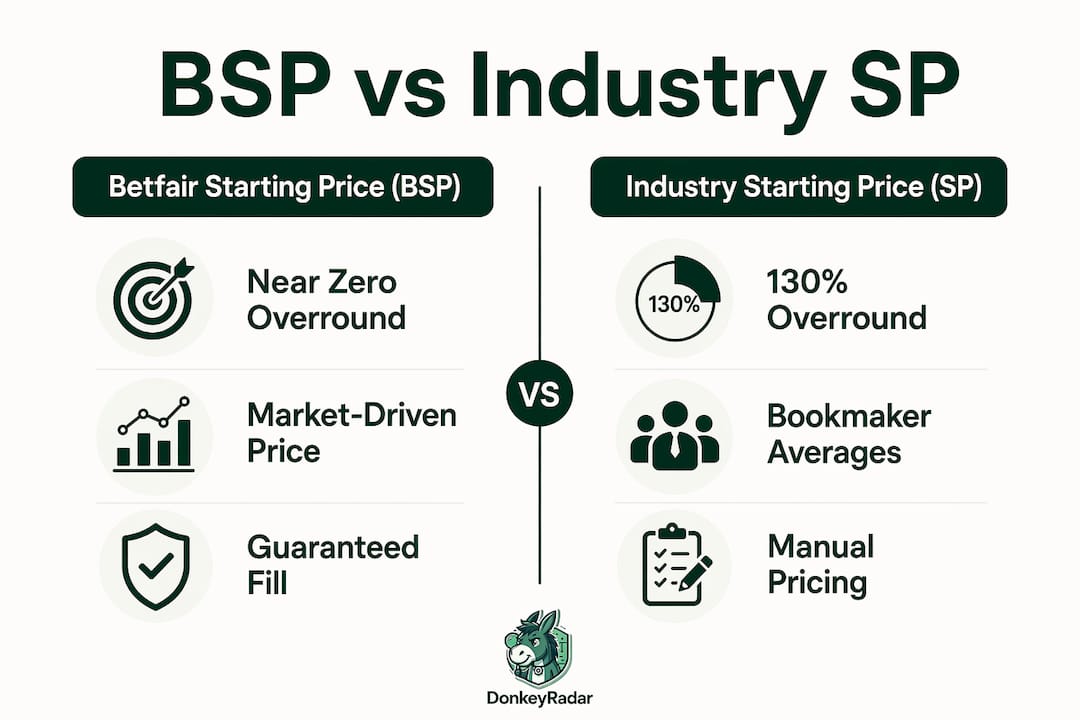
| Dimension | Betfair Starting Price (BSP) | Industry Starting Price (SP) |
|---|---|---|
| How price is set | Automated exchange clearing price at the off | On-course bookmaker board average, recorded by officials |
| Typical price level | Near-zero overround; generally longer prices | ~130% overround; structurally compressed outsiders |
| Timing | Fixed at the moment the race starts | Fixed at the moment the race starts |
| Execution control | Guaranteed match; no price choice | Price known in advance if fixed; SP unknown until off |
| Commission | Betfair charges 2%–9% on net winnings | No commission; overround is the bookmaker’s margin |
| Best for lay bettors | Liquid UK races, systematic strategies | BOG situations, odds-on runners, thin exchange markets |

The single most important practical difference: SP carries an average overround of approximately 130% in UK racing, while BSP operates close to 100%. That 30-percentage-point gap is the structural reason BSP wins in aggregate.
How Betfair calculates the BSP
BSP is an automated, exchange-derived clearing price calculated at the precise moment a race begins. There is no human intervention and no bookmaker margin built in.
Here is how the process works:
- Before the off, you place a lay order and tick “Betfair Starting Price” rather than specifying a price.
- At the off, Betfair’s algorithm surveys all matched bets and all unmatched orders sitting in the market.
- It finds the clearing price: the single price at which the total volume of back requests and lay requests balance.
- Your bet is matched at that price, guaranteed, regardless of where it sat in the queue.
- If your order was partially unmatched before the off, the unmatched portion converts to BSP automatically.
The practical consequences are clear. You get a guaranteed fill and a price that reflects genuine crowd-sourced exchange sentiment. What you give up is price control: you cannot know your exact lay price until the race has started. Commission on net winnings applies at your Betfair rewards tier (2% on the Basic package, 6% at the standard Rewards rate, 9% at Rewards+).
How the industry SP is determined at racecourses
Industry SP is an on-course, manually recorded average of bookmaker board prices at the off. It is set by designated officials who observe the boards of approved bookmakers in the ring and aggregate those prices according to rules overseen by the Starting Price Regulatory Commission.
The structural difference from BSP is one of incentives. Bookmakers manage liability, not just probability. That liability management creates a systematic overround: On Course Profits modelling shows that SP compresses outsider prices in particular, because bookmakers shorten the tails to limit exposure on longer-priced runners. The implied probabilities of all runners in a race sum to roughly 130% of certainty under SP, meaning bettors are collectively paying a 30% margin on every race.
SP remains the settlement price for the vast majority of bets placed in shops and on most online bookmaker platforms. It is also the reference price for Best Odds Guaranteed offers, which is where SP’s relevance to exchange bettors becomes interesting.
What the BSP vs SP difference means in practice for lay bettors
BSP usually gives better net value for lay bettors after commission in most UK markets. The overround gap is large enough that even after Betfair’s commission, the exchange price is structurally superior for the majority of runners.
Here is a worked example for a lay bet on a runner priced at BSP 6.0 (5/1):
- You lay £10 at BSP 6.0. Your liability is £50 (£10 × (6.0 − 1)).
- The horse loses. You collect £10 profit.
- Betfair charges 6% commission on net winnings: £0.60. Net profit = £9.40.
- The same runner settles at SP 5.0 (4/1) due to the overround compressing the price.
- Your SP lay profit on a £10 stake would be £10 with no commission deduction.
- Net BSP advantage: £9.40 vs £10.00 here. But across a full book, the longer BSP prices mean more losers are priced longer, increasing lay profitability overall.
The breakeven point matters. BSP after commission typically beats SP at prices above roughly 3/1, and the advantage grows as prices lengthen. Below 3/1, commission can erode the edge.
Pro Tip: Check your Betfair commission tier before committing to a BSP-heavy lay system. The difference between 2% (Basic) and 9% (Rewards+) changes the breakeven price significantly. Many systematic lay bettors deliberately manage their tier to keep commission low.
For execution, BSP suits bettors who cannot monitor markets to the off or who run automated systems. If you need a precise lay price, you must use pre-off matched orders instead. BSP is passive; manual trading is active. Both have a place, but they are not interchangeable.
When can industry SP outperform BSP?
SP can beat BSP in a small minority of cases. Recognising those situations is as important as understanding the general BSP advantage.
- Best Odds Guaranteed (BOG). If you take a morning fixed price with a BOG bookmaker and the SP rises by the off, the bookmaker pays the higher SP. BSP has no equivalent mechanism. In races where prices drift significantly between morning and the off, BOG can deliver returns that exceed BSP.
- Odds-on favourites. At very short prices, the SP overround per runner is small (often 1–2%). After Betfair’s commission, BSP can deliver a lower net return than SP on winning lays at these prices. The margins are tight, but commission tips the balance more often than you might expect.
- Thin exchange liquidity. On obscure all-weather cards, low-grade fixtures, or races with very small fields, the BSP matching pool may be shallow. Exchange distortion in thin markets can push BSP away from sensible long-run values. SP, backed by a larger and more established pricing mechanism, can be the more reliable figure in these cases.
- Late on-course steam. Heavy on-course money arriving in the final minutes before the off can shorten SP without fully reaching the exchange. If you are laying a runner and SP shortens sharply on-course while BSP stays longer, SP settlement would have been more favourable for your lay.
How to spot these situations quickly: check matched volume in the Betfair market before the off. Low matched volume (under a few thousand pounds) on a runner signals thin liquidity. For BOG opportunities, compare morning fixed prices against the current exchange price; a widening gap suggests drift is in play.
Practical workflow: using BSP and SP in a lay-betting system
A consistent pre-race checklist prevents costly execution errors. Follow these steps before committing a lay stake:
- Check market liquidity. Open the Betfair price ladder for the race. If matched volume on your selection is thin, consider whether BSP will produce a reliable clearing price or whether a manual lay order is safer.
- Confirm your commission tier. Log into your Betfair account and verify your current rewards rate. Factor that percentage into your expected net return before sizing the stake.
- Assess the price range. If the runner is priced above 4/1 in a liquid market, BSP is almost always the right execution method. Below 3/1, weigh commission against the SP overround for that specific runner.
- Check for BOG availability. If you hold a morning fixed price with a BOG bookmaker and the exchange price has drifted since, SP may now be the better settlement route.
- Set your order type. For BSP, click the SP column in the Betfair market view. For unmatched orders approaching the off, decide in advance whether to convert to BSP or cancel.
- Cross-reference Donkeyradar signals. Before the off, check whether the runner appears in today’s lay signals and note the staking tier grade. Higher-grade signals carry stronger statistical backing.
- Record the outcome. Log BSP or SP settlement price, commission paid, and net P&L. Over time, this data tells you which execution method is working in your specific market segment.
For a full walkthrough of placing lay orders on the exchange, the step-by-step lay guide covers every order type in detail.
What Donkeyradar’s verified results show about BSP
Donkeyradar publishes weekly verified roundups so bettors can assess real-world signal performance rather than relying on back-tested projections. The week 25 roundup and subsequent weeks show consistent strike rates well above the 85% threshold the service targets.
| Week | Wins | Losses | Strike Rate |
|---|---|---|---|
| Week 25 | — | 3 | — |
| Week 26 | — | 7 | 75% |
| Week | — | 3 | above 85% |
| Week 28 | — | 2 | — |
Week 26 shows a dip to 75%. That is worth noting, not hiding it.
These results are generated using BSP execution in liquid UK markets. The consistency across weeks 25–28 reflects what a systematic lay approach looks like when signals are statistically grounded and execution is disciplined. A single losing week does not invalidate the model; a pattern of losing weeks would.
How to interpret BSP vs SP statistics without being misled
Small-sample volatility can mislead. A four-week sample showing an 85% average strike rate tells you something useful, but it does not tell you everything.
Key caveats to apply when assessing any BSP vs SP claim:
- Sample size. Fewer than 200 races is not enough to draw firm conclusions about long-run value. Short samples amplify variance.
- Selection bias. Results that only report winning periods overstate the true edge. Always look for verified records that include losing runs.
- Commission assumptions. A BSP advantage calculated at 0% commission is not the advantage you will actually receive. Always apply your specific tier rate.
- Survivorship bias. Systems that appear in published results survived; many that did not work were quietly abandoned. Seek independently verified records.
The On Course Profits modelling of SP-to-BSP relationships uses UK and Irish racing data across multiple seasons, which is the kind of sample size that produces reliable conclusions. Single-season or single-service claims deserve more scepticism.
Key takeaways
BSP is the structurally superior execution method for lay bettors in liquid UK markets, but commission, price level, and liquidity determine whether that advantage holds on any given race.
| Point | Details |
|---|---|
| BSP wins in aggregate | Near-zero overround vs ~130% SP overround gives BSP a structural edge across most UK races. |
| Commission changes the maths | BSP after commission typically beats SP at prices above roughly 3/1; below that, the gap narrows. |
| SP has genuine exceptions | BOG situations, odds-on runners, and thin exchange markets can all favour SP over BSP. |
| Liquidity check is non-negotiable | Always verify matched volume before relying on BSP for significant stakes in lower-grade races. |
| Donkeyradar signals use BSP | Verified weekly results (85%+ average strike rate across weeks 25–28) are generated in liquid BSP markets. |
Why the conventional wisdom on BSP gets oversimplified
The standard line is “BSP is always better than SP.” That is close to true in aggregate, but it papers over the cases where it is not. The overround gap is real and large. The commission cost is also real. At short prices, those two forces nearly cancel each other out, and BOG can tip the balance the other way entirely.
What most guides miss is that the BSP advantage is not uniform across the price range. It is largest on mid-to-long-priced runners in liquid markets, which is precisely where systematic lay strategies tend to operate. For that audience, the case for BSP is strong and data-backed. For a punter who mainly backs odds-on favourites or uses BOG accounts, the picture is genuinely more complicated.
Donkeyradar’s approach is to publish the results as they are, including the weeks where the strike rate dips. The data is the argument. Bettors who want to verify the BSP-based performance themselves can check the public results archive directly rather than taking any service’s word for it.
Try Donkeyradar’s lay signals free
Donkeyradar gives lay bettors a free daily signal based on the same statistical model that produced an 85%+ average strike rate across weeks 25–28. The free tier delivers one signal per day with direct Betfair Exchange links and staking tier grades, so you can see exactly which runners the algorithm flags and at what confidence level.
Premium subscribers get real-time alerts via email and Telegram, full results history, API access for trading software integration, and priority signal delivery before the off. Every result, win or loss, is published publicly so you can validate the record yourself before committing a penny.
If you are new to laying horses on Betfair, the lay betting explained guide covers the mechanics from scratch. Ready to go further? The verified results page shows the full public history. Start with the free tier at donkeyradar.com and check the signals against your own judgement before upgrading.
Betting profits in the UK are tax-free. The edge is yours to keep.
Further reading and primary sources
- Betfair Starting Price (BSP): Exchange SP vs Industry SP — FixedOdds analysis comparing BSP and SP performance across UK racing seasons; primary source for the BSP outperformance claim.
- SP vs BSP: Which Starting Price Gives Better Value? — Detailed breakdown of overround mechanics, commission maths, and edge-case scenarios including BOG and odds-on runners.
- What is Starting Price Betting? — Sporting Life explainer citing the ~10% average BSP advantage figure.
- Betfair SP explained — Practical guide to BSP mechanics, market scope (UK and Irish racing), and commission considerations.
- Betfair Starting Price (BSP): Exchange SP explained — Operational detail on unmatched order conversion, automated systems, and BSP limitations.
- Modelling the relationship between SP, BSP and beyond — On Course Profits statistical modelling of SP compression on outsiders using UK and Irish racing data.
- Donkeyradar weekly roundup — week 25 — Primary source for the verified weekly results data cited in this article.
- Donkeyradar verified results — Public archive of all weekly roundups for independent verification.
This article is general information for educational purposes. It is not financial or betting advice. Always verify current Betfair commission rates and terms directly with Betfair before placing bets.