← Blog · 📝 Article · 27 July 2026
Going bias betting: a practical guide for lay bettors
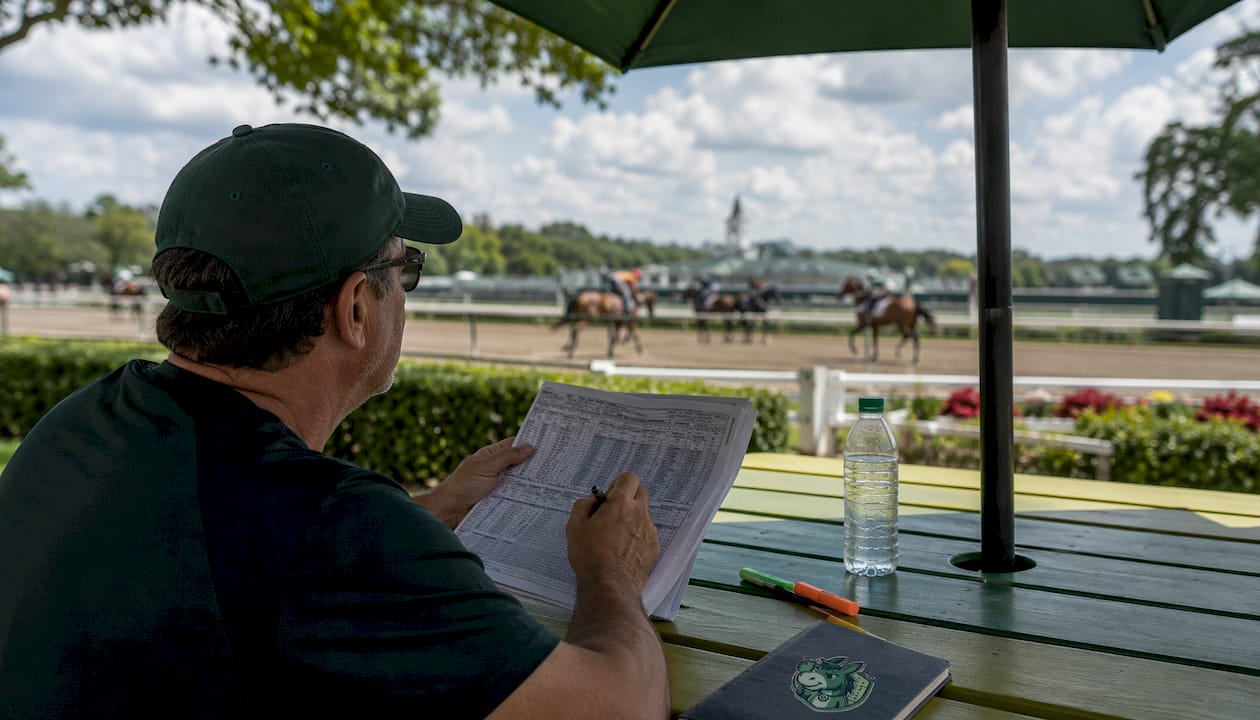
Use observed going bias to sharpen your statistical lay signals, not to replace them. Check the first three races for a consistent pattern, then either press your lay signal with added conviction or stand aside.
Quick-start checklist:
- Identify your statistical lay signal before the meeting starts
- Watch races 1–3 for a repeating positional pattern (inside, outside, front-runners)
- Confirm the pattern against official going, coursecam footage, and in-play price drift
- Adjust your stake tier up or skip the trade entirely if bias contradicts the signal
- Log every trade: signal source, observed bias, stake, entry price, outcome
Table of Contents
- What is going bias in horse racing?
- How to spot an emerging going bias on race day
- How to apply going bias to your lay betting workflow
- Common mistakes and the psychology that makes them worse
- What tools help you confirm bias live in the UK?
- How Donkeyradar integrates going bias into its lay signals
- Key takeaways
- The case for patience over conviction
- Try Donkeyradar’s lay signals free today
- Useful sources and further reading
What is going bias in horse racing?
Track bias refers to physical characteristics of a course — rail position, moisture profile, soil composition, and kickback — that create faster or slower corridors and systematically favour certain running styles or draw positions. The industry term is track bias; “going bias” is the shorthand most UK bettors use when the ground condition is the primary driver.
The causes split into two groups by persistence. Weather and maintenance effects (watering schedules, rail movements, overnight rain) tend to persist across a meeting. Kickback and wind effects are more transient and can shift between races. Narrow, tight-turn tracks amplify even small biases; wide, sweeping courses dilute them. Chelmsford City on a wet night behaves very differently from Newmarket’s Rowley Mile in the same conditions.
For lay bettors, the significance is clear: a horse priced as if it will run its true form may be systematically disadvantaged by the track before the stalls open. That mispricing is the opportunity.
How to spot an emerging going bias on race day
A single race proves nothing. Three or four races showing the same pattern is a signal worth acting on. Here is the routine:
- Check official going before racing. The BHA publishes going descriptions and rail movements on the Racing Post and the course’s own site. Note any rail shift from the advertised position.
- Watch race 1 for positional clues. Where did the winner travel? Did front-runners dominate, or did closers sweep through? Note the winning draw.
- Repeat for races 2 and 3. A consistent pattern across early races — inside winners, front-runner dominance, or a specific draw advantage — is your threshold signal.
- Listen to jockey commentary. Post-race interviews often contain direct references to ground conditions or preferred parts of the track. Treat this as confirmation, not primary evidence.
- Check coursecam footage. Most UK meetings stream live; watch where the ground is cut up and where it remains fresh.
- Apply the 3-of-4 rule. If three of the first four races show the same pattern, treat bias as confirmed for staking purposes. Fewer than three and you are speculating.
Modern track maintenance has reduced extreme biases, but micro-biases remain common and are frequently ignored by the wider market. That lag between observation and price adjustment is where your edge lives.
How to apply going bias to your lay betting workflow
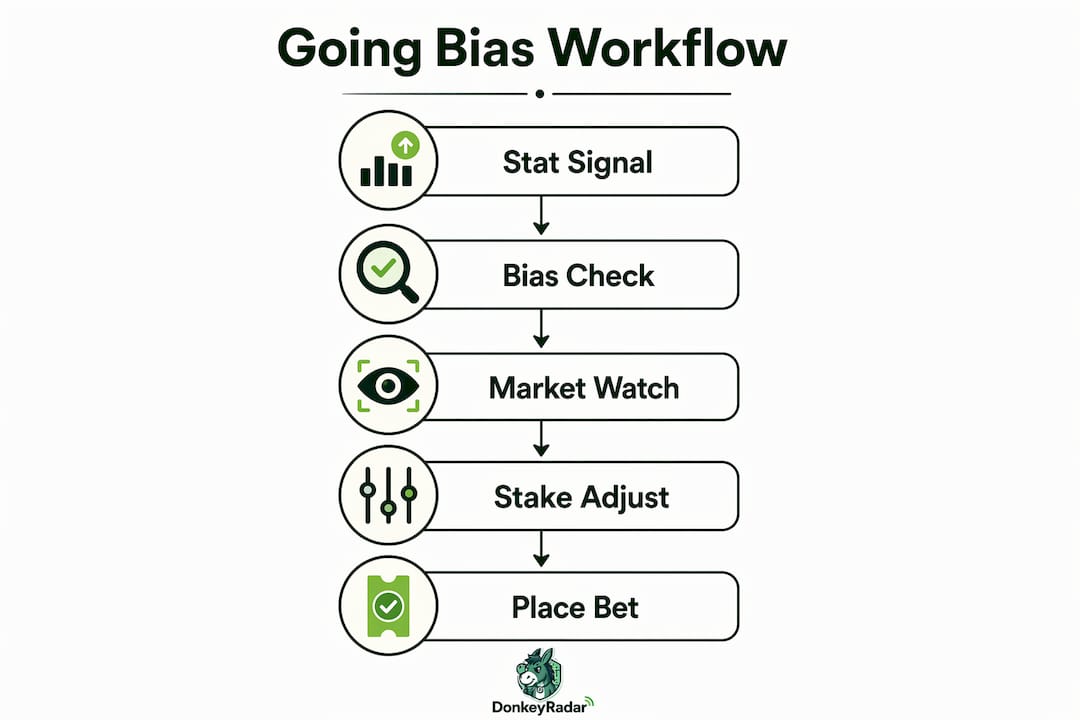
Bias changes the probability you assign to a statistical lay signal. A horse already flagged as a likely loser by your model becomes a stronger lay candidate when the track actively works against its running style. Here is the step-by-step process:

Step 1 — Pre-race filter. Start with your statistical lay signal. Does the horse’s preferred running style (hold-up, wide draw, needs cut in the ground) conflict with the observed bias? If yes, conviction increases. If the bias actually suits the horse, consider skipping the trade.
Step 2 — Market check. Open the Betfair in-play market and watch price movement in the final minutes before the off. A horse drifting in price while the bias is confirmed is a strong corroborating signal. A horse shortening despite the bias warrants caution.
Step 3 — Staking adjustment. Use graded tiers rather than flat stakes. A signal with confirmed bias behind it might warrant moving from your base tier (say, 1% of bank) to your elevated tier (2%). Never exceed your pre-set maximum regardless of conviction.
Step 4 — Execution and stop-loss. Place the lay via Betfair Exchange. Set a mental stop-loss: if the horse leads or moves to the favoured part of the track in the first furlong, consider a partial hedge rather than riding the full liability.
Logging template:
| Field | Example |
|---|---|
| Signal source | Statistical model / Donkeyradar |
| Observed bias | Inside rail, front-runners, races 1–3 |
| Stake tier | Tier 2 (2% of bank) |
| Outcome | Won (lay settled) |
Pro Tip: Track Closing Line Value (CLV) by bias category. If your bias-confirmed lays consistently beat the closing price, the combination is generating real edge. If they do not, the bias observation is adding noise, not signal.
Common mistakes and the psychology that makes them worse
The biggest error is treating going bias as a standalone system. Experts are clear that bias should augment form analysis and probability assessment, never replace it. Here are the traps that catch most bettors:
- Treating bias as a system. Two or three bias-driven winners in a row is not a method. It is a sample. Require a minimum of 30 logged trades before drawing any conclusions about your approach.
- Ignoring form entirely. A horse disadvantaged by the track but running in a dramatically weaker field than its rivals may still win. Bias adjusts probability; it does not override class.
- Over-adjusting stakes after a winning run. Recency bias is powerful. Cap stake increases at your pre-set tier ceiling regardless of recent results.
- Laying longshots because the track looks against them. This compounds the favourite–longshot bias: longshots already lose more than their odds imply, and recreational money systematically overvalues them. Laying a 20/1 shot because of bias may feel logical, but the liability-to-reward ratio rarely justifies it.
- Confirmation bias in race-watching. Once you have decided a bias exists, you will find evidence for it everywhere. Apply the 3-of-4 rule mechanically to counteract this.
Research by Snowberg and Wolfers confirms that the favourite–longshot bias is driven by misperceptions of probability rather than rational risk preference. Recreational money overvalues longshots, which is why lay betting tips built around statistical signals tend to focus on the mid-to-short price range where the market is most efficient and liability is manageable.
What tools help you confirm bias live in the UK?
Combine visual confirmation with market data and official going updates before committing to a trade. No single source is sufficient on its own.
| Tool | What it confirms | Update speed |
|---|---|---|
| BHA / Racing Post official going | Ground condition, rail position | Pre-race, updated during meeting |
| Coursecam / live stream | Visual ground wear, preferred lanes | Real-time |
| Betfair in-play market | Market consensus on likely winner | Continuous |
| Sectional timing feeds (where available) | Split times by section of track | Post-race, same day |
| Jockey / trainer post-race comments | Anecdotal ground preference | Post-race, within minutes |
The minimum confirmation threshold: visual evidence from the coursecam plus a drift in the Betfair market for the horse you intend to lay, consistent with the official going. If any one of those three is absent or contradicts the others, stand aside.
How Donkeyradar integrates going bias into its lay signals
Donkeyradar’s approach is to combine historical strike-rate analysis with live market adjustment, producing a pre-published, timestamped lay signal before each race. The methodology works in three stages: the algorithm identifies the statistically weakest runner based on historical performance data; live market prices are checked against that assessment; and the signal is graded into staking tiers before publication.
Strike rate: Donkeyradar publishes a verified strike rate of over 85% across UK, Australian, and US races, with all signals timestamped before the off and results continuously tracked.
Every signal includes a direct Betfair Exchange link, so execution takes seconds rather than minutes. The verified results history is publicly accessible, which means you can audit the sample before committing a single pound.
To combine an externally observed bias with a Donkeyradar signal: check the dashboard for the day’s flagged runner, confirm the horse’s running style conflicts with your observed bias, then apply the appropriate staking tier from the signal. Real-time alerts via email and Telegram mean you receive the signal with enough lead time to complete your own bias check before the off. The data-driven strategy behind the platform is designed precisely for this kind of layered decision-making.
Key takeaways
Going bias is most valuable when it confirms a statistical lay signal, not when it stands alone as the reason to trade.
| Point | Details |
|---|---|
| Bias augments signals | Use track bias to increase conviction on an existing statistical lay signal, never as a standalone reason to lay. |
| 3-of-4 rule | Require three of the first four races to show the same positional pattern before treating bias as confirmed. |
| Graded staking | Move one tier up when bias confirms your signal; never exceed your pre-set bank percentage ceiling. |
| Skip the trade | If observed bias suits the horse you intended to lay, stand aside rather than force the trade. |
| Donkeyradar | Donkeyradar publishes pre-race, timestamped lay signals with verified results and direct Betfair links for UK, Australian, and US races. |
The case for patience over conviction
The temptation with going bias betting is to act quickly and confidently. You have watched three races, spotted a pattern, and the signal is right there. That confidence is earned — but only if the sample is real and the process is disciplined.
What most guides do not say plainly enough: bias observation is a skill that degrades under pressure. The more you want a trade to work, the more readily you will see a bias that supports it. The 3-of-4 rule and the logging template exist precisely to protect you from yourself. Start with small stakes, keep the log religiously, and let CLV data tell you whether the bias layer is adding genuine edge after 30 or more trades. If it is, scale carefully. If it is not, the log will show you why before the damage is done. Stake only what you can afford to lose, and treat the bank as a fixed resource to be protected, not a score to be maximised.
Try Donkeyradar’s lay signals free today
Donkeyradar gives you a pre-built, data-verified starting point for every race day — so you spend your time observing bias and confirming signals, not building a model from scratch.
The service offers lay signals across UK, Australian, and US races. Premium subscribers receive real-time alerts via email and Telegram, full results history, graded staking tiers, and API access for trading software. Every signal is published before the off with a timestamp, and results are tracked continuously so you can verify the effectiveness before you commit.
Features at a glance:
- Timestamped signals published pre-race
- Direct Betfair Exchange links in the dashboard
- Graded staking tiers matched to signal strength
- Publicly verified results history (over 85% strike rate)
- Real-time alerts via email and Telegram
Start with the free tier, apply the bias workflow from this guide, and check the verified strike rate for yourself. If you are new to laying horses, the complete guide to lay betting on the Donkeyradar site is the right place to begin.
Useful sources and further reading
These are the primary sources used to build this guide. Each is worth reading in full if you want to go deeper on the underlying evidence.
- Track bias in horse racing explained — A practical overview of how rail position, moisture, and soil composition create bias, with notes on micro-biases and how to spot them during a meeting.
- Understanding track bias (Thoroughbred Racing Commentary) — Covers the persistence of different bias types and how course geometry affects their magnitude. Useful for calibrating how much weight to give a bias observation.
- Understanding track bias in horse racing (RacingRant) — Explains how combining a physical bias observation with a mispriced runner produces a high-probability lay candidate.
- Snowberg and Wolfers — Risk love or decision weights (NBER) — The foundational academic paper arguing that the favourite–longshot bias is driven by probability misperception. Essential reading for understanding why recreational money systematically overvalues longshots.
- Favourite–longshot bias (Wikipedia) — A well-maintained summary of the academic literature, including Thaler’s classic data showing longshots lose significantly more than favourites over large samples.
This article is general information for educational purposes. It is not financial or betting advice. Always verify current rules with the relevant authority and bet within your means.