← Blog · 📝 Article · 27 July 2026
In-play lay betting: the complete UK guide for 2026

In-play lay betting is the practice of placing a bet against a selection during a live event on a betting exchange, rather than backing it to win. You take the role of the bookmaker: you offer odds, someone accepts them, and you profit if the selection fails to win. The key difference from pre-race laying is that odds shift constantly as the event unfolds, creating both opportunity and risk in real time.
Here is what defines in-play lay betting at its core:
- You bet against an outcome, not for one. If the selection loses, you keep the backer’s stake.
- Betting exchanges are the only venue for this. Platforms like Betfair Exchange, Smarkets, Matchbook, and EasyBet match you directly with opposing bettors.
- Odds move dynamically based on live event developments, creating price discrepancies you can exploit.
- Liability is your maximum loss, calculated as (odds minus 1) multiplied by your stake. A lay bet at odds of 4.0 puts your liability at three times your stake.
- You can close positions at any time before the event ends, locking in a profit or cutting a loss regardless of the final result.
- Bet delays apply to all in-play markets, typically 1–8 seconds depending on the sport.
The goal for most experienced layers is not simply to pick a loser. It is to identify a price that is too high relative to the true probability, then trade that position before the market corrects.
Table of Contents
- How does in-play lay betting work on exchanges?
- How does lay betting differ from traditional fixed-odds betting?
- Which UK exchanges are best for in-play lay betting?
- What are the liability risks and legal rules for UK lay bettors?
- What lay betting strategies work best for beginners?
- How does Donkeyradar use data to improve your lay betting signals?
- Donkeyradar gives you a data-backed edge on every lay bet
- Key takeaways
How does in-play lay betting work on exchanges?
Placing a lay bet during a live event follows the same mechanical steps as pre-event laying, but the pace is faster and the margin for error is smaller. You select your market on the exchange, enter your lay odds and stake in the back/lay interface, and submit. The exchange matches your offer against a backer willing to accept those odds.

The betting ladder is the most efficient interface for in-play trading. It displays the full range of available odds in a vertical column, with available liquidity at each price. As the event progresses, the ladder updates in real time, showing you exactly where money is sitting and how quickly the market is moving.
Bet delays are the most important mechanical constraint to understand. Betfair imposes bet delays on in-play markets, varying by sport. These delays exist to prevent automated systems from exploiting live data feeds faster than the exchange can process them. For manual traders, 8 seconds is a long time when a horse is accelerating to the front.
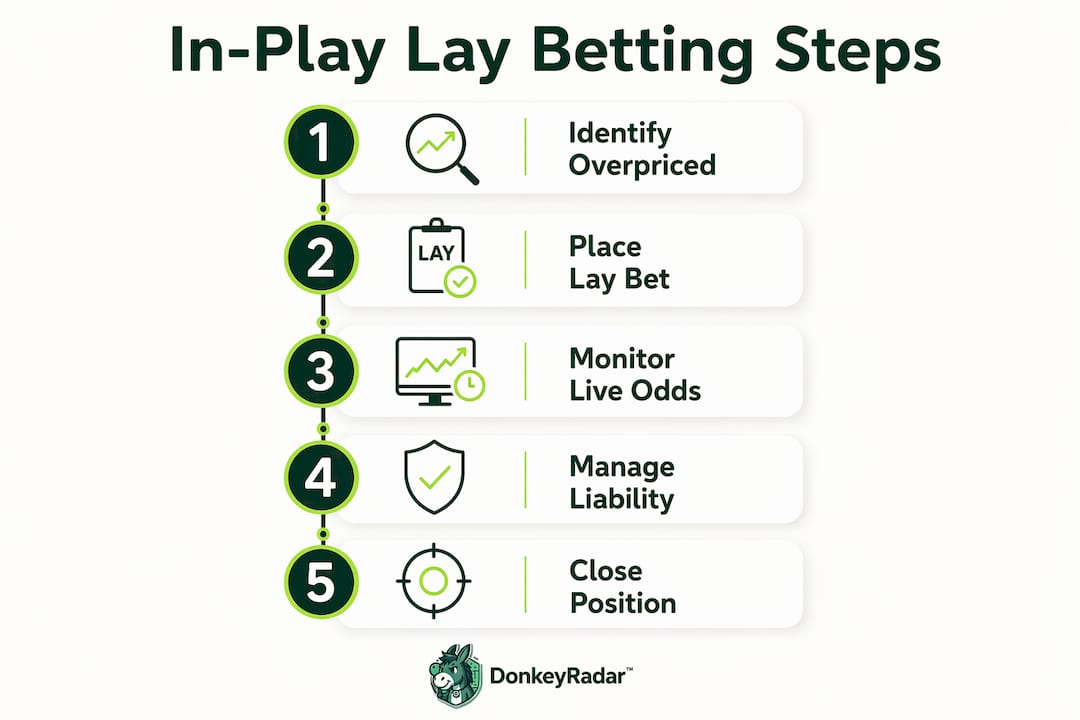
Greening up is the technique of placing an offsetting back bet after your initial lay to lock in a guaranteed profit across all outcomes. If you laid a horse at 6.0 and it drifts to 8.0 during the race, you back it at 8.0 for a proportional stake. The exchange calculates a balanced return regardless of whether the horse wins or loses. Most professional traders aim to green up rather than hold to the finish.
Key considerations for in-play lay betting on exchanges:
- Liquidity drops sharply during live events in smaller markets. Thin markets mean price slippage and difficulty exiting positions.
- One-click betting tools like Bet Angel and Geeks Toy reduce execution time significantly, which matters most in high-delay sports like horse racing.
- Market suspension can occur at any moment during a race or match, trapping open positions temporarily.
- Commission applies to net winnings on most exchanges, typically 2–5% depending on the platform and your activity level.
- Odds can move against you faster than you can react manually, particularly in the final stages of a horse race.
How does lay betting differ from traditional fixed-odds betting?
The structural difference is straightforward. A traditional backer stakes £50 on a horse at 5.0 and risks only that £50 to win £200. A layer offering those same odds risks £200 to win £50. The backer’s downside is capped at the stake; the layer’s downside scales with the odds.
That asymmetry sounds unfavourable, but it is offset by two factors. First, most selections lose. A layer backing market inefficiencies rather than simply guessing losers has a structural edge. Second, lay betting allows you to exit a position at any point, something a traditional fixed-odds bet does not permit once placed.
Pros and cons compared to traditional betting:
| Lay betting | Traditional fixed-odds | |
|---|---|---|
| Profit when | Selection loses or you green up | Selection wins |
| Maximum loss | (Odds – 1) × stake | Stake only |
| Exit flexibility | Yes, before event ends | No (cash-out limited) |
| Requires exchange | Yes | No |
| Commission | Yes (on net winnings) | No |
| Complexity | Higher | Lower |
A common misconception is that lay betting is inherently safer because you are “betting against” something. It is not. A layer who ignores liability management and lays short-priced favourites at odds of 1.2 faces enormous exposure relative to potential profit. The risk profile is different from traditional betting, not smaller.
Lay betting also offers hedging flexibility that fixed-odds betting cannot match. You can back a selection pre-race and lay it in-play once it shortens in price, locking in a green book before the race is decided. That kind of position management is the foundation of professional exchange trading.
Which UK exchanges are best for in-play lay betting?
The exchange you choose affects liquidity, commission rates, and the quality of your in-play experience. All four platforms below hold UK Gambling Commission licences.
Betfair Exchange
Betfair Exchange is the dominant UK exchange by liquidity, particularly for horse racing. Its in-play markets attract the deepest pools of money, which means tighter spreads and easier position exits. The standard commission rate starts at 2% and rises based on market rates. Betfair’s API is widely supported by third-party trading software, making it the default choice for serious in-play traders. The 8-second horse racing delay is a constraint, but the liquidity advantage generally outweighs it.

Smarkets
Smarkets charges a flat 2% commission on net winnings, one of the lowest rates available in the UK market. Its interface is clean and straightforward, which suits bettors who prefer a less cluttered experience. In-play liquidity is lower than Betfair’s, particularly for smaller racing meetings, but Smarkets performs well on major football and political markets.
Matchbook
Matchbook positions itself as a low-commission alternative, with rates starting at 1.5% for active users. It supports in-play betting across horse racing, football, and tennis. Liquidity is more limited than Betfair’s, but Matchbook’s odds are often sharper on the markets it does cover, and its interface handles live betting well.
EasyBet
EasyBet offers a straightforward exchange experience suited to bettors who are newer to lay betting. Its commission structure and in-play market coverage make it a reasonable starting point, though liquidity is thinner than the larger platforms. For learning the mechanics of in-play laying without the complexity of Betfair’s full interface, it serves its purpose.
Criteria for choosing an exchange for in-play lay betting:
- Liquidity in your target market — thin markets create slippage and trapped positions
- Commission rate — even 1% differences compound significantly over volume
- API and software compatibility — essential if you plan to use trading tools
- Mobile interface quality — relevant if you trade away from a desktop
- Bet delay length — varies by sport and platform
What are the liability risks and legal rules for UK lay bettors?
Liability is the single most important number in lay betting. The formula is simple: (lay odds minus 1) multiplied by your stake. A lay bet’s liability is your maximum loss, calculated as (odds minus 1) multiplied by your stake. For example, at odds of 5.00 with a £100 stake, your liability is £400. At odds of 2.00, your liability is £100. This scaling effect catches new layers off guard, particularly in in-play markets where odds can shorten rapidly. A horse priced at 8.0 before a race can trade at 1.5 once it hits the front. If you have an open lay position at that point, your liability has not changed, but the probability of it crystallising has risen sharply.
Key financial risks and common pitfalls:
- Over-staking relative to bankroll — professionals limit liability per trade to a small percentage of their total bankroll
- Laying at high odds without a stop-loss — a single winner at 15.0 can wipe out weeks of profit
- Ignoring market suspension — positions cannot be closed during a suspension
- Chasing losses — increasing stakes after a run of losers accelerates drawdown
- Failing to account for commission — net P&L after commission is the only figure that matters
On the legal side, lay betting in the UK is fully regulated. The Gambling Commission oversees in-play betting markets and requires all exchanges to hold an operating licence under the Gambling Act 2005. Betting on a UK-licensed exchange is legal for UK residents. Crucially, betting winnings are tax-free for individuals in the UK. You pay no income tax or capital gains tax on profits from exchange betting. The exchange pays a point-of-consumption tax, not you.
Always use a Gambling Commission-licensed platform. If you are concerned about your betting behaviour, GambleAware provides free, confidential support.
What lay betting strategies work best for beginners?
The most accessible starting point for new layers is identifying overpriced favourites in horse racing. When the market has pushed a horse’s odds below what the form and conditions justify, laying it offers a positive expected value. You are not guessing it will lose; you are identifying that the price is wrong.
Lay-the-draw is a popular football strategy. You lay the draw at the start of a match, then back it in-play once a goal is scored and the draw price drifts. The goal shortens the draw odds, so your offsetting back bet costs less than your original lay stake, locking in a profit. It requires discipline: if no goal arrives, you either accept the loss or hold the position.
Laying after tracking live performance is specific to in-play markets. A horse that breaks slowly from the stalls or a football team that concedes early will see its odds lengthen. Laying at the shortened pre-event price and greening up once the odds drift is a lower-risk approach than holding to the finish.
Bankroll management is non-negotiable. Set a maximum liability per bet before you place it, not after. A hard stop-loss, where you close a position at a predetermined loss level, prevents a single bad trade from damaging your overall book.
Common mistakes to avoid:
- Laying at odds above 6.0 without a clear exit strategy
- Placing in-play bets manually without accounting for the bet delay
- Treating every race as a trading opportunity regardless of liquidity
- Sizing stakes on gut feel rather than a fixed percentage of bankroll
- Holding losing positions in hope of a reversal rather than cutting losses early
Pro Tip: Use one-click betting software for all in-play lay bets. The 8-second horse racing delay means your manually typed bet can be submitted, processed, and matched before you have finished reading the price. One-click tools like Bet Angel eliminate that friction and let you focus on the market.
How does Donkeyradar use data to improve your lay betting signals?
Most layers spend hours analysing form, going, and market moves before identifying a single signal. Donkeyradar does that work algorithmically, processing historical strike rates and live market prices to identify the weakest runner in each race before it starts.
The statistical model behind Donkeyradar generates lay signals with a verified strike rate of over 85%. Every signal is published before the race, and every result is tracked publicly. There is no selective reporting. Losses appear in the results history alongside wins, because transparency is the whole point.
Advanced strategies built into Donkeyradar’s approach include price wobble trading, where the algorithm identifies selections whose market price is oscillating above a fair value threshold, and layered offsetting, where a lay signal is paired with a recommended back price a few ticks higher. A lay-to-back strategy targeting higher odds yields a notable success rate; with an offsetting back bet, success improves further.
Best practices from Donkeyradar’s data-driven approach:
- Focus on signals where the algorithm identifies a clear price discrepancy, not every race
- Use the staking tier grading in the dashboard to size bets proportionally to signal confidence
- Set up real-time alerts via email or Telegram so you never miss a signal close to post time
- Cross-reference Donkeyradar signals with the Betfair lay betting strategy framework for context
- Review the verified results history regularly to understand which race types generate the strongest signals
- Use the API integration if you run automated trading software for faster execution
Pro Tip: Pair Donkeyradar’s pre-race signals with in-play monitoring. If a signalled horse breaks poorly or is badly positioned early, the in-play odds will drift, giving you a secondary entry point at better value than the pre-race price.
The trust signals matter here. Donkeyradar’s results are verified and continuously updated. The algorithm is built on historical data, not opinion. And the platform operates within UK regulatory requirements, so every signal is delivered through a compliant, licensed framework.
Donkeyradar gives you a data-backed edge on every lay bet
Picking lay selections manually is time-consuming and inconsistent. Donkeyradar removes the guesswork by delivering statistically graded signals for UK, Australian, and US horse racing, all verified against a public results history with a strike rate above 85%.
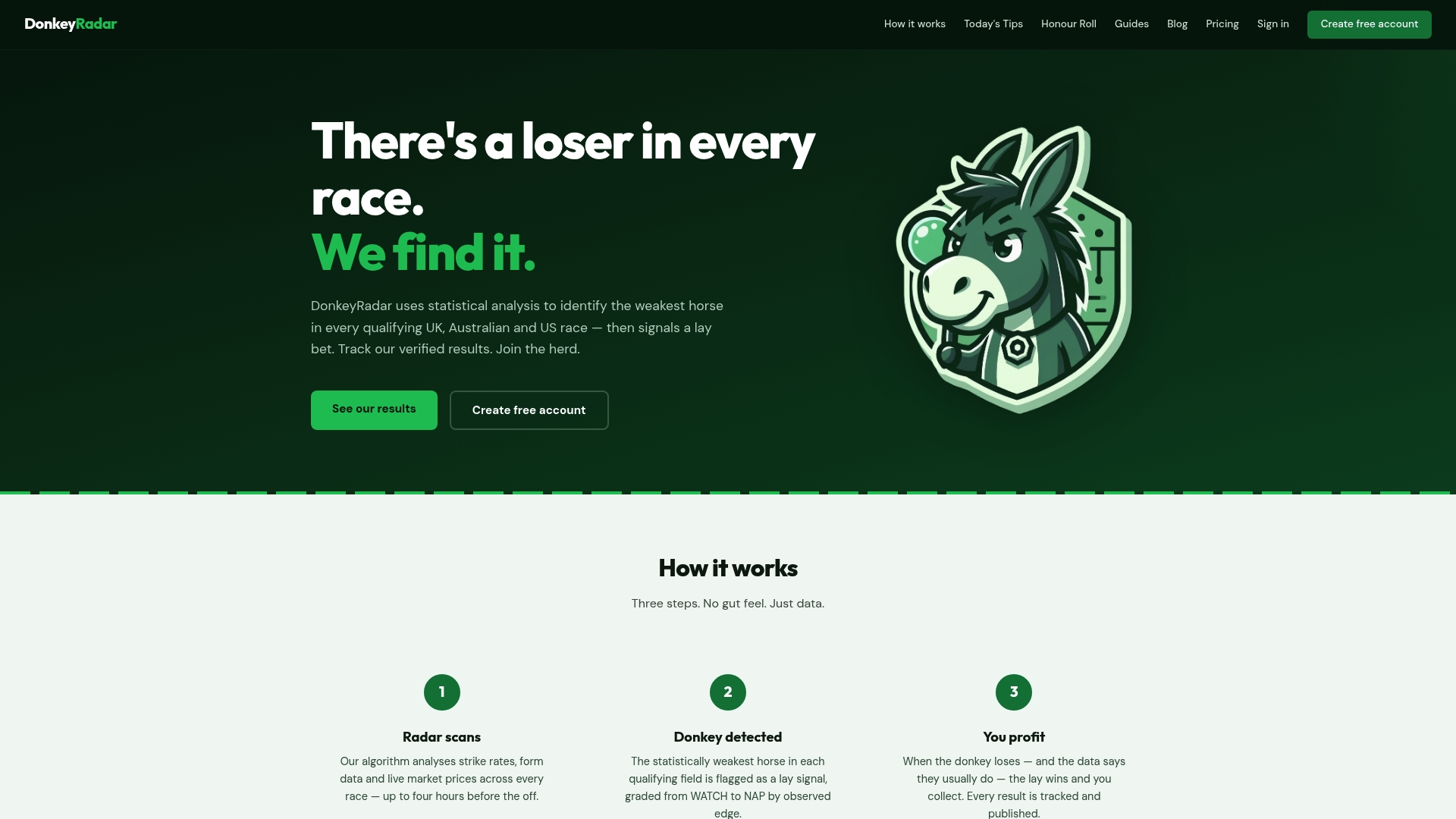
The free tier gives you daily lay signals with direct Betfair Exchange links built into the dashboard. Upgrade to a paid subscription and you get real-time alerts via email and Telegram, the full results archive, staking tier grading, and API access for trading software integration. Every signal is published before the race starts. Every result is logged. You always know exactly what the numbers say.
If you are ready to apply a data-driven lay betting approach to your exchange trading, start with Donkeyradar’s free daily signals at donkeyradar.com.
Key takeaways
In-play lay betting is most profitable when you combine disciplined liability management with statistically graded signals rather than relying on form reading alone.
| Point | Details |
|---|---|
| Liability scales with odds | Lay bet liability scales with odds; always calculate your exposure before placing a bet. |
| Bet delays are a hard constraint | Horse racing in-play bets carry an 8-second delay on Betfair, making one-click software essential. |
| Greening up beats holding | Closing positions for a guaranteed profit before the result is the professional standard. |
| Bankroll discipline is non-negotiable | Professionals limit liability per trade to 1–2% of total bankroll to protect against drawdown. |
| Donkeyradar’s signals | A verified strike rate above 85% with publicly tracked results across UK, Australian, and US racing. |