← Blog · 📝 Article · 20 July 2026
Lay to back strategy: your 2026 horse racing guide

The lay to back strategy is defined as laying a horse at its current low odds first, then backing it at higher odds once the price drifts, locking in a profit regardless of the race result. Unlike traditional betting, this method does not require you to predict a winner. It exploits shifting market odds on betting exchanges, turning price movement into guaranteed green. Donkeyradar’s data shows this approach works best when combined with disciplined bankroll management and systematic horse selection, not guesswork or gut instinct.
What is the lay to back strategy and how does it work?
The lay to back strategy is a trading method that exploits market inefficiencies on betting exchanges, not a method for picking winners. You act as the bookmaker first, laying a horse at short odds. If the price drifts outward, you back the same horse at the new, higher odds. The difference between the two positions creates a profit on both outcomes, a technique known as “greening up.”
The industry term for the reverse approach is back to lay, where you back first at high odds and lay later at lower odds. Both methods share the same core mechanic: capturing price movement between two positions. The back to lay formula is: Lay Stake = (Back Stake × Back Odds) / Lay Odds. Understanding this calculation is non-negotiable before placing a single trade.
Lay to back suits horses that are expected to drift in the market before a race. A horse priced at 3.0 that moves out to 4.5 gives you a clear window to profit. The key is identifying those candidates early and acting before the market corrects.
What do you need before applying the lay to back method?
Preparation separates profitable traders from those who lose their bankroll in the first month. You need four things in place before your first trade.
- A verified betting exchange account with sufficient funds to cover lay liability
- A clear understanding of liability, which is the amount you pay out if the horse wins, not the stake itself
- A bankroll of at least 100–200 times your unit stake to absorb normal variance without going bust
- A stake calculator or spreadsheet that factors in exchange commission on every trade
The liability point catches most beginners off guard. Lay liability grows sharply at lower odds, meaning laying a short-priced favourite ties up far more capital than laying a 6.0 shot. A horse at 2.0 requires £10 liability for every £10 lay stake. A horse at 6.0 requires £50 for the same stake. That asymmetry restricts how many trades you can run simultaneously.
| Lay odds | Lay stake | Liability |
|---|---|---|
| 2.0 | £10 | £10 |
| 3.0 | £10 | £20 |
| 5.0 | £10 | £40 |
| 8.0 | £10 | £70 |
Pro Tip: Start with horses priced between 4.0 and 8.0. Liability is manageable, and odds drift is more common in that range than at the extremes.
Professional bettors cap daily exposure at 8–10% of their total bankroll. That ceiling prevents a single bad session from wiping out weeks of gains. Set your daily limit before you open the exchange, not after a losing trade.
How to execute the lay to back strategy step by step
Execution follows a fixed sequence. Deviating from it is where most traders lose money.
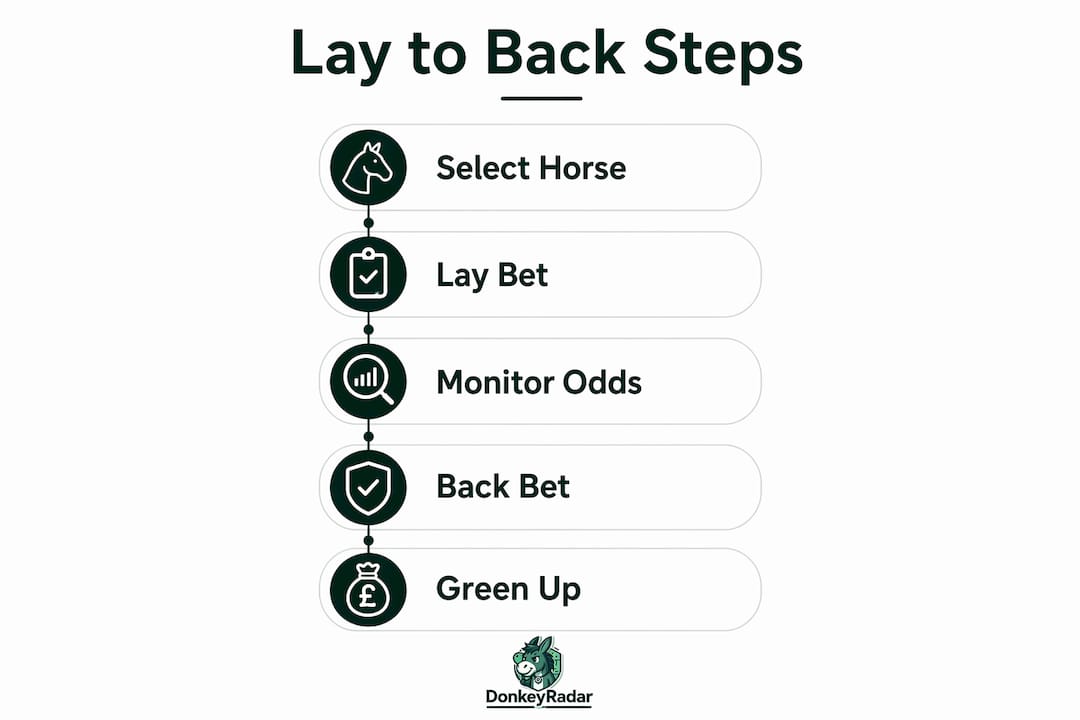
- Identify a candidate. Look for horses where pre-race market activity suggests a drift. Data-backed signals such as a slow start probability or early market support that fades are reliable triggers. Donkeyradar’s algorithm processes historical strike rates and live prices to flag these candidates before races begin.
- Place your lay bet. Lay the horse at its current odds. Record the lay stake, lay odds, and the resulting liability.
- Monitor the price. Watch the market. If the horse drifts as expected, the back odds will rise above your lay odds.
- Place your back bet. Back the same horse at the higher odds using the formula: Back Stake = (Lay Stake × Lay Odds) / Back Odds. This locks in a profit on both sides.
- Green up. Distribute the profit evenly across all outcomes using your exchange’s cash-out or manual greening function.
| Step | Action | Key metric to record |
|---|---|---|
| 1 | Select candidate | Expected drift range |
| 2 | Lay at current odds | Lay stake, liability |
| 3 | Monitor market | Price movement direction |
| 4 | Back at higher odds | Back stake, back odds |
| 5 | Green up | Profit per outcome |
Commission must be incorporated into your lay stake calculation. A standard exchange commission of 2% changes your effective lay odds. Subtract the commission percentage from the lay odds denominator before calculating your back stake. Ignoring this step turns a calculated profit into a net loss.
Pro Tip: Ante-post markets often show the clearest drift patterns because early money moves before the broader public engages. Check markets 24–48 hours before a race, not just in the final hour.
Timing your green-up is as important as the entry. Traders should green up when a significant profit is available, when uncertainty increases, or when freeing capital for another trade makes sense. Waiting for maximum drift often means watching the price reverse and losing the position entirely.
How to manage risk and bankroll when using lay to back methods
Sustainable trading requires treating your bankroll like a financial portfolio with fixed rules, not a pot to dip into freely. Staking 1–2% of your bankroll per trade is the standard for surviving losing streaks without going bust. That percentage feels conservative until you hit a run of six consecutive losses, which is statistically normal.
Closing Line Value (CLV) is the primary long-term success indicator in betting exchanges. If your lay prices consistently beat the closing market price, your process is sound even when individual trades lose. Track CLV on every trade, not just your P&L.
Daily and weekly exposure caps are non-negotiable. Set a maximum daily loss of 5% of your bankroll. If you hit it, stop trading for the day. This rule feels unnecessary on winning days and absolutely critical on losing ones.
- Flat percentage staking outperforms variable staking in volatile markets. Flat 1–2% staking keeps you in the game through normal variance.
- Track every trade in a spreadsheet: lay odds, back odds, stake, liability, commission, and net profit.
- Review weekly, not daily. Daily P&L creates emotional noise. Weekly trends reveal whether your selection process has edge.
- Never adjust stakes based on feelings. Psychological discipline separates professionals from amateurs. A losing streak does not mean your strategy is broken.
Liability on favourites grows disproportionately at lower odds. Laying a horse at 1.5 requires £5 liability for every £1 of potential profit. That ratio makes favourites poor candidates for lay to back unless you have a very large bankroll reserve. Stick to mid-range odds where liability is proportionate and drift is more likely.
What mistakes do most lay to back traders make?
The most common errors are mechanical, not strategic. They stem from skipping steps or reacting emotionally to market movements.
- Ignoring commission. Miscalculated lay stakes that exclude commission produce losses disguised as profits. Always adjust your formula for the exchange’s commission rate.
- Waiting too long to back. Odds drift and then reverse. Traders who hold out for maximum movement often watch the price return to the original lay level, leaving them with an open liability and no profit.
- Trading in illiquid markets. Low liquidity traps traders by making it impossible to match lay bets or complete green-ups at desirable prices. Stick to the most active races on the card.
- Emotional staking. Doubling stakes after a loss to “recover” is the fastest route to a blown bankroll. Adjusting stakes emotionally is the single behaviour that separates amateurs from professionals.
- Poor horse selection. Laying any horse and hoping for drift is not a strategy. Selection must be based on data signals, not preference.
Pro Tip: Use Donkeyradar’s lay betting tips to cross-reference your own selections. A second data source reduces the risk of acting on a single flawed signal.
The fix for most of these mistakes is a pre-trade checklist. Before placing any lay bet, confirm the market liquidity, calculate the commission-adjusted stake, and set a price target for your back bet. Write it down. Discipline is a process, not a personality trait.
Key takeaways
The lay to back strategy generates profit by exploiting odds drift on betting exchanges, not by predicting race outcomes, and it requires commission-adjusted calculations, disciplined staking, and liquid markets to work consistently.
| Point | Details |
|---|---|
| Lay first, back later | Lay at current low odds, then back at higher odds once the price drifts. |
| Commission changes everything | Always adjust your lay stake formula to account for exchange commission or profits become losses. |
| Liability grows at short odds | Laying favourites ties up disproportionate capital; target horses priced between 4.0 and 8.0. |
| Flat staking protects your bankroll | Stake 1–2% of your bankroll per trade to survive losing streaks without going bust. |
| CLV is your real success metric | Track closing line value on every trade, not just your weekly P&L, to measure process quality. |
My honest view on mastering the lay to back approach
I have tracked lay to back trades across hundreds of horse racing markets, and the pattern is always the same. Bettors who struggle are not failing because the strategy does not work. They are failing because they skip the preparation, ignore commission, and abandon their staking rules the moment a losing streak arrives.
The strategy is genuinely mechanical once you understand it. You are not predicting winners. You are identifying price movement and capturing it. That shift in mindset is the hardest part. Most people who come to betting want to be right about a horse. Lay to back does not care about being right. It cares about process.
What I have found is that tracking CLV weekly, rather than obsessing over daily P&L, changes how you relate to losses. A losing trade with a good process is not a failure. A winning trade built on a flawed process is a problem waiting to surface. The data tells you which is which, if you record it honestly.
Losing streaks will happen. They do not negate a solid strategy. They test whether you built one in the first place. If your staking rules hold during a bad week, your edge survives. If they do not, no strategy will save you.
— Donkey
How Donkeyradar supports your lay to back trading
Donkeyradar publishes verified lay signals before every race, processed through an algorithm that analyses historical strike rates and live market prices across UK, Australian, and US racing. The platform’s strike rate sits above 85%, and every result is tracked and published transparently so you can verify performance before committing a penny.
If you are building your lay to back process from scratch, start with Donkeyradar’s complete lay betting guide to understand liability and mechanics. Then move to the step-by-step Betfair guide for execution detail. Betting profits in the UK are tax-free, which means every unit of edge you build goes directly into your pocket. Donkeyradar gives you the signals. The strategy in this guide gives you the framework to use them.
FAQ
What is the lay to back strategy in horse racing?
The lay to back strategy involves laying a horse at its current odds, then backing it at higher odds once the price drifts, locking in a profit on both outcomes. It is a trading method that captures price movement on betting exchanges rather than predicting race results.
How do I calculate my back stake in a lay to back trade?
Use the formula: Back Stake = (Lay Stake × Lay Odds) / Back Odds. Always adjust for exchange commission by reducing the effective lay odds before calculating, or the result will overstate your profit.
What odds range works best for lay to back trading?
Horses priced between 4.0 and 8.0 offer the best balance of manageable liability and realistic odds drift. Laying short-priced favourites ties up disproportionate capital and limits how many trades you can run simultaneously.
Why does commission matter so much in lay to back betting?
Commission changes the effective lay odds, which alters the back stake needed to green up correctly. Ignoring commission can turn a calculated profit into a net loss, particularly on trades with tight margins.
How much of my bankroll should I risk per lay to back trade?
Stake 1–2% of your total bankroll per trade. Professional bettors also cap daily exposure at 8–10% of bankroll to prevent a single bad session from causing serious damage to their overall position.