← Blog · 📝 Article · 29 July 2026
Lay vs back betting: a beginner's guide

Lay vs back betting: a beginner’s guide
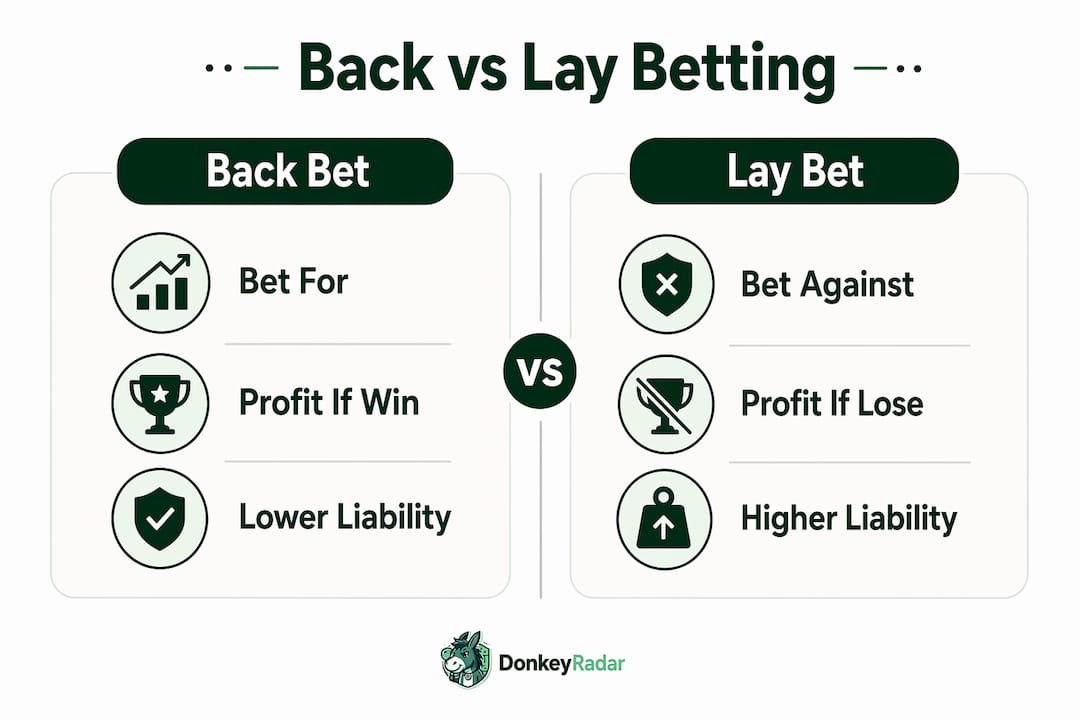
Backing means betting that something will happen; laying means betting that it will not. On a betting exchange like Betfair Exchange, you can do both. That single distinction is the foundation of exchange betting, and once you understand it, a much wider set of strategies opens up.
Here is the practical decision rule for beginners:
- Back when you have a straightforward opinion that a selection will win, or when you are completing the bookmaker side of a free-bet promotion.
- Lay when you want to act as the bookmaker, profit if a selection loses, or lock in a position through matched betting or hedging.
- Quick example: You back a favourite at odds of 3.0 with a £10 stake. If it wins, you return £30 (£20 profit). Alternatively, you lay a longshot at odds of 8.0 with a £10 lay stake. Your liability is £70 (calculated below), but if the horse loses, you keep the £10. Lay bets are only available on betting exchanges, not with traditional bookmakers.
- Tax note: Betting profits in the UK are generally not subject to tax under HMRC rules, making both strategies tax-free for recreational bettors.
- Donkeyradar uses statistical models to identify likely losers and publishes verified lay signals before races start, providing beginners a data-driven starting point.
Table of Contents
- What do back, lay, liability and odds actually mean?
- How does a betting exchange actually match your bet?
- How do you calculate returns and liability?
- Which strategies should beginners try first?
- How do you place a back and a lay on Betfair?
- What mistakes do beginners most often make?
- How does Donkeyradar approach lay betting?
- Key takeaways
- Why most beginners get lay betting backwards
- Ready to put lay signals to work?
- Useful sources and further reading
What do back, lay, liability and odds actually mean?
Every term you will see on a betting exchange, defined plainly.
| Term | Definition | Formula / Example |
|---|---|---|
| Back bet | A bet that a selection will win or an outcome will occur. | Stake £10 at odds 3.0 → return £30, profit £20 |
| Lay bet | A bet that a selection will NOT win. You act as the bookmaker. | Lay stake £10 at odds 3.0 → liability £20 |
| Liability | The maximum amount you can lose on a lay bet if the selection wins. | Liability = Lay stake × (Lay odds − 1) |
| Stake | The amount you risk on a back bet, or the amount you accept from the backer on a lay. | — |
| Decimal odds | The multiplier applied to your stake to calculate total return. | Odds 4.0 → £10 stake returns £40 |
| Implied probability | The likelihood implied by the odds. | Probability = 1 ÷ Decimal odds |
| Matched bet | A back and lay placed simultaneously to cover both outcomes. | Used in matched betting to extract free-bet value |
| Market liquidity | The total money available to be matched at a given price. | Low liquidity = risk of unmatched bets |
| Commission | The exchange’s fee on net winnings, typically 2–5%. | Reduces net profit on winning positions |
Backing and laying are mirror outcomes: one side’s profit is the other side’s loss. The exchange simply matches the two parties.
Implied probability in practice: odds of 5.0 imply a 20% chance (1 ÷ 5.0 = 0.20). If you believe the true probability is lower than 20%, laying that selection has positive expected value.
How does a betting exchange actually match your bet?
When you place a bet on Betfair, you are not betting against the exchange. You are betting against another user. The exchange runs an order book: backers submit the odds they want and the stake they are willing to risk; layers submit the odds at which they will accept liability. When a backer’s requested odds match a layer’s offered odds, the bet is matched and both sides are locked in.
The exchange displays two columns: blue for the best available back price and pink for the best available lay price. The gap between those two figures is the spread. It is the true cost of entering a position, and beginners who ignore it lose value even when their selection performs exactly as expected.
Commission is charged on net winnings only, typically in the range of 2–5% on Betfair depending on your market base rate. It does not affect losing bets. On a net winning bet, you keep slightly less than the total due to commission. Small amounts, but they compound across a large number of bets.
Market liquidity determines whether your bet gets matched at all. Low available volume at your price can leave a bet partially matched or unmatched entirely, which is a particular risk in niche markets or just before a race goes in-play.
Pro Tip: Always check the volume figure shown next to the price before placing. If less than your intended stake is available, either split the order or accept a slightly different price. An unmatched lay leaves you with open liability and no offsetting position.
How do you calculate returns and liability?
Get these two formulas right and you will avoid the most expensive beginner mistakes.
Back bet: calculating your return
Return = Stake × Odds Profit = Stake × (Odds − 1)

A £20 back bet at odds of 4.0 returns £80 in total; profit is £60.
Lay bet: calculating your liability
Liability = Lay stake × (Lay odds − 1) Profit (if selection loses) = Lay stake
A lay at decimal odds of 10.0 with a lay stake of £20 produces a liability of £180. That asymmetry catches many newcomers off guard. The potential profit is only £20, but the potential loss is nine times that.
Worked examples
| Bet type | Stake | Odds | Liability | Profit if correct | Loss if wrong |
|---|---|---|---|---|---|
| Back bet | £10 | 3.0 | £10 (your stake) | £20 | £10 |
| Lay bet | £10 | 3.0 | £20 | £10 | £20 |
| Lay bet | £20 | 10.0 | £180 | £20 | £180 |
Matched betting: calculating the lay stake
In matched betting, you back with a bookmaker and lay on an exchange to cover both outcomes. The lay stake formula is:
Lay stake = (Back stake × Back odds) ÷ Lay odds
Example: back £10 at 3.0 with a bookmaker, lay at 3.1 on Betfair. Lay stake = (£10 × 3.0) ÷ 3.1 = £9.68
After commission (say 2%), your net qualifying cost is small. The free bet you unlock is then extracted using the same back/lay process, with most of its value converted to cash profit.
Pro Tip: Use a dedicated matched betting calculator to handle commission and rounding. Doing it manually is fine for learning, but a calculator removes arithmetic errors that erode your qualifying cost.
Which strategies should beginners try first?
Matched betting
Matched betting uses a bookmaker back and an exchange lay to lock in profit from free-bet promotions. The qualifying bet costs a small amount (the spread plus commission); the free bet then generates a predictable cash return. It is procedure-driven rather than prediction-driven, which makes it the most accessible starting point for exchange beginners.
Lay-the-draw
In football, laying the draw at kick-off and then trading out once a goal is scored is a widely used strategy. The logic: once a team scores, the draw becomes less likely and the lay price shortens, letting you back the draw at lower odds to lock in profit. It requires active monitoring during the match.

Back-to-lay trading
Back at higher odds, then lay at a lower price to guarantee profit before the event settles. This is common in horse racing, where prices drift or shorten in the minutes before the off. The risk is that the price moves against you before you can close the position.
In-play hedging
In-play trading lets you back or lay during an event to lock in profit as the market moves. It requires fast execution. Browser-based interfaces can be too slow for serious in-play work; API access or a dedicated trading platform is preferable once you move beyond the basics.
Practical rules for beginners:
- Start with matched betting before attempting live trading.
- Always calculate liability before confirming a lay.
- Check liquidity at your price, not just the headline figure.
- Use staking tiers to grade your stakes by confidence level.
Pro Tip: Matched betting and active trading are genuinely different skill sets. Matched betting is methodical; trading requires position management and a tolerance for short-term variance. Master one before attempting the other.
How do you place a back and a lay on Betfair?
Placing a back bet
- Log in to Betfair Exchange and navigate to your chosen market (e.g. horse racing, football).
- Find your selection and click the blue price in the back column.
- The bet slip opens. Enter your stake in the stake field.
- Check the “Profit if wins” figure shown by the platform.
- Confirm the bet. If the odds are available, it matches immediately. If not, it sits as an unmatched order until another user accepts it.
Placing a lay bet
- In the same market, click the pink price in the lay column next to your selection.
- The bet slip opens showing the lay odds and a liability field.
- Enter your lay stake (the amount you want to win if the selection loses).
- Check the liability figure carefully before proceeding. This is the amount that will be reserved from your account balance.
- Confirm. The bet matches when a backer accepts your price.
For a full visual walkthrough of the Betfair interface, Betfair’s own support pages and Donkeyradar’s step-by-step lay guide cover the blue and pink columns in detail.
What to check every time before confirming
- Liquidity: Is enough volume available at your price?
- Unmatched behaviour: Know whether your exchange is set to keep or cancel unmatched portions.
- Commission setting: Confirm your current market base rate.
- Account balance: Your balance must cover the full liability before a lay is accepted.
- Spread: Is the gap between back and lay prices reasonable, or unusually wide?
What mistakes do beginners most often make?
Most early losses on exchanges come from a handful of avoidable errors.
Liability miscalculation is the most damaging. Laying at short odds feels safe because the liability looks small, but laying at longer odds without checking the formula first can expose you to losses many times your intended stake. Run the formula before every lay.
Ignoring the spread is the second most common issue. The spread between the best back and best lay is a real cost. A wide spread means you are already behind before the event starts.
Forgetting commission skews profit calculations. Net profit after a 2% commission on a £100 win is £98, not £100. Over many bets, that difference is material.
Thin markets create execution risk. Low available volume at your price means partial matching, leaving you with an incomplete position. Always check the volume figure, not just the price.
Red flags to watch for:
- Liability more than 10× your intended profit on a single lay.
- Spread wider than 5–10% of the mid-price.
- Available volume at your price less than your full stake.
- Odds moving sharply against you immediately after you place.
Risk management checklist:
- Set a maximum liability per bet before you open the exchange.
- Use staking tiers: grade stakes by signal confidence, not by gut feel.
- Keep a matched betting calculator open when running qualifying bets.
- Pre-define a stop-loss rule: if your session liability reaches a set figure, stop placing new bets.
For a structured set of lay betting rules, Donkeyradar’s practical guide covers ten principles worth reading before you place your first lay.
How does Donkeyradar approach lay betting?
Donkeyradar’s methodology is built on statistical analysis rather than opinion. The platform processes historical strike rates and live market prices to identify the runner most likely to lose in a given race. Signals are published before the race starts, with a staking tier attached to each one so users know how much weight to give it relative to their bankroll.
The results history is public and continuously updated. Every signal, win or loss, is recorded. That transparency matters: you can audit the track record before committing a single pound. Donkeyradar’s verified lay signal results show a strike rate of over 85%, meaning the selected runner fails to win in more than 85 in every 100 signals issued.
Each signal on the dashboard includes a direct link to the relevant Betfair Exchange market, removing the step of searching for the race manually. Real-time alerts are available via email and Telegram for subscribers who want to act quickly when a signal drops.
How to use signals responsibly:
- Check market liquidity at the signalled price before placing. A signal is only as good as the price available.
- If the market has moved significantly since the signal was issued, reassess before placing.
- Use the staking tier as a guide, not a guarantee. No signal has a 100% strike rate.
- API access is available for users who want to integrate signals directly into trading software.
On tax: Betting profits in the UK are generally not subject to income tax or capital gains tax for recreational bettors. HMRC does not treat gambling winnings as taxable income in most circumstances. If you are betting at a professional scale or through a business structure, confirm your position with a qualified tax adviser.
This article is general information, not financial or tax advice. Verify your own position with HMRC or a qualified professional.
Key takeaways
Laying is betting against an outcome; backing is betting for one, and the core maths of liability separates beginners who profit from those who lose their bankroll in the first week.
| Point | Details |
|---|---|
| Back vs lay defined | Backing bets on an outcome happening; laying bets against it, making you the bookmaker. |
| Liability formula | Always calculate: Liability = Lay stake × (Lay odds − 1) before confirming any lay. |
| Spread is a real cost | The gap between the best back and best lay price is the true entry cost on any exchange position. |
| Start with matched betting | It is procedure-driven and lower-risk than live trading, making it the right first strategy for beginners. |
| Donkeyradar signals | Donkeyradar publishes verified lay signals with a strike rate of over 85%, staking tiers, and direct Betfair links. |
Why most beginners get lay betting backwards
The conventional wisdom is that laying is the advanced, complicated side of exchange betting and backing is the safe starting point. That framing is backwards in one important respect.
Backing a selection at long odds is actually riskier for a beginner than laying a short-priced favourite, because the implied probability of a longshot winning is low. When you lay a 1.3 favourite, your liability is small (£3 for every £10 lay stake) and the selection loses most of the time. When you back a 15.0 shot, you lose your stake the vast majority of the time. The maths of expected value does not care which side of the bet you are on; what matters is whether the price reflects the true probability.
The psychological shift that laying requires is actually useful. Laying widens the range of profitable opportunities because identifying a likely loser is often easier than identifying a likely winner. In a field of twelve horses, eleven will lose. Statistical tools like Donkeyradar’s models are built precisely on that logic: find the weakest runner, not the strongest.
Where beginners genuinely do go wrong with laying is liability management, not the concept itself. A lay at odds of 10.0 with a £20 stake carries £180 of liability. That is not complicated, but it is easy to overlook when you are focused on the potential £20 profit. The formula is simple; the discipline to run it every single time is what separates sustainable exchange bettors from those who blow their bankroll on a single miscalculated lay.
Start small. Use staking tiers. Check the liability before you check the potential profit.
Ready to put lay signals to work?
If you have read this far, you understand the mechanics. The next step is applying them with data behind you rather than guesswork.
Donkeyradar publishes daily lay signals for UK, Australian, and US horse racing, each graded by staking tier and linked directly to the relevant Betfair Exchange market. The free tier gives you access to daily signals with no subscription required. Paid plans add real-time alerts via email and Telegram, full results history, and API access for users who want to connect signals to trading software.
The results history is fully public. Before you subscribe to anything, check the verified signal track record and audit the strike rate yourself. Over 85% of signals result in a losing runner, and every result, win or loss, is logged transparently.
For a deeper look at how to combine Donkeyradar signals with a structured Betfair approach, the Betfair lay betting strategy guide covers the full methodology. Start with the free tier today at donkeyradar.com.
Useful sources and further reading
- Betfair Exchange: what does “lay” mean? — Betfair’s own explanation of lay bets, liability, and how the exchange matches orders. The authoritative platform-specific reference.
- Donkeyradar verified results — Public signal history with strike rate data. Audit before you subscribe.
- Donkeyradar lay betting guide — A plain-language walkthrough of how laying a horse works, including the psychology and the maths.
- HMRC: gambling and tax — HMRC’s guidance on personal tax. Confirm your own position here if you are betting at scale.
- GambleAware — Free, confidential support and information on responsible gambling in the UK.
- Gambling Commission public register — Verify that any exchange or operator you use holds a valid UK Gambling Commission licence.