← Blog · 📝 Article · 14 July 2026
Market movers on Betfair: how to spot and use them

Market movers on Betfair are selections whose odds shift significantly due to concentrated backing or laying activity, signalling where informed money is flowing before a race. These price changes are not random. They reflect aggregated market sentiment across thousands of bettors and, at high volume, often indicate professional or syndicate activity. UK horse racing markets see 30–50% of total matched volume transacted in the final 10 minutes before the off. That single fact tells you exactly when the market speaks loudest. Understanding how to read these signals is one of the most transferable skills in Betfair betting.
What are market movers on Betfair?
A market mover on Betfair is defined by two things: a meaningful price change and sufficient matched volume to confirm that change carries weight. Price alone is not enough. A selection drifting from 4.0 to 6.0 on £500 matched is noise. The same drift on £50,000 matched is a signal worth acting on.
The industry distinguishes between two primary types of price movement. A steamer is a selection whose odds shorten, meaning more money is backing it. A drifter is a selection whose odds lengthen, meaning support is draining away. Both carry strategic implications, but neither should be acted on without volume confirmation.

Price reflects probability, while volume reflects certainty. A favourite priced at 2.0 with £50,000 matched carries far more informational weight than the same price with £5,000 matched. This distinction is the foundation of any credible market mover analysis.
The Betfair Exchange is the primary venue for observing these phenomena in UK horse racing. Its peer-to-peer structure means prices are set by the market itself, not a bookmaker’s margin. That transparency is what makes genuine market mover signals possible.
How to identify market movers on Betfair: price and volume indicators explained
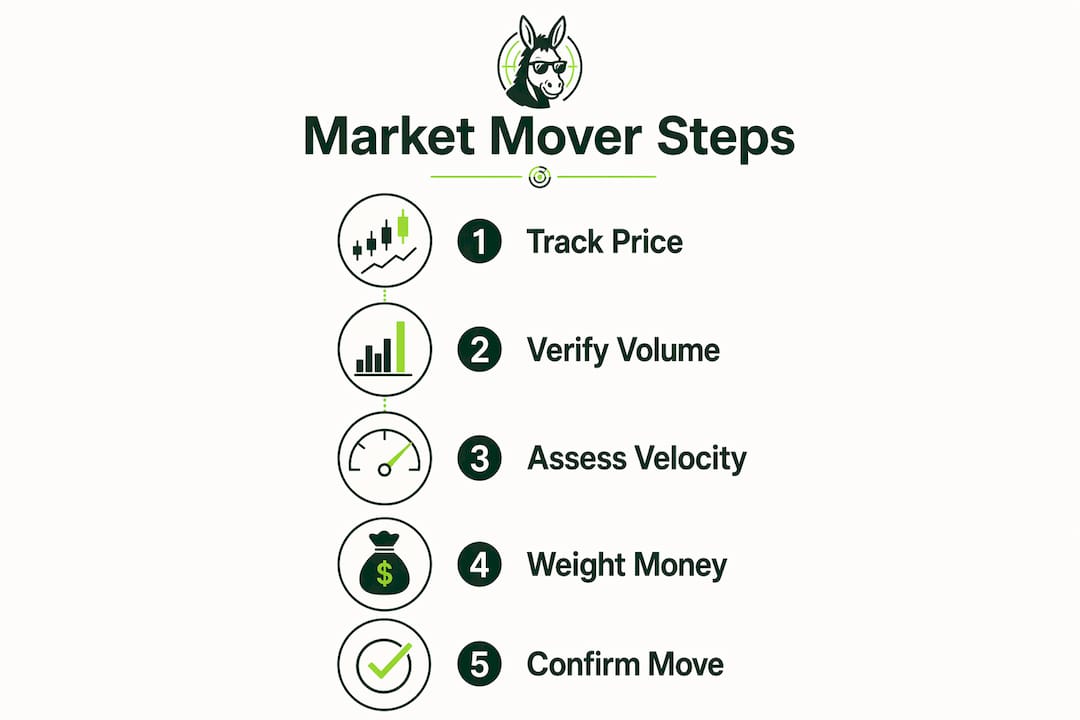
Spotting a genuine market move requires tracking four indicators simultaneously: price direction, matched volume, volume velocity, and weight of money (WOM).
- Price direction tells you whether a selection is being backed (shortening) or laid (drifting). A move of more than 10 ticks in a short window warrants attention.
- Matched volume confirms whether the price move has substance. Volume thresholds of £50,000 at market level and £5,000 at runner level are commonly used as minimum filters before entering a position.
- Volume velocity measures how quickly money is arriving. Sophisticated traders watch for volume acceleration in the final 10 minutes before the off as confirmation of informed money, often from syndicates or professionals.
- Weight of money (WOM) shows the imbalance between back-side and lay-side liquidity in the order book. A heavy back-side imbalance typically precedes a price shortening within seconds to minutes.
The Betfair Streaming API provides real-time data feeds that allow you to track all four indicators programmatically. Without it, you rely on the Betfair website’s basic interface, which updates more slowly and can cause you to miss fast-moving signals.
Common pitfalls include reacting to low-volume price moves, chasing odds that have already moved, and confusing retail noise with informed activity. A price that moves sharply and then reverses quickly is almost always noise. A price that moves steadily and holds is far more likely to represent genuine conviction.
Pro Tip: Set a minimum volume filter before you consider any price move meaningful. A runner with less than £2,000 matched can be moved by a single large bet. That is not a market signal. It is one person’s opinion.
What types of market movers exist and how do they affect strategy?
Professional traders do not rely on a single approach. Relying only on backing steamers or laying drifters is insufficient. The most effective bettors cycle through multiple strategies depending on market conditions. Here are the five main types of market mover strategies and what each one implies.
-
Backing steamers. When a selection shortens significantly on strong volume, backing it early captures value before the price compresses further. The key is entering before the move is complete, not after it has already happened.
-
Laying drifters. A selection drifting on high volume is losing market support. Laying a drifter at a lengthening price gives you a better liability position and aligns you with the market’s collective judgement.
-
News-driven moves. Confirmed information, such as a non-runner declaration, a jockey change, or a going report, triggers clear and reliable price adjustments. Confirmed news moves odds by 5–15 ticks and provides high-conviction opportunities. Rumour-based moves are a different matter entirely. Acting on unconfirmed information is gambling, not strategy.
-
Position trading. This involves holding a position for longer, from several minutes to several hours, based on a fair value assessment of where the price should settle. Pre-match traders typically target price swings of 10–30 ticks with holds ranging from 5 minutes to several hours.
-
Weight of money trades. These are fast, order-book-focused entries that last seconds to a minute. WOM trading capitalises on back-side and lay-side imbalances to anticipate short-term price moves. It requires fast execution and a clear exit plan.
Combining these approaches gives you flexibility. A bettor who only backs steamers will miss profitable laying opportunities. A bettor who only trades WOM will struggle in low-liquidity markets.
Pro Tip: Always confirm the type of move before committing. Ask: is this price change driven by news, volume, or order-book pressure? Each type requires a different response and a different exit strategy.
When and where to spot market movers: timing and market selection
Timing is not optional. It is the primary variable that separates profitable market mover analysis from expensive guesswork. The table below summarises the key windows and their characteristics for UK horse racing on Betfair.
| Time window | Market quality | Volume level | Recommended action |
|---|---|---|---|
| 60–10 minutes before off | Moderate | Building | Monitor for early steamers and drifters |
| 10–5 minutes before off | High | Peak | Enter positions; 30–50% of volume transacts here |
| 5–0 minutes before off | Volatile | Very high | Avoid new entries; exit existing positions |
| Saturday 14:00–17:00 UK | Excellent | 3–5x weekday | Highest-quality window for all strategies |
Saturday afternoons between 14:00 and 17:00 UK time represent the peak liquidity window, with volume running at 3–5 times typical weekday levels. That depth means tighter spreads, faster execution, and more reliable signals.
The final 5 minutes before the off present a different picture. Spreads widen and liquidity becomes erratic in this window, making it difficult to exit trades cleanly. Professional traders avoid opening new positions here. The risk-to-reward ratio deteriorates sharply.
Market selection matters as much as timing. Liquid markets, such as Class 2 handicaps, Cheltenham Festival races, and Royal Ascot meetings, produce cleaner signals than low-grade weekday races with thin books. A price move in a market with £200,000 matched is far more meaningful than the same move in a market with £8,000 matched.
Festival days and major Saturday cards also attract sharper money earlier in the day. On a standard Tuesday at a minor track, informed activity may not arrive until the final 10 minutes. On a Cheltenham Gold Cup day, the market starts moving meaningfully an hour before the off.
Practical tips and common mistakes when using market movers
Applying market mover analysis effectively requires discipline at every stage. These are the rules that separate consistent bettors from those who give their edge back through poor execution.
- Set entry and exit prices before the market opens. Decide in advance what price triggers your entry and what price triggers your exit. Changing these targets mid-trade in response to market noise is the single most common source of avoidable losses.
- Never chase a move that has already happened. If a horse has already steamed from 5.0 to 3.0, the value is gone. Entering now means you are buying at the top of the move, not the bottom.
- Avoid markets with insufficient liquidity. A minimum market volume of £50,000 and a minimum runner volume of £5,000 are practical thresholds. Below these levels, price moves are unreliable.
- Integrate signals with form and going data. A steamer that aligns with strong recent form and a favourable going report carries more weight than a steamer that contradicts the form book. Market mover signals are strongest when they confirm what other data already suggests.
- Size stakes to match market volatility. High-volatility windows, such as the final 10 minutes before the off, require smaller stakes. The potential for slippage and adverse price moves increases significantly in this period.
- Use lay betting strategies to exploit drifters. A confirmed drifter on strong volume is one of the cleanest signals in horse racing betting. Laying at a lengthening price and closing the position if the drift continues is a structured, repeatable approach.
Pro Tip: Keep a log of every trade, including the volume at entry, the price move, and the outcome. After 50 trades, patterns emerge. You will see which market conditions produce your best results and which ones consistently cost you money.
Key takeaways
Identifying genuine market movers on Betfair requires combining price direction, matched volume, volume velocity, and weight of money into a single, disciplined assessment before every entry.
| Point | Details |
|---|---|
| Volume confirms price | A price move only carries weight when matched volume meets minimum thresholds, such as £50,000 at market level. |
| Peak window is 10–5 minutes before off | This is when 30–50% of total volume transacts and signals are most reliable. |
| Saturday afternoons are the best session | The 14:00–17:00 UK window delivers 3–5 times typical weekday volume and tighter spreads. |
| Five strategy types exist | Steamers, drifters, news trades, position trades, and WOM trades each require a different entry and exit approach. |
| Avoid the final 5 minutes | Erratic spreads and difficult exit conditions make new positions in this window high-risk. |
My view on market movers after years of watching Betfair
Most bettors treat market movers as a shortcut. They see a horse steaming and assume someone smarter than them knows something. Sometimes that is true. Often it is not.
The honest reality is that time-based systems built on liquidity rhythms produce mechanical edges, but those margins compress as more participants adopt the same approach. The window between spotting a move and acting on it profitably gets shorter every year. Automation has made that worse.
What I have found genuinely useful is treating market mover signals as confirmation, not as the primary reason to bet. When the form, the going, and the market all point in the same direction, the signal is worth acting on. When only the market is moving and nothing else supports it, I pass. Experienced traders treat confirmed news as the foundation for profitable decisions. Rumour-based moves are where discipline breaks down and losses accumulate.
The bettors who use market mover analysis well are not the ones who react fastest. They are the ones who wait for the clearest signals in the most liquid markets and then execute without hesitation. Patience and selectivity matter more than speed.
— Donkey
How Donkeyradar’s lay signals work alongside market mover analysis
Donkeyradar uses statistical analysis to identify the weakest horse in every qualifying UK, Australian, and US race, then signals a lay bet. That process runs parallel to market mover analysis. When Donkeyradar’s model flags a horse as the weakest runner and the Betfair market begins to drift on that same selection, the two signals reinforce each other.

Bettors who understand Betfair lay betting strategy can combine Donkeyradar’s data-driven signals with live price movement to time their entries more precisely. The platform also publishes daily lay tips that reflect current market conditions, giving you a structured starting point for each race day. If you are new to the mechanics, the lay betting explained guide covers the fundamentals clearly and without jargon.
FAQ
What is a market mover on Betfair?
A market mover is a selection whose odds shift significantly due to concentrated backing or laying activity. The move is only meaningful when matched volume is high enough to confirm genuine market conviction.
How do I find market movers on Betfair?
Track price direction, matched volume, and weight of money in the 10–5 minutes before the off. Use the Betfair Streaming API for real-time data, or monitor the exchange interface during peak liquidity windows.
What is the difference between a steamer and a drifter?
A steamer is a selection whose odds shorten as backing money arrives. A drifter is a selection whose odds lengthen as support drains away. Both are types of market movers with different strategic implications.
When is the best time to spot market movers on Betfair?
The 10–5 minute window before the off is the most reliable period, when 30–50% of total matched volume transacts. Saturday afternoons between 14:00 and 17:00 UK time offer the highest overall liquidity and the cleanest signals.
Should I always follow a market mover?
No. A market mover is a signal, not a guarantee. Always confirm the move with sufficient volume, cross-reference with form and going data, and avoid acting on rumour-driven price changes rather than confirmed information.