← Blog · 📝 Article · 17 July 2026
Odds drifting explained: what it means for bettors

Odds drifting is defined as the increase in a betting selection’s price, signalling that the market views it as less likely to win. A horse priced at 4.00 that moves out to 6.00 has drifted in the market. This is the opposite of odds shortening, where a price contracts to reflect growing confidence. Understanding odds movement is one of the most practical skills a bettor can develop, because price changes carry real information about where money is flowing and why. Donkeyradar’s data-driven approach to lay betting is built on exactly this kind of market reading, and the principles apply whether you back or lay a selection.
What causes odds to drift in betting markets?
Odds drift occurs due to negative news, reduced betting volume, or bookmaker liability management. The cause is rarely just one factor. Most drifts are the result of several forces acting at the same time.
The most common triggers for odds drifting include:
- Negative news. A reported injury, a late withdrawal scare, or poor weather conditions at the track can push a price out quickly. Odds can shift without any official announcement, driven purely by rumour or speculative activity in the market.
- Reduced backing volume. When bettors stop placing money on a selection, bookmakers have less reason to hold a tight price. The odds lengthen to reflect lower demand.
- Bookmaker liability balancing. Bookmakers adjust odds to manage their risk exposure, not solely to reflect probability changes. If one side of a market is over-backed, they will drift the price to discourage further bets on that selection and attract money to the other side.
- Sharp money moving elsewhere. When professional bettors place significant volume on a rival selection, the target selection drifts as a consequence. The drift is a side effect, not a direct signal about that selection’s chances.
- Speculative market activity. Early market movements often reflect price discovery rather than firm intelligence. Odds can fluctuate before any meaningful information enters the market.
The speed of a drift also carries meaning. Movements can be gradual over days or near-instant after breaking news or a sharp betting pattern. A slow drift over 48 hours tells a different story from a price that moves out by two points in 20 minutes.
Pro Tip: Watch the rate of drift, not just the direction. A slow, steady drift is often routine liability management. A fast, sharp drift close to race time is worth investigating further.

Odds shortening vs drifting: what each signal means
Odds shortening is the decrease in a selection’s price, implying the market sees it as more likely to win. Shortening and drifting are mirror images of each other, but they carry different implications depending on context.
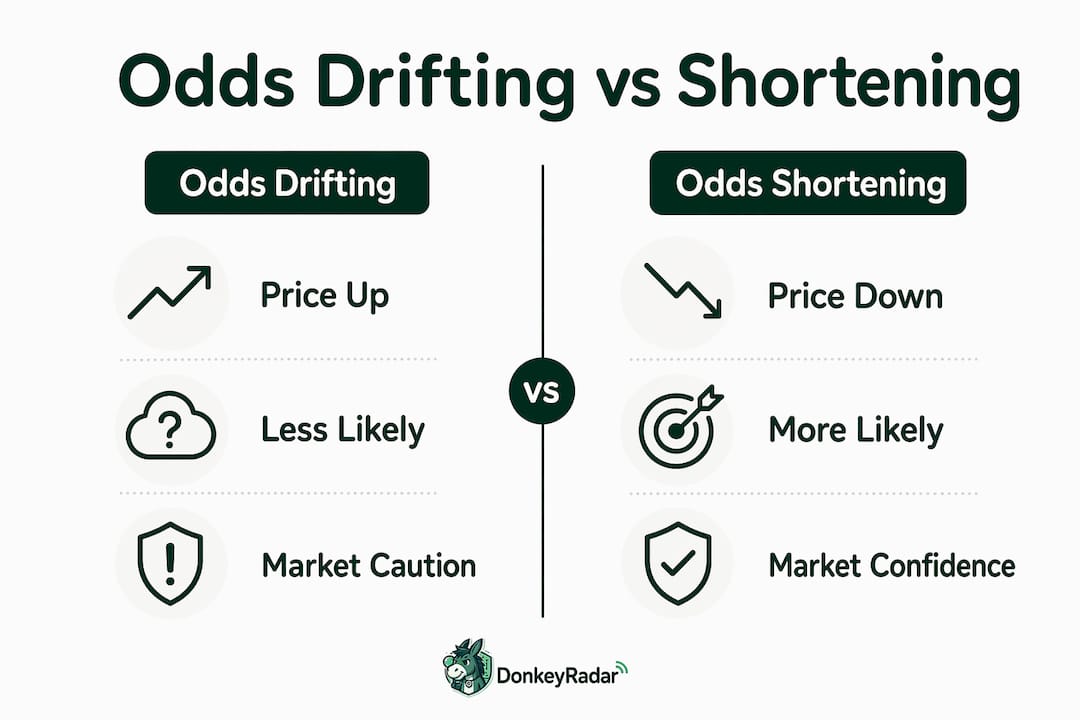
| Movement | Price change | Market signal | Common cause |
|---|---|---|---|
| Drifting | 4.00 out to 6.00 | Market sees selection as less likely | Negative news, liability management, money on rival |
| Shortening | 6.00 in to 4.00 | Market sees selection as more likely | Strong backing, positive news, sharp money arriving |
A few points bettors frequently get wrong about odds fluctuations:
- Shortening does not guarantee a win. A heavily backed favourite still loses regularly. The price reflects market consensus, not certainty.
- Drifting does not guarantee a loss. A selection whose price lengthens can still win. The market is expressing reduced confidence, not a verdict.
- Not all shortening is informed. Public money from casual bettors can shorten a price just as effectively as sharp professional money. The source matters.
The key distinction is between market sentiment and actual probability. Odds reflect changing market consensus influenced by team news, external conditions, and betting patterns. That consensus can be wrong. Treating a price movement as a prediction is one of the most common errors in betting.
Pro Tip: Compare prices across multiple bookmakers when you spot a drift. If one firm has drifted a selection but others have not moved, the drift may be firm-specific liability management rather than a genuine market signal.
What does odds drifting actually tell you?
A drifting price does not guarantee a loss, and misinterpreting odds moves as predictions is a widespread betting mistake. Odds drifting meaning is more nuanced than most bettors initially assume.
Betting markets function as continuous feedback loops. Markets update in real time as new money, news, and sentiment flow in. A drift is the market’s current best guess, not a fixed conclusion. That guess can be influenced by emotional public money just as much as by informed sharp money.
Professional bettors focus on the source of the money behind a drift. Distinguishing emotional public money from informed sharp money is the core skill. Public money tends to follow narratives, media coverage, and recent form. Sharp money follows data, inside knowledge, and genuine probability assessments.
False drifters are a particularly useful concept. Odds can lengthen due to betting volume shifting to a rival selection, not because the drifting selection’s real chances have changed at all. If a rival attracts a large volume of backing, the original selection drifts as a mechanical consequence of the market rebalancing. The selection’s actual probability is unchanged.
Timing adds another layer. Early drift often reflects price discovery, where the market is still finding its level. Late drift, particularly in the final hour before a race, carries greater informational weight. Late movements are more likely to reflect sharp professional money acting on real intelligence.
- Early drift: routine price discovery, lower signal value
- Mid-market drift: possible liability management or speculative activity
- Late drift: higher signal value, more likely to reflect informed money
Practical strategies for betting around odds drifting
Understanding odds fluctuations is only useful if it changes how you bet. These steps turn market reading into a repeatable process.
-
Form your own probability estimate first. Before checking the market, assess the selection on its own merits. Assign a rough probability. This gives you a baseline to compare against the market price.
-
Compare your estimate to the current price. If your estimate suggests a selection has a 30% chance of winning, the fair price is around 3.33. If the market has drifted it out to 5.00, that gap represents potential value. Value betting involves assessing your own probability estimate against market prices, and drift can create value when overreaction occurs.
-
Identify the likely cause of the drift. Is there a news reason? Has a rival been heavily backed? Is this late drift or early? The cause determines how much weight to give the signal.
-
Check multiple bookmakers. A drift at one firm that is not reflected elsewhere is a firm-specific adjustment. A drift across all major bookmakers is a genuine market movement.
-
Avoid acting on drift alone. Drift is one signal among many. Professional bettors distinguish between the “dumb money” driving casual market moves and the “sharp money” behind informed ones. A drift without a clear cause is not a reason to back or lay a selection by itself.
-
Consider lay betting on confirmed drifters. When a selection drifts for clear, well-founded reasons and the price still looks too short relative to its real chances, laying it on an exchange can be a structured approach. Donkeyradar’s lay betting strategy guide covers how to apply this kind of data-driven thinking to race markets.
-
Track your decisions. Record why you acted on a drift and what the outcome was. Over time, patterns emerge that sharpen your ability to read market signals accurately.
Key takeaways
Odds drifting signals reduced market confidence in a selection, but the cause, timing, and source of that drift determine whether it carries genuine informational value.
| Point | Details |
|---|---|
| Drifting defined | A selection’s price increasing, e.g. 4.00 out to 6.00, signals lower market confidence. |
| Causes vary | Drift stems from negative news, liability management, or money flowing to a rival selection. |
| False drifters exist | Odds can lengthen without any real change in a selection’s chances, due to rival backing. |
| Timing matters | Late drift carries more informational weight than early price discovery movements. |
| Value can emerge | Overreaction drift can create mispriced odds if your own probability estimate differs from the market. |
My honest read on odds drifting after years of market watching
Most bettors treat a drifting price as a warning sign and walk away. I understand the instinct. It feels like the market knows something you do not. But that reaction is often exactly what the market wants you to do.
The bettors I have seen profit consistently from odds movements are the ones who do their own assessment first, then compare it to the market. They are not following the drift. They are asking whether the drift is justified. When it is not, they have found an edge.
The discipline required is harder than it sounds. Watching a price drift out while you hold a position is uncomfortable. Emotional control is not a soft skill in betting. It is the difference between a structured approach and reactive gambling.
Odds drifting opened up a new way of thinking for me about lay betting tips. A selection drifting for no clear reason, still priced shorter than its real chances justify, is a lay candidate. That is a concrete, repeatable signal. Not a hunch.
— Donkey
How Donkeyradar’s lay betting resources build on this
Odds drifting is one piece of a larger picture. Knowing a price has moved is useful. Knowing what to do with that information is where real edge comes from.

Donkeyradar’s guides cover the practical side of acting on market signals. The lay betting explained guide walks through how to bet against a selection on an exchange, which is the natural next step when a drift signals a selection is overpriced. Donkeyradar’s algorithm processes historical strike rates and live market prices to identify lay signals before races start, with a verified strike rate of over 85%. Profits from betting in the UK are tax-free, which makes a consistent, data-driven approach even more worthwhile. If you want to see the method in practice, the horse racing lay tips page publishes all signals before races with full results tracking.
FAQ
What does odds drifting mean in betting?
Odds drifting means a selection’s price is increasing, indicating the market views it as less likely to win. For example, a horse moving from 3.00 to 5.00 has drifted.
What is a drifter in horse racing?
A drifter is a selection whose odds have lengthened in the market, often due to negative news, reduced backing, or money flowing to a rival. Not all drifters lose; some drift for reasons unrelated to their actual chances.
Does a drifting price mean a selection will lose?
No. A drifting price reflects reduced market confidence, not a guaranteed outcome. Misreading drift as a prediction is one of the most common mistakes bettors make.
What is the difference between odds shortening and drifting?
Odds shortening means a price is decreasing, implying higher likelihood. Odds drifting means a price is increasing, implying lower likelihood. Both reflect market sentiment, not certainty.
When does late odds drift carry the most weight?
Late drift, particularly in the final hour before a race, carries greater informational value than early movements. Early drift often reflects routine price discovery, while late drift is more likely to indicate sharp professional money acting on real intelligence.