← Blog · 📝 Article · 23 July 2026
Odds-on lay strategy: the practical UK punter's guide
Odds-on lay strategy: the practical UK punter’s guide
Laying odds-on favourites means betting against selections priced under 2.0 on a betting exchange, effectively taking the bookmaker’s position. When you lay a bet, you win if the favourite fails to win, and you pay out if it does. The liability formula is straightforward: Stake × (Odds − 1). Lay a £10 stake at 1.5 odds and your liability is £5 to win that £10. Because odds-on prices imply a high win probability, the liability stays relatively contained, which is precisely why this range attracts disciplined layers.
The strategy applies exclusively to betting exchanges, not traditional bookmakers. In the UK, the main platforms are:
- Smarkets — charges an industry-low 2% commission on net winnings across a wide range of sports markets
- BETDAQ — offers 0% commission promotional periods and cashback up to £1,000 for new customers, with standard commission typically at 2%
- BetConnect — licensed and regulated by the UK Gambling Commission under account number 44346, covering horse racing, football, greyhounds, and more
- OddsMonkey — a tools and odds-matching platform that helps bettors identify lay opportunities and track value across exchanges
Each platform has different commission structures, liquidity levels, and promotional offers, so the choice of exchange directly affects your net P&L.
How to manage liability and risk when laying odds-on favourites
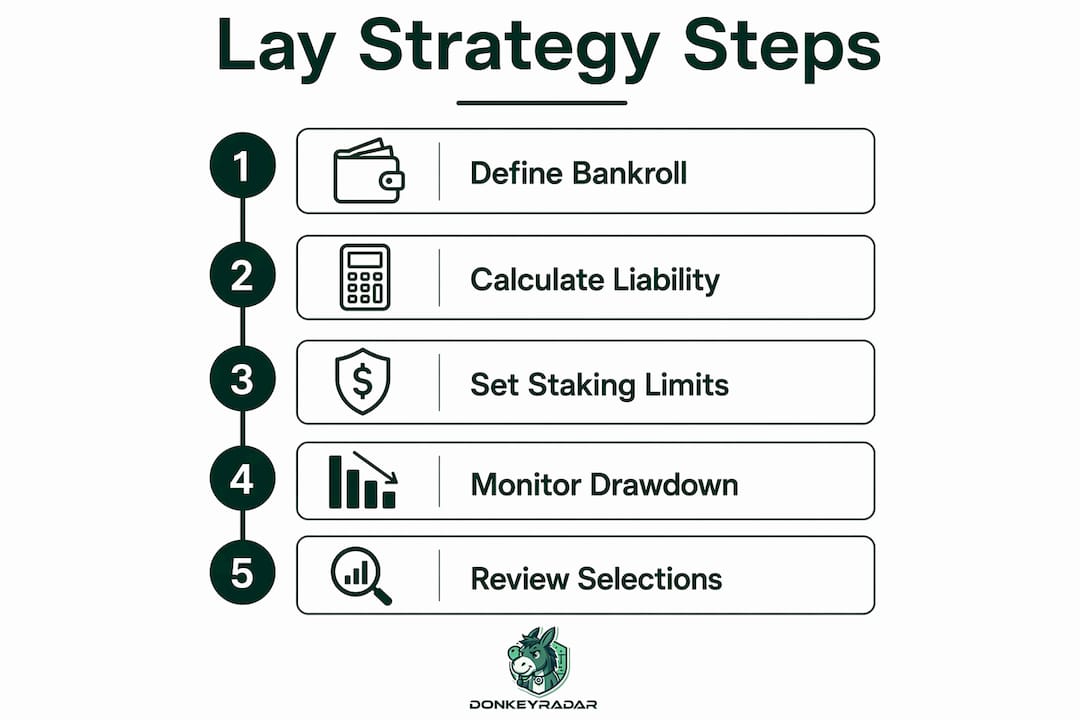
Liability control is the foundation of any sustainable odds-on lay approach. Without it, a single losing lay can erase weeks of profit.
The core formula: Liability = Stake × (Odds − 1). At odds of 1.8 with a £20 stake, your liability is £16. At 1.5 with the same stake, it drops to £10. The closer the odds are to 1.0, the smaller the liability per unit staked, but the more frequently the favourite wins, so neither extreme is automatically safe.

| Lay Odds | Backer’s Stake (£) | Your Liability (£) | Your Profit if Lay Wins (£) |
|---|---|---|---|
| — | 10 | 3 | 10 |
| 1.5 | 10 | 5 | 10 |
| 1.8 | 10 | 8 | 10 |
| 2.0 | 10 | 10 | 10 |
Notice that your profit stays fixed at the backer’s stake regardless of odds, while liability climbs. That asymmetry is the central risk in lay betting.
Professionals use fixed-liability staking, capping maximum exposure per bet at no more than 2% of total bankroll. On a £1,000 bankroll, that means no more than £20 at risk per lay. Exchange commission compounds the pressure: a raw expected value of +8% shrinks to roughly +7.6% after a 5% commission deduction. Setting a minimum post-commission EV threshold of 3% before placing any lay bet is a practical discipline that filters out marginal trades.
Pro Tip: Set a weekly drawdown limit of 10% of your bankroll. If you hit it, stop and review your selection criteria before placing another lay.
Practical lay betting strategies for odds-on favourites on UK exchanges
Selectivity separates profitable layers from losing ones. Blindly opposing favourites produces negative ROI; identifying specific, evidence-based reasons why a favourite is overvalued is what generates edge.
Key criteria for identifying a lay opportunity:
- Recreational money shortening the price. When public sentiment rather than form drives a favourite’s odds down, the implied probability overstates the true win chance. That gap is where the layer’s edge lives.
- Market timing. Early market movements often reflect sharp money; late price compression frequently reflects recreational volume. Monitoring how a price moves from opening to race-off reveals which dynamic is at play.
- Going and distance mismatches. A soft-ground specialist racing on firm ground, or a sprinter entered at a staying trip, carries a meaningful performance risk the headline odds may not reflect.
- Stable form signals. A yard in poor form across multiple runners is a concrete negative signal, not just noise.
- Back-to-lay trading. Lay the favourite pre-race, then back it in-play if the price drifts. This locks in a profit regardless of the result and removes the binary win/lose outcome entirely.
On Smarkets and BETDAQ, you can set your own lay odds rather than accepting the best available price. Use that feature to target a specific liability level rather than chasing the market. On BetConnect, the mobile app makes in-play monitoring straightforward for horse racing and football. OddsMonkey’s dutching and matched betting calculators help you cross-reference lay prices against back prices at traditional bookmakers to confirm genuine value before committing.
Common mistakes and psychological challenges when laying odds-on favourites

The biggest error is laying without a reason. Favourites win frequently enough that blind laying produces a losing record over any meaningful sample. You need a specific, documented reason for every lay.
Common mistakes that erode bankrolls:
- Ignoring commission. Many bettors calculate profit on raw odds without deducting the exchange’s cut, then wonder why their P&L is worse than expected.
- Chasing losses. After a favourite wins and wipes out several small profits, the temptation is to lay the next race at longer odds to recover quickly. That breaks the liability ceiling and compounds the damage.
- Poor record-keeping. Without tracking every signal, odds, liability, and result, you cannot identify whether your selection criteria actually work.
- Overconfidence after a winning streak. A run of successful lays can lead to increasing stake sizes before the bankroll justifies it.
The psychological pressure of lay betting is distinct from backing. You win small amounts frequently and lose larger amounts occasionally. Even with a 70–75% strike rate, improper bankroll control leads to rapid fund depletion. The variance feels brutal in real time, even when the long-run EV is positive.
Pro Tip: Keep a simple spreadsheet logging every lay: date, event, selection, odds, liability, result, and P&L. Review it weekly. Patterns in losing lays are almost always visible in the data before they become expensive.
When you should not use the odds-on lay strategy
Not every odds-on favourite is a lay opportunity. Knowing when to step back protects your bankroll as much as knowing when to act.
Avoid laying in these conditions:
- Thin liquidity markets. Low-volume exchanges or obscure events produce wide spreads and poor price discovery. Your lay may not get matched at a fair price, or at all.
- Extreme odds-on without clear evidence. Laying a 1.1 or 1.15 favourite means your liability is tiny, but the favourite wins at that price the vast majority of the time. Without a concrete overvaluation signal, the maths does not support the lay.
- Heavy in-play volatility. Live markets move fast. Laying in-play without a pre-set strategy and automated tools exposes you to prices that shift before your order is matched.
- Incomplete or misleading data. Late scratchings, undisclosed injuries, or unreliable going reports all distort the picture. If the information base is uncertain, the lay signal is unreliable.
- High-commission environments. On markets where commission exceeds 5%, small edges disappear entirely after deduction. Confirm the commission rate before placing any lay.
How Donkeyradar’s analytics sharpen the odds-on lay strategy
Data-driven selection is what converts a theoretically sound lay approach into a consistently profitable one. Donkeyradar’s algorithm processes historical strike rates and live market prices to identify the weakest runner in UK races before they start.
“Donkeyradar’s algorithm delivers lay signals with a strike rate above 85%, with all results verified and published before races commence. Every signal includes a staking tier grade so you can size your liability appropriately for each opportunity.”
That transparency matters. Results are tracked publicly, so you can audit the historical record rather than taking performance claims on faith. For UK punters, there is an additional practical advantage: betting profits in the UK are tax-free, meaning every unit of P&L you generate through a verified lay signal goes directly into your pocket.
Real-time alerts via email and Telegram mean you receive signals with enough lead time to place your lay at the best available price, rather than scrambling as the market moves. The dashboard includes direct links to Betfair Exchange, so execution is a matter of clicks rather than manual searching. For bettors who use trading software, API access integrates Donkeyradar’s signals directly into automated workflows.
Selectivity and data-driven insight are what distinguish winning layers from losing ones. Indiscriminate laying leads to sustained losses; a verified signal with a documented strike rate gives you a concrete basis for each decision.
Is the odds-on lay strategy actually profitable?
Profitability depends entirely on selectivity and EV discipline. Laying all favourites blindly produces a negative ROI of around -4.2% over large samples. Laying only those with specific vulnerability signals shifts that to approximately +9.8% ROI. The difference is not marginal; it is the entire basis of whether the strategy works.
Expected value must remain positive after commission. The formula: Lay EV = (1 − P_win) − P_win × (Odds − 1). If your model gives a favourite a 50% chance of winning and the exchange lay odds imply 54%, you have a positive-EV lay. After a 5% commission, a raw +8% EV becomes roughly +7.6%. Edges below 3% post-commission rarely survive the friction.
Favourites win 55–60% of the time across UK horse racing, which means blind laying loses more often than casual intuition suggests. A 70–75% strike rate is achievable for selective layers, but only with a disciplined filtering process applied to every candidate.
How does the odds-on lay strategy compare to other exchange strategies?
| Strategy | Typical odds range | Win frequency for layer | Liability per £10 stake | Key risk |
|---|---|---|---|---|
| Odds-on lay | —–1.99 | High (frequent small wins) | £3–£10 | Favourite wins often; low margin for error |
| Lay 3.0–5.0 range | 3.0–5.0 | Moderate (70–75%) | £20 | Higher liability per bet |
| Lay the draw | — | Moderate | £23 | Specialist play; high variance |
| Back-to-lay trading | Variable | Depends on trade exit | Variable | Requires active monitoring |
| Lay outright winner | — | Very high | £70 | Single loss wipes multiple wins |
The odds-on range keeps liability low, which suits bettors managing smaller bankrolls or learning the mechanics. The 3.0–5.0 range offers better risk-to-reward balance for experienced layers, with a more sustainable long-run ROI when selection criteria are applied rigorously. Back-to-lay trading removes the binary result entirely by locking in a profit through price movement, but it requires active in-play management and fast execution.
No single strategy dominates in all conditions. The odds-on lay approach works best when combined with verified signals, strict liability limits, and a clear EV threshold, rather than as a standalone mechanical system.
Try Donkeyradar’s verified lay signals
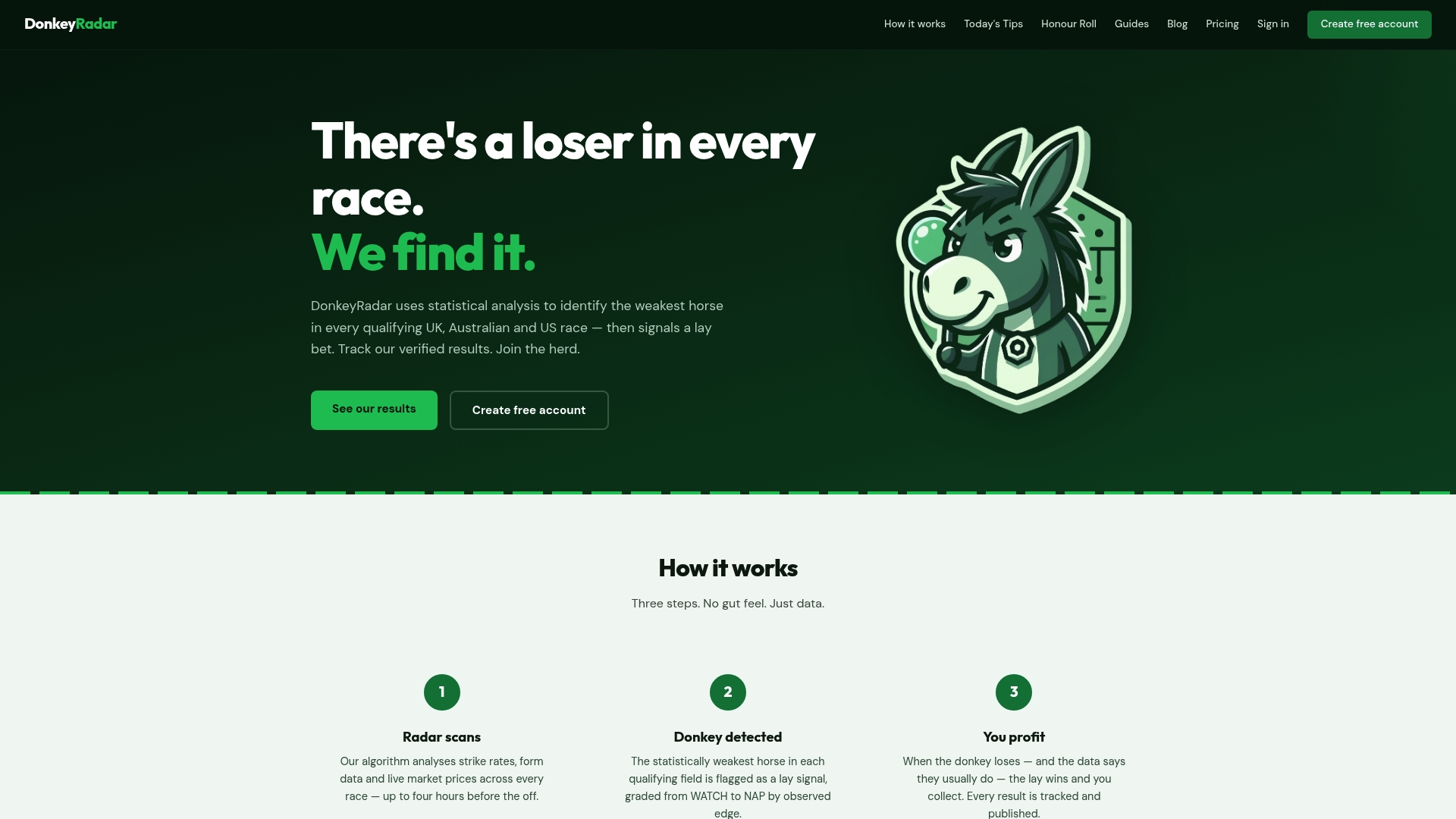
Donkeyradar publishes daily lay betting signals for UK horse racing, graded by staking tier and backed by a verified strike rate above 85%. The free tier gives you access to daily signals; the premium subscription adds real-time Telegram alerts, full results history, and API access for trading software. All results are published before races and tracked publicly. Start with the free tier and see the signal quality for yourself before committing to a subscription.
Key takeaways
The odds-on lay strategy is only profitable when selectivity and post-commission EV discipline are applied consistently to every lay decision.
| Point | Details |
|---|---|
| Liability stays low at odds-on prices | At 1.5 odds with a £10 stake, your liability is just £5, keeping bankroll exposure manageable. |
| Blind laying loses money | Laying all favourites produces a negative ROI; selective laying of vulnerable favourites can lead to a positive ROI. |
| Commission erodes thin edges | A raw +8% EV shrinks to roughly +7.6% after a 5% commission deduction; set a 3% post-commission minimum threshold. (Setting a minimum post-commission EV threshold of 3% is critical for profitability.) |
| Fixed-liability staking protects the bankroll | Cap each lay at no more than 2% of total bankroll to survive losing streaks without catastrophic drawdown. |
| Verified signals improve selectivity | Donkeyradar’s algorithm delivers lay signals with a strike rate above 85%, with all results published and tracked before races start. |