← Blog · 📝 Article · 21 July 2026
Risk of ruin in betting: your 2026 UK survival guide

Risk of ruin is the probability that your betting bankroll is exhausted or falls below a usable threshold before your edge has time to produce profit. It is not the same as a losing streak, and it is not simply variance. It is the mathematical endpoint of poor bankroll management, and for UK bettors, understanding it is the difference between sustainable wagering and going broke.
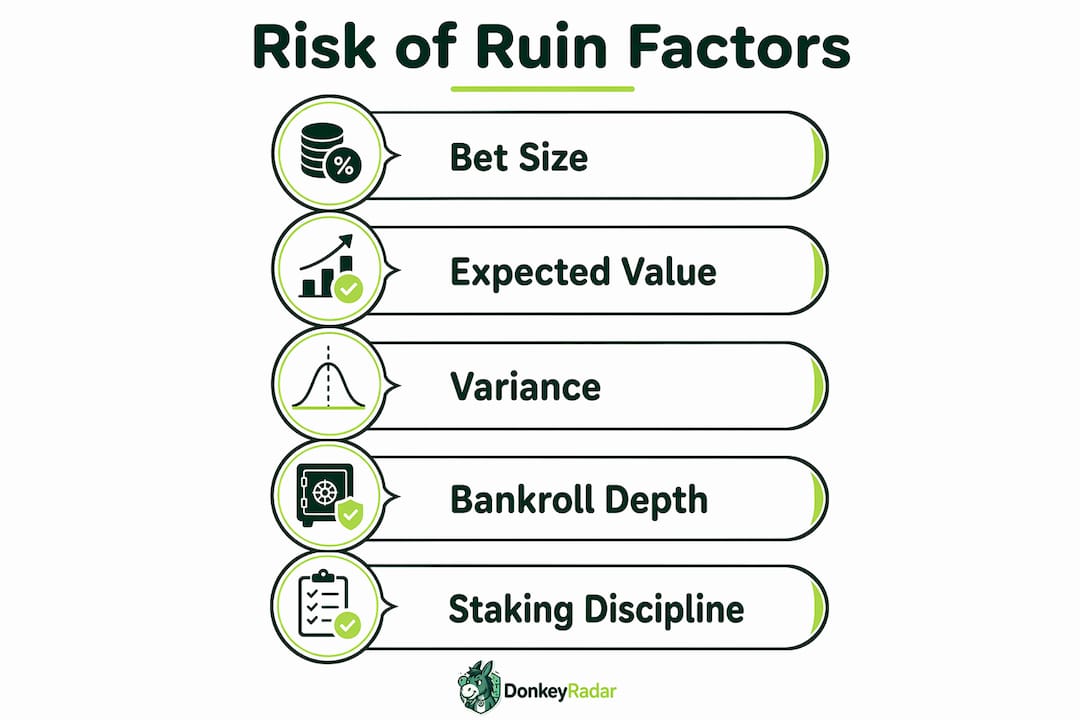
The core drivers are straightforward:
- Bet size relative to bankroll: the single biggest lever. Doubling your stake percentage more than doubles ruin probability due to exponential, not linear, scaling.
- Expected value (edge): without a positive edge, ruin approaches 100% over infinite play regardless of system or bankroll size.
- Variance: the natural swing in results that can deplete a bankroll before the edge manifests.
- Losing streak length: even bettors with a genuine edge face ruin if a streak hits before a sufficient buffer is built.
- Bankroll depth: the number of units your bankroll contains relative to your bet size.
Professional bettors keep stakes at 1–3% of total bankroll per wager. Ruin risk rises sharply at higher stake percentages even with a positive edge.
How do you calculate risk of ruin in betting?
The formula inputs are: bankroll size (B), bet size as a percentage of bankroll (u), edge or expected value (EV), odds, and bet frequency. For even-money bets with a fixed bet size, the classic formula is:

R = (q/p)^n
Where p is the probability of winning a single bet, q = 1 minus p, and n = B/u (the number of units in the bankroll). This formula assumes indefinite play with a fixed absolute bet size.
The calculation steps:
- Establish your bankroll size (e.g., £1,000).
- Set your bet size as a percentage (e.g., 2% = £20 per bet, giving n = 50 units).
- Estimate your win probability per bet (e.g., p = 0.53, q = 0.47).
- Calculate q/p (0.47/0.53 ≈ 0.887).
- Raise that figure to the power of n: 0.887^50 ≈ 0.0025, or roughly 0.25% ruin probability.
Reduce the bankroll depth to fewer units (larger bet sizing) with the same edge, and ruin probability climbs dramatically. At p = 0.50, no edge at all, R = 1 regardless of bankroll size. Ruin is mathematically guaranteed.
Positive vs negative EV matters enormously. A negative EV bettor is simply paying to play, and ruin is certain over time. A positive EV bettor still faces ruin if bet sizing is too aggressive relative to bankroll depth.
For more realistic modelling, Monte Carlo simulations run thousands of bet sequences using actual historical data, capturing variance dynamics that static formulas miss. They are the tool professional bettors use when a formula’s assumptions feel too clean.
Pro Tip: Static formulas give you the upper bound on ruin probability over infinite play. Simulations show what is likely to happen over your actual planned number of bets, which is usually a more useful number.
Key factors that drive your risk of ruin higher
1. Bet size is exponential, not linear
Ruin probability scales exponentially with bet size as a proportion of bankroll. Moving from 5% to 10% stake sizing does not double your risk. It can increase it by an order of magnitude. A bettor with a 55% win rate and 10% bet sizing faces meaningful ruin within 1,000 bets. The same bettor at 1–2% sizing faces near-zero ruin across the same sample.
2. Expected value determines your survival floor
Without a positive edge, no staking plan saves you. The gambler’s ruin theorem confirms that a bettor playing a fair game against an opponent with effectively unlimited capital will eventually go broke. Negative EV simply accelerates that outcome.

3. Variance and losing streaks hit hardest early
Most ruin events happen early in play, when the bankroll is smallest relative to bet size and no buffer has been built. A bettor who survives the initial variance phase is increasingly protected by the cushion their edge has created.
4. Bankroll depth is your primary protection
A bettor with a relatively small bankroll relative to bet size faces genuine ruin risk even with a positive win rate. The same bettor with a much larger bankroll relative to bet size has effectively negligible ruin risk. The edge is identical. Only the depth changed.
5. Overestimating your edge is a hidden danger
A bettor who overestimates their win rate may size bets incorrectly, potentially leading to expected zero or negative bankroll growth. The bettor expects to grow and is mathematically shrinking.
Statistic callout: Stakes above 5% of bankroll exponentially increase ruin probability even when the bettor holds a positive edge. The industry standard of 1–3% per wager exists precisely because it reduces ruin rates to near zero across all realistic edge scenarios.
6. The linear misconception destroys bankrolls
Most bettors assume risk grows proportionally with bet size. It does not. Doubling your stake percentage more than doubles your ruin probability. This misconception is why bettors who “just bump up” their stakes during a cold run accelerate their own ruin rather than recovering losses faster.
Practical bankroll management to keep ruin probability low
Bankroll management has one primary goal: buy survival. Keeping ruin probability under 1% gives your edge enough time to produce profit. Here are the practices that achieve it.
- Stake 1–3% per bet. At 1–2% sizing, ruin rates are effectively zero across all realistic edge scenarios. This is the mathematical basis for the professional standard.
- Use only disposable income. A bankroll built from money you cannot afford to lose produces desperation-based decisions that accelerate ruin.
- Size dynamically, not in fixed pounds. If your bankroll drops 25%, your unit stake drops 25% too. Percentage-based sizing means a losing streak costs you real capital but never compromises your structural ability to continue.
- Never chase losses. Increasing stakes after losses is the most common and most destructive pattern in betting. You are raising risk precisely when your confidence and edge assessment should be at their lowest.
- Separate your bankroll from daily finances. Keeping funds separate makes every win and loss tangible, supports accurate unit calculations, and removes the emotional pressure of real-life finances from betting decisions.
- Track Closing Line Value, not just P&L. CLV is a more reliable long-term profit indicator than short-term win rate, and it prevents premature stake increases triggered by variance.
Pro Tip: Set your “stop and review” bankroll level before you start betting, not during a losing run. Pre-deciding the threshold while calm is what stops emotional tilting when results are painful.
For lay betting specifically, Donkeyradar’s data-driven staking approach aligns directly with these principles, grading signals by confidence tier so you never need to guess how much to stake.
What the risk of ruin formulas do not tell you
The standard formula assumes fixed bet sizing, a constant edge, and independent bets. Real betting breaks all three assumptions.
Fixed sizing: most bettors do not maintain fixed fractional sizing under pressure. Emotional escalation after losses means real ruin rates are worse than formula predictions.
Constant edge: your edge fluctuates with market conditions, your analytical accuracy, and the bookmaker’s pricing. A formula calibrated to a 55% win rate is wrong the moment your true rate shifts.
Independent bets: in horse racing, correlated outcomes (same trainer, same going conditions, same race type) mean consecutive losses are not always statistically independent. Monte Carlo simulations using real betting sequences capture this; static formulas do not.
Infinite horizon vs finite play: the analytical formula predicts ruin over infinite bets. Simulations run over your actual planned sample, typically 1,000 bets, which produces lower ruin estimates because some bettors who would eventually go broke have not done so yet. For small bet sizes and moderate edges, the gap is minimal. For larger bet sizes, it can be meaningful.
The formula is a useful starting point, not a guarantee. Use it to set conservative sizing, then verify with simulation tools that account for your actual betting history.
How Donkeyradar helps you manage bankroll risk
Donkeyradar’s lay betting signals come with staking tier grades, so every signal tells you not just which horse to lay but how much confidence the algorithm assigns to it. That grading maps directly onto a sensible unit system: standard signals at 1 unit, higher-confidence signals at 2–3 units, with a hard cap that prevents oversizing on any single bet.
The platform’s verified results history, published before races commence, gives you the sample size to assess your actual edge rather than guessing. That matters because overestimating your edge is one of the fastest routes to ruin, and Donkeyradar’s transparency removes that guesswork.
UK betting profits are generally tax-free, which means every pound of edge you protect through disciplined bankroll management stays in your pocket. Explore Donkeyradar’s lay betting guide to see how data-driven signals and sound staking work together.
Key takeaways
Risk of ruin in betting is primarily a function of bet size relative to bankroll depth, and keeping stakes at 1–3% of total bankroll reduces ruin probability to near zero across all realistic edge scenarios.
| Point | Details |
|---|---|
| Bet size drives ruin exponentially | Doubling your stake percentage more than doubles ruin probability, not linearly. |
| Negative EV guarantees ruin | Without a positive edge, ruin approaches 100% over infinite play regardless of bankroll size. |
| Stakes above 5% are high risk | Bets above 5% of bankroll exponentially increase ruin probability even with a positive edge. |
| Early bets are the most dangerous | Most ruin events occur within the first 150 bets, before any edge buffer has been built. |
| Formulas have real limits | Static ruin formulas assume fixed sizing and constant edge; Monte Carlo simulations give more realistic estimates. |