← Blog · 📝 Article · 16 July 2026
Set and forget lay betting: a practical 2026 guide

A set and forget lay is a disciplined betting method where you define every parameter of your lay bet before placing it, then walk away and let the market settle without interference. The approach removes emotional decision-making, which is the leading cause of losses in lay betting on horse racing. Betfair Exchange is the primary platform for executing this strategy in the UK, and the method aligns with 2026 bankroll standards recommending a maximum liability of 2%–5% per bet. Donkeyradar’s data-driven signals are built specifically to support this kind of structured, low-intervention approach.
What is a set and forget lay strategy?
A set and forget lay is defined as a framework where entry point, stop-loss, and stake size are all fixed before execution, with no post-entry monitoring permitted. Once the bet is placed, you do not adjust, cancel, or second-guess it. This is not passive laziness. It is active discipline applied before the race, not during it.
The method works because most lay betting losses come from emotional interference mid-event. A trader watches a horse drift in the market, panics, and removes a stop-loss that was correctly placed. The result is a larger loss than planned. Set and forget eliminates that window entirely.

The industry term for this approach in financial trading is “fire and forget” or “set and forget trading,” and the same principles apply directly to Betfair lay betting. You predefine risk, you execute, and you trust the process.
Tools, platforms, and bankroll requirements
Betfair Exchange is the standard platform for lay betting in the UK. It provides the liquidity, market depth, and in-play functionality that a set and forget approach requires. Without sufficient liquidity, your lay bet may not be matched at your target price, which breaks the entire framework.
Bankroll management is non-negotiable. Maximum liability per lay bet should sit between 2% and 5% of your total bankroll. Exceeding 5% liability per bet accelerates drawdown during losing runs, and losing runs happen to every trader.
| Tool or requirement | Purpose | Notes |
|---|---|---|
| Betfair Exchange | Place and match lay bets | Primary UK platform |
| Bankroll limit | Cap liability per bet | 2%–5% per lay bet maximum |
| Automation software | Remove manual intervention | Bots execute pre-set rules only |
| Signal service | Identify lay candidates | Donkeyradar publishes pre-race signals |
| Record-keeping log | Track P&L and strike rate | Spreadsheet or dedicated app |
Automation software adds a layer of protection by executing your pre-set rules without human input. The key distinction is that automation multiplies a valid edge, not a flawed one. Validate your strategy manually before switching to automated execution.
Pro Tip: Set a daily loss limit in your automation software that is stricter than the platform default. If you hit that limit, the system stops placing bets for the day regardless of how many signals remain.
How to select lay bets in the right odds range
The optimal odds range for a set and forget lay is 2.5 to 6.0. Laying horses priced 15.00 or higher carries high liability and is high variance, making it unsuitable for a structured, low-intervention approach. The 2.5 to 6.0 range balances liquidity with a realistic strike rate.
Signals that identify value lay candidates
Not every horse in the 2.5 to 6.0 range is a valid lay. You need a repeatable signal to justify each selection. Three reliable signals are:
- A visible drift in the market in the 30 minutes before the off, suggesting money is leaving the horse
- A horse with a poor recent form record that is overpriced relative to its historical strike rate
- Market inefficiencies where the lay price is significantly shorter than the true probability warrants
Donkeyradar’s algorithm processes historical strike rates and live market prices to surface exactly these signals before races begin. The platform publishes all signals prior to the race, so you can assess them during your pre-race window.
Setting entry, stop-loss, and exit parameters
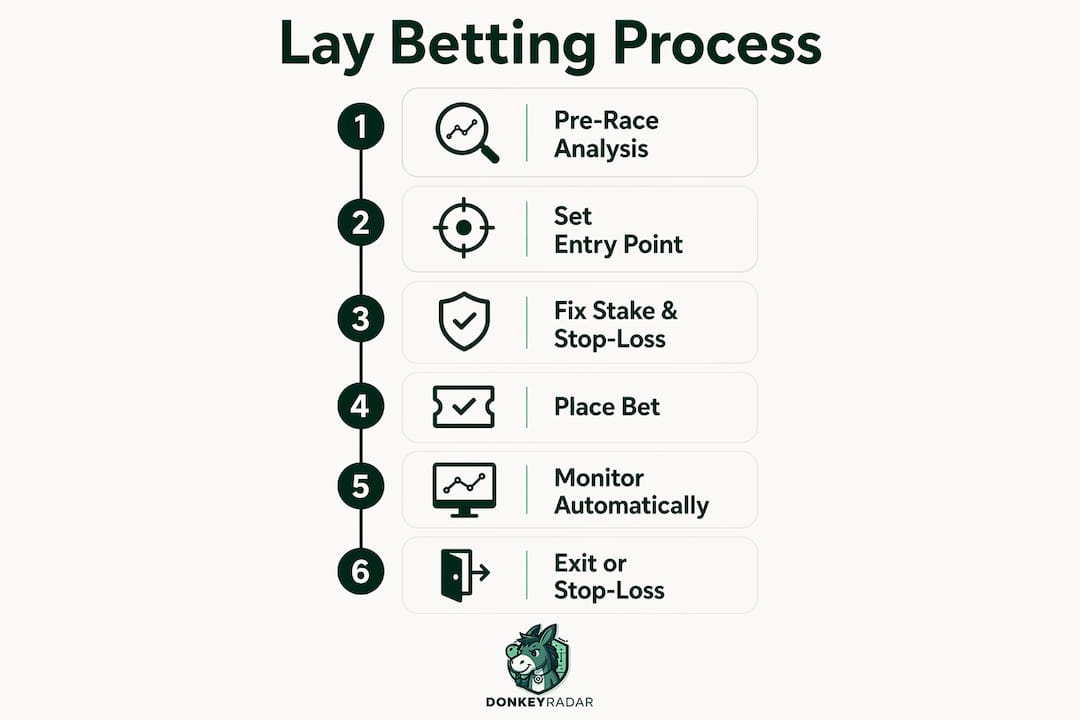
Follow these steps for every selection before placing a single bet:
- Confirm the horse sits in the 2.5 to 6.0 odds range at the time of your analysis.
- Calculate your maximum liability using the 2%–5% bankroll rule.
- Set your lay price. Do not accept a worse price to get matched.
- Define your stop-loss. If the odds shorten significantly against you in-play, the stop-loss triggers an automatic exit.
- Record all parameters in your log before placing the bet.
Pro Tip: Never lay a horse at odds above 6.0 unless you have a statistically validated edge in that range. High-odds lays feel attractive because the stake is small, but the liability is large.
Lay bets must be based on specific, repeatable signals, not opinions or gut feel. If you cannot articulate the signal in one sentence, the bet does not meet the criteria.
Step-by-step execution of a set and forget lay bet
The execution process begins 15–20 minutes before the race. Pre-race analysis of this length is sufficient to assess risk, confirm signals, and set parameters without rushing. Longer analysis does not improve outcomes. It increases the chance of overthinking.
Set and forget trading means planning entry, stop-loss, and size before execution. No improvisation is permitted after the bet is placed. The discipline is in the preparation, not the watching.
Follow this sequence for every bet:
- Open your signal source (Donkeyradar or your own analysis) 15–20 minutes before the off.
- Confirm the selection meets your odds and signal criteria.
- Calculate stake size based on your bankroll and the 2%–5% liability rule.
- Place the lay bet at your target price on Betfair Exchange.
- Set your stop-loss order if your automation software supports it.
- Close the screen. Do not monitor the race.
| Step | Key action | Expected outcome |
|---|---|---|
| Pre-race analysis | Confirm signal and odds range | Valid or rejected selection |
| Stake calculation | Apply 2%–5% liability rule | Fixed, controlled risk |
| Bet placement | Lay at target price only | Matched or unmatched at discipline |
| Stop-loss setting | Automate exit trigger | Limits loss if market moves against |
| Post-placement | No intervention | Emotional bias removed |
The most common mistake at this stage is removing the stop-loss after placement because the race looks like it is going well. That decision converts a controlled risk into an open-ended one. Position size must be calculated from stop-loss distance, not from potential profit. Stick to the plan.
Commission affects your net profit on every winning lay. Typical commission at 2% reduces gross lay profit, and this must be factored into your expected value calculation before you place the bet, not after.
Common mistakes and how to avoid them
Lay betting carries steeper risk than backing because losing bets are paid from your own funds. That asymmetry makes discipline non-negotiable. The most frequent errors are:
- Emotional interference. Watching the race and adjusting the bet mid-event. This is the single biggest cause of losses.
- No stop-loss. Placing a lay bet without a defined exit point exposes you to unlimited liability in theory.
- Wrong liability sizing. Exceeding 5% liability per bet means one bad run can damage your bankroll beyond recovery.
- Ignoring liquidity. Laying in thin markets means your bet may not be matched, or the spread is too wide to be profitable.
- Laying high-odds horses. Horses priced above 6.0 carry disproportionate liability relative to the stake.
Corrective actions are straightforward. Set a rule that you stop placing bets after three consecutive losses in a session. Review your log weekly, not daily, to avoid reacting to short-term noise. Treat each bet as one data point in a long series, not a standalone event.
Pro Tip: Keep a simple spreadsheet with date, selection, odds, liability, result, and P&L for every bet. Review it monthly. Patterns in your losing bets will become obvious within 60 days.
Scheduled reviews also reveal whether your signal source is performing. If your strike rate drops below your historical average over 50 bets, pause and reassess the signal criteria before continuing.
Key takeaways
A set and forget lay strategy succeeds when preparation is thorough and post-placement discipline is absolute.
| Point | Details |
|---|---|
| Odds range matters | Lay horses priced 2.5 to 6.0 for the best balance of liquidity and strike rate. |
| Bankroll rule is fixed | Keep maximum liability per bet between 2% and 5% of your total bankroll. |
| Preparation replaces monitoring | Complete all analysis in the 15–20 minutes before the race, then do not intervene. |
| Automation supports discipline | Use software to enforce stop-losses and remove emotional decision-making. |
| Commission reduces profit | Factor Betfair’s 2% commission into expected value before placing any bet. |
My honest view on set and forget lay betting
The name is slightly misleading, and I think that causes problems for new traders. “Set and forget” sounds effortless. The reality is that the hard work happens before the bet, not after. The forgetting part is easy once you have done the preparation correctly.
What I have found is that most people who struggle with this method are not failing at the strategy. They are failing at the preparation. They skip the signal check, they estimate the liability rather than calculate it, and then they watch the race because they are not confident in the bet they placed. That lack of confidence is a symptom of inadequate preparation, not a flaw in the method.
Automation is a force multiplier, not a substitute for a valid edge. I have seen traders automate a losing strategy and simply lose faster. Validate manually first. Run at least 50 bets with full records before you consider automating anything.
Losing streaks are part of the process. The traders who survive them are the ones who sized their bets correctly from the start. A 2% liability cap feels conservative until you hit five losses in a row. Then it feels like the best decision you ever made.
— Donkey
Donkeyradar’s lay signals for structured betting
Donkeyradar publishes pre-race lay signals for UK, Australian, and US horse racing, with a verified strike rate of over 85%. Every signal is based on statistical analysis of historical strike rates and live market prices, giving you a data-backed starting point for your pre-race preparation.
The platform’s transparent results tracking means you can assess signal performance before committing. All signals are published before the race, which fits directly into the 15–20 minute pre-race window this strategy requires. For betters building a structured approach, Donkeyradar’s lay betting tips and horse racing lay tips provide the signal foundation that set and forget execution depends on. Profits from betting in the UK are tax-free, which makes consistent, disciplined lay betting even more worthwhile.
FAQ
What is a set and forget lay bet?
A set and forget lay bet is a structured approach where you define your lay price, stake, and stop-loss before placing the bet, then take no further action. The method removes emotional interference, which is the primary cause of losses in lay betting.
What odds range works best for lay betting?
The 2.5 to 6.0 odds range offers the best balance of liquidity and strike rate for lay bettors. Laying horses priced above 15.0 carries high liability and is unsuitable for a set and forget approach.
How much of my bankroll should I risk per lay bet?
Maximum liability per lay bet should be 2%–5% of your total bankroll. Exceeding 5% liability significantly increases the risk of rapid bankroll drawdown during a losing run.
Do I need automation software for set and forget lay betting?
Automation software helps enforce stop-losses and removes the temptation to intervene, but it is not mandatory. Manual execution works if your pre-race preparation is thorough and your discipline is consistent.
How does commission affect lay betting profits?
Betfair charges commission on winning bets, typically around 2%. This must be included in your expected value calculation before placing any bet, as ignoring it overstates your net profit on every winning lay.