← Blog · 📝 Article · 20 August 2026
How Betfair commission impacts your profit: a trader's guide

How Betfair commission impacts your profit: a trader’s guide
Yes, Betfair charges commission, but only on what you actually win. Losing markets cost you nothing extra, and unmatched bets are never charged. The formula sits behind every Exchange payout: net winnings × market base rate × (100% − discount rate). That last part matters more than most bettors realise: your effective rate depends on the market you’re in, your loyalty discount, and whether your account is profitable enough to trigger the Expert Fee, a separate weekly surcharge that only touches the most consistently winning accounts.
Key Takeaways
Betfair commission applies only to net winnings per market, and understanding the formula lets you set gross targets that actually deliver your intended net profit.
| Point | Details |
|---|---|
| Commission hits net winnings only | Losing markets and unmatched bets carry no commission charge at all. |
| Rates vary by market type | Most markets sit at 5%, UK/Irish horse racing typically at 2%. |
| Per-market netting rewards concentration | Trading multiple legs in one market offsets losses before commission applies. |
| Expert Fee only affects top winners | A weekly surcharge tops up fees for accounts with high gross profit and low commission paid. |
| Model commission into your targets | Use required gross = desired net ÷ (1 − commission rate) before sizing any trade. |
| Donkeyradar consolidates signals | Pre-race lay signals reduce scattergun market activity, helping cut unnecessary commission events. |
Where to verify the rules yourself
Check your own account for personalised rates and active promotions before relying on any general figure.
- Exchange: What is Commission and how is it calculated?
- Expert Fee FAQs
- How does commission work on the Betfair Exchange | Sporting Life
- BeGambleAware for safer-gambling support
Table of Contents
- What “commission” means on the Exchange and how Betfair calculates it
- What are Betfair’s typical commission rates?
- How does per-market netting affect your total commission?
- What is the Premium Charge and who actually pays it?
- How does commission change scalping, swing trading and matched betting?
- What checklist should you run before every trade?
- How can lay-signal tools help manage commission drag?
- Want fewer commission events without changing how you trade?
- Sources
What “commission” means on the Exchange and how Betfair calculates it
Commission is charged on your net market winnings, not on each individual bet. If you back and lay the same horse three times and finish the market up £20 overall, Betfair takes its cut from that £20, not from every winning leg along the way.
The official calculation is:
- Net market winnings × Market Base Rate × (100% − Discount Rate)
Your Discount Rate comes from My Betfair Rewards, Betfair’s loyalty scheme, which can shave a small percentage off the headline rate as you build betting volume.
Two examples show the swing:
- Standard market with typical commission: you net profit on a football market and pay the corresponding commission rate. You keep most of your winnings after commission.
- UK/Irish horse racing with lower commission: the same net profit costs you less in commission, so you keep a slightly higher amount.
That gap between £47.50 and £49 on identical profit is the whole reason serious traders track which markets they use.
Pro Tip: Calculate your net target before you size a trade. If you need £50 clear after commission on a 5% market, aim to net roughly £52.65, not £50, or you’ll come up short.
What are Betfair’s typical commission rates?
Most Exchange markets carry a Market Base Rate of 5%, but that headline figure isn’t universal. UK and Irish horse racing markets are the standout exception at 2% for most users, which is why so many scalpers gravitate towards racing over other sports.
Rates also shift by country. Australian accounts, for instance, often face higher effective rates once local taxes are factored in, while other jurisdictions can differ again, according to independent rate breakdowns.
- Most sports and markets: 5%
- UK/Irish horse racing: 2% for most accounts
- Some low-liquidity or specialist markets: rates can vary further
- Occasional promotions: short-term 0% offers or capped commission rebates for new customers
Never assume. Check the market’s Rules tab or the commission display before you place a trade, especially if you’re new to a market type or trading outside the UK.
How does per-market netting affect your total commission?
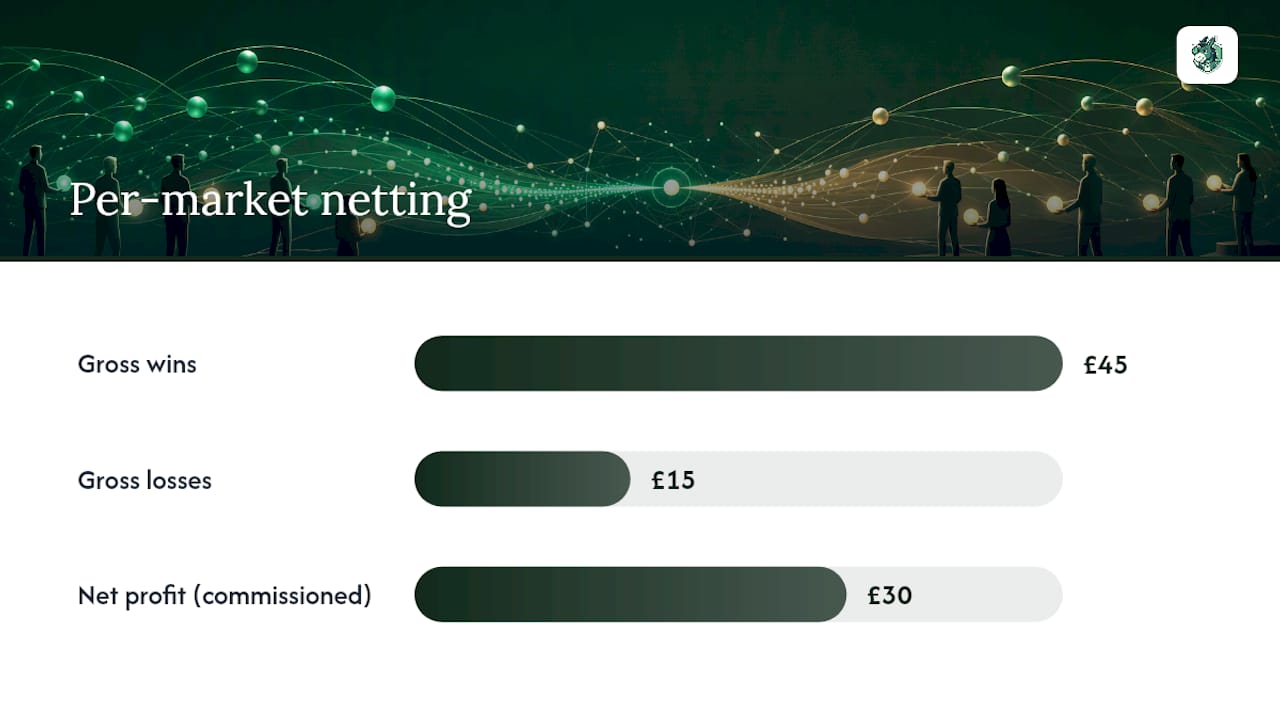
Every position you hold within a single market gets netted into one figure before commission applies. This is one of the most underused facts on the Exchange, and it rewards concentration over spread.
Say you place four trades in the same horse race: two lay bets that lose £15 combined, and two back bets that win £45 combined. Your net position is £30 profit. Commission applies only to that £30, not to the £45 gross win.
- Add up every back and lay result within the market.
- Subtract losses from wins to reach the net figure.
- Apply the Market Base Rate and Discount Rate only to that net amount.
The practical effect is that losses inside a market genuinely offset wins before Betfair takes anything, a point the Betfair hub itself stresses when advising traders on cost management. Spread the same activity across five separate markets instead, and you lose that offsetting benefit entirely, often paying commission on gross wins in each one.
- Concentrate trading activity in fewer, well-chosen markets where possible
- Let losing legs within a market do their job before you judge total commission
- Treat scattergun trading across many thin markets as a hidden cost, not just a diversification tactic
What is the Premium Charge and who actually pays it?
The Premium Charge, now generally referred to as the Expert Fee, is a weekly surcharge that only applies to the most consistently profitable, low-commission accounts. Betfair designed it to align total fees with gross profit for users who generate very little commission relative to how much they win, according to the Expert Fee FAQs.
The mechanics: Betfair calculates your “commission generated” by blending commission actually paid with an implied commission of 2.5% on market losses, then compares that to your weekly gross profit after a buffer is applied. If the ratio falls short of the target rate, the fee tops it up.
- Applies only to accounts with sustained high gross profit and low commission paid
- Uses a rolling measure that factors in both actual and implied commission
- Recreational bettors and most semi-professional traders rarely come close to triggering it
Pro Tip: Watch your account’s lifetime gross profit against commission generated in your Betfair statements. A widening gap between the two is the earliest sign you might be approaching Expert Fee territory.
How does commission change scalping, swing trading and matched betting?
Commission hits different strategies in different ways. Swing traders, chasing fewer but larger moves, pay commission less frequently but on bigger sums each time. Matched bettors typically pay commission only on the lay side of a qualifying loss, since that’s usually where the net profit sits.

A useful rule of thumb: required gross profit = desired net profit ÷ (1 − commission rate).
Mitigation tactics worth building into your routine:
- Favour 2% horse-racing markets for high-frequency scalping rather than 5% sports markets
- Pool stakes into fewer, more liquid markets instead of spreading thinly
- Build betting volume to unlock better My Betfair Rewards discount tiers
- Use temporary commission-free promotions when your account qualifies, confirming terms first
Run a quick audit of your own activity: total volume, average win size, which markets you actually trade, and your effective commission percentage across the last month.
Wider spreads and slippage on shallow books routinely cost more than the commission saving, a point independent guides on exchange fees also flag.*
What checklist should you run before every trade?
Three calculations, every time, before you commit stake:
- Confirm the market’s base rate and your current discount rate on the Rules tab.
- Work out the gross figure you need to hit your desired net profit using the formula above.
- If you’re trading multiple legs in one market, apply per-market netting to your running total rather than judging each leg separately.
Quick pre-trade checklist:
- Rules tab checked for the exact commission rate
- Expected liquidity assessed for likely slippage
- Spread checked against the commission you’d actually pay
- Weekly gross profit reviewed if you’re a high-volume winner
A winning lay nets roughly £6.67 before commission, £6.53 after, a small but real difference that compounds across a season.
How can lay-signal tools help manage commission drag?
Specialist tools won’t change Betfair’s rates, but they can change how often you generate a commission event in the first place. A dashboard with direct Exchange links, staking tiers, and a running P&L that tracks commission alongside gross profit gives you a much clearer view of your real net return than checking each bet in isolation.
Donkeyradar’s lay betting strategy approach publishes signals before races rather than encouraging scattergun activity across dozens of markets, which naturally consolidates trading and reduces unnecessary commission events. Combined with a lay betting calculator to check liability and break-even points, you can see the net picture before you commit.
- Verify any tool’s claimed results with a short trial and your own P&L tracking
- Remember that lower commission alone doesn’t guarantee higher net profit if liquidity or slippage eat the gain
- Cross-check signal timing against the market’s own Rules tab for the applicable rate
Commission is a cost to model, not a penalty to fear
Commission behaves exactly like a transaction cost in any other market: fixed, predictable, and worth building into your required edge rather than resenting after the fact. Most recreational bettors will never come close to Expert Fee territory; the real gains come from disciplined sizing, fewer wasted commission events, and honest record-keeping, not from chasing the lowest possible rate.
Want fewer commission events without changing how you trade?
Every extra market you scatter small stakes across is another commission calculation working against you. Donkeyradar’s lay betting signals are published before races, so instead of chasing dozens of thin markets to find an edge, you can concentrate on the selections the data actually flags, which keeps your trading tighter and your commission events fewer.
The free tier gets you daily signals to test the approach yourself; the paid tiers add real-time alerts, full verified results history, and API access if you want to plug signals straight into your own trading software. Run your own P&L for a week or two before drawing conclusions. Commission rates, liquidity and market conditions all vary, and results shown are illustrative of the method, not a guarantee of future returns. Start with the horse racing lay tips page and track your own numbers from day one.
Sources
- Exchange: What is Commission and how is it calculated?
- Expert Fee FAQs
- Understanding commission (Betfair hub)
- Betfair Commission: How Much You Pay (Rates Explained, 2026)
- BeGambleAware