← Blog · 📝 Article · 12 August 2026
Betfair reduction factor: what it is and how it works
When a horse is withdrawn from a race, Betfair applies a reduction factor to all matched bets. This is the exchange’s equivalent of the traditional bookmaker Rule 4 deduction. The effect is immediate: your potential winnings as a backer are reduced, and your liability as a layer decreases by the same proportion.
Three things to know straight away:
- The reduction factor is expressed as a percentage, derived from the withdrawn runner’s forecast price at market load.
- Reductions are normally applied to matched bets when the withdrawn runner’s factor is 2.5% or greater in win markets.
- Unmatched lay offers face a separate cancellation threshold of 4.0% in certain contexts, which creates a practical gap traders need to understand.
Key takeaways
The Betfair reduction factor is the exchange’s Rule 4 equivalent: a percentage deduction applied to matched bets when a non-runner is declared, calculated from the withdrawn runner’s forecast price and designed to keep both backers and layers on fair terms.
| Point | Details |
|---|---|
| RF equals exchange Rule 4 | Betfair’s reduction factor mirrors the bookmaker Rule 4 deduction; check it before every bet. |
| Win vs place thresholds differ | Win markets apply RFs of 2.5% or greater; place markets apply all RFs with no minimum floor. |
| Unmatched lay cancellation at 4.0% | Unmatched lay offers are only cancelled when the withdrawn runner’s RF reaches 4.0% or more. |
| Factors update until 15 minutes pre-off | UK race RFs can change until approximately 15 minutes before the off; always check the latest figure. |
| Donkeyradar calculator | Donkeyradar’s lay betting calculator applies RF maths instantly, removing arithmetic errors from staking decisions. |
Table of Contents
- What the Betfair reduction factor is and why it exists
- How Betfair calculates reduction factors
- How reductions differ between win and place markets
- What happens to your matched and unmatched bets
- Step-by-step worked examples
- When reduction factors are set and when they change
- Practical tips for managing stakes around reduction factors
- How a reduction factor calculator helps you trade more accurately
- The part most bettors skip — and why it costs them
- Donkeyradar’s tools make RF management straightforward
- Sources
What the Betfair reduction factor is and why it exists
A reduction factor is a percentage deduction applied to matched prices when a runner is declared a non-runner. Betfair calculates it from the forecast price of the withdrawn horse: the shorter the price, the larger the deduction, because a short-priced runner’s removal improves the remaining field’s chances more significantly.
The rationale is straightforward. If you backed a horse at 5.0 and the 2.0 favourite is then withdrawn, the remaining runners’ implied chances all increase. Without an adjustment, layers would face inflated liability on bets struck at prices that no longer reflect the true market. Betfair’s Rule 4 rules state explicitly that reductions are designed to be equitable for both backers and layers, preventing either side from gaining an unfair advantage after a withdrawal.
This mirrors the Rule 4 deduction that traditional bookmakers apply, though the mechanics differ. Bookmakers use a fixed pence-in-the-pound table based on the SP of the withdrawn runner. Betfair uses the last available exchange price, which tends to be more accurate because it reflects real money rather than a tissue price.
Pro Tip: Always check the reduction factor shown on the Betfair info page before placing a pre-race bet. A horse priced at 3.0 carries a much larger reduction factor than one priced at 20.0, and knowing this in advance prevents surprises if a fancied runner is pulled out.
How Betfair calculates reduction factors
Reduction factors are set when the market is loaded, using a forecast price for each runner. They can be updated during the market’s life as trading liquidity shifts prices, but they are not recalculated continuously in real time.
The calculation formula
The adjusted price after a reduction is applied using this formula:
New price = ((Original price − 1) × (1 − RF/100)) + 1
Where RF is the reduction factor expressed as a percentage. Betfair also states that the adjusted price cannot fall below 1.01, regardless of the size of the deduction.
For potential winnings on a back bet, the simpler version is:
Adjusted winnings = Original winnings × (1 − RF/100)
The Rule 4 table
Traditional bookmakers use a fixed table mapping the SP of the withdrawn runner to a pence-in-the-pound deduction. Betfair’s reduction factors follow a similar logic but use the last available exchange price rather than the SP. The table below shows the standard industry brackets:
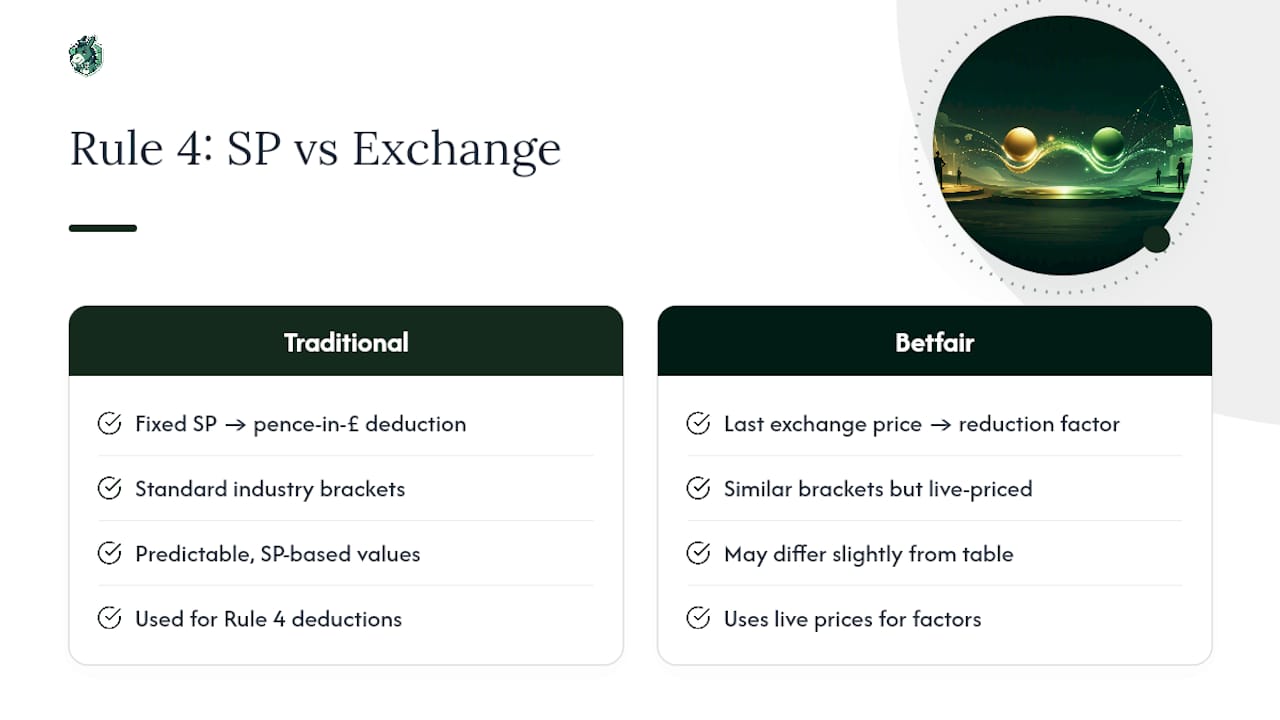
Betfair’s own reduction factors may differ slightly from this table because they use live exchange prices, but the brackets give you a reliable guide to the likely scale of any deduction.
How reductions differ between win and place markets
Win and place markets follow different rules, and confusing them is one of the most common sources of unexpected settlement figures.
Win markets
Unmatched lay offers may be cancelled when the factor reaches a higher threshold.
Place markets
Place markets are stricter. Betfair’s place market rules state that reduction factors for all non-runners are applied to potential winnings, including those with factors under 2.5%.
| Market type | RF applied to winnings | Minimum RF threshold | Unmatched lay cancellation |
|---|---|---|---|
| Win | Matched price adjusted | 2.5% | Varies by context |
| Place | Potential winnings adjusted | No minimum (all RFs applied) | 4.0% or greater |
The practical consequence for each-way bettors is that the place portion of an each-way bet can be reduced by even a small deduction that would have been ignored in the win market. If you are trading each-way positions on Betfair, the place leg needs separate attention.
Pro Tip: When you have an each-way position open, check the reduction factor for both the win and place markets independently. They can differ, and the place leg will always apply a wider set of deductions.
What happens to your matched and unmatched bets
Matched bets
Once a bet is matched, Betfair adjusts the settlement price rather than cancelling the bet. The formula applied to the matched price is:
New price = ((Original price − 1) × (1 − RF/100)) + 1
Your potential winnings drop from £500 to £400. The stake is returned regardless.
For a lay bet, the same adjustment reduces your liability. Both sides of the market are treated symmetrically.
Betfair’s stated principle: reduction factors are designed to be fair to both backers and layers. The process reduces matched prices to prevent layers being excessively exposed after a non-runner changes the market probabilities. The deduction cannot reduce odds below 1.01, and where multiple withdrawals occur, total deductions are capped at 90p in the pound.
Unmatched lay offers
Unmatched lay bets are not automatically cancelled every time a non-runner is declared. In win markets, cancellation typically occurs only when the reduction factor reaches the relevant threshold. In place markets, the threshold for unmatched lay cancellation is 4.0%. Your offer stays live at a price that no longer reflects the adjusted market.
BSP bets and post-race reconciliation
If a non-runner cannot be removed before the race starts and a Betfair Starting Price bet has already been matched, Betfair delays settlement. It then manually reconciles the SP by applying the non-runner’s reduction factor to the original SP odds. This process takes longer than standard settlement, so do not be alarmed if a BSP bet takes additional time to clear.
Step-by-step worked examples
1. Back bet in a win market
- Original price: 8.0 (decimal)
- Stake: £50
- Reduction factor: 25% (withdrawn runner priced around 3.5)
- Adjusted price: ((8.0 − 1) × 0.75) + 1 = 6.25
- Original potential profit: £350
- Adjusted potential profit: £350 × 0.75 = £262.50
- Stake returned: £50 regardless
Your net return if the horse wins drops from £400 to £312.50.
2. Lay bet in a win market
- Lay price: 5.0
- Lay stake (backer’s stake): £100
- Original liability: £400
- Reduction factor: 20%
- Adjusted price: ((5.0 − 1) × 0.80) + 1 = 4.20
- Adjusted liability: £100 × (4.20 − 1) = £320
The reduction saves you £80 in potential liability. If the horse loses, you still collect the £100 lay stake.
3. Place market (each-way place portion)
- Original place price: 3.0
- Place stake: £20
- Reduction factor applied: 10% (a small non-runner, factor below 2.5% but still applied in place markets)
- Adjusted potential winnings: (3.0 − 1) × £20 × 0.90 = £36
- Stake returned: £20
In the place market, it is costing you £4 in this example.
When reduction factors are set and when they change
Each runner receives a reduction factor when the market is loaded, based on a forecast price. This is not the final figure. Betfair’s exchange rules confirm that reduction factors may be updated during the market’s life as prices shift, but updates usually stop approximately 15 minutes before the off for UK races and approximately 5 minutes before the off for Australian and US markets.
After that window closes, the factor shown is effectively fixed for pre-race bets. Betfair does retain discretion to amend factors post-race in exceptional circumstances, so the figure is not always absolutely final until settlement completes.
Late withdrawals create the most operational complexity. If a horse is withdrawn after the market has gone in-play, or if a non-runner cannot be processed before the off, Betfair handles settlement manually. For BSP bets, the reconciliation process described above applies. For pre-race matched bets, the reduction is applied at settlement using the factor that was current at the time of withdrawal.
Reserve runners in large fields can also trigger reductions if they are added to the market and then removed. Check the Betfair info page for any race with a reserve runner listed.
Pro Tip: For UK races, the reduction factor shown 15 minutes before the off is the one most likely to be applied to your bet. Refresh the info page at that point and note the figure before committing to a large stake.
Practical tips for managing stakes around reduction factors
Before placing any pre-race bet on Betfair, a short checklist prevents most of the common errors:
- Check the current reduction factor on the Betfair info page for every runner in the field, not just the one you are betting on.
- Identify the market type — win or place — because the thresholds and application rules differ materially.
- Note the 2.5% floor for win markets and remember it does not apply in place markets.
- For lay bets, calculate your worst-case liability before the reduction and your best-case liability after. The gap tells you how much the RF is worth to you.
- Consider BSP for large fields where late withdrawals are more likely; BSP bets are reconciled post-race, removing the need to monitor pre-race RF updates manually.
- Green up before the off if you are holding a trading position and a significant non-runner is declared. A lay betting strategy that accounts for RF changes will include a green-up plan as standard.
- Adjust stakes proportionally when a large reduction is likely. If you expect a 25% deduction, size your stake so the adjusted return still meets your minimum target P&L.
Pro Tip: Use the Betfair Calculator to enter your original matched price and the reduction factor before confirming a bet. The adjusted payout figure takes seconds to verify and removes arithmetic errors entirely.
For UK lay tips specifically, the reduction factor on a short-priced favourite is the single biggest variable that can erode a lay profit. Checking it is a 30-second task that pays for itself repeatedly.

How a reduction factor calculator helps you trade more accurately
A reduction factor calculator takes three inputs: the original matched price, the stake, and the reduction factor percentage. It outputs the adjusted price, the adjusted potential winnings or liability, and the net P&L after the deduction. That sounds simple, but under race-day pressure the arithmetic is easy to get wrong.
The Betfair Calculator handles back and lay stakes, green-up calculations, and post-RF adjustments in one place. Enter your lay price, your stake, and the RF, and it returns the adjusted liability instantly. For each-way bets, run the place portion separately using the place odds and the place RF.
Donkeyradar’s lay betting calculator integrates directly with the staking tier framework used in the signal service. When a Donkeyradar signal is issued, the calculator helps you size the lay stake correctly given the current RF, so your liability stays within the tier’s recommended exposure. The dashboard also carries direct Betfair market links, which means you can move from signal to market to calculator without switching between multiple tabs.
Statistical modelling research, including the foundational work by Bill Benter on probability-based racing models, demonstrates that formal staking frameworks consistently outperform ad hoc sizing over a long run. Applying that principle to RF management means treating the deduction as a known variable in your staking model, not an afterthought.
Key inputs to check before placing or greening out:
- Original matched price and stake
- Current reduction factor (from Betfair info page)
- Market type (win or place)
- Whether any unmatched lay offers are live and their exposure at the current RF
The part most bettors skip — and why it costs them
Over a season of each-way betting, those small place deductions accumulate into a meaningful drag on P&L.
The second overlooked point is the unmatched lay gap. Your offer stays live at a stale price. If the market reprices quickly after the withdrawal, you can find yourself matched at a price that no longer reflects the adjusted field. Monitoring unmatched offers after any non-runner announcement is not optional for serious lay traders.
The third thing: reduction factors are dynamic until roughly 15 minutes before the off for UK races. Checking the figure once and then ignoring it is not a strategy.
Using a calculator and a structured staking approach removes most of this risk. It is not about being cautious; it is about knowing your actual numbers before the race starts.
Donkeyradar’s tools make RF management straightforward
Reduction factors are manageable once you have the right tools in place. Donkeyradar’s lay betting calculator handles the RF arithmetic instantly: enter your price, stake, and the current factor, and your adjusted liability is there in front of you. No mental maths, no settlement surprises.

Each signal comes with a staking tier grade and a direct Betfair market link, so you move from signal to market to sized lay bet in one workflow. The free tier gives you daily signals; the premium subscription adds real-time alerts via email and Telegram, full results history, and API access for trading software.
Start with the lay betting calculator to verify your next position, then explore the horse racing lay tips to see how the signal service integrates with your Betfair workflow.
Sources
The following pages cover the official rules and provide practical tools for verifying your own calculations:
Check the Betfair info page for live reduction factors before any race. The figures shown there are the ones Betfair will use at settlement.