← Blog · 📝 Article · 13 September 2026
Liability First Expected Value for Lay Betting with DonkeyRadar Checks

Yes, expected value applies fully to lay betting. You keep long-term profit only when your model’s probability of a horse winning sits below the market’s implied probability once commission is factored in, and only if you size each lay by liability rather than stake. Get either of those wrong and a genuinely +EV lay can still bleed you dry.
TL;DR:
- Successful lay betting requires ensuring your model’s probability estimate is below the market-implied probability after accounting for commission and liability costs.
- The lay expected value formula depends on your probability estimate and odds, with positive EV only when the market price overestimates the horse’s true chances.
- Most disciplined bettors risk between 0.5% and 2% of their bankroll on odds between 2.0 and 4.0, using liability-based sizing to manage risk effectively.
- In-play markets and market mispricings after non-runners can create short-term positive EV opportunities if checked carefully.
- Using tools like lay calculators and maintaining strict record-keeping helps verify the edge before placing real stakes and managing variance over many bets.
Table of Contents
- What expected value means for lay betting
- How to calculate lay EV (with worked examples)
- Commission and liability: how they change the EV you actually receive
- Sizing and bankroll management for lay bets
- When laying produces positive EV
- Tools and calculators to verify lay EV before you bet
- How DonkeyRadar operationalises EV for lay betting
- Author perspective: discipline is the whole game
- Try the calculator before you stake anything
- Sources
- FAQ
What expected value means for lay betting
Expected value is the long-run average profit you’d earn from placing the identical bet thousands of times over. In backing, EV equals the weighted average return per bet: probability of winning multiplied by net profit, minus probability of losing multiplied by stake. Laying flips that logic on its head, but the maths stays symmetrical.
When you lay a horse, you’re the bookmaker. You win your stake if the horse loses and pay out the backer’s winnings if it wins. That mirror-image relationship means every +EV back bet has a corresponding lay bet somewhere on the market that’s close to break-even, and vice versa. The edge lives in the gap between your own probability estimate and the market’s.
- EV in lay betting is the average profit per identical lay, taken across many races, not the result of any single bet.
- Because backing and laying are mathematical opposites, a horse can be simultaneously bad value to back and good value to lay, or neither.
- Short-term variance is enormous in lay betting, particularly at longer odds, so a handful of losing lays tells you almost nothing about whether your model is right.
How to calculate lay EV (with worked examples)
The lay-specific EV formula is: Lay EV = (1 − P) − P × (D − 1), where P is your estimated probability of the horse winning and D is the decimal lay odds you’re offered.
Working through it takes three steps:
- Convert the lay odds to an implied probability by dividing 1 by D. A lay price of 4.0 implies a 25% winning chance.
- Compare that implied probability against your own model probability, P.
- Plug both into the formula to get raw EV per unit of stake, before commission.
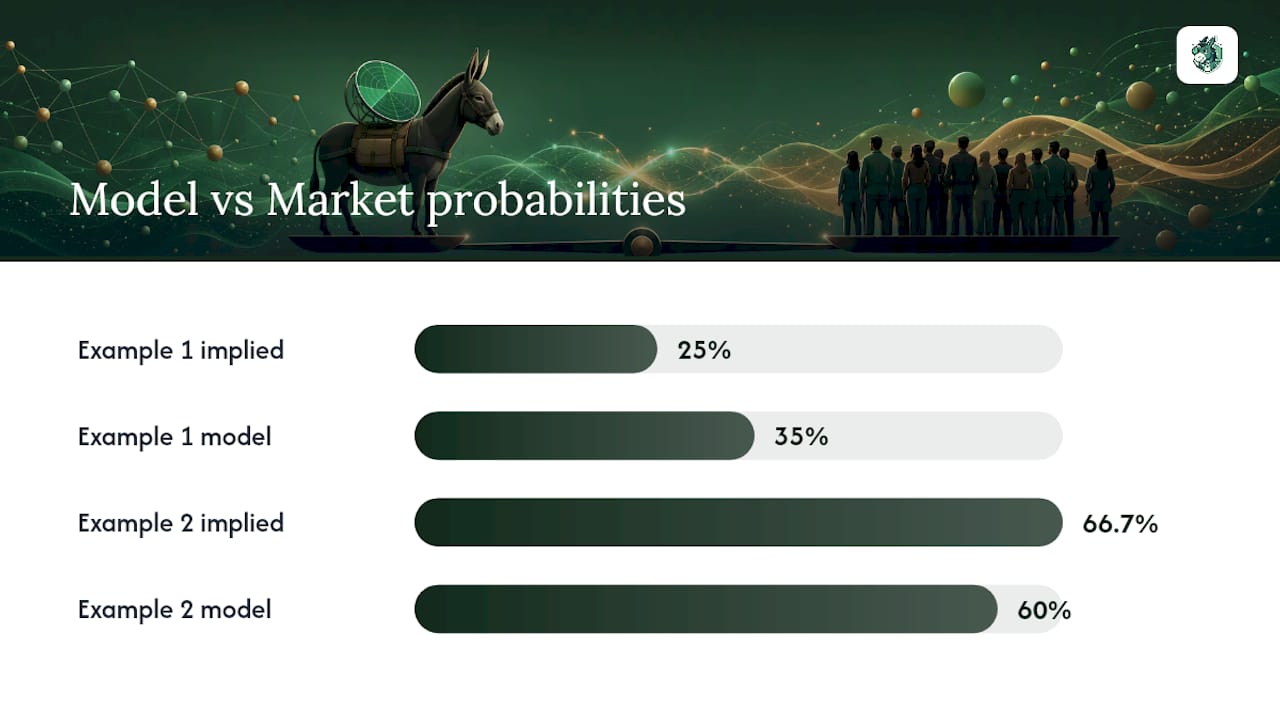
Worked example one: you lay a horse at 4.0 and your model puts its winning chance at 35%, versus the market’s implied 25%. EV = (1 − 0.35) − 0.35 × (4.0 − 1) = 0.65 − 1.05 = negative 0.40. The market’s price is too generous to the backer relative to your view. This is a bad lay, even though 4.0 looks like a tempting price to lay against a horse many people think is overbacked.
Worked example two: you lay a short-priced favourite at 1.5, and your model rates it at 60% (below the market’s implied 66.7%).
That second scenario is the shape you’re hunting for: a market probability that’s slightly too confident, and a lay price that reflects it.
Commission and liability: how they change the EV you actually receive
Raw EV is a fiction until you subtract commission from your winnings. Exchange commission on winning lays typically runs between 2% and 5%, depending on your account tier and the exchange, and it applies only to the profit on a winning lay, not the stake.
On tight margins, commission can turn a marginal edge into a losing one.
Post-commission edge rule: aim for a positive expected value after commission before placing a lay. Edges too thin to comfortably cover model error or commission are generally not worth the liability you’re carrying.
Liability is the other half of the equation. The liability formula is straightforward: Liability = backer stake × (lay odds − 1).
- Lay £10 at 1.5: liability is £10 × 0.5 = £5.
- Lay £10 at 4.0: liability is £10 × 3.0 = £30.
- Lay £10 at 10.0: liability is £10 × 9.0 = £90.
Liability climbs steeply with odds, which is why laying long shots creates lopsided risk-to-reward ratios that demand exceptional model confidence to justify.
Sizing and bankroll management for lay bets
Kelly criterion sizing works for lay betting, but you apply it to liability rather than the stake you place. The formula derives a liability fraction of bankroll, which you then convert back into the backer stake your exchange account will accept for that price.
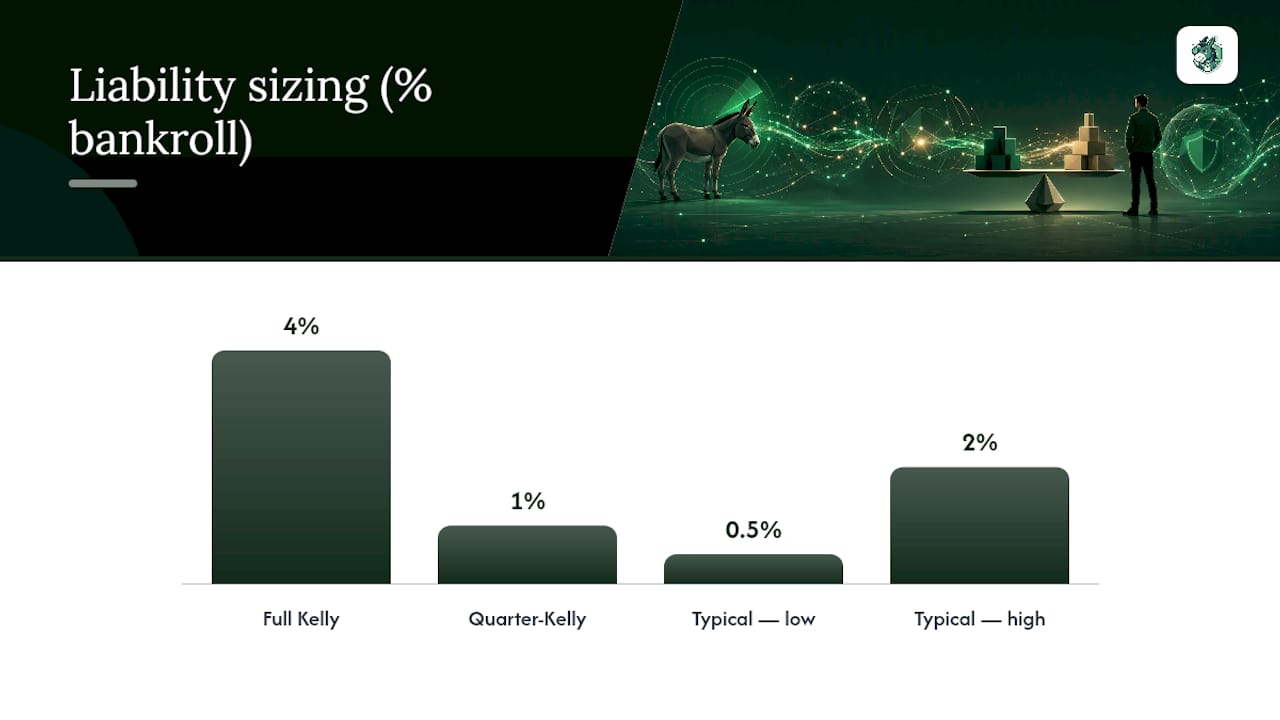
Full Kelly is aggressive and punishes small errors in your probability estimate hard. Quarter-Kelly is the commonly recommended compromise: it captures most of the growth benefit of Kelly sizing while cutting the swings dramatically.
On a £2,000 bankroll, that’s £20 in liability rather than £80, a difference that matters enormously the first time your model is wrong three races running.
- For lay odds between 2.0 and 4.0, most disciplined lay bettors risk somewhere between 0.5% and 2% of bankroll in liability per bet.
- Odds above 6.0 or 7.0 warrant liability closer to the bottom of that range, if at all, given how quickly liability outpaces the potential win.
- Consistent fractional sizing, not bet-by-bet judgement calls, is what actually protects a genuine edge over hundreds of races.
Pro Tip: Calculate liability first, then work backwards to the stake. Sizing by stake alone hides how much you’re actually risking, especially at longer prices where liability balloons.
When laying produces positive EV
Certain market patterns recur often enough in horse racing to be worth watching directly. Favourites are frequently overbet by recreational money chasing the “safe” runner, pushing prices shorter than the horse’s true winning chance justifies. That gap between sentiment and probability is where a lot of lay edge lives.
In-play markets create their own openings. A horse that shortens sharply after a strong early split, or a market that hasn’t fully digested a late scratching can leave temporary mispricing that a quick, disciplined check exploits before the field catches up.
Before placing any lay, run through a short mental checklist:
- Is your model probability meaningfully below the market’s implied probability, not just marginally?
- Is the market deep enough that your lay stake won’t move the price against you?
- After applying commission, does the edge still clear your minimum threshold?
Tools and calculators to verify lay EV before you bet
A lay betting calculator turns the formulas above into a thirty-second check rather than mental arithmetic under time pressure. Feed it the lay odds, the exchange’s commission rate, your model probability, and the stake you’re considering, and it returns liability, net profit after commission, and the break-even probability the market is pricing in.
- Confirm liability first: it tells you the maximum you can lose if the horse wins.
- Check net EV after commission against your 3% threshold before confirming the bet.
- Compare the calculator’s break-even probability against your own model figure directly, using tools like DonkeyRadar’s lay betting calculator.
- Log every trade, win or lose, so you can review whether your model’s edge holds up over a real sample rather than a lucky run.
How DonkeyRadar operationalises EV for lay betting
Some lay signal services build their signals around frameworks like this, publishing lay signals before races and providing verified results history so the model’s edge can be checked.
- Signals are often published pre-race and tracked openly, letting users audit strike rate and profit and loss over time rather than cherry-picked highlights.
- A dedicated lay calculator converts a signal’s implied edge into a liability-based stake sized to your bankroll.
- New users are best served by paper-trading signals for a few weeks, then moving to small real stakes, and tracking ROI against the model’s stated edge before scaling up.
Author perspective: discipline is the whole game
Here’s the part most explainers skip: a correctly identified +EV lay will still lose more often than it wins if the odds are long enough, and that’s not a flaw in the maths, it’s the maths working exactly as intended. Bettors who abandon a sound model after a losing run usually weren’t wrong about the edge. They were wrong about their own tolerance for variance.
Conservative sizing and honest record-keeping are what let a thin, genuine edge compound into something meaningful. Test small, trust the sample size, and let the calculator do the arithmetic your nerves can’t be trusted to do mid-race.
— Donkey
Try the calculator before you stake anything
There are lay betting calculators available that turn your odds, commission rate, and model probability into liability, net EV, and a break-even probability in one step, giving a practical edge over doing this maths by hand quickly before a race.
Start with the lay betting explained guide if you want the fundamentals before you run numbers, or head straight to the lay betting calculator if you already have a race and a model probability in mind. Run a handful of signals from today’s lay tips at small stakes first, and track the results against the EV the calculator gives you. The tools handle the arithmetic. Getting your probability estimates right, and staying disciplined when a correct lay loses, is still down to you.
Sources
- How to calculate expected value in betting
- Lay Betting Strategy: 5-Step EV Framework for Picking Lay Value | KiqIQ
- Lay Betting Calculator: Liability, Commission & Risk/Reward for Exchanges
- Bankroll Management in Sports Betting: The Complete Guide
FAQ
What is expected value betting?
Expected value betting means placing bets only when your own probability estimate diverges favourably from the market’s implied probability, so that the bet shows a positive long-run average profit across many repetitions.
How do you calculate the expected value of a bet?
For a lay bet, use Lay EV = (1 − P) − P × (D − 1), where P is your model’s probability of the horse winning and D is the decimal lay odds, then subtract exchange commission from the profit side of that figure.
What is the 80/20 rule in betting?
There’s no single agreed definition of an “80/20 rule” specific to betting; most bettors who use the phrase mean that a small fraction of well-researched bets or markets tends to produce most of a portfolio’s long-term profit, which is really just a restatement of focusing on genuine EV rather than volume.