← Blog · 📝 Article · 30 August 2026
Cap Every Lay Loss: Fixed Liability Staking With UK Exchange Rules

Fixed liability staking sets the maximum you can lose on every lay bet, working out the stake so a losing lay never exceeds the liability you chose upfront. Instead of betting a flat stake regardless of price, you fix the risk and let the stake move with the odds. The formula behind it is simple: Stake = Liability ÷ (Decimal odds − 1).
TL;DR:
- Fixed liability staking ensures your maximum loss remains constant regardless of odds movements, with stakes calculated as liability divided by (odds minus one).
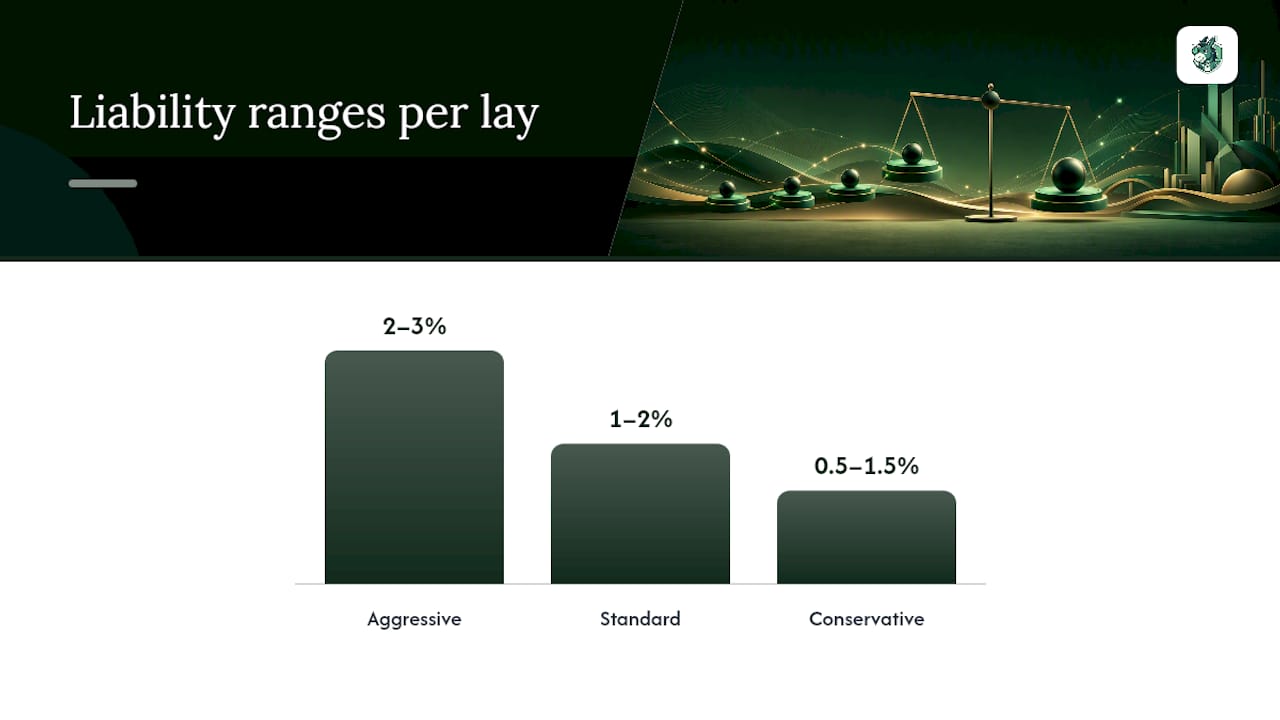
- The recommended liability size is typically between 1% and 3% of your bankroll, with more cautious bettors choosing 0.5% to 1.5% for better risk control.
- Betfair minimum stakes and starting price thresholds can prevent small calculations from executing, so rounding liabilities upward is essential for long odds and SP bets.
- Recalculating your stake before each bet is crucial when odds drift to ensure you do not exceed your fixed risk limit and protect your bankroll.
- Using automated tools like Bet Angel or staking calculators helps eliminate arithmetic errors and keeps your fixed liability plan consistent during live betting.
Table of Contents
- What is fixed liability staking and how does the formula work?
- Why use fixed liability staking, and when does it suit you?
- How much bankroll should you risk on each lay?
- Betfair minimums that can quietly break your calculations
- Common mistakes and a pre-bet checklist
- How Donkeyradar verifies its lay signals
- Fixed liability staking beyond horse racing
- Adjusting the plan when odds keep moving
- A typical session, and the one habit that keeps it sustainable
- Practise the maths before you stake it live
- Sources
What is fixed liability staking and how does the formula work?
Laying by liability flips the usual staking question. Rather than asking “how much do I stake?”, you ask “how much am I prepared to lose?” and let the maths sort the rest out. The formula that governs it is:
Stake = Liability ÷ (Decimal odds − 1)
Say you want a fixed liability of £50 on a horse trading at decimal odds of 5.0. Divide £50 by (5.0 − 1), which gives you a stake of £12.50.
- If the horse loses (your lay wins): you collect £12.50, minus Betfair’s commission on winnings (typically 2 to 5%, depending on your account).
- If the horse wins (your lay loses): you pay out £50, exactly your chosen liability, regardless of how the odds moved before the race.
That £50 figure never changes no matter which horse you’re laying that day, provided you keep the liability constant. Shorten the odds to 2.0 and the same £50 liability needs a £50 stake. Lengthen them to 11.0 and the stake drops to £5. The liability itself is calculated as (Lay odds − 1) × Lay stake, which is simply the same formula rearranged.
Pro Tip: Build the formula into a spreadsheet cell rather than doing it in your head trackside. One misplaced decimal on a 20.0 shot turns a small lay into a bank-denting liability. Tools like Bet Angel and The Staking Machine also offer built-in lay-by-liability modes that automate this calculation, which removes the arithmetic risk entirely.
Why use fixed liability staking, and when does it suit you?
The appeal is psychological as much as mathematical. Knowing your worst-case outcome before you click “place bet” removes the guesswork that causes bettors to freeze or chase losses. Because downside stays capped while upside can run, the method smooths your equity curve, particularly in markets where prices swing hard, such as in-running trading or a horse drifting after a stumble at the start.
Advantages:
- Every lay carries the same worst-case loss, so a losing run drains your bank at a predictable, controllable rate.
- You can size liabilities into a system with fluctuating odds without recalculating your risk tolerance bet by bet.
- Losing streaks feel psychologically manageable because the number never surprises you.
Drawbacks:
- At long odds, your stake shrinks, so a winning lay pays out relatively little compared with the liability you’re risking.
- At short prices (odds close to 1.5 or 2.0), the stake needed to hit your target liability can be large, tying up more of your bank per bet.
Set against lay level staking (same stake every time, liability floats) or recovery-style plans that increase stakes after losses, fixed liability sits in the middle: less aggressive than chasing plans, more consistent than flat staking when odds vary widely.
How much bankroll should you risk on each lay?
Liability sizing is where most bettors either protect their bank or quietly destroy it over a few bad weeks. The convention among lay bettors is to set liabilities between 1% and 3% of your starting bank, with more cautious operators sticking to 1% to 1.5%. On a moderate-sized bank, liability sizes typically fall in a controlled range per lay, not per stake.
- Aggressive range (2 to 3%): suits bettors with a proven edge and the stomach for sharper drawdowns.
- Standard range (1 to 2%): the most common starting point for new lay bettors.
- Conservative range (0.5 to 1.5%): better if you’re running fixed liability staking alongside other exposure, such as matched betting or trading.
Decide early whether your liability is a fixed cash figure or a percentage recalculated against your current bank. Fixed cash is simpler and easier to track; percentage-based liability compounds your risk down (and up) as your bank moves, which needs tighter discipline to avoid over-betting after a win streak.
Set practical stop-loss limits and maximum stakes to avoid large losses on short-priced favourites. A dedicated lay betting bankroll kept separate from other betting or trading funds also stops one bad session bleeding into unrelated activity.
Pro Tip: After a losing run, resist the urge to raise your liability to “get it back” faster. Fixed liability staking only protects you if the liability actually stays fixed.
Betfair minimums that can quietly break your calculations
Exchange rules interfere with the pure maths more often than bettors expect, particularly at long odds where the required stake shrinks close to zero.
- Betfair enforces a minimum backer’s stake of £2 on exchange lay bets, which sets a floor on how small your calculated stake can go. Lay a 41.0 shot with a £20 liability and the formula wants a 50p stake, but the exchange won’t accept it below £2.
- Starting Price (SP) bets carry a higher minimum liability threshold, roughly £10, for SP conversion. If your unmatched portion would leave an SP liability under that figure at the off, Betfair cancels it rather than converting it to SP.
- Check the traded price ladder before the off. If your bet shows as unmatched with a liability close to the SP minimum, expect it to be pulled rather than settled.
The practical workaround is straightforward: round liabilities up on long-priced outsiders so the stake clears £2 comfortably, and avoid running very small liabilities through SP if you need certainty of execution. Our Betfair liability explainer walks through worked examples of exactly where this trips people up.
Common mistakes and a pre-bet checklist
Most fixed liability errors come from rushing the numbers, not misunderstanding the concept.
- Confusing odds formats. The formula needs decimal odds; running it against fractional prices without converting first produces a wildly wrong stake.
- Forgetting commission. Your net return on a winning lay is always lower than the raw stake once Betfair’s commission is deducted.
- Ignoring exchange minimums. Small liabilities on long shots can fail to match or get cancelled at SP, as covered above.
- Leaving bets partially matched. If only part of your stake matches before the off, your actual liability is lower than planned. Check the “matched” tab, not just your original order, before assuming your exposure.
Before every lay, confirm: decimal odds, calculated stake, available funds to cover the full liability, and a session stop-loss already set. Our pre-bet checklist covers the same ground in a printable format if you want it pinned next to your screen.
How Donkeyradar verifies its lay signals
Donkeyradar’s signals come from an algorithm that processes historical strike rates against live market prices to flag the weakest runner in a race, publishing every signal before the race starts rather than after the result is known. That sequencing matters. Anyone can claim a good strike rate retrospectively; publishing the pick first and tracking the outcome afterwards is what makes the results history checkable rather than just claimed.
A strike rate above 85% only means something once you know the sample size and the period it covers. A dozen races tells you nothing; a few thousand, tracked publicly and updated after every result, tells you whether the edge is real or a lucky run.
Fixed liability staking works best layered on top of a genuine selection edge, not instead of one. The staking method controls your risk per bet; it does nothing to improve the quality of the horses you’re laying in the first place.
Fixed liability staking beyond horse racing
The same formula travels well outside racing, because the logic doesn’t depend on the sport. Any market with a lay side and moving odds can use it.
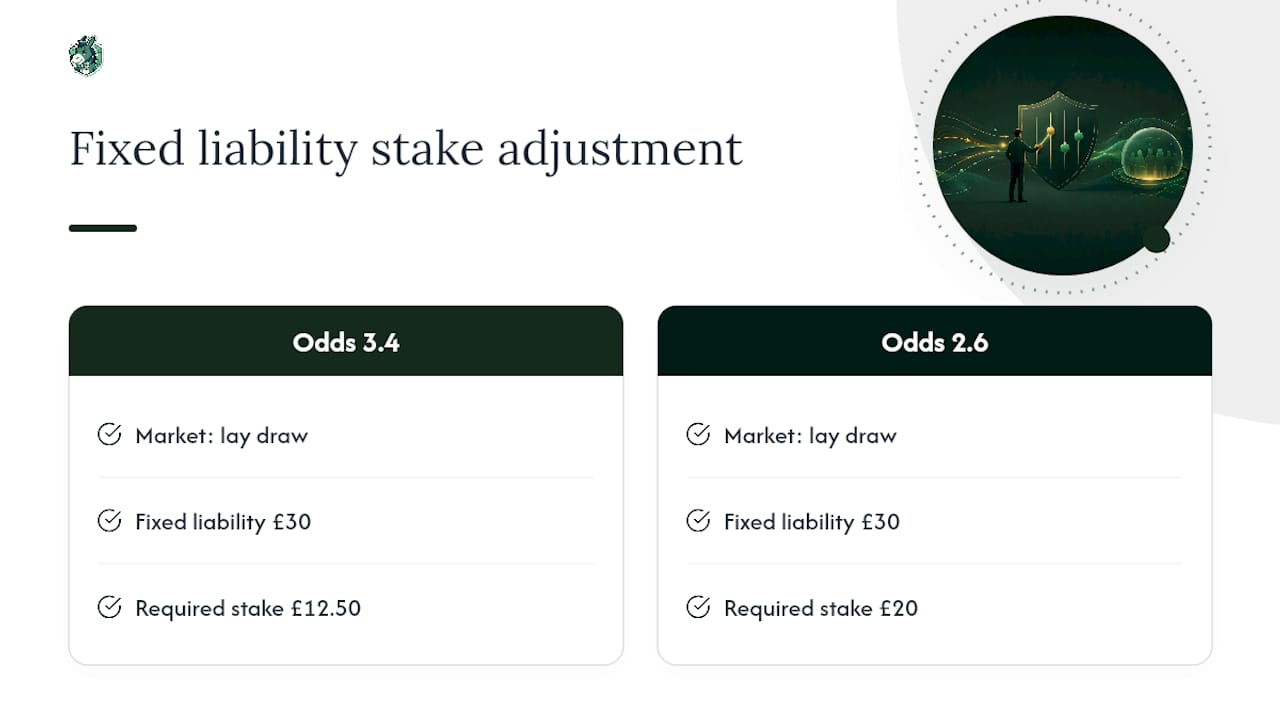
In football exchange trading, lay bettors use fixed liability to cap risk when laying the draw or a short-priced favourite before kick-off, then adjust as in-play prices swing. A £30 liability against a draw at 3.4 needs a £12.50 stake; if the price shortens to 2.6 after an early chance, the same £30 liability now needs a £20 stake to keep the risk identical.
Tennis is where fixed liability arguably earns its keep most, given how sharply odds swing on a single break of serve. Laying a player at 1.8 who then loses their serve and drifts to 3.5 lets you either lock in profit by laying again at the new price or hold with your original fixed liability intact throughout the swing.
Outside sport, spread betting and CFD trading use an almost identical concept under different names, capping loss per position while letting the position size float with the entry price. The mechanism is the same: decide the maximum acceptable loss first, then let the instrument’s price dictate the size of the trade. Horse racing lay bettors already thinking in decimal odds and liability terms tend to pick this up in other markets faster than bettors coming from flat-stake backgrounds.
Adjusting the plan when odds keep moving
Prices rarely sit still between your decision to lay and the moment your bet matches, and fixed liability staking has to accommodate that drift rather than ignore it.
If a horse you’re planning to lay at 6.0 drifts to 8.0 before you place the bet, recalculate the stake rather than reusing your original number. A £40 liability needs an £8 stake at 6.0 but only £5.71 at 8.0. Reusing the old stake either overshoots your liability or leaves it under your intended risk, defeating the point of fixing it in the first place.
In-running trading demands the same discipline at speed. If you’ve laid a favourite and it’s drifting as the race unfolds, decide in advance whether you’ll add a fresh fixed-liability lay at the new price or leave your original position alone. Stacking multiple lays on the same runner without tracking combined liability is how bettors accidentally double their intended risk.
For markets with slow, grinding price movement, such as ante-post racing weeks out from an event, wider liability bands make more sense than trying to hit an exact figure. Treat your chosen liability as a ceiling rather than a target, and round stakes down slightly on volatile markets to leave room for the odds moving against you before matching completes.
A typical session, and the one habit that keeps it sustainable
A disciplined session starts with a fixed liability decided before looking at a single race, usually 1% to 2% of the bank, applied consistently across every qualifying lay that day. Selections get filtered first; the liability size never changes to chase a “better” opportunity mid session.
Three consecutive losing liabilities is the usual signal to stop for the day, win or lose overall. Streaks happen even with a genuine edge, and protecting the bank matters more than proving a point against a bad run.
The habit that matters most: recalculate the stake every single time, even when it feels obvious. Complacency on the maths, not the strategy, is what erodes a fixed liability plan over months.
— Donkey
Practise the maths before you stake it live
Reading the formula is one thing. Running it under time pressure on a live market, with odds ticking over while you’re still typing numbers into your phone, is another. Donkeyradar built its tools around that gap, so bettors can rehearse fixed liability staking with real numbers before a single pound is at risk.
Start with the lay betting calculator, which computes stake, liability, and break-even instantly from any decimal odds you enter, useful for checking your own workings against a second source. Pair it with the lay betting explainer if you want the fundamentals refreshed before applying fixed liability against real signals, or the data-driven lay betting strategy guide for how staking plans slot alongside a systematic selection process.
Donkeyradar’s seven-day trial gives you access to pre-race signals with a public, verified results history, so you can practise sizing liabilities against real markets with a demo bankroll before committing real funds. Whatever liability you settle on, check Betfair’s minimum stake and SP thresholds for that specific market before you go live.
Sources
- Betfair help: Starting price (SP) and Exchange betting
- Why laying by liability works so well — Bet Angel
- Lay Fixed Liability Staking Plan — The Staking Machine
- Lay bet liability explained — Oddsmatched