← Blog · 📝 Article · 6 August 2026
Green up Betfair: how to lock in profit every time

Greening up on Betfair locks in a guaranteed profit (or a controlled loss) across every outcome by placing an opposing bet after the market moves in your favour. The industry term for the balanced position is a green book: every selection in your market shows green in the P&L column, regardless of which one wins.
Two formulas cover the vast majority of situations:
- Back-first hedge: Lay stake = (Original back stake × Back odds) ÷ Current lay odds
- Lay-first hedge: Back stake = (Original lay stake × Original lay odds) ÷ Current back odds
Three practical routes to execute: calculate manually, use Betfair’s Cash Out, or let trading software handle it automatically. Each has trade-offs covered in full below.
Pro Tip: Always round your hedge stake up to the next penny, never down. Rounding down leaves a small residual liability on one outcome.
Table of Contents
- What does greening up actually mean?
- When should you green up?
- How to calculate your hedge stake: worked examples
- Which tools help you green up reliably?
- How partial greening and scaling out work
- Risks, costs and execution issues to know about
- Common mistakes when greening and how to fix them
- Pre-trade checklist before you hedge
- Key takeaways
- Discipline is the part most traders underestimate
- Donkeyradar fits directly into a greening workflow
- Useful sources
What does greening up actually mean?
On a betting exchange you can back or lay any selection. When you back, you win if the selection wins. When you lay, you win if it loses. Greening up exploits that two-way market: after your original bet, you place the opposite bet at a different price to redistribute your P&L so every outcome pays the same amount.
The Betfair interface makes this visual. An unbalanced position shows red figures next to outcomes you lose on and green next to the one you profit from. Once you hedge correctly, every figure turns green. That is the green book, and it is why traders use the phrase.
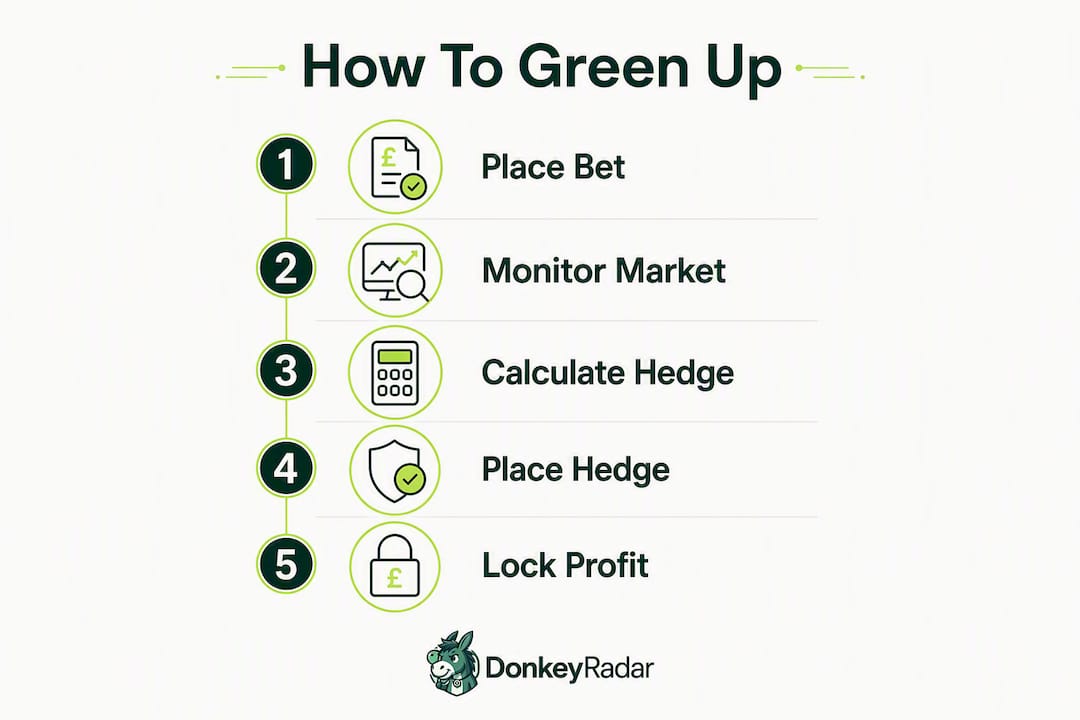
One point worth being clear on: greening up is a risk-management action, not a profit-generation method. The profit was created by your original directional call. Greening simply distributes it evenly so the result of the race no longer matters.
When should you green up?
The decision to hedge comes down to your objective at that moment in the trade.
Primary objectives:
- Lock profit: the market has moved in your favour and you want to bank the gain with certainty.
- Limit loss: the market has moved against you and you want to cap the damage before it worsens.
- Rebalance liability: you have multiple selections open and want to reduce exposure on one.
- Convert a free bet or promotion: greening converts a one-sided bonus into guaranteed cash across outcomes.
Market timing matters. The minutes immediately before the off tend to be the most liquid window for UK horse racing. Spreads are tightest, matched volume is highest, and your hedge stake is most likely to be matched at the price you want. In-play greening is possible but prices move faster, slippage is higher, and partial fills become a real risk. Avoid greening in markets with low matched volume; a thin order book means your hedge stake can shift the price against you as it fills.
Experienced traders consistently recommend targeting 3–5 ticks rather than waiting for a large swing. Small, repeatable gains compound reliably; chasing a big move often means the market reverses before you act.
Pro Tip: Set your tick target before you enter the trade. If the market hits it, green up immediately. Waiting for “just one more tick” is where discipline breaks down.
How to calculate your hedge stake: worked examples
The core formulas
Both formulas share the same logic: calculate the total return from your original bet, then divide it by the current opposing price to find the stake that distributes that return equally.
Back-first formula: Lay stake = (Original back stake × Back odds) ÷ Current lay odds

Lay-first formula: Back stake = (Original lay stake × Original lay odds) ÷ Current back odds
Worked example: back first
You back a horse at 5.0 for £20. The horse shortens in the market and the lay price is now 4.0. Your hedge stake is:
Lay stake = (£20 × 5.0) ÷ 4.0 = £25
| Input | Value |
|---|---|
| Original back stake | £20 |
| Original back odds | 5.0 |
| Current lay odds | 4.0 |
| Hedge lay stake | £25 |
| Gross locked profit | £20 |
| After 2% racing commission | £19 |
Worked example: lay first
You lay a horse at 6.0 for £10 (liability: £50). The horse drifts to 8.0. You back at 8.0 to hedge:
Back stake = (£10 × 6.0) ÷ 8.0 = £7.50
Gross locked profit across all outcomes: £7.50. After a 2% commission deduction, net profit is approximately £7.35.
Commission is not trivial on small-tick strategies. A locked £20 profit before commission becomes roughly £19 after a 2% racing fee and £18 after a 5% non-racing fee. Always calculate net profit before deciding whether a trade is worth executing.
Use the Donkeyradar lay betting calculator to verify these numbers instantly without manual arithmetic.
Which tools help you green up reliably?
Betfair Cash Out
Betfair’s native Cash Out button is effectively an automated green-up for recreational users. One click and Betfair calculates and places the hedge for you. The trade-off is precision: Cash Out uses Betfair’s own price, which may not be the best available, and the feature can be withdrawn if liquidity drops suddenly. For casual bettors locking in an occasional profit, it is perfectly adequate.
Green-up calculators
A dedicated calculator (such as the SharpBetting green-up calculator) lets you input your original stake, original odds, and current odds to get the exact hedge stake in seconds. This is the right tool for manual trading sessions where you want precision without software overhead.
Trading software: Bet Angel and Geeks Toy
For traders working at volume or speed, dedicated software is the standard choice. Both Bet Angel and Geeks Toy offer:
- A “Green All” function that calculates and places the hedge in one click
- API integration for automated triggers at a target profit
- Partial-fill handling and one-click hedge buttons
- Configurable commission rates so net profit is always visible
The cost is a monthly subscription and a learning curve. The payoff is speed and accuracy that manual methods cannot match at scale.
| Tool | Precision | Speed | Cost | Best for |
|---|---|---|---|---|
| Betfair Cash Out | Moderate | Instant | Free | Recreational, occasional |
| Green-up calculator | High | Manual | Free | Manual trading sessions |
| Bet Angel / Geeks Toy | Highest | Automated | Monthly fee | Active, volume traders |
One caution on automation: software can be less cost-effective if slippage or partial fills occur at speed. Always check that your hedge stake was fully matched before assuming the green book is locked.
How partial greening and scaling out work
Full greening distributes your entire profit equally across all outcomes. Partial greening hedges only a portion of your position, locking some profit while keeping exposure to the outcome you originally favoured.
A practical example: you have £30 of potential profit open on a back bet. Rather than hedging the full amount, you hedge a portion — for instance, locking in a guaranteed amount across all outcomes while leaving the remainder as upside if your original selection wins. This makes sense when you have a strong conviction about the direction but want to remove the risk of a total loss.
Scaling out works the same way across multiple price points: hedge a third of your position at 3 ticks, another third at 5 ticks, and let the remainder run to your full target or stop-loss. This smooths returns and reduces the impact of a single bad exit.
Concrete rules of thumb for trade management:
- Stop-loss: no more than 1.5× your target tick gain (if you target 4 ticks profit, exit at 6 ticks loss)
- Stake size: no more than 1–2% of your trading bank per position
- Maximum open exposure: no more than 5% of bank across all open trades at once
- Log every trade, including partial greens, so you can review entry quality over time
The Donkeyradar lay betting strategy guide covers staking frameworks in more detail for traders ready to formalise their approach.
Risks, costs and execution issues to know about
Greening is not risk-free once you factor in the mechanics of execution.
Cost factors:
- Exchange commission of 2% on UK racing markets reduces every locked profit by that margin
- Non-racing markets carry a 5% standard commission rate, which can consume small-tick gains entirely
- Premium charges apply to consistently profitable accounts; check your current rate in your Betfair account settings
Execution risks:
- Slippage: prices move between your calculation and your order being matched, especially in fast in-play markets
- Partial fills: in illiquid markets, only part of your hedge stake may be matched, leaving residual liability
- Unmatched bets: a hedge stake sitting unmatched in the queue is not a green book; it is an open position
Liquidity guidance: markets with less than approximately £100,000 matched volume carry a meaningful risk of partial fills on hedge stakes of any significant size. Stick to the most liquid UK racing markets, particularly the major meetings, when learning.
Small tick profits can be entirely consumed by commission and slippage. Always calculate net profit before entering a trade, not after.
Common mistakes when greening and how to fix them
Execution errors:
- Clicking the back button instead of lay (or vice versa) when placing the hedge. Fix: use software with a dedicated hedge button, or double-check the bet type before confirming.
- Rounding the hedge stake down, leaving a small liability on one outcome. Fix: always round up to the next penny.
- Greening in a thin market where the hedge stake shifts the price. Fix: check matched volume before trading; if it is low, reduce stake size or avoid the market.
- Failing to factor commission into the net profit calculation. Fix: set your commission rate in your software or calculator before every session.
Behavioural errors:
- Greening only on winning trades and letting losing trades run, which distorts your P&L record and masks poor entry quality.
- Waiting for a larger move than your pre-set target because the position looks promising. The market can reverse in seconds.
- Greening emotionally after a string of losses to “get back to green” on the session rather than following entry rules.
If a hedge stake is only partially matched, check your unmatched bets immediately. Cancel the remainder, recalculate with the current price, and re-enter. Never assume a partial fill has locked your position.
Pre-trade checklist before you hedge
Run through this before placing any hedge stake:
- ✅ Market matched volume is sufficient (ideally above £100,000 for racing)
- ✅ Bid-ask spread is tight (one or two ticks maximum)
- ✅ Commission rate is correctly set in your software or calculator
- ✅ Hedge stake is calculated and rounded up to the next penny
- ✅ Hedge price is confirmed at the current lay or back price, not an old quote
- ✅ Target ticks and stop-loss are pre-defined and have not been moved
- ✅ Trade will be logged immediately after execution
One-line summary to pin to your screen: Check liquidity, spread, commission, stake, price, target, stop-loss, then log.
Key takeaways
Greening up is a risk-management tool that locks in profit created by a correct directional call; it does not generate profit by itself, and commission plus slippage must always be factored into the net result.
| Point | Details |
|---|---|
| Core formula | Lay stake = (Back stake × Back odds) ÷ Current lay odds; reverse for lay-first trades. |
| Commission effect | A 2% racing commission reduces a £20 gross profit to roughly £19; a 5% rate reduces it to £18. |
| Tick targets | Target 3–5 ticks consistently; chasing larger moves increases the risk of reversal before hedging. |
| Liquidity threshold | Avoid greening in markets with low matched volume; partial fills leave residual liability open. |
| Donkeyradar workflow | Use Donkeyradar lay signals to identify candidates, then execute and log results using your chosen tool. |
Discipline is the part most traders underestimate
Most traders who struggle with greening are not making arithmetic errors. They are making behavioural ones: moving the target, skipping the stop-loss, or greening selectively on winners while letting losers run.
The calculation is the easy part. Bet Angel and Geeks Toy will do it in one click. What software cannot do is enforce your entry criteria or stop you from waiting for one more tick. That part is entirely on you.
A repeatable routine matters more than any single formula. Pre-define your entry conditions, your tick target, and your stop-loss before the market opens. When the target is hit, green up immediately and log the trade. No exceptions. Over time, the log tells you whether your entry criteria are actually generating edge, which is the only honest way to improve.
Greening is the closing skill for scalping, swing trading, and other Betfair strategies. It does not create the profit; it preserves it. The quality of your entries determines whether there is anything worth preserving.
Donkeyradar fits directly into a greening workflow
Knowing how to green up is one part of the equation. Knowing which markets and selections to trade is the other, and that is where most traders lose time and money.
Donkeyradar identifies the statistically weakest runner in UK, Australian, and US horse races using historical strike rates and live market prices, publishing lay signals before the off with a verified strike rate above 85%. Every signal includes a direct Betfair Exchange link, a staking tier grade, and a real-time alert via email or Telegram, so you spend your time executing rather than searching.
The workflow is straightforward: receive a Donkeyradar signal, check the market liquidity and spread, calculate your hedge stake using the lay betting calculator or your trading software, execute and log. The API integration means Bet Angel and Geeks Toy users can pull signals directly into their software. All results are publicly tracked and verified, so you can audit the signal history before committing a penny.
Start with the seven-day trial to test signals with small stakes across real markets. No long-term commitment required.
Useful sources
- Green Up Explained on Betfair — Lock In Profit: core definition, both formulas, commission effect, and common execution errors.
- Green Up Calculator: How to Calculate Your Stakes: SharpBetting-style calculator walkthrough and stake verification.
- What Is Greening Up? Learn to Lock In Profits: practical explainer with a low-stress routine framework.
- Betfair Trading: A Low-Stress Green-Up Routine: discipline rules, tick targets, and software comparison.
- Green Up in Betting: The Complete Guide: frames greening as a closing skill within broader Betfair trading strategies.
- Swing Trading on Betfair: Complete Strategy: tick-target guidance and consistency principles.
- BeGambleAware: responsible gambling support and resources.
This article is general information about Betfair trading techniques, not financial or gambling advice. Always verify current commission rates and market rules directly with Betfair, and gamble responsibly within your means.