← Blog · 📝 Article · 17 August 2026
Lay betting bankroll: a guide for lay and matched bettors

A lay betting bankroll is the pool of money you keep apart from everyday spending, dedicated solely to accepting bets on an exchange. It exists to absorb liability, not just stakes, and that single distinction is why it needs its own rules. Get the sizing wrong and one bad result on a short-priced favourite can wipe out weeks of grinding profit.
Three rules will keep that bankroll intact from day one. First, cap the liability on any single lay at 2–5% of your total bank, a range backed by tested Betfair strategies. Second, hold back a reserve for commission and voided or tied markets, because exchanges lock your liability the moment a bet is placed. Third, keep this money entirely separate from wages, bills, or savings, so a losing run never touches anything but the bank you assigned to betting.
Before placing another lay, run one worked example through the DonkeyRadar Lay Betting Calculator or your exchange’s own tool. Seeing the actual liability figure in pounds, rather than guessing, changes how you stake almost immediately.
Quick-start rules:
- Set maximum liability per lay at 2–5% of your bankroll.
- Reserve 10–15% of your bank for commission, ties, and voided bets before you calculate any stake.
- Keep lay betting funds in a separate account or exchange wallet, never mixed with living expenses.
Bankroll snapshot: on a £1,000 bank, a 2–5% liability rule means each lay should risk no more than £20 to £50, regardless of how confident you feel about the selection, according to Tipster Reviews’ tested approaches.
Key Takeaways
| Point | Details |
|---|---|
| Size by liability | Cap liability per lay at 2–5% of your bankroll, never by the headline stake figure. |
| Keep a reserve buffer | Hold back 10–15% of your bank for commission, ties, and locked liability. |
| Separate your bank | Keep lay betting funds apart from living expenses and bookmaker balances entirely. |
| Track every bet | Log odds, stake, liability, commission, and P&L on every lay to spot drift early. |
| Verify before scaling | Donkeyradar publishes time-stamped signals with public verified results, useful for checking a provider’s edge before trusting it with larger liability. |
Table of Contents
- What is a lay betting bankroll?
- Why does bankroll management matter so much in lay betting?
- How much bankroll do you actually need to start?
- How do you calculate lay stake and liability?
- What staking rules and risk controls actually work?
- How do exchanges and liquidity affect your bankroll needs?
- How should you track bankroll, P&L and liabilities?
- How do you grow a lay betting bankroll safely?
- What mistakes drain a lay betting bank fastest?
- How do verified signals change the bankroll you actually need?
- What actually matters most in a lay betting bankroll?
- A calculator-first way to manage your lay betting bank
- Frequently asked questions
- Sources
What is a lay betting bankroll?
A lay betting bankroll is a segregated fund used specifically to accept bets from backers on an exchange, sized around liability rather than stake. That word, liability, is what separates it from a normal betting bank. When you back a horse, the most you can lose is your stake. When you lay a horse, you are effectively acting as the bookmaker, and your liability, the amount you owe if the selection wins, can run several times larger than the stake you laid it for.
This matters because a £10 lay stake at odds of 6.0 does not carry £10 of risk. It carries £50 of liability, as explained in Goal. A bankroll built for back-only betting, where you size stakes as a percentage of the pot, simply does not translate to laying without adjustment.
Matched bettors run into this constantly. A typical matched bet involves backing a horse with a bookmaker offer and laying the same horse on an exchange to lock in a guaranteed result regardless of outcome. That lay leg needs enough liquid, unencumbered funds sitting on the exchange to cover the liability at all times, which is why many matched bettors keep their lay betting bankroll entirely distinct from bookmaker balances. Mixing the two makes it far too easy to place a lay you cannot actually afford to lose.
Why does bankroll management matter so much in lay betting?
Poor bankroll control does not just cost you money slowly. It can lock you out of the market entirely, at the worst possible moment.
- Account blowout from a single oversized liability. One lay sized without discipline, say 20% of your bank on a horse that wins, can undo months of steady grinding in one race.
- Frozen funds blocking new opportunities. Exchanges lock your liability the second you place a lay, and that money stays reserved until the market settles, according to BetfairSquare’s strategy guide. If your whole bank is tied up in one race, you cannot act on the next signal even if it is a stronger opportunity.
- Commission quietly turning thin edges negative. Exchange commission typically runs between 2% and 5%, and an edge that looks profitable before commission can slip into loss once it is deducted, a point covered in KiqIQ’s EV framework.
- Repeated small losses compounding faster than expected. Without a cap on consecutive losing lays, a run of five or six unlucky results can erode a bank far quicker than the odds alone would suggest.
If any of this starts to feel like chasing losses rather than following a plan, it is worth pausing and speaking to BeGambleAware, which offers free, confidential support and tools for anyone concerned about their betting habits.
How much bankroll do you actually need to start?
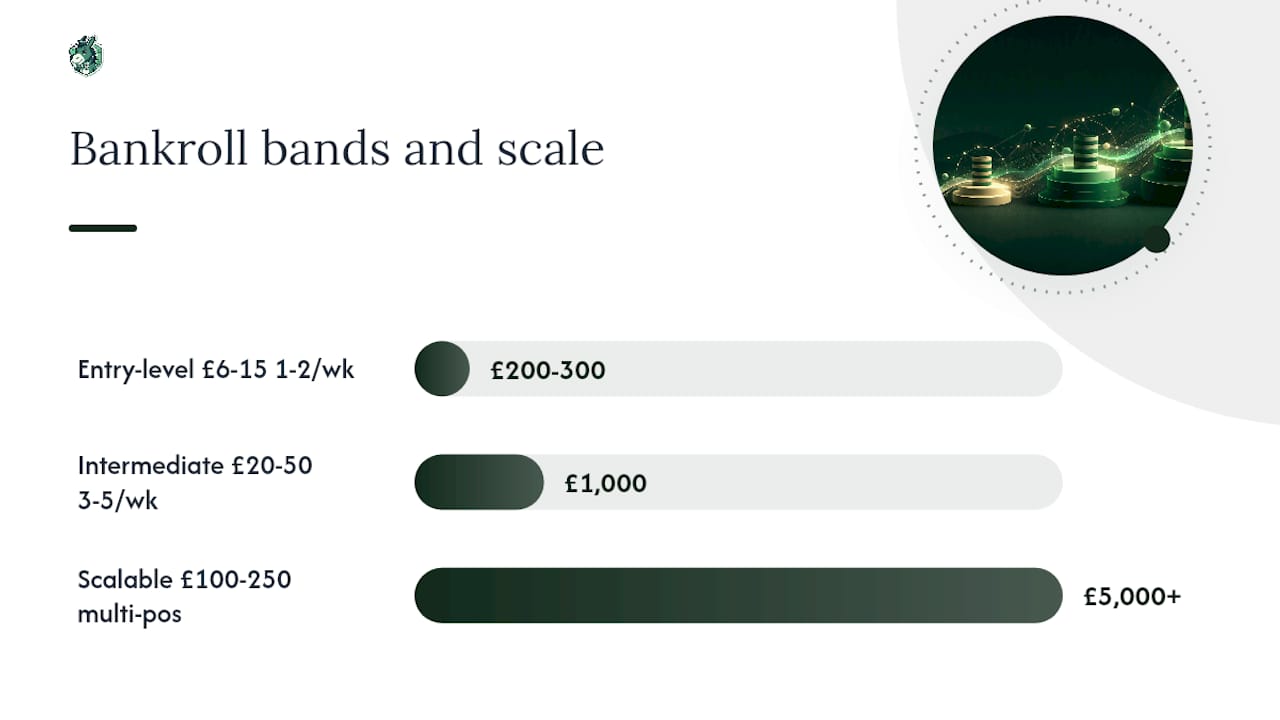
The honest answer depends on how often you want to trade and how much liability you are comfortable holding at once, but three practical bands cover most bettors.
Entry-level: £200–£300. This is broadly the practical floor for occasional lay betting, according to BetfairSquare.
Weekly returns at this stage vary hugely with strike rate and market selection, but disciplined staking within that range is what keeps the bank alive long enough for an edge to show up.
Scalable: £5,000+. At this level you can run multiple concurrent positions across different races or sports, provided liquidity allows it.
| Bankroll band | Example bank | Liability per lay (2–5%) | Typical pace |
|---|---|---|---|
| Entry-level | £200–£300 | £6–£15 | 1–2 trades/week |
| Intermediate | £1,000 | £20–£50 | 3–5 trades/week |
| Scalable | £5,000+ | £100–£250 | Multiple concurrent positions |
How do you calculate lay stake and liability?
Two formulas do almost all the work here, and once you have run them a handful of times they become second nature.
Liability = lay stake × (lay odds − 1).
So if you lay a horse for a £20 stake at odds of 4.0, your liability is £20 × (4.0 − 1) = £60. That £60 is what the exchange locks from your account, and what you lose if the horse wins.
Often you will want to work backwards from a fixed liability you are willing to accept. Rearranging the formula gives you: lay stake = desired liability ÷ (lay odds − 1). If you have decided your maximum liability for this bet is £40 and the lay odds are 5.0, your stake becomes £40 ÷ (5.0 − 1) = £10.
Commission then comes off any winning lay. Using the Lay EV formula, Lay EV = (1 − P) − P × (D − 1), where P is the model’s estimated win probability and D is the lay odds, you can see how commission erodes a marginal edge.
Practical steps before you click Place Bet: enter the lay odds and stake into the Lay Betting Calculator, confirm the liability figure it returns against your bank’s percentage limit, then check the available balance on your exchange to make sure that liability will not exceed what you have free. Skipping that last check is how bettors end up with a bet rejected mid-race, or worse, a bank overcommitted across two markets at once.
What staking rules and risk controls actually work?
Three liability bands cover most situations, and sticking to one consistently matters more than which exact number you pick.
- Safe: 1–2% liability per lay. Suits beginners and anyone still calibrating their probability estimates.
- Standard: 2–5% liability per lay. The range most experienced lay bettors settle on, per Tipster Reviews.
- Hard ceiling: never exceed 5% on a single lay, regardless of confidence level.
Add operational rules on top: a daily loss cap (stop for the day once losses hit a fixed percentage of the bank), a limit of three or four consecutive losing lays before you pause and review your selections, and a firm no-chase policy that bars increasing stake size to recover a previous loss.
Pro Tip: Apply quarter-Kelly to your liability, not your stake. The Kelly Criterion for lay betting uses the formula f = p − q × (L − 1), where L is your liability multiple. Running it at a quarter of the full recommended size keeps volatility manageable while you build a track record of at least 200 to 300 bets.*
How do exchanges and liquidity affect your bankroll needs?
Not every exchange behaves the same way, and the differences matter for how much bank you need to hold spare.
Betfair Exchange, Smarkets, and Matchbook are the three main platforms supporting lay markets across horse racing and other sports, as outlined by Goal.com. That difference means the same signal, laid on a lower-commission exchange, needs less raw edge to stay profitable, a point KiqIQ’s EV framework makes explicitly.
Liquidity is the other variable that catches bettors out. A thin market, one with few backers willing to take your lay at the price you want, can force a partial fill, leaving you with less liability covered than intended and the rest exposed at worse odds. This tends to happen most in smaller races or lower-tier markets, where the money simply is not deep enough to absorb larger stakes without moving the price.
Three habits protect your bank against this:
- Prefer liquid, well-traded markets over obscure ones, even if the odds look marginally better elsewhere.
- Factor commission into your minimum required edge before placing a lay, not after settling it.
- Size your intended liability for the worst realistic fill, not the best-case price shown on screen.
How should you track bankroll, P&L and liabilities?
A spreadsheet remains the simplest way to see whether your bank is actually growing, and the fields worth recording on every single lay are: date, event, market, back odds, lay odds, backer’s stake, your lay stake, resulting liability, commission paid, net profit or loss, and available balance once the liability locks.

Three numbers deserve regular attention. Bankroll growth percentage tells you whether the bank is compounding or stagnant over a rolling period. Average liability per lay as a percentage of bank confirms you are actually sticking to your own staking rules rather than drifting upward after a good week. Win rate versus ROI matters because a high win rate on lay bets can still produce a poor return if the odds you laid were too short to justify the risk, something Tipster Reviews flags directly with favourites under 2.5.
Manual entry is where most bettors fall down, mistyping a stake or forgetting a commission deduction after a long session. Where available, exchange API access or export tools built into a signals service reduce that transcription risk considerably and keep the record accurate without extra effort each evening.
How do you grow a lay betting bankroll safely?
Reinvestment should follow a rule, not a mood.
Scaling up liability limits, moving from quarter-Kelly towards half-Kelly for instance, should wait for objective evidence rather than a good fortnight. Look for a track record across 200 to 300 bets showing your probability estimates are well calibrated, alongside confirmation that the markets you trade actually have the liquidity to support larger positions, as BetfairSquare notes is often the binding constraint, not theoretical edge.
Matched betting offers and bookmaker reloads can accelerate bank growth meaningfully, since the guaranteed nature of a well-matched offer removes most of the variance a pure lay bet carries. Treat them as a supplement to disciplined staking, not a replacement for it.
What mistakes drain a lay betting bank fastest?
- Misreading liability as if it were the stake. Fix: always check the pounds-at-risk figure the calculator returns, never the stake box alone.
- Chasing a loss by increasing the next stake. Fix: set a fixed staking plan before the session starts and follow it regardless of the previous result.
- Laying very short-priced favourites without a genuine edge. Fix: odds below roughly 2.5 need a win rate above 70% just to cover commission, per Tipster Reviews, so only lay them with strong supporting evidence.
- Ignoring commission when judging whether a lay is worth taking. Fix: calculate net EV after commission every time, not just the headline odds.
- Staking by feel rather than by liability percentage. Fix: apply the same 2–5% rule to every bet, win or lose.
- Sloppy or missing record-keeping. Fix: log every lay the moment it settles, not at the end of the week from memory.
How do verified signals change the bankroll you actually need?
Better-calibrated probability estimates reduce the liability you need to hold spare, because a well-tested model produces fewer surprise losers eating into your reserve buffer. This is the operational argument for verification, separate from any promotional claim: if a signal provider’s strike rate genuinely holds up over time, you can run a tighter buffer and scale positions with more confidence, since the Kelly Criterion sizing rules work on the assumption that your probability inputs are accurate.
Time-stamped, publicly viewable results, published before the race rather than curated afterwards, are the only real test of whether a signal provider’s stated strike rate is genuine. Anything settled after the fact, or edited retrospectively, tells you nothing you can rely on.
Donkeyradar publishes its lay signals ahead of each race and keeps a verified results history available for anyone to check, which is the kind of transparency worth demanding from any provider before trusting a claimed edge with real liability.
What actually matters most in a lay betting bankroll?
Most advice on this topic obsesses over finding the next winning signal and treats bankroll management as an afterthought, a paragraph tacked onto the end of a strategy article. That gets the priority backwards.
The other place conventional advice falls short is treating stake and liability as interchangeable. They are not, and the Kelly Criterion for exchange betting exists precisely because liability scales faster than reward as odds lengthen. Bettors who size by stake alone are routinely taking on two or three times the risk they think they are.
If you prioritise one thing from this guide, make it the reserve buffer. Everyone remembers to set a liability cap. That gap is where most blown accounts actually start.
A calculator-first way to manage your lay betting bank
Spreadsheets and manual staking rules get you a long way, but they rely entirely on your own probability estimates being accurate, and most bettors have no reliable way to check that. Donkeyradar approaches the problem differently: it publishes statistically generated lay signals for UK, Australian, and US horse racing before each race, with results tracked and verified publicly afterwards, so you can judge the strike rate for yourself rather than taking it on trust.
The free tier gives you daily signals to test against your own staking rules, while the paid subscription adds real-time alerts, staking tier guidance, full results history, and API access for anyone running their own tracking spreadsheet or trading software. Because profits from betting in the UK are tax-free, every pound of edge a verified signal adds goes straight into your bankroll rather than being eroded elsewhere. If you want to see how the maths behind a signal actually works before committing any stake, start with the Lay Betting Explained guide, then run a live figure through the Lay Betting Calculator and try the seven-day trial to see whether the signals hold up against your own bank.
Frequently asked questions
What is a lay betting bankroll? It is a fund set apart specifically for accepting bets on an exchange, sized around the liability a lay bet creates rather than the stake alone.
How much should I stake per lay?
Which exchanges support lay betting? Betfair Exchange, Smarkets, and Matchbook all offer lay markets, though commission rates and liquidity differ between them.
Why does commission matter so much for lay bankroll sizing?
How do I calculate liability on a lay bet? Liability equals your lay stake multiplied by the lay odds minus one. A £20 stake at odds of 4.0 creates £60 of liability.
When should I increase my staking after a winning streak? Only after a meaningful track record, generally 200 to 300 bets, confirms your probability estimates are well calibrated and the markets you trade have enough liquidity to support larger positions.
This article is general information, not a substitute for advice from a qualified financial advisor. Consult a qualified financial professional about your own circumstances before acting on anything here.
Sources
- BeGambleAware
- Kelly Criterion Lay Calculator: What most bettors miss — Sports Command
- Goal
- Lay betting strategies that actually work on Betfair Tested approaches - Tipster Reviews