← Blog · 📝 Article · 24 August 2026
UK horse racing alerts: real-time lay signals explained
The fastest route from racing insight to a placed bet is real-time lay alerts paired directly with exchange access. Donkeyradar’s approach uses an algorithm that processes historical strike rates and live market prices to flag the weakest horse in a race, publish every signal before the off, and report a verified strike rate above 85%. Immediate success looks simple: you get a timely alert, check the current odds, and place your lay on Betfair or another exchange before the market moves against you.
What that actually requires in practice:
- An alert that arrives with enough time to check prices, not just after the fact
- A direct link or clear market reference so you can find the right race on your exchange
- A published, checkable history behind the signal, not just a strike rate quoted in isolation
- A staking approach that caps your liability before you click “place bet”
Key Takeaways
Real-time lay alerts only deliver value when they’re fast enough to act on, verifiable against a published history, and paired directly with exchange execution on Betfair.
| Point | Details |
|---|---|
| Speed beats volume | A slower service with a checkable history beats a faster one with none; verify before you trust either. |
| Check odds on receipt | Compare bookmaker and exchange prices the instant an alert arrives, since prices shift within minutes. |
| Cap liability, not just stake | Calculate lay liability (odds minus one, times stake) before confirming any bet on Betfair. |
| Demand a public ledger | Only trust a strike rate backed by a timestamped, dated archive of past signals. |
| Donkeyradar as the benchmark | Publishes signals before races, tracks results publicly, and reports a strike rate above 85% with a seven-day trial. |
Table of Contents
- How do UK horse racing alerts actually work?
- What makes a UK alerts service worth paying for?
- How should you act on a lay alert once it lands?
- How do you spot a misleading alerts service?
- Setting up UK horse racing alerts step by step
- Legal considerations and compliance for receiving and acting on UK horse racing alerts
- What pitfalls and scams should you watch for?
- How do you judge alert quality beyond the strike rate?
- How do alerts fit with the betting platforms UK bettors already use?
- Why do odds fluctuations change how useful an alert really is?
- Donkey’s viewpoint on using lay alerts responsibly
- Why choose Donkeyradar for your UK lay alerts?
- Frequently asked questions
- Sources
How do UK horse racing alerts actually work?
An alert is only as useful as its delivery speed and the detail it carries. Most UK services use one or more of four channels, each with a different trade-off between speed and reliability.
- Push notifications — fastest for mobile users, but easy to miss if your phone is on silent or the app is closed.
- Telegram — near-instant, works across devices, and lets you review a running history in the chat itself rather than hunting through an inbox.
- Email — slower than push or Telegram, but a dependable fallback and better for logging notes against each tip, which is exactly what My Timeform’s tracker offers.
- API or webhook — feeds straight into trading software, useful if you already run automated staking rules.
Timing matters more than most bettors realise. Alerts typically fire at four points: when a horse is declared to run, as a race-off reminder, when a non-runner is confirmed, and at a final-odds snapshot shortly before the start. Racing TV Tracker built its whole notification system around these four triggers, and for good reason. A useful alert names the course, the runner, the race time, the best odds available at the moment of sending, and a recommended action. Because lay betting means backing a horse to lose rather than win, the alert needs to point you towards an exchange, and in the UK that overwhelmingly means Betfair, where you can actually take the other side of a bet rather than just backing a runner with a bookmaker.
What makes a UK alerts service worth paying for?
Not every alert service performs the same job well. Before committing to one, whether on a free trial or a paid tier, run it through a short checklist.
-
Speed and redundancy. Push and Telegram together beat either alone, because a missed push notification shouldn’t cost you the whole signal.
-
A results archive you can actually check. Look for dated, time-stamped entries rather than a single headline strike rate.
-
Direct exchange links. A signal that drops you straight into the right Betfair market saves precious seconds when prices are moving.
-
Useful filters. Being able to narrow by course, trainer, jockey, or odds range cuts the noise, a point borne out by tracker apps that build filtering in as standard.
-
Clear staking guidance. Tiered recommendations beat vague “stake to your own judgement” language.
-
Transparent pricing and trial terms. A seven-day trial with no hidden conversion tricks tells you more about a provider than any marketing copy.
Pro Tip: Run any trial against your own spreadsheet, not the provider’s dashboard. If their published strike rate and your own tally of results don’t roughly match after a fortnight, that’s your answer.
How should you act on a lay alert once it lands?
Getting an alert is the easy part. Turning it into a matched lay bet without overpaying for liability or missing the window takes a bit of discipline.
- Check live odds the moment it arrives. Compare the price across major bookmakers and the exchange before deciding whether the lay still makes sense at current prices.
- Open the right market on Betfair. Confirm you’re laying the correct runner in the correct race, and check whether your intended stake would fully match against existing back offers or sit partly unmatched.
- Calculate liability before you confirm. A lay bet’s liability isn’t your stake, it’s stake multiplied by (odds minus one), so a £10 lay at 5.0 carries £40 of liability, not £10. Use a liability calculator rather than doing the maths under pressure.
- Cap liability to a fixed percentage of your bankroll. Many disciplined bettors work to 1 to 2% of bankroll per lay, adjusting for the confidence tier the signal carries.
- Mind the clock. Alerts sent 60 to 10 minutes before the off usually offer the best balance of price stability and available liquidity; the final few minutes bring tighter odds but thinner markets, which can leave part of your lay unmatched.
- Log every result. Record the odds you took, the stake, the outcome and the running P&L, because that’s the only way to know your real return on investment rather than trusting memory.
Strike rate alone doesn’t tell you whether a service is profitable. A service quoting an 85% strike rate on lay bets can still lose money overall if the average liability on the 15% of losers outweighs the returns from winners, which is why Donkeyradar publishes running P&L alongside strike rate rather than either figure in isolation.
How do you spot a misleading alerts service?
A strike rate on its own tells you almost nothing. Ask whether the figure comes from a large enough sample, and whether every signal was published before the race rather than assembled afterwards from a bigger pool of predictions.
- Look for a timestamped, dated archive of past signals rather than a single headline percentage.
- Be wary of any service that won’t show you raw results or a public ledger you can scroll through yourself.
- Treat vague sample sizes (“thousands of winning tips”) as a red flag rather than reassurance.
- Discount testimonials you can’t verify against a named, checkable account.
Pro Tip: During any trial, track hit rate, running P&L and your worst drawdown separately. A service can look strong on hit rate while still handing you a losing run that breaks your bankroll rules, and you’ll only spot that by tracking all three.
Setting up UK horse racing alerts step by step
Getting alerts flowing takes about ten minutes if you set it up properly the first time.
- Join the provider’s Telegram channel and turn on notifications at the OS level, not just within the app, so messages aren’t silently muted.
- Add email as a fallback. Even with Telegram running, an email alert with notes attached gives you a second copy to check against if you miss the first ping.
- Enable push notifications in the app, if one is offered, and confirm your phone’s battery-saving settings aren’t quietly blocking background alerts.
- Connect alerts to Betfair directly where possible. Some Telegram-based signal services link straight through to the relevant market, cutting out the search step entirely.
- Set your filters. Narrow by course, trainer, or odds range if the option exists, particularly if you only bet on Flat racing or avoid low-liquidity meetings.
- Test with a dummy race first. Confirm the alert format, timing, and link all work before you’re relying on it with real money on the line.
Legal considerations and compliance for receiving and acting on UK horse racing alerts
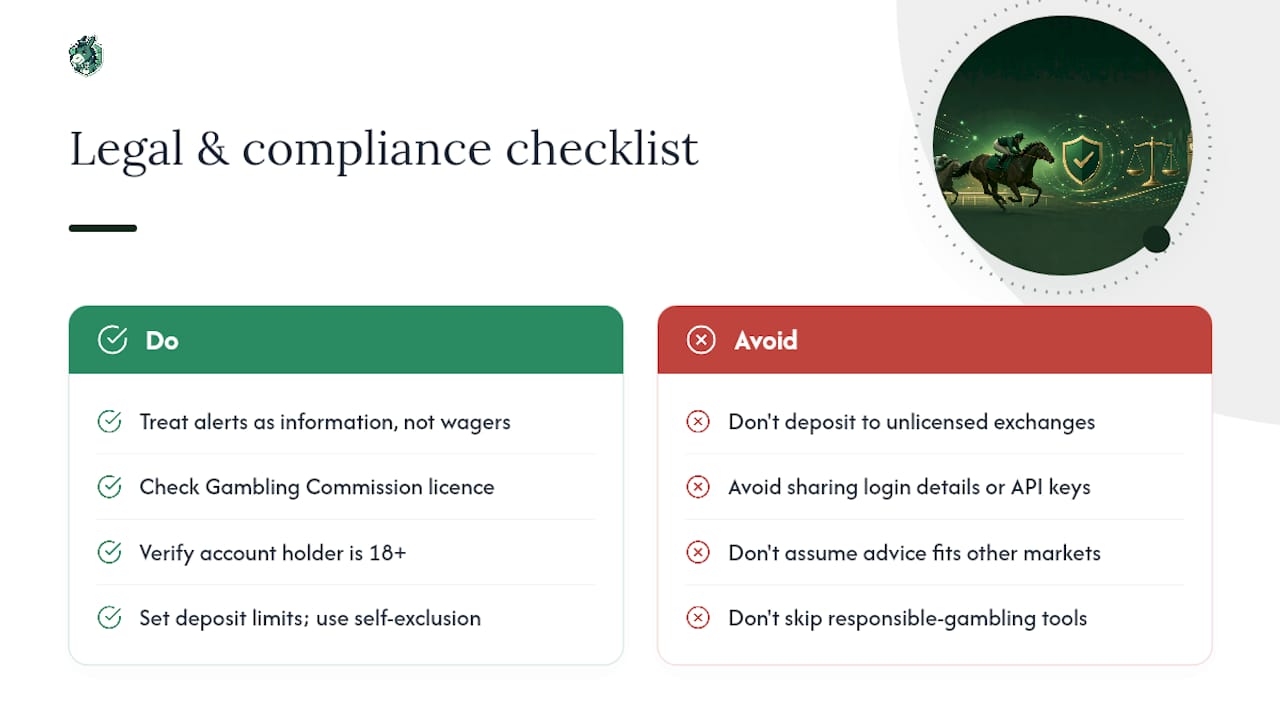
Receiving a tip or signal is not the same as placing a bet, and the two sit under different rules. Alert services themselves are typically publishing information or opinion, not taking bets, so they generally sit outside the Gambling Commission’s licensing regime that applies to operators who accept wagers.
The exchange you actually bet through is different. Betfair and similar platforms operating in Great Britain hold licences from the Gambling Commission, and you should confirm any exchange you use is licensed before depositing funds. UK residents also benefit from a straightforward tax position: profits from betting, including lay betting profits, are tax-free for private individuals in the UK, which isn’t the case in every market and is worth bearing in mind if you’re used to reading advice written for US or Australian audiences.
Age verification matters too. UK gambling law sets the minimum age at 18, and any legitimate exchange or bookmaker will verify this before letting you fund an account. If you’re receiving alerts via a third-party bot or unofficial channel rather than a provider’s own verified system, be cautious about handing over exchange login details or API keys, since that crosses from “receiving information” into a much less regulated space. Responsible gambling tools, including deposit limits and self-exclusion schemes such as GAMSTOP, apply regardless of whether your bets are triggered by an alert or your own research, and it’s worth setting these limits before you start acting on real-time signals rather than after a difficult week.
What pitfalls and scams should you watch for?
The horse racing tipping space has its share of operators who sound confident and prove nothing. A handful of patterns show up again and again.
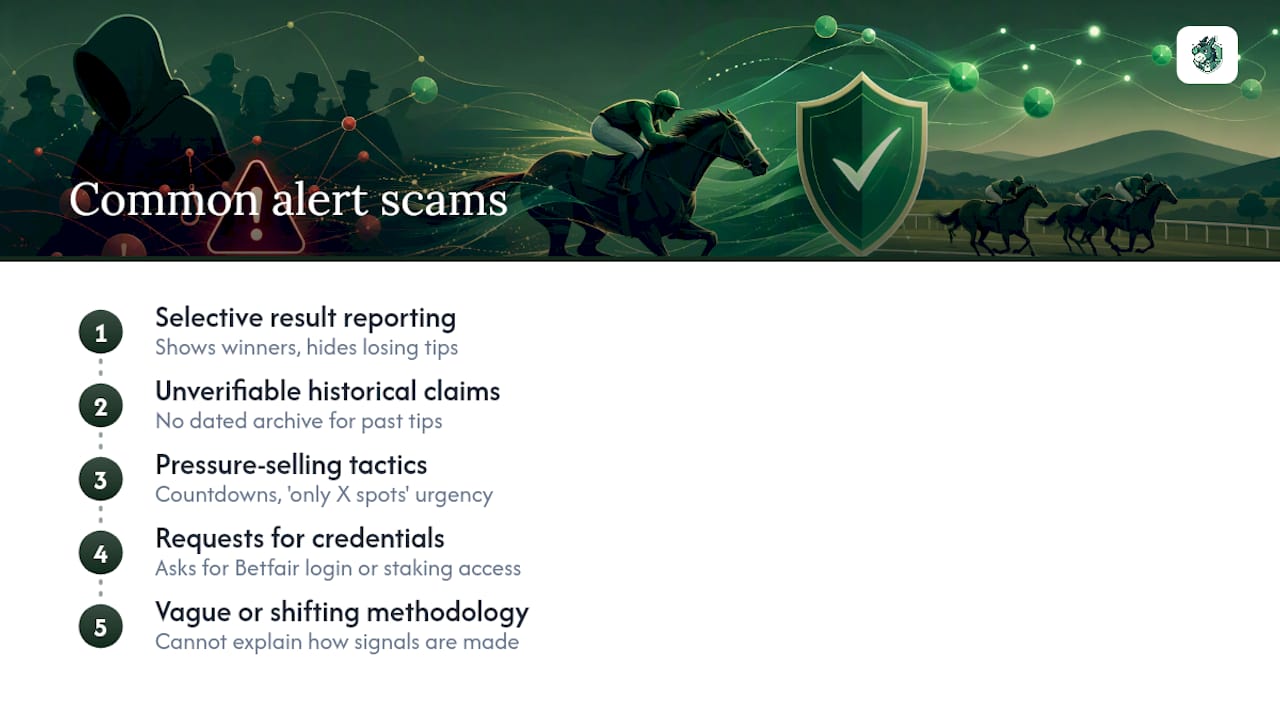
Selective result reporting is the most common issue. A provider posts winning tips prominently on social media while quietly dropping losing calls from any public record, which inflates the apparent strike rate without anyone technically lying.
Unverifiable historical claims follow close behind. If a service says it has “thousands of winning tips” but won’t let you see a dated archive, treat the number as marketing rather than evidence.
Pressure-selling tactics are a clear warning sign: countdown timers, “only 3 spots left” messaging, or urgent upgrade prompts sent mid-trial have nothing to do with signal quality and everything to do with conversion rate.
Requests for exchange credentials or automated staking access deserve real scrutiny. A legitimate alerts provider tells you what to do; it has no reason to need your Betfair login or the ability to place bets on your behalf.
Vague or shifting methodology matters too. If a provider can’t explain in plain terms roughly how a signal is generated, whether that’s form analysis, market movement, or a published algorithm, be sceptical of the results that supposedly flow from it. Donkeyradar publishes its methodology summary alongside every signal precisely because an unexplained black box invites exactly this kind of doubt, and a reader shouldn’t have to take a strike rate on faith.
How do you judge alert quality beyond the strike rate?
Strike rate is the first number most bettors look at and the easiest one to game. A far better test is whether the provider’s published signals, when you tally them yourself over a real sample, produce a positive return on investment after typical exchange commission, not just a high hit rate on paper.
Consistency across time matters as much as the headline figure. A service that performed well over one strong month but has no visible track record before or after that spike should raise more questions than it answers. Look instead for a running history stretching across different racing seasons, jump and Flat, so you can see how the approach holds up when conditions change.
Sample size changes what a strike rate actually means. An 85% strike rate from 20 signals could plausibly be luck; the same figure from 2,000 signals is a much stronger claim. Ask, or check the archive yourself, before treating any headline percentage as meaningful.
Transparency about losing runs is arguably the strongest quality signal of all. A provider willing to show you a rough week, not just the good ones, is telling you something a polished highlight reel never will. Finally, check whether the timing of published signals genuinely precedes the race, since a tip “published” after the result is known proves nothing at all.
How do alerts fit with the betting platforms UK bettors already use?
Most UK bettors already juggle two or three tools: an exchange account, a bookmaker app or two for price comparison, and increasingly some kind of tracking spreadsheet or app. Alerts work best when they slot into that existing setup rather than demanding a new one.
Betfair remains the dominant exchange for lay betting in the UK, and any alert worth acting on should point you towards a specific market there, ideally via a direct link rather than a general description you then have to search for. Price comparison tools that pull live odds from multiple bookmakers and exchanges side by side are useful for confirming that the price named in your alert is still available by the time you act on it, since prices can shift in the seconds between an alert firing and you opening the app.
API and webhook access matters mainly to bettors running semi-automated staking through trading software such as Bet Angel or Geeks Toy, where a signal needs to arrive as structured data rather than a plain-text message. For everyone else, a Telegram channel with a clean link straight into the relevant Betfair market covers most of what’s needed without adding another piece of software to manage.
Why do odds fluctuations change how useful an alert really is?
An alert’s value decays the moment the price it quotes moves. Horse racing markets shift constantly in the run-up to a race as money flows in from bookmakers, syndicates, and the wider public, and a lay signal priced at 4.0 an hour before the off can easily be 3.4 by post time if the market has firmed against your selection.
This is exactly why timing recommendations matter so much. An alert that arrives 60 to 10 minutes before the race usually gives you a workable window: enough time to check the price, calculate liability, and get matched, while still being close enough to the off that the market has mostly settled. Signals sent hours in advance carry more price risk, since a lot can change between then and the start.
Liquidity compounds the problem. In the final couple of minutes before a race, prices can look attractive on screen but the actual matched volume behind them may be thin, meaning your lay only partially fills at the quoted odds and the rest matches at a worse price, or not at all. A quality alert doesn’t just tell you a horse looks weak; it accounts for how tradeable the market is likely to be by the time you act, which is part of why Donkeyradar times its signals to arrive with enough runway for the odds to still be genuinely workable.
Donkey’s viewpoint on using lay alerts responsibly
Alerts are a tool, not a guarantee, and treating a strong strike rate as licence to increase stake size is the fastest way to turn a good signal into a bad month. Our own tracked history shows what a genuine edge looks like over hundreds of races, not dozens, and that patience is the part most bettors underrate.
Set a fixed percentage of bankroll per lay and don’t deviate from it when you’re on a winning run. Overtrading, chasing every alert rather than the ones that fit your filters, erodes an edge faster than any single losing bet. One UK-specific point worth remembering: betting profits are tax-free for private individuals here, which is a genuine advantage, but it’s not a reason to stake beyond what you can comfortably lose. Gamble responsibly.
Why choose Donkeyradar for your UK lay alerts?
Donkeyradar gives you something most tipping services won’t: a published methodology and a results archive you can check yourself rather than take on trust. The platform’s algorithm scans historical strike rates and live market prices to flag the weakest horse in UK, Australian, and US races, sends the signal via Telegram or email before the off, and links straight through to the relevant Betfair market so there’s no searching involved.
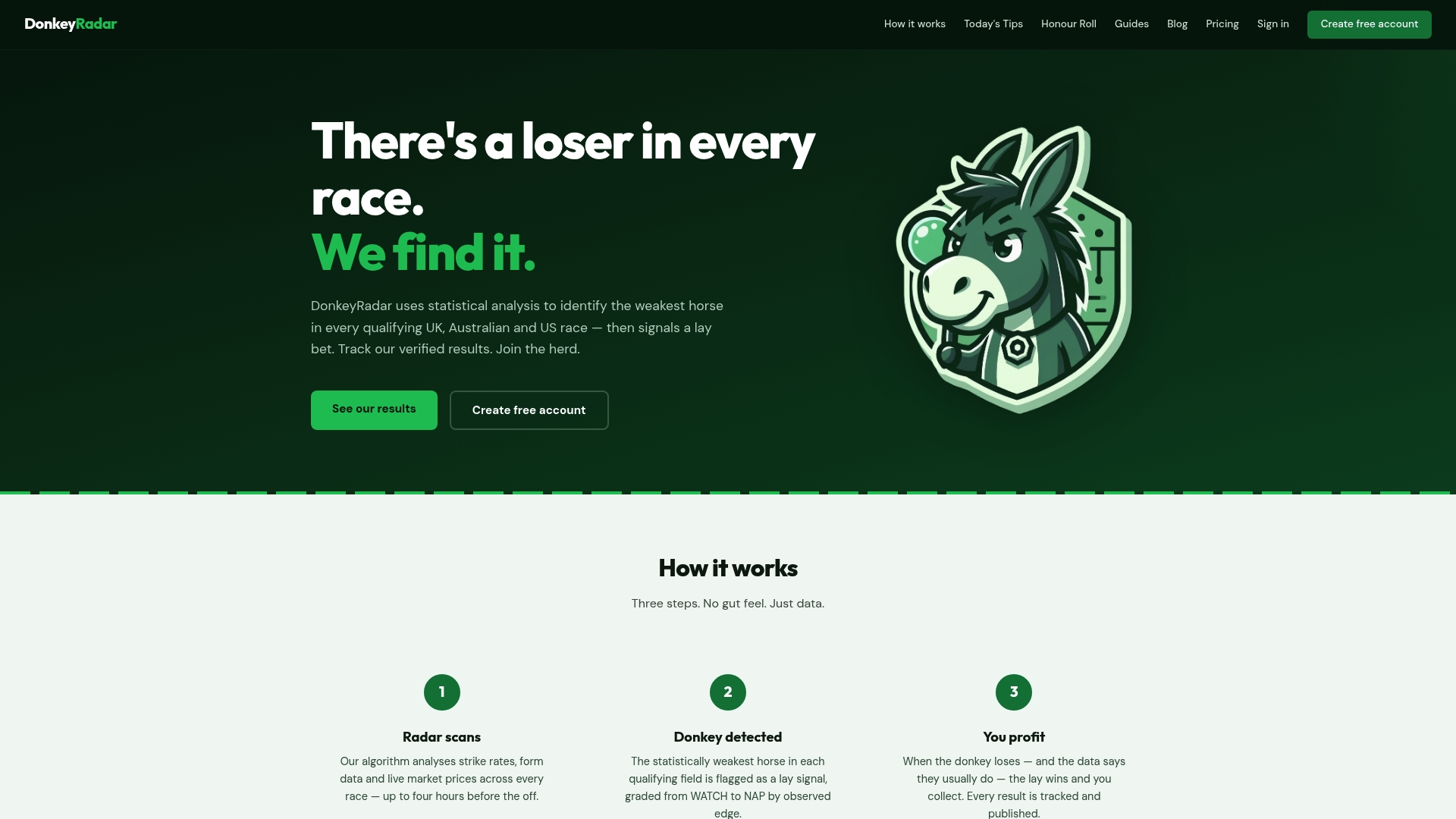
The free tier gives you daily lay signals, enough to see how the approach performs before committing to anything. The premium subscription unlocks real-time alerts, the full verified results history, and API access for anyone running their own trading software. Every plan starts with a seven-day trial, which is exactly the window you need to run your own hit-rate and P&L check rather than relying on marketing claims.
If you want to understand the staking side before you start, the lay betting guide walks through liability and risk in plain terms. Start your seven-day trial and see whether the published numbers hold up against your own tracking.
Frequently asked questions
What are the best UK horse racing alerts for lay betting? The strongest services combine fast delivery (Telegram or push), a published and dated results archive, and a direct link into the Betfair market, so you can act within seconds rather than searching for the race yourself.
Are horse racing alert services legal in the UK? Yes. Publishing tips or signals isn’t gambling activity itself and generally sits outside Gambling Commission licensing, though the exchange you bet through must hold a valid UK licence, and you must be 18 or over to hold a betting account.
Do I need a Betfair account to use lay alerts? You need access to a betting exchange to place a genuine lay bet, since you’re backing a horse to lose rather than win, and Betfair is the dominant UK exchange for this. Some bookmakers don’t support laying at all.
How quickly should I act after receiving an alert? Ideally within a few minutes. Odds move constantly, and a signal quoted an hour before the race can carry a noticeably different price by the time you check it, particularly in the final ten minutes before the off.
Is lay betting profit taxed in the UK? No. Betting profits, including lay betting, are tax-free for private individuals in the UK, which is one reason exchange-based lay strategies have become popular among recreational bettors here.