← Blog · 📝 Article · 10 August 2026
Betfair trading alerts: pre-race lay signals for UK bettors

In this article, “Betfair trading alerts” means one specific thing: a pre-race lay signal that identifies the likeliest loser in a race, published before the off, and delivered with the proposed lay odds, a recommended liability or staking tier, and a direct Betfair Exchange market link. Not in-play price alerts. Not software notifications. Pre-race lay signals, backed by historical strike rates and published with a timestamp you can verify.
-
What you get: selection name, proposed lay odds, staking tier, liability guidance, Betfair market link, and a pre-race timestamp.
-
Trust signals to look for: public verified results history, a stated strike rate with sample size, and proof the signal was published before the off.
-
Immediate next step: view today’s live signals and verified results at Donkeyradar’s lay tips feed, or start the seven-day free trial to access real-time email and Telegram alerts.
Key takeaways
Pre-race lay alerts are only as reliable as the methodology and verification behind them: selectivity, timestamps, and a credible sample size are the three non-negotiable checks.
| Point | Details |
|---|---|
| Definition | A pre-race lay alert identifies the likeliest loser, with odds, staking tier, liability guidance, and a Betfair market link. |
| Verification standard | Require pre-race timestamps, a public results archive, and a minimum sample of 200+ signals before trusting any strike rate. |
| Liability rule | Cap maximum liability per lay at 1–2% of your bankroll; define a stop-loss before you place your first signal. |
| UK tax position | Recreational betting profits are generally not taxable under HMRC guidance; confirm with a tax adviser if trading at scale. |
| Donkeyradar trial | Start the seven-day free trial, verify a week of signals against the public results history, then scale with confidence. |
Table of Contents
- What are pre-race lay alerts, and what are they not?
- How are data-driven pre-race lay signals generated?
- What does each alert contain, and when should it arrive?
- How do you act on an alert on the Betfair Exchange?
- How do you read and verify a provider’s performance claims?
- Risks, bankroll rules, and the UK tax position
- How do you evaluate a pre-race lay alerts service?
- A quick word on where to start
- Donkeyradar: verified pre-race lay signals with a seven-day trial
- Sources
What are pre-race lay alerts, and what are they not?
A pre-race lay alert is a signal telling you to lay a specific horse before the race starts. You are acting as the bookmaker: if the horse loses, you collect the backer’s stake. If it wins, you pay out the liability. The Betfair Exchange defines your liability as (odds − 1) × lay stake, so a £10 lay at 4.0 carries a £30 liability.
A valid pre-race lay alert must include all of the following: the selection, proposed lay odds, recommended liability or staking tier, a timestamp showing it was published before the off, and a direct Betfair market link. Without a timestamp, you cannot verify the signal was genuinely pre-race. Without a staking tier, you have no liability guidance.
What alerts are not: they are not a guarantee. They are probabilistic signals backed by historical strike rates and sample data. A stated 85%+ strike rate means roughly 15 in every 100 selections will win. Losses happen. Transparency about that is the whole point.
Pre-race lay alerts are also distinct from in-play trading signals or price-movement notifications generated by trading software. Those serve a different audience with a different workflow. The signals covered here are published before the off and require no in-play execution.
How are data-driven pre-race lay signals generated?
Credible alert providers run a scoring model across a defined set of inputs for each race. The goal is to identify horses whose market price understates their true probability of losing. Research into vulnerable-favourite filtering shows that applying selective red-flag criteria to a sample of 500 favourites produced positive ROI in the filtered subset, where laying all favourites did not.
| Input | What it detects | Signal produced |
|---|---|---|
| Historical strike rate | Base win probability by class/distance | Baseline vulnerability signal |
| Speed ratings | Pace relative to field | Overpriced runner flag |
| Trainer/yard form | Stable confidence signal | Negative stable flag |
| Surface/distance fit | Career-best bounce risk | Mismatch red flag |
| Live market price | Market consensus vs. model price | Drift or overlay alert |
A “3 red flags” threshold is a common selectivity filter: a horse must trigger at least three independent negative signals before an alert is published. This keeps the sample selective. Selectivity matters more than volume; a provider publishing 20 alerts a day is almost certainly diluting quality.
Pro Tip: Ask any provider how many alerts they publish per day on average. Fewer, more selective signals with a documented sample size are a stronger indicator of methodology discipline than a high daily volume.
What does each alert contain, and when should it arrive?
Every actionable pre-race lay alert should carry these fields:
- Race details: venue, time, race name or ID.
- Selection: horse name and race card number.
- Proposed lay odds: the maximum odds at which the signal is valid.
- Staking tier: a graded recommendation (e.g. 1 unit, 2 units) tied to signal confidence.
- Liability figure or formula: so you can calculate exposure before you act.
- Betfair market link: direct to the correct Exchange market.
- Pre-race timestamp: proof the signal was published before the off.
- Strike rate and sample size: the historical backing for this signal type.
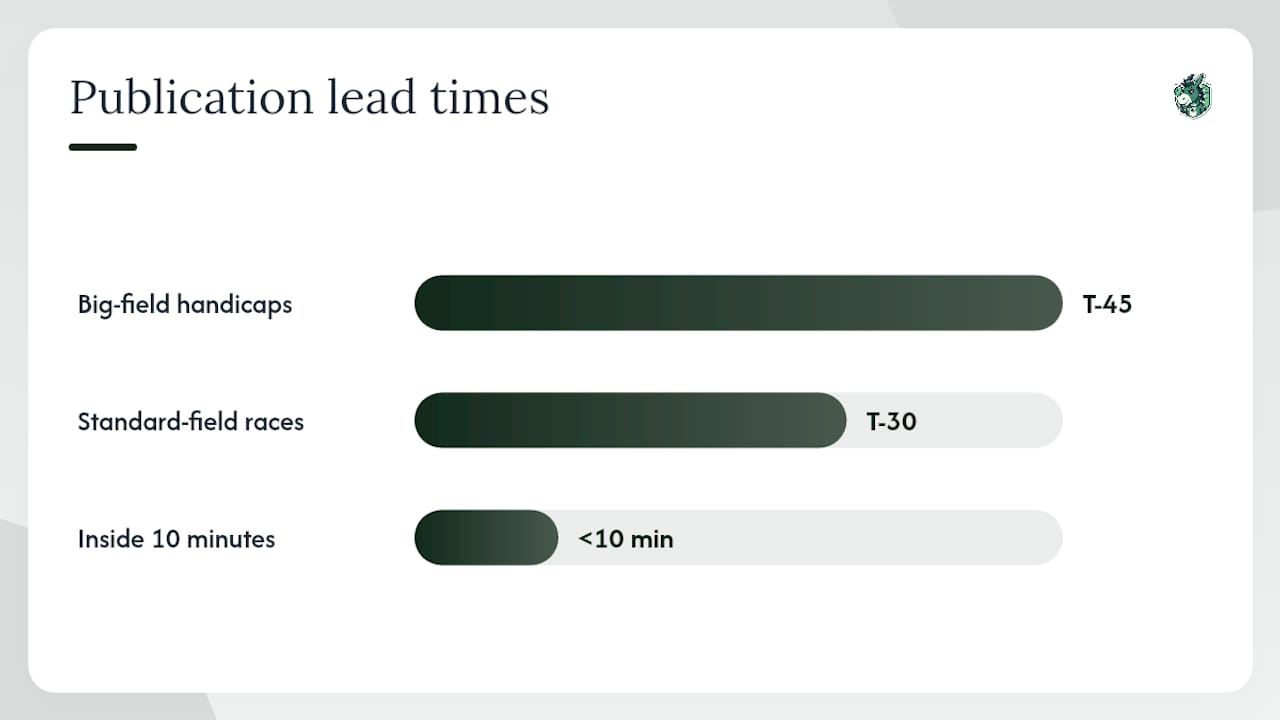
On timing: most liquid UK horse racing markets are active 30–60 minutes before the off. Signals published inside 10 minutes of the off leave little time to check liquidity and place the lay cleanly. A T-30 publication target is a reasonable minimum for standard-field races; big-field handicaps benefit from T-45 or earlier.
Delivery channel matters for latency. Telegram and app push notifications are typically the fastest, arriving within seconds of publication. Email is reliable and creates an archive, but inbox delays of 1–5 minutes are common. SMS is the slowest and most expensive channel for providers, and is largely being replaced by Telegram. For time-sensitive pre-race signals, Betfair’s exchange interface shows available matched volume in real time, so you can confirm liquidity the moment you open the market link.
How do you act on an alert on the Betfair Exchange?
- Open the market link from the alert. Confirm the race, venue, and off time match the signal.
- Locate the selection in the lay column. Check the current lay odds against the proposed odds in the alert. If the market has moved significantly, reassess before proceeding.
- Check available matched volume. Thin liquidity means partial fills or no fill at all. Betfair’s exchange screens show the order book depth in the lay column.
- Calculate your liability. Formula: liability = (lay odds − 1) × lay stake. Example: £20 lay at 3.5 = (3.5 − 1) × £20 = £50 liability. Use the Donkeyradar lay betting calculator if you want a quick check.
- Set your lay stake in the bet slip. Confirm the liability shown matches your calculation.
- Submit the lay. Monitor for a full or partial fill before the off.
- Plan your exit. If the horse drifts further, you may hedge by backing it at longer odds to lock in a profit regardless of outcome. BetfairSquare’s strategy guide covers pre-race drift hedging with worked examples.
On BSP: Betfair Starting Price lays are available but remove your control over the final odds. For pre-race signals with a specific odds threshold, BSP is generally unsuitable unless the signal explicitly states it is BSP-valid. Read the full BSP explainer on Donkeyradar before using it for lay signals.
Pro Tip: If your lay is only partially filled with two minutes to the off, do not chase the remainder at worse odds. Accept the partial fill or cancel. A half-sized position at the right odds beats a full position at the wrong ones.
How do you read and verify a provider’s performance claims?
The most common manipulation in alert services is a high strike rate on a tiny sample. A 90% strike rate across 20 signals is statistically meaningless. Look for at least 200 signals across a minimum three-month period before treating any strike rate as credible.
Verification requires timestamps and exportable records. A provider that publishes pre-race timestamps on every signal and offers a CSV export of results makes independent auditing straightforward. You can cross-reference signal publication times against race-off times from official race cards. Providers without timestamps are asking you to take their word for it.
The HorseRacingOracle.AI study illustrates why selectivity drives ROI: filtering 500 favourites down to a vulnerable subset using bounce, surface mismatch, and negative stable signals produced positive sample ROI, while the unfiltered group did not. That is the practical case for a red-flag threshold rather than a high-volume approach.
Risks, bankroll rules, and the UK tax position
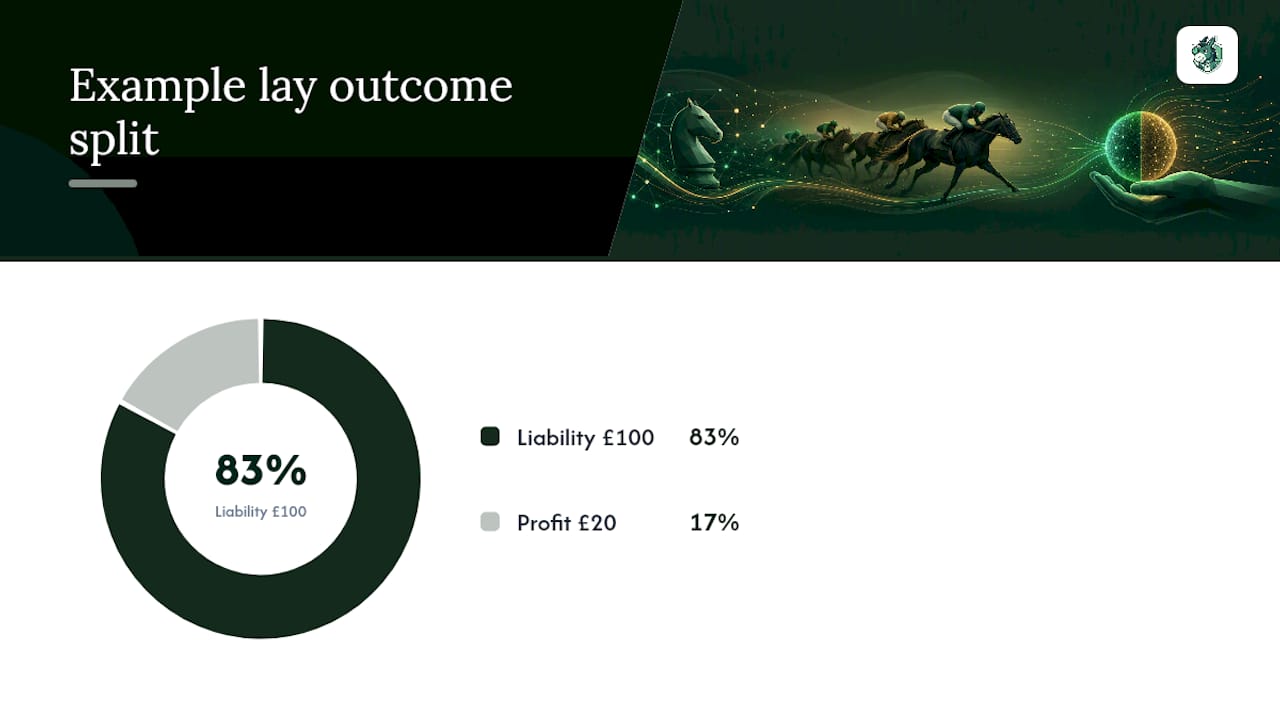
Lay betting carries asymmetric risk. Your maximum profit on any lay is the backer’s stake. Your maximum loss is the full liability. A £20 lay at 6.0 risks £100 to win £20. That asymmetry demands strict liability caps.
Recommended rules, consistent with best practice for lay execution:
- Maximum liability per lay: 1–2% of your total betting bankroll.
- Mandatory stop-loss: define a drawdown limit (e.g. 10 units) at which you stop and review.
- Log every trade: record selection, odds, stake, liability, outcome, and P&L.
- Review weekly, not daily. Short-run variance is normal; trend analysis requires volume.
UK tax position: under HMRC guidance, profits from recreational betting are generally not subject to income tax or capital gains tax. Betting becomes potentially taxable only if HMRC determines the activity constitutes a trade or profession, which typically requires consistent, systematic profit-making as a primary income source. If you are trading at significant scale, confirm your position with a tax adviser. For most recreational bettors, Timeform’s guidance and HMRC’s own published material both support the non-taxable position.
Pro Tip: Export your results from the exchange or your alert provider monthly and store them. If your activity ever comes under scrutiny, a clean log of stakes, liabilities, and outcomes is your clearest evidence of recreational scale.
How do you evaluate a pre-race lay alerts service?
Before you subscribe or trial, score any provider against these criteria:
- ✅ Pre-race timestamps on every published signal.
- ✅ Public verified results accessible without logging in.
- ✅ Sample size stated: minimum 200 signals, ideally 500+, across at least three months.
- ✅ Methodology transparency: what inputs drive the model, and what threshold triggers a signal.
- ✅ Delivery channel options: at minimum, email plus Telegram or app push.
- ✅ Free trial: seven days is standard; shorter trials are insufficient to assess signal quality.
- ✅ Cancellation policy: month-to-month with no lock-in is the norm for reputable services.
- ❌ Red flag: strike rate claimed above 95% with no sample size stated.
- ❌ Red flag: results only visible to subscribers (no public archive).
- ❌ Red flag: no methodology description beyond “proprietary algorithm.”
On pricing: the market for pre-race lay alert services in the UK typically runs from a free tier (limited daily signals) through a mid-tier subscription (real-time alerts, full results history) to a premium or API tier for traders integrating signals into their own software. A guide to judging lay tips services covers the evaluation criteria in more depth.
A quick word on where to start
Start with a free trial, not a subscription. Use the first week to verify a sample of signals against the public results archive before you place a single bet. Trade small stakes initially, one unit maximum, and keep a log from day one. Once you have 20–30 verified signals in your own records, you have enough data to assess whether the service’s stated strike rate holds in your sample period.
Practical first steps: subscribe to the alert feed, set your staking rules before the first signal arrives, test with one market type (UK flat racing is the most liquid), and scale only after you have a baseline. For readers who want a deeper grounding in the underlying strategy, the Donkeyradar lay betting strategy guide covers the full data-driven methodology.
Donkeyradar: verified pre-race lay signals with a seven-day trial
Donkeyradar publishes pre-race lay signals for UK, Australian, and US horse racing, with every signal timestamped before the off and linked directly to the correct Betfair Exchange market. The model scores each runner against historical strike rates, speed ratings, trainer form, and surface fit, then publishes only when a defined red-flag threshold is met. The result is a selective signal set, not a high-volume feed.
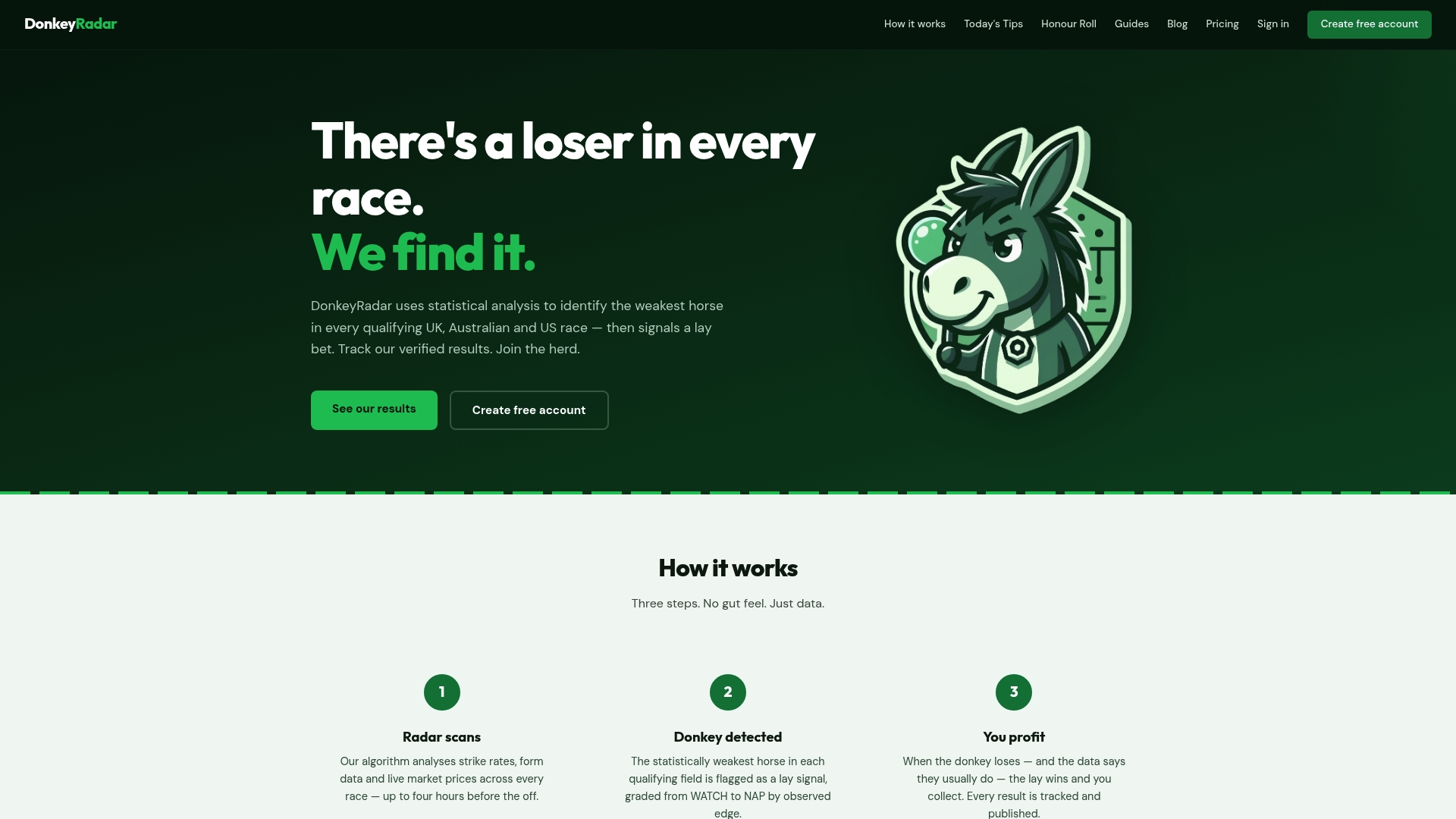
Signals are delivered via email and Telegram in real time. The dashboard includes staking tier grading, a public verified results history you can inspect before you subscribe, and API access for bettors who want to integrate signals into their own trading setup. The free tier gives you daily signals; the premium subscription adds real-time alerts and the full results archive. The verified results page shows the public track record. Start the seven-day free trial at Donkeyradar to access premium alerts and test the service against your own records before committing.
Sources
- Timeform — Lay betting on the Betfair Exchange (education)
- Betfair Support — What does the term ‘lay’ mean and what is a lay bet?
- HorseRacingOracle.AI — AI lay betting: vulnerable favourites
- BetfairSquare — Laying horses on Betfair: when and how
- BookiesReviews — Exchange betting explained