← Blog · 📝 Article · 21 August 2026
A US racing lay strategy that actually holds up under pressure

The core rule for laying US racing on an exchange is simple: never let the field size or the race type override your liability discipline. Lay short-priced favourites in the 2.5 to 6.0 odds band, size every position by liability rather than stake, and treat US claiming and allowance races as structurally different animals from UK handicaps. Favourites across race types win roughly 30–35% of the time, which leaves significant opportunities for a disciplined layer. Pro Tip: Before you confirm any lay, check your liability figure twice, not your stake. Liability is what actually leaves your account if the horse wins, and it’s the number that ends careless sessions. DonkeyRadar publishes pre-race lay signals for exactly this kind of decision, with a verified results history behind them.
Key Takeaways
A profitable US racing lay strategy depends on sizing every position by liability, trading favourites in the 2.5 to 6.0 odds band, and confirming market liquidity before you enter.
| Point | Details |
|---|---|
| Size by liability, not stake | Cap liability at 1 to 2% of your laying bankroll per race, regardless of how confident the signal looks. |
| Trade the right odds band | Favourites priced between 2.5 and 6.0 offer the best balance of liability and edge on US cards. |
| Respect US field-size differences | Avoid laying favourites in fields of five runners or fewer; favour larger claiming and allowance races. |
| Time entries around peak liquidity | Place pre-race lays in the final ten to fifteen minutes before post, when the price reflects the most information. |
| Use DonkeyRadar as your signal layer | DonkeyRadar publishes pre-race lay signals with a verified results history to complement your own execution. |
Table of Contents
- What is a US racing lay strategy and how does the maths work?
- What makes US racing markets different for laying?
- Which lay strategies work best on US races?
- How much should you risk on each lay?
- Which exchanges and tools support US lay betting?
- How do you actually place and manage a lay on a US race?
- Are lay betting profits taxed in the UK?
- Frequently asked questions about US racing lay strategy
- Sources
What is a US racing lay strategy and how does the maths work?
A lay bet inverts the normal bet. You’re not backing a horse to win, you’re betting it loses, and your liability (not your stake) is what’s at risk. Betfair’s own explainer sets this out with worked examples: if you lay a horse at 4.0 for a £10 backer stake, your liability is £30 (stake × (odds minus 1)), and if the horse loses, you keep the £10 stake minus commission.
Three quick numbers to internalise. Lay at 3.0 for £20 backer stake: liability is £40, profit if it loses is £20 minus commission. Lay at 5.0 for £15: liability jumps to £60, profit stays at £15 minus commission. Lay at 10.0 for £10: liability is £90 against a £10 gain, which is why odds-band discipline matters more than most beginners realise.
Commission eats into every win, so build it into your break-even maths rather than treating it as an afterthought. Smarkets charges among the lowest commission rates in the market, and lower commission directly lowers the model accuracy you need before a lay is profitable.
Before confirming any lay, check:
- Available balance covers the full liability, not just the stake
- Liability figure matches what you intended to risk
- You’ve selected the exchange with the best price and lowest commission for that market
- The odds sit inside your pre-agreed lay-EV threshold
What makes US racing markets different for laying?
Market liquidity is the single biggest difference, and it changes almost everything about timing. US racing runs on shorter fields more often than UK handicaps, with claiming and allowance races making up a large share of the card, and thinner fields mean favourites carry a different reliability profile than in a 16-runner UK handicap.

Liquidity builds gradually through the morning and tightens hard in the final ten minutes before post time, similar to the pattern UK traders know from Betfair’s pre-off surge, but with a narrower window because US meetings often run tighter between-race gaps. Trading the deepest liquidity means working the last few minutes before off rather than locking in early prices on a thin market.
Pro Tip: Avoid laying favourites in fields of five runners or fewer on US cards. Small fields concentrate market confidence in one or two horses, which distorts the odds-band logic that works so well in larger UK handicaps. Save your favourite-lay strategy for larger claiming and allowance fields where the market has more information to misprice.
Which lay strategies work best on US races?
Three approaches do most of the heavy lifting: laying short-priced favourites where your own model disagrees with the market, lay-the-field on wide-open races, and in-running lays on horses that visibly struggle early. Each demands a different entry rule and a different exit discipline.
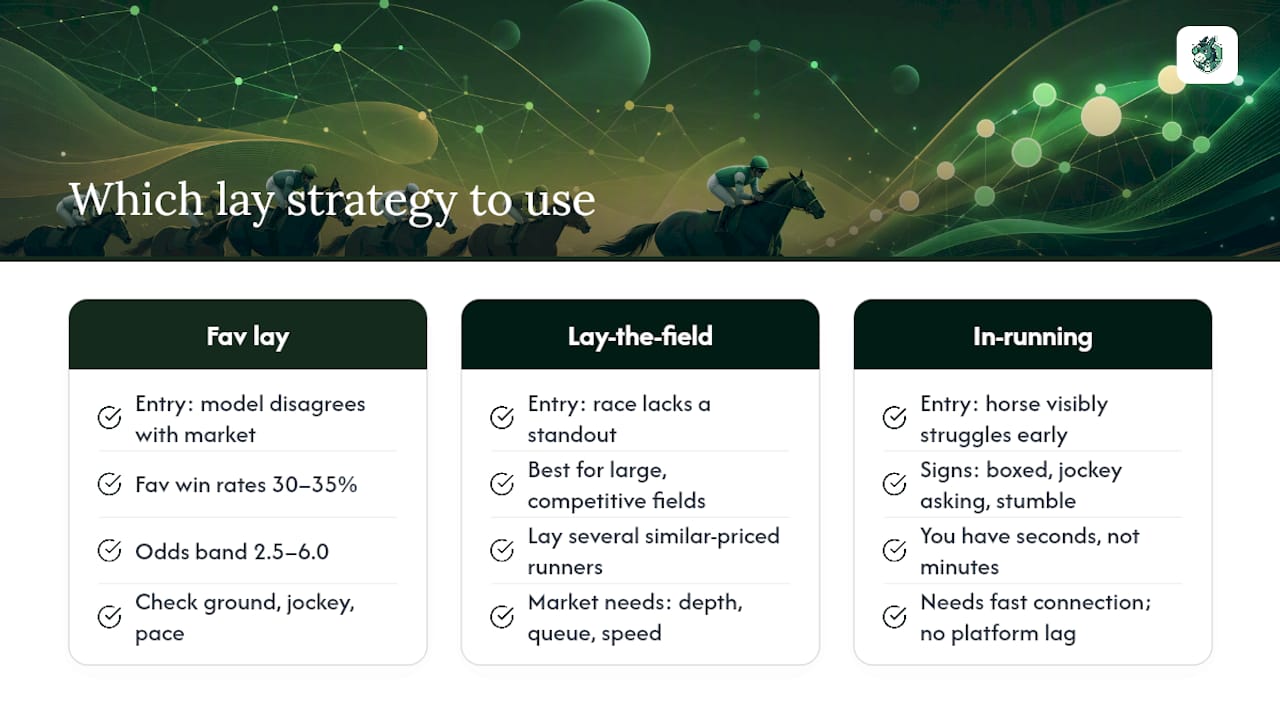
Pre-race favourite laying targets horses priced shorter than your model justifies. Favourite win rates hover around 30–35%, so a favourite sitting at 2.0 when your data suggests a 40% win chance is not automatically safe to lay. Look for ground mismatches, a jockey switch, or a pace scenario that doesn’t suit a front-runner. Odds bands between 2.5 and 6.0 tend to offer the best balance of liability and edge, keeping the downside manageable while the market still overprices confidence.
Trade-based lay-the-field works when a race lacks a standout, and you lay several runners around similar prices, hoping to trade out once one shortens as the market firms. This is a technique that depends heavily on execution: queue position, market depth, and how quickly you can get matched all determine whether it’s profitable or a slow bleed. It suits large fields with genuinely competitive form, not small, one-horse races.
In-running lays react to what you can see: a horse boxed in on the rail, a jockey who’s clearly asking early, a stumble out of the gate. You typically have seconds, not minutes, to act once a leader visibly struggles, and this only works with a fast connection and a platform that doesn’t lag.
A worked pattern for the favourite lay: you lay a 2.2 favourite for a £20 backer stake (liability £24), the price drifts to 3.0 as market sentiment shifts, and you back it back at that price for a smaller stake to lock a partial profit regardless of the result. Pro Tip: Watch queue position before you commit to a lay-the-field trade. If you’re fifteenth in the queue at your chosen price, you may never get matched at all, and chasing the price down erodes the exact edge you were trying to capture.
How much should you risk on each lay?
Cap liability at 1 to 2% of your laying bankroll per race, never per bet, because it’s liability, not stake, that determines your actual downside. A £1,000 bankroll therefore means a £10 to £20 liability ceiling on any single lay, regardless of how confident the signal looks.
Converting that into a backer stake is straightforward. If your liability cap is £20 and you’re laying at 4.0, your maximum backer stake is £6.67 (liability divided by odds minus 1). At 6.0, the same £20 cap only allows a £4 stake, which is exactly why longer-priced lays need smaller stakes to stay inside the same risk band.
A liability-aware Kelly approach adjusts stake size to the asymmetric risk of lays rather than treating them like a standard back bet, and it’s worth adopting even in a simplified form.
Stop-loss rules matter as much as entry rules:
- Set a hard daily liability stop, for example 5% of bankroll, and walk away once it’s hit
- Hedge incrementally as a lay moves in your favour rather than waiting for the close
- Never stack multiple lays on the same race without recalculating combined liability
- Never increase stake size after a winning run to chase bigger numbers
Commission and variance both push liability caps down, not up, especially on higher-commission exchanges where each win is worth less. A practical minimum bankroll for testing these strategies sits around £500 to £1,000, enough to survive a losing run without breaching your stop rules. The most common pitfall isn’t a bad pick, it’s ignoring commission until the maths no longer works.
Which exchanges and tools support US lay betting?
Betfair Exchange remains the deepest liquidity pool for lay betting generally, with Smarkets, Matchbook, and SpreadEx offering alternative commission structures and market coverage worth comparing before you commit capital. The single most valuable tool type beyond the exchange itself is a real-time signal feed paired with direct exchange links, because it removes the lag between spotting an edge and acting on it.
Market depth and commission both vary meaningfully between platforms. Betfair typically carries the deepest books for major racing, which matters most for lay-the-field trades. Smarkets runs lower commission, which lowers your break-even threshold on every lay. Matchbook and SpreadEx availability for US racing markets varies by meeting, so check coverage before building a strategy around a specific card.
DonkeyRadar fits this workflow as the signal layer rather than the exchange itself. Alerts land by email or Telegram, and direct Betfair links plus API access mean the gap between signal and execution stays small. A practical toolbox for serious lay trading includes a signal feed, a trading ladder for order entry, a queue-depth view so you know where you sit in the market, and a stake or liability calculator to keep sizing consistent race after race.
How do you actually place and manage a lay on a US race?
Before anything else, confirm your liability figure is visible on screen and sits within your pre-set cap. Skipping that check is the single most common way a good signal turns into a bad session.
- Choose the market: confirm the race type, field size, and current liquidity depth
- Confirm the signal or edge: check your model or your signal source (a data-driven feed like DonkeyRadar) against the current price
- Calculate liability: work out liability at your intended stake before entering anything
- Place the lay order: select a price close to the current best lay, avoiding chasing a moving market
- Monitor and manage: hedge back once your target profit or your stop-loss level is hit
- Record the result: log price, liability, and outcome for every trade, win or lose
Pre-race lays are best placed in the final ten to fifteen minutes before post, when liquidity peaks and the price reflects the most current market information. If your order only partially fills, decide in advance whether you’ll top up at the same price or accept the smaller position. In the final two minutes before off, avoid adjusting prices unless the market moves sharply against your signal.
A small example: you lay a horse at 4.0 for a £10 stake (£30 liability). The price drifts to 5.5 as market confidence fades. You back it at 5.5 for a stake that locks in roughly £4 profit regardless of the result, closing the trade before the race even starts. The lay betting calculator handles this arithmetic automatically if you’d rather not run it by hand mid-market.
Are lay betting profits taxed in the UK?
Profits from lay betting, like all betting profits in the UK, are tax-free for the individual bettor, regardless of whether you’re laying UK, Australian, or US races. This has been the position since betting duty shifted to bookmakers and exchanges rather than punters, and it applies to exchange trading profits just as it applies to a standard bookmaker win.
This matters more for lay betting than for backing because lay traders often run higher volumes and larger liabilities, and the tax-free treatment means every pound of edge you extract stays yours in full. There’s no separate reporting threshold to worry about for casual or even fairly active recreational betting activity.
One caveat worth flagging honestly: if betting becomes your primary trade or business activity in a way HMRC would classify as a trading operation rather than gambling, the picture can shift. That’s a genuinely rare classification for individual exchange bettors, and it hinges on specific facts about how the activity is structured, not simply on how much you win. If your betting activity has grown into something resembling a full-time occupation with significant scale, it’s worth a conversation with an accountant familiar with gambling and trading income rather than relying on general guidance. For the overwhelming majority of UK bettors using exchanges to lay US races alongside a normal job or other income, profits stay outside the tax system entirely, which is one of the quieter advantages exchange trading has over other forms of speculation.
Why discipline beats intuition in lay trading
Laying is a different psychological game to backing, because a single missed liability check can undo weeks of careful, disciplined signal-following in one race. Intuition tends to underweight tail risk on lays precisely because most lays win, which breeds a false sense of safety right up until the one that doesn’t. A data-led signal source such as DonkeyRadar doesn’t remove that risk, but it gives you a published, checkable baseline to trade against rather than a gut feeling dressed up as a system.
Try DonkeyRadar’s US racing lay signals before your next session
DonkeyRadar’s free tier delivers daily lay signals with staking tier guidance, while the paid subscription adds real-time email and Telegram alerts, full verified results history, and API access for anyone running their own trading software. What that saves you is the hours spent building and back-testing a favourite-lay model from scratch, plus the lag between spotting an edge and getting an alert on it.
Every signal publishes before the race, not after, so you can check the call against the result rather than trusting a claim on faith. If you want to see how the numbers in this guide translate into a live workflow, start with the lay betting calculator to get your liability sizing right, then move on to the verified US lay tips to see the signal history for yourself.
Frequently asked questions about US racing lay strategy
What is the safest odds range to lay in US horse racing? Most disciplined layers work within 2.5 to 6.0, where liability stays manageable while genuine market overpricing still occurs often enough to build an edge.
Can I lay US races on Betfair Exchange from the UK? Yes, Betfair Exchange carries US racing markets alongside UK and Australian cards, and UK-based accounts can access them the same way they access domestic racing.
Do I pay tax on lay betting profits from US races? No, betting profits are tax-free for UK individuals regardless of which country’s racing you’re laying, aside from the rare case where betting is classified as a trading business rather than gambling.
How is a lay bet different from a back bet mathematically? A back bet risks your stake for a fixed return; a lay bet risks your liability, calculated as stake multiplied by (odds minus 1), for a fixed profit equal to the backer’s stake minus commission.
Which tool helps most with US racing lay signals? A published, verified signal feed like DonkeyRadar removes the guesswork from selection, giving you pre-race calls you can check against results rather than building a model from scratch.
This article is general information, not a substitute for advice from a qualified financial advisor. Consult a qualified financial professional about your own circumstances before acting on anything here.
Sources
- Exchange – what does the term ‘lay’ mean and what is a lay bet? — Betfair Help Centre
- Lay betting strategy: 5-step EV framework — KiqIQ
- Laying horses — when and how (2026 strategy guide) — BetfairSquare
- Lay the field strategy — Traderline
- What is lay betting on an exchange — Smarkets Help Centre