← Blog · 📝 Article · 31 August 2026
Prove Your Edge Before Kelly: 1–2% Bankroll Rules and 200+ Bets

The most practical bankroll rule for most bettors is flat unit staking at 1 to 2% of your total roll on every wager. Stick with it until you have logged 200+ bets and can show consistent positive closing line value. Only then does fractional Kelly staking earn a place in your process, and every plan needs pre-set drawdown stops regardless of which staking method you choose.
TL;DR:
- Most bettors should stick to flat staking at 1 to 2% of their bankroll until they have logged over 200 bets with consistent positive closing line value.
- Fractional Kelly staking becomes relevant only after building a significant sample size, as overestimating edge can lead to large bankroll swings.
- Recalculating stake sizes frequently creates instability; a monthly review of bankroll and unit size is more disciplined.
- Drawdown thresholds at 10%, 20%, 30%, and 50% help trigger automatic review and adjustment of stakes to prevent total ruin.
- Tracking every bet’s details and positive closing line value is essential to verify an edge and maintain disciplined staking over time.
Table of Contents
- What is bankroll management in betting?
- Flat staking versus the Kelly family: which wins?
- How much should you stake per bet?
- What is risk of ruin and how do drawdowns protect you?
- What should you track to prove you have an edge?
- Which mistakes wreck a bankroll fastest?
- How can verified data support your staking discipline?
- One habit worth building now
- Try the tools that back this process
- Sources
What is bankroll management in betting?
Bankroll management is the set of rules that decide how much you stake, when you scale up or down, and when you stop. It has nothing to do with picking winners. Its job is to keep you solvent long enough for whatever edge you have to actually show up in your results.
Most bettors who lose money don’t lose it because their picks are bad. They lose it because a string of losers panics them into staking more to “catch up”, and one bad week turns into a wiped-out account. Ring-fencing money into a dedicated betting bankroll, kept entirely separate from your everyday finances, removes that psychological trap before it starts. You can see the number, watch it move, and make decisions based on data rather than dread.
Five pillars hold this together:
- A dedicated bankroll, sized only from money you can genuinely afford to lose
- Unit sizing based on a fixed percentage, not a fixed cash amount
- Discipline: no chasing losses, no doubling down on a bad run
- Record keeping for every single bet, win or lose
- Pre-set drawdown limits that trigger automatically, not on a whim
On sizing your starting bankroll, treat it like an entertainment budget for the next three to six months, not your rent money. If losing it would change your life, it’s too big.
Flat staking versus the Kelly family: which wins?
Flat staking wins for almost everyone starting out, and for a specific reason: it’s the only method that doesn’t require you to already know your edge. You bet the same percentage of your bankroll on every wager, recalculating only when the bankroll itself moves meaningfully. It’s simple, it’s robust against emotional decision-making, and it makes your results easy to measure because every bet carries the same weight in your data. Flat unit staking at 1 to 2% of bankroll is the standard default for this reason.
The Kelly Criterion works differently. It sizes each stake according to your estimated edge and the odds on offer, in theory maximising long-run growth. The problem is that full Kelly assumes your probability estimates are accurate, and most bettors’ aren’t. Overestimate your edge even slightly and full Kelly can swing your bankroll violently, sometimes toward ruin. Kelly is genuinely an advanced technique, not a beginner’s shortcut.
Fractional Kelly, typically a half or a quarter of the full Kelly stake, is the compromise experienced bettors actually use. It captures most of the growth benefit while cutting the variance down substantially, which is why it turns up so often in professional staking plans rather than the textbook full version.
- Start with flat staking at 1 to 2% and stay there while you build your sample.
- Log every bet until you hit 200+ with demonstrable positive closing line value.
- Only then, consider shifting a portion of your stakes to quarter or half Kelly.
Pro Tip: Don’t switch to Kelly staking because a hot month convinces you that you’ve “found your edge”. Switch because your closing line value has been positive across hundreds of bets, in different market conditions, over enough time to rule out luck.
How much should you stake per bet?
Your experience level and the strength of your evidence should set your unit size, not your mood on a given Saturday. A workable framework looks like this:
| Bettor profile | Unit size (% of bankroll) | Stake on a — bankroll | Stake on a — bankroll | Stake on a — bankroll |
|---|---|---|---|---|
| Beginner | 1% | £2 | £10 | £50 |
| Intermediate | 1–2% | £2–£5 | £10–£20 | £50–£100 |
| Experienced | 2–3% | £5–£7 | £20–£30 | £100–£150 |
| Aggressive | 3–5% | £7–£12 | £30–£50 | £150–£250 |
This mirrors the standard professional unit framework, where many serious bettors think of their bankroll as roughly 100 units, which naturally lands most stakes in the 1 to 2% band.
Scaling should follow the bankroll, not your confidence. A sensible cadence:
- Increase your unit size after your bankroll has meaningfully grown
- Cut your unit size after a significant drop in bankroll, not after every losing bet
- Recalculate only on these meaningful moves, never bet to bet
- Cap total daily exposure, and treat parlays as a separate, strictly limited category rather than your core staking
Recalculating constantly turns a stable plan into a moving target. Fix the number, review it monthly, and let the discipline do the work.
What is risk of ruin and how do drawdowns protect you?
Risk of ruin is the mathematical probability that a losing streak wipes out your bankroll before your edge has a chance to play out. Stake size, more than anything else, decides that probability. Double your unit size and you don’t just double your risk; you compound it, because bigger stakes mean bigger swings hit a smaller remaining bank.
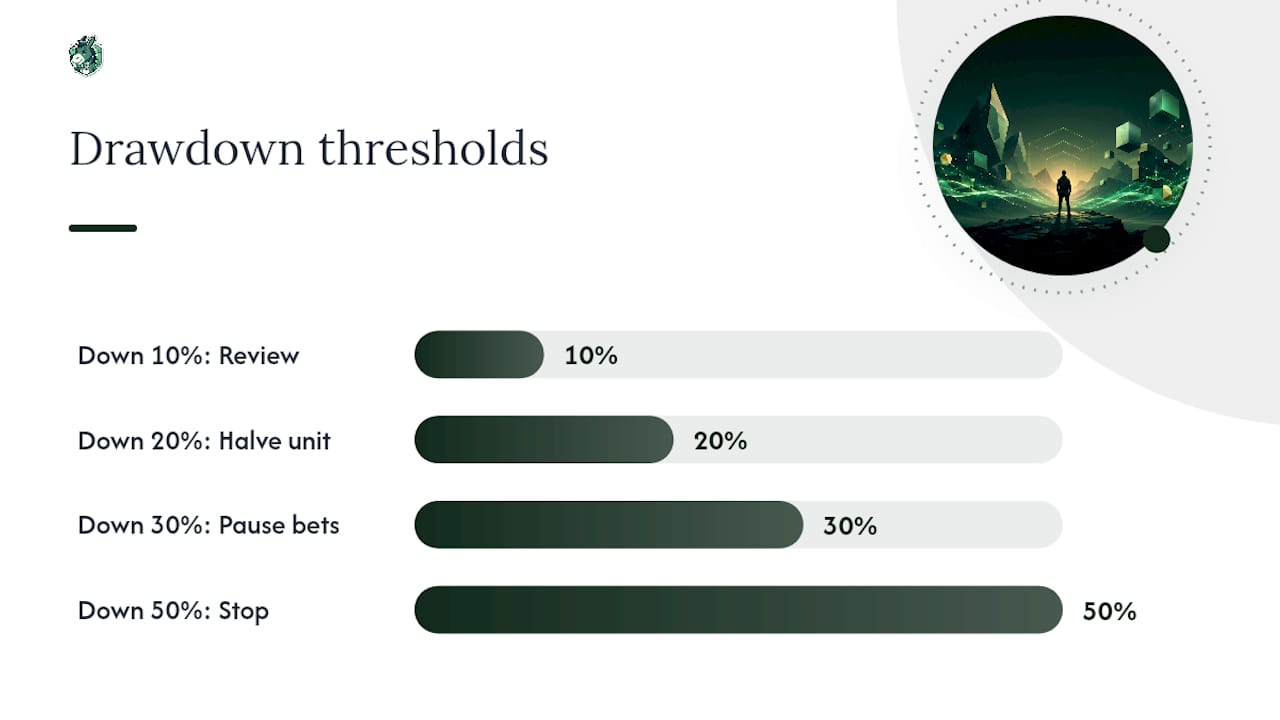
Drawdown thresholds give you an objective trigger instead of a gut decision made mid-slump:
- Down 10%: review your process and recent bets, but keep staking as planned
- Down 20%: halve your unit size until the bankroll recovers
- Down 30%: pause new bets and conduct a full review of your selections and staking
- Down 50%: stop completely and rebuild your process before risking further money
Variance differs by sport and market too. Horse racing and in-play markets swing harder than, say, football match odds, so a unit size that’s comfortable in one context can be reckless in another. Adjust downward for higher-variance markets rather than applying one flat number everywhere.
What should you track to prove you have an edge?
You cannot manage what you don’t measure, and betting is unforgiving of guesswork here. Every single bet should generate a record with these minimum fields:
- Date and kick-off/race time
- Sport and specific market
- Odds taken and estimated probability
- Stake, expressed in units, not cash
- Result and running profit or loss
Closing line value, the difference between the odds you took and the odds available right before the event starts, is the strongest practical signal that you’re beating the market. Win rate alone is misleading over small samples; consistent positive CLV over time is much harder to fake or get lucky into.
Treat a substantial number of bets as the minimum sample before drawing any real conclusions, and review your numbers weekly or monthly using a simple spreadsheet or a proper betting results tracking process rather than trusting memory.
Which mistakes wreck a bankroll fastest?
Nearly every blown bankroll traces back to a handful of repeatable errors, not bad luck.
- Chasing losses by upsizing the very next bet after a defeat.
- Treating a short winning run as proof of skill and scaling up prematurely.
- Mixing betting funds with rent, bills, or savings.
- Running Martingale-style progressive systems that double stakes after losses.
- Letting parlays creep beyond entertainment money, ideally capped near 0.5% of bankroll.
- Ignoring your own pre-declared exposure caps once a bad week starts.
If you breach a limit you set for yourself, that’s the signal to pause, document what happened, and work out the root cause before staking again. GamblingTherapy offers useful resources if betting starts to feel compulsive rather than recreational.
How can verified data support your staking discipline?
Sound staking rules work better when they’re fed by evidence you can actually check, not gut feeling. Donkeyradar’s model identifies the statistically weakest runner in a race and publishes lay signals before the race starts, with a verified strike rate above 85% tracked against a public results history. That kind of transparency lets you validate a signal source the same way you’d validate your own edge: over a real sample, against real closing prices, not marketing copy.
The discipline doesn’t come from the signal. It comes from what you do with it: sizing the stake correctly, respecting your drawdown limits, and logging the result whether it wins or loses.
A lay betting calculator helps translate a signal into a properly sized stake and liability figure before you place it. But no calculator, however good, replaces the unit rules and drawdown guardrails that actually keep you solvent across hundreds of bets.
One habit worth building now
Set a weekly hour to reconcile every bet against your log, and automate the rule that recalculates your unit whenever the bankroll moves 25% either way. Patience compounds. Chasing variance rarely does.
— Donkey
Try the tools that back this process
Bankroll rules keep you solvent; they don’t generate an edge on their own. That’s where a structured signals service becomes a useful adjunct rather than a replacement for the discipline above. Donkeyradar publishes lay betting signals before UK, Australian, and US races, backed by a public, continuously verified results history, so you’re never asked to trust a claim you can’t check against past performance.
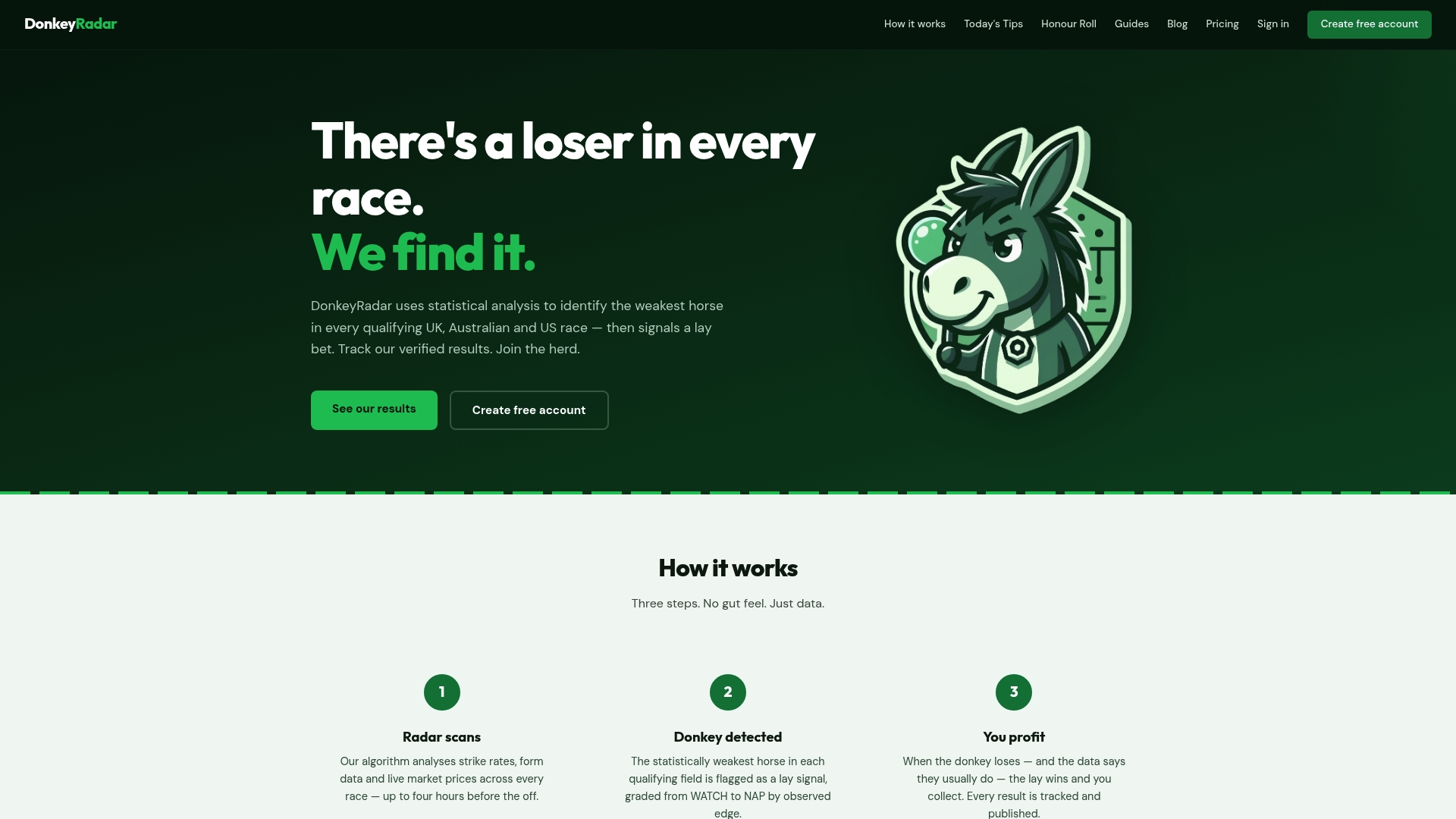
The dashboard pairs each signal with a lay betting calculator that works out liability and break-even points, so you can size a stake correctly against your own unit rules before you touch Betfair. Real-time alerts via email and Telegram mean you’re not refreshing a page hoping to catch a price. If you’re new to laying horses rather than backing them, start with how lay betting actually works, then check today’s published lay tips against the verified history before you commit a single unit.
This article is general information, not a substitute for advice from a qualified financial advisor. Consult a qualified financial professional about your own circumstances before acting on anything here.
Sources
- Bankroll Management in Sports Betting: The Complete Guide
- Betting Bankroll Management Guide: Stop Going Bust (2026)
- Sports Betting Bankroll Management Guide | BetResearcher
- Bankroll Management Sports Betting: Unit Sizing | OddsShopper