← Blog · 📝 Article · 4 August 2026
Best Betfair strategies for traders: practical shortlist

The five strategies that consistently produce profit on Betfair are pre-race scalping, swing trading, back-to-lay, lay the field, and lay the draw. If you are new to trading, start with swing trading and back-to-lay: both are forgiving on execution speed, work well in UK horse racing markets, and give you time to think before committing.
TL;DR: which strategy fits you?
- Pre-race scalping — best for high-volume traders with fast software and low commission, comparatively; targets a small number of ticks per trade
- Swing trading — best starter strategy; targets 5–15 ticks, trades several times per session, less execution-sensitive
- Back-to-lay — back a horse pre-race, exit when the price shortens; suits patient traders who can read steam moves
- Lay the field — trade price movement across the whole field without picking a winner; needs large fields (12+ runners)
- Lay the draw — football strategy; back the draw at kick-off, trade out when a goal is scored; requires pre-match filters
- Tennis in-play trading — react to set and game inflection points; needs automation or very fast execution
- Place-market scalping — lower volatility than win markets; useful for building consistency at small stakes
One-line recommendation: Begin with swing trading to build price-reading skills, then layer in back-to-lay once you can reliably spot steam moves.
Table of Contents
- What you need to understand before placing your first trade
- The best Betfair strategies: execution rules and worked examples
- Bankroll rules, staking plans and trader psychology
- Which tools do you actually need to trade Betfair?
- How Donkeyradar implements data-driven lay signals: verified results
- How to choose the right strategy for your situation
- Managing risk when markets move suddenly
- How to identify reliable market conditions before you trade
- A step-by-step plan for practising strategies safely
- How strategy performance varies across sports and market types
- Keeping up with regulatory changes that affect Betfair trading in the UK
- Key takeaways
- What trading Betfair markets actually teaches you
- Donkeyradar: pre-race lay signals with verified results
- Useful sources and further reading
What you need to understand before placing your first trade
Trading on Betfair is not the same as betting. A bettor tries to predict an outcome; a trader exploits price movement and closes the position before the event settles. Your edge comes from reading the market, not the race. That distinction matters in practice: many profitable Betfair trading strategies never require you to have an opinion on who wins.
Core markets and why liquidity varies
UK horse racing is the most liquid and lowest-commission environment on the Betfair Exchange. Roughly £40 million is matched on a single Cheltenham Tuesday, which means tight spreads and easy entry and exit. Football match odds are liquid around kick-off and at half-time but thin out mid-half. Tennis markets spike during breaks of serve and set points. Choose your market based on when you can trade, not just which sport you follow.
Commission: the number that changes everything
Typical commission on UK and Irish racing accounts is low; football and tennis markets attract higher commissions. For a scalper targeting 2-tick margins, that difference can erase the entire edge on a trade.
Commission rates are not a footnote — they are a core input to every strategy decision. A scalper on a 5% commission market needs to win roughly two and a half times as many ticks to match the net return of the same trade on a 2% market.
Pre-trade checklist
Before entering any position, confirm:
- Matched volume is above £50,000 (win market) or £10,000 (place market) with at least 10 minutes to off
- Team news or jockey bookings are confirmed (no late scratching risk)
- No obvious market mover already in progress that you have missed
- Liquidity peaks for UK racing fall between 8 and 3 minutes before the off; football peaks 30 minutes before kick-off and at half-time
Essential glossary
| Term | Meaning |
|---|---|
| Back | Bet on a selection to win |
| Lay | Bet against a selection (act as bookmaker) |
| Tick | Smallest price increment on the ladder |
| Ladder | Visual interface showing price and volume at each tick |
| Steam | Rapid, sustained price shortening driven by professional money |
| Drift | Price lengthening, often indicating lack of confidence |
| Matched | Order fully executed at the requested price |
| Unmatched | Order sitting in the queue, not yet executed |
The best Betfair strategies: execution rules and worked examples
1. Pre-race scalping on favourites
How it works: Place a lay order one tick above the current best lay price, wait for it to match, then immediately back at the same price or one tick lower to lock in a tick profit. Repeat at high frequency.

Entry rule: Enter only when matched volume exceeds £80,000 and the spread is one tick. Exit immediately if the spread widens to two ticks.
Stop-loss: If the price moves two ticks against you, exit at market price. No averaging down.
Stake sizing: 1–2% of bankroll per trade. At a £1,000 bankroll, that is £10–£20 per trade.
Worked example: Lay £50 at 3.00, back £50 at 2.98 (two ticks lower). Gross profit: £1.00. After 2% commission: £0.98. Repeat 20 times in a session: £19.60 net. Skilled scalpers can net notable daily profit from horse racing at high volume, but that requires enterprise-grade execution and comparatively very low commission.
Required tools: Fast ladder software (Bet Angel or equivalent), sub-50ms connection, 2% commission account.
Skill level: Advanced. This is not a beginner strategy despite its apparent simplicity.
2. Swing trading
How it works: Identify a horse whose price is likely to move 5–15 ticks in a predictable direction, enter at the start of the move, and exit when the target is reached or the move stalls.
Entry rule: Back a horse when you see early steam (price shortening on rising volume) at T-20 minutes. Target exit shortly before the event when liquidity peaks.
Stop-loss: 5 ticks against entry. If the price drifts 5 ticks from your back price, exit the lay side immediately.
Stake sizing: 2–3% of bankroll. At £500 bankroll: £10–£15 per trade.
Worked example: Back £20 at 5.00. Price moves to 4.50 (10 ticks). Lay £20 at 4.50 to trade out. Gross profit: £20 × (5.00 − 4.50) / 4.50 = approximately £2.22. After 2% commission: approximately £2.18. Swing trading targets 5–15 ticks typically and trades several times per session, making it far more forgiving than scalping for traders without fast execution infrastructure.
Skill level: Beginner to intermediate. The recommended starting point for most traders.
3. Back-to-lay (pre-race)
How it works: Back a horse early in the morning when its price is long, then lay it out as professional money shortens the price closer to the off.

Entry rule: Back well before the event when the horse is priced above its likely off-price, based on market mover activity. Exit by laying at T-5 minutes.
Stop-loss: If the price drifts more than 15% from your back price, exit at market. Do not hold through the off.
Worked example: Back £30 at 6.00 at 9:00 AM. Price steams to 4.80 by T-5. Lay £30 at 4.80. Gross profit: £30 × (6.00 − 4.80) / 4.80 = £7.50. After 2% commission: £7.35.
Skill level: Intermediate. Requires patience and the ability to read steam and drift moves reliably.
4. Lay the field (pre-race)
How it works: Lay every runner in the field at a price above the current market, then back each one at a lower price as the market moves. You profit when any runner’s price passes through your lay level.
Lay the field works best in large fields (12+ runners) during morning markets or major festivals, where steam moves are common. The risk is that multiple runners move through your lay levels simultaneously, creating compounding liability.
Entry rule: Set lay orders at least 3–4 ticks above the current best lay price. Layer orders across two price bands to limit simultaneous matching.
Stop-loss: Pre-set a maximum liability per race (e.g. £50). If total matched liability approaches that figure, back out all remaining positions at market.
Skill level: Intermediate. Requires careful order management and a clear liability cap.
5. Lay the draw (football)
How it works: Lay the draw before kick-off, then trade out for a profit when a goal is scored (the draw price lengthens sharply). If the match stays goalless, you take a loss at half-time or full-time.
A correctly filtered lay-the-draw approach can achieve a high success rate on selected fixtures. Filters should include combined expected goals, attacking form for both teams, and specific pre-match draw odds ranges.
Stop-loss: Exit at half-time if the score is 0–0. Hard stop at 1.5 times your lay stake in liability.
Worked example: Lay the draw at 3.40 for £20 liability. A goal is scored at 25 minutes; draw price moves to 5.50. Back £20 at 5.50 to trade out. Gross profit: approximately £12.40 before commission.
Skill level: Beginner to intermediate. The pre-match filter discipline is the hard part, not the execution.
6. Tennis in-play set and point trading
How it works: React to predefined inflection points (a break of serve, a set going to 6–6) where the price moves predictably and quickly. Professionals wait for clear triggers and use pre-calculated hedges to execute fast.
Entry rule: Enter only at pre-defined price levels (e.g. lay the favourite at 1.25 when they are a set down). Never enter mid-rally.
Stop-loss: 10 ticks or a second break of serve against you, whichever comes first.
Skill level: Advanced. Requires automation or very fast manual execution. Not suitable without sub-50ms tooling.
7. Place-market scalping
How it works: Scalp the place market (top 3 or 4 finishers) rather than the win market. Volatility is lower, spreads are tighter, and the market is less dominated by professional money.
Entry rule: Same as win-market scalping but with smaller stakes and a focus on the 8–5 minute window before the off.
Skill level: Beginner to intermediate. A useful stepping stone before attempting win-market scalping.
Strategy comparison table
| Strategy | Best for | Required skill | Typical profit target | Trade frequency | Tools required | Commission impact |
|---|---|---|---|---|---|---|
| Pre-race scalping | High-volume, fast traders | Advanced | 1–3 ticks | Very high | Fast ladder, low latency | High — 5% erases edge |
| Swing trading | Beginners, patient traders | Beginner–Intermediate | 5–15 ticks | 5–15 per session | Basic ladder | Moderate |
| Back-to-lay | Patient, morning traders | Intermediate | 10–20 ticks | Low | Ladder, price alerts | Low–Moderate |
| Lay the field | Large-field race traders (12+ runners) | Intermediate | 3–8 ticks per runner | Moderate | Ladder, liability tracker | Moderate |
| Lay the draw | Football traders | Beginner–Intermediate | Variable (goal-dependent) | Low | Basic platform | Moderate |
| Tennis in-play | Fast, automated traders | Advanced | 5–15 ticks | Moderate–High | API/automation | High |
| Place-market scalping | Beginners building consistency | Beginner | 1–2 ticks | Moderate–High | Basic ladder | Moderate |
Bankroll rules, staking plans and trader psychology
Sound money management separates traders who last from those who blow up in the first month. The rule is simple: risk 1–2% of your total bankroll per trade. At a £500 bankroll, that is £5–£10 per trade. At £2,000, it is £20–£40.
Practical staking examples
| Bankroll | Risk per trade (1–2%) | Typical lay liability | Reserve (20%) |
|---|---|---|---|
| £500 | £5–£10 | £15–£30 | £100 |
| £1,000 | £10–£20 | £30–£60 | £200 |
| £2,000 | £20–£40 | £60–£80 | £500 |
Keep 20% of your bankroll in reserve at all times. Extract profits monthly rather than letting them compound unchecked — this forces you to treat trading as a business, not a gambling session. Use the lay betting calculator to confirm your liability before every trade.
Half-Kelly staking (betting half the theoretically optimal fraction) is a practical middle ground: it reduces variance significantly while preserving most of the long-run growth rate. In practice, most traders do not have precise edge estimates, so the 1–2% flat-risk rule is more reliable.
Trade log template
Record every trade with these fields:
- Date, race/event, strategy tag
- Entry price, exit price, stake
- Commission paid, net P&L
- Notes (why you entered, what happened, what you would change)
A log of 100 trades gives you statistically meaningful data on your strike rate and average P&L per strategy. Without it, you are guessing.
Psychology rules
No averaging down — ever. If a trade moves against you, exit at your stop-loss. Adding to a losing position is the single most common way traders turn a small loss into an account-ending one.
Set a session time limit (two hours maximum for beginners) and a daily loss limit (5% of bankroll). When either is hit, stop. Tilt — the emotional state that follows a losing run — causes traders to increase stakes and abandon rules. The only cure is to stop trading for the day.
Losing runs are part of every strategy. A 60% strike rate means you lose 40% of trades. The question is not whether you will lose — it is whether your sizing means those losses are survivable.
Pro Tip: Tag every trade by strategy in your log. Run a separate P&L column per strategy. This reveals which approach is actually profitable for you, rather than letting a strong strategy mask a losing one.
Which tools do you actually need to trade Betfair?
The right software makes a measurable difference to execution quality, particularly for in-play strategies. Here is what to look for:
Essential features checklist
- Ladder interface with one-click stake entry
- Queue position and volume display at each price level
- Pre-set hedge and green-up buttons
- Auto stop-loss (triggered at a defined tick loss)
- In-play delay indicator (shows when the market suspends)
Latency: the number that matters for in-play trading
Specialist trading software can achieve sub-50ms execution; the standard Betfair web interface typically runs at 100–500ms. For pre-race scalping and swing trading, web-UI latency is acceptable. For in-running horse racing or tennis point trading, it is not. You will consistently miss your entry price by the time your order reaches the exchange.
Bet Angel is the most widely referenced third-party ladder tool in the UK trading community. It provides a full ladder interface, automation rules (Guardian), one-click trading, and API connectivity. For scalping, its speed advantage over the standard Betfair interface is material. For swing trading, the difference is smaller but still useful for clean exits.
Testing bots and automation safely
Start in Bet Angel’s simulation mode (or equivalent sandbox). Run at least 50 simulated trades before going live. Then trade at minimum stakes (£2–£5) for a further 50 trades. Only scale up when your live results match your simulated results within a reasonable margin. Automation removes emotion but does not remove bad strategy logic — test the logic first.
A bot executing a flawed strategy at speed loses money faster than a human would. Simulation is not optional.
How Donkeyradar implements data-driven lay signals: verified results
Donkeyradar applies statistical analysis to identify the weakest runner in UK, Australian, and US horse races before the off. The algorithm processes historical strike rates and live market prices to generate lay signals, published on the dashboard before each race. Every signal includes a staking tier grade, and all results are tracked publicly so you can audit the performance history yourself.
Verified results metrics
| Metric | Donkeyradar figure |
|---|---|
| Strike rate | Over 85% |
| Signal timing | Pre-race (before off) |
| Markets covered | UK, Australian, US horse racing |
| Results transparency | All signals published and tracked publicly |
| Staking tiers | Graded per signal confidence band |
Worked trade example using a Donkeyradar signal
Signal: Lay runner priced at 4.50, staking tier 2 (moderate confidence).
- Lay stake: £20 at 4.50 (liability: £70)
- Runner drifts to 6.00 pre-race; back £20 at 6.00 to trade out
- Gross profit: £20 × (6.00 − 4.50) / 4.50 = £6.67
- After 2% commission: £6.53
- Net return on liability: approximately 9.3%
Alternatively, hold the lay to settlement. If the runner loses (as the signal predicts), you collect the £20 lay stake minus commission. With an over-85% strike rate, the long-run expectancy is positive across a sufficient sample.
All Donkeyradar signals are published before races commence and results are continuously tracked. There is no selective reporting — wins and losses both appear in the public history.
Pro Tip: Use Donkeyradar’s staking tier grades to size your trades. Tier 1 signals (highest confidence) can take your full 2% bankroll allocation; Tier 3 signals warrant half that. Running all signals at the same stake ignores the information the confidence grade carries.
How to choose the right strategy for your situation
Work through these steps in order:
-
How much time can you trade per day? Less than one hour: lay the field or back-to-lay (set orders and monitor). One to three hours: swing trading or lay the draw. Three-plus hours with fast tools: scalping or tennis in-play.
-
What is your bankroll? Under £500: place-market scalping or swing trading at minimum stakes. £500–£2,000: swing trading, back-to-lay, lay the draw. Over £2,000: any strategy, including scalping if you have the tools.
-
What is your latency situation? Standard broadband and web UI: stick to pre-race strategies. Dedicated software and sub-50ms connection: in-play strategies become viable.
-
Which sport do you understand best? Horse racing: scalping, swing, back-to-lay, lay the field. Football: lay the draw. Tennis: in-play set trading.
-
How do you handle drawdowns? Low tolerance: lay the draw with strict half-time stop, or place-market scalping. Higher tolerance: swing trading and back-to-lay with wider stops.
When to add a second strategy or move to automation
Graduate to a second strategy only after 100 logged trades in your first strategy show a positive P&L. Add automation when your manual execution is consistent — automation amplifies your process, good or bad. Never automate a strategy you have not yet validated manually.
Managing risk when markets move suddenly
Volatile markets — a late jockey change, a red card in football, a rain shower on a flat track — can move prices 20–30 ticks in seconds. Standard stop-losses are not always enough.
Specific controls for volatile conditions
- Pre-set liability caps per race: Set a maximum total liability before entering any position. If the market suspends and reopens at a worse price, your loss is bounded.
- Avoid in-play in the final furlong: Horse racing markets suspend unpredictably in the last 30 seconds. Close all positions by T-1 minute unless you are running a specific in-play strategy with automation.
- Use the Betfair in-play delay to your advantage: The in-play delay (typically 3–5 seconds for horse racing) means your order may not match at the price you see. Factor this into your exit planning.
- Layer your exit orders: Rather than exiting in one block, split your exit across two price levels. This reduces the risk of missing your exit entirely in a fast-moving market.
- Never hold a position through a market suspension without a pre-set hedge: If you cannot hedge before suspension, your position is exposed to the reopening price, which can be dramatically different.
For lay-the-field positions specifically, the risk of multiple runners moving through your lay levels simultaneously is real. Set lay prices at least 3–4 ticks above the current market and cap total race liability before entering.
How to identify reliable market conditions before you trade
Not every race or match is worth trading. Entering a thin or erratic market is one of the most common mistakes new traders make.
Signals that a market is tradeable
- Matched volume above £50,000 with 10+ minutes to the off (win market, UK racing)
- Spread of one tick at the price you intend to trade
- No obvious late market mover already in progress (check the last 5 minutes of price history on the ladder)
- Confirmed runners: no non-runner risk, team sheets published for football
Signals to avoid
- Volume below £20,000 with less than 5 minutes to the off
- Spread of two ticks or more (your scalp margin is already gone)
- Price moving erratically without clear directional momentum
- Major news event pending (press conference, injury update) that could spike the market unpredictably
Liquidity in UK racing peaks between 8 and 3 minutes before the off. Attempting a scalp at T-15 in a thin market means your order sits unmatched or moves the price against you. Patience here is a genuine edge.
For football, the 30 minutes before kick-off and the half-time interval are the two windows where the match-odds market is liquid enough for reliable entry and exit. Mid-half trading in a 0–0 game is where most lay-the-draw losses occur.
A step-by-step plan for practising strategies safely
Step 1: Paper trade for two weeks
Record every trade you would have made without placing real money. Note entry price, exit price, stake and P&L. This builds discipline around your rules without financial risk.
Step 2: Use Bet Angel’s simulation mode
Run 50 simulated trades in your chosen strategy. Confirm your entry and exit rules work in real market conditions before any money is at risk.
Step 3: Go live at minimum stakes
Start with £2–£5 stakes. Your goal is not profit at this stage — it is confirming that your execution matches your paper-trade results. Run 50 live trades.
Step 4: Review your first 100 trades
Calculate your strike rate, average P&L per trade, and commission paid. If the numbers are positive, scale stakes by 50%. If not, return to simulation and identify the rule being broken.
Step 5: Scale methodically
Double stakes only after each 100-trade review shows consistent positive P&L. Never increase stakes after a winning streak — that is emotion, not evidence.
For lay signals specifically, Donkeyradar’s free tier gives you daily signals to paper trade against before committing to a paid subscription. Use the public results history to calibrate your expectations before you place a single pound.
How strategy performance varies across sports and market types
No single strategy dominates every sport. The table below summarises how the main approaches perform across the three primary Betfair markets.
| Strategy | UK horse racing | Football match odds | Tennis |
|---|---|---|---|
| Pre-race scalping | ✓ Best environment (high liquidity, low commission, comparatively) | ✗ Thin pre-match spreads | ✗ Insufficient volume |
| Swing trading | ✓ Strong (steam/drift moves reliable) | ✓ Viable pre-match | ✗ Too fast for manual swing |
| Back-to-lay | ✓ Strong (morning markets) | ✓ Viable (team news driven) | ✗ Prices too stable pre-match |
| Lay the field | ✓ Best environment (large fields (12+ runners)) | ✗ Not applicable | ✗ Not applicable |
| Lay the draw | ✗ Not applicable | ✓ Core strategy | ✗ Not applicable |
| In-play trading | ✓ Viable with automation | ✓ Viable (goal events) | ✓ Best environment (set/game triggers) |
UK horse racing is the highest-volume, lowest-commission, most liquid trading environment on the exchange. It is where most profitable traders build their primary edge. Football is viable for lay the draw and pre-match swing trades but carries higher commission and less predictable liquidity. Tennis in-play trading has the sharpest price moves of the three sports but demands the fastest execution.
Keeping up with regulatory changes that affect Betfair trading in the UK
Betfair trading in the UK operates under the Gambling Commission’s licensing framework. Profits from betting and trading are tax-free for UK residents — HMRC does not treat gambling winnings as taxable income for recreational or professional traders. This is a genuine advantage worth noting.
However, the regulatory environment does change. The UK Gambling Act review has been ongoing, and any changes to exchange licensing, stake limits, or affordability checks could affect how you fund and use your Betfair account. Stay current by:
- Monitoring the Gambling Commission website directly for licensing updates
- Checking Betfair’s own terms and conditions page for commission structure changes (premium charges apply to consistently profitable accounts)
- Following BeGambleAware for responsible gambling guidance and any changes to consumer protection rules
The premium charge is the regulatory detail most traders overlook. Betfair applies it to accounts that generate consistent profits above a defined threshold, effectively increasing commission for highly successful traders. If your account reaches that threshold, your strategy economics change materially. Factor it into your long-term planning.
This article provides general information about Betfair trading strategies and is not financial or legal advice. Confirm current tax rules and regulatory requirements with HMRC or a qualified professional.
Key takeaways
Swing trading and back-to-lay are practical starting strategies for UK traders: both are forgiving on execution speed, work in liquid horse racing markets, and give clear entry and exit rules to practise with discipline.
| Point | Details |
|---|---|
| Start with swing trading | Targets 5–15 ticks per trade, 5–15 trades per session; less execution-sensitive than scalping. |
| Commission determines viability | At 5% commission, scalping margins are erased; target 2% racing markets for high-frequency strategies. |
| Risk 1–2% per trade | At a moderate bankroll, stake amounts should reflect a consistent risk percentage; keep a reserve portion at all times. |
| Log 100 trades before scaling | Strike rate and average P&L over 100 trades is the only reliable signal to increase stakes. |
| Donkeyradar for lay signals | High strike rate, pre-race signals with public verified results and staking tier grades for UK racing. |
What trading Betfair markets actually teaches you
Most traders underestimate how much of this is about restraint rather than insight. The strategies are not complicated. The execution rules are clear. What separates consistent traders from those who give up after three months is the discipline to follow those rules when a trade is going against them.
The traders who struggle most are not the ones who pick the wrong strategy. They are the ones who pick the right strategy and then abandon its rules the moment a losing run starts. Averaging down, removing stop-losses, switching strategies mid-session — these are the behaviours that turn a manageable drawdown into an account-ending one.
Two patterns come up repeatedly. The first: a trader who masters swing trading over 200 trades, then switches to scalping because the profits look bigger, without the tools or speed to execute it properly. The result is a string of missed exits and widening losses. The fix is simple — stay in your validated strategy until you have the infrastructure to support the next one.
The second: a trader who ignores commission until it shows up in the monthly P&L. At 5% commission on football markets, a strategy that looks profitable on paper often is not in practice. Run your commission calculation before you trade a new market, not after.
Data-driven signals, like those Donkeyradar publishes, reduce the emotional component of selection. When the signal is generated by an algorithm processing historical strike rates and live prices, you are not second-guessing your own judgement on every race. That removes one of the biggest sources of tilt. It does not remove the need for sound money management — but it does make the process more consistent.
Donkeyradar: pre-race lay signals with verified results
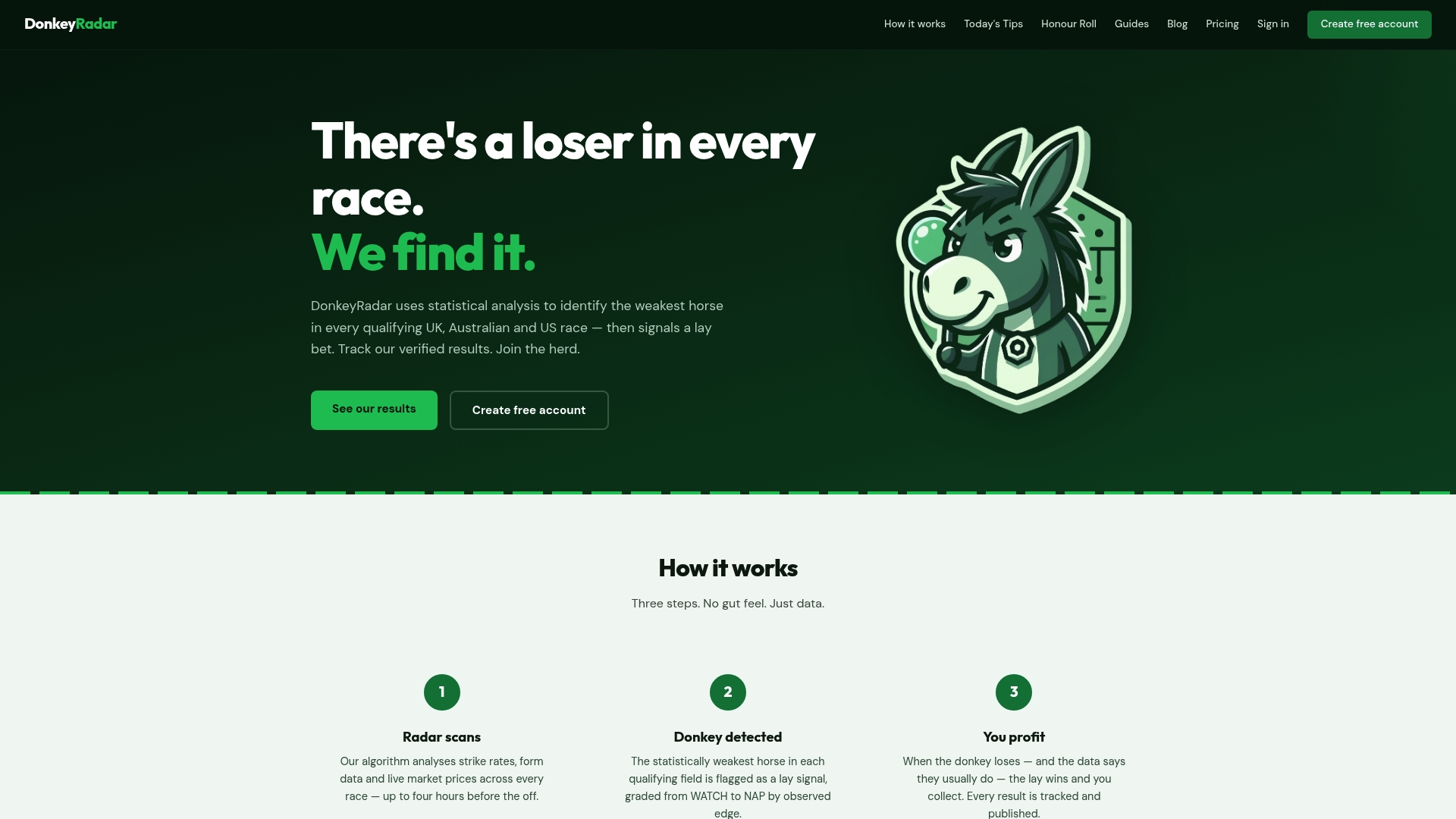
Donkeyradar publishes pre-race lay signals for UK, Australian, and US horse racing, generated by statistical analysis of historical strike rates and live market prices. The service identifies the weakest runner in each race before the off, with all signals and results tracked publicly.
What you get:
- Pre-race lay signals with staking tier grades (confidence-banded)
- Dashboard with direct Betfair Exchange links for one-click execution
- Real-time alerts via email and Telegram
- Public verified results history (wins and losses, no selective reporting)
- API access for integration with trading software such as Bet Angel
- Over-85% strike rate across tracked signals
The free tier gives you daily signals to paper trade before committing. The seven-day trial of the paid subscription unlocks real-time alerts, the full results history, and API access. Start by paper trading the signals against the public results for two weeks, then trial the service at minimum stakes using the lay betting calculator to confirm your liability on each trade. Check the lay-signal dashboard to see today’s signals and the full verified results history.
Stake responsibly. Use the staking tier grades to size positions, and apply the 1–2% bankroll rule to every signal.
Useful sources and further reading
The sources below support the claims in this article and provide deeper reading on specific strategies and tools.
- Betfair Horse Racing Trading: Complete Guide — comprehensive overview of UK and Irish racing markets, liquidity patterns, and strategy frameworks
- Lay the Field Strategy: How to Trade Horse Racing Without Picking a Winner — detailed breakdown of lay-the-field mechanics, position pile-up risk, and mitigation rules
- Lay the Draw Strategy on Betfair: Complete Guide — pre-match filters, stop-loss rules, and worked examples for football trading
- Betfair in-play trading mastery guide — in-running strategy rules, trigger-based execution, and automation guidance
- In-running horse racing trading on Betfair — latency requirements, software comparison, and execution timing for in-play horse racing
- BeGambleAware — responsible gambling resources and consumer protection guidance for UK bettors
- How to lay a horse on Betfair: step-by-step guide — practical execution guide for placing lay bets on the exchange
- Market movers on Betfair: how to spot and use them — identifying steam and drift for swing and back-to-lay strategies