← Blog · 📝 Article · 14 August 2026
Betting results tracking: the UK lay bettor's guide

Betting results tracking: the UK lay bettor’s guide
Start tracking every bet today. Record stake, odds taken, and closing line for each wager, then store it in a dedicated tracker or a disciplined CSV spreadsheet. For UK lay bettors, Donkeyradar is the recommended starting point: verified results, Betfair exchange links, staking tier grading, and CSV export are all built in.
First steps to take now:
- Log every wager immediately after placing it; memory is unreliable and backfilling corrupts your data
- Capture the closing line for every bet, not just the odds you took
- Record deposits, withdrawals, and exchange balances as transactions, not just P&L
- Back up your CSV or tracker data to cloud storage weekly
Key takeaways
Consistent betting results tracking requires logging every bet with closing line data, segmenting by market to calculate CLV, and acting on objective thresholds rather than short-term ROI alone.
| Point | Details |
|---|---|
| Log every bet immediately | Record stake, odds, closing line, and fees at placement; never backfill from memory. |
| CLV beats short-term ROI | Consistently beating the closing line signals a +EV process even when results fluctuate. |
| Sample size before action | Wait for 50+ bets per slice for basic ROI signals; 100–200 bets for reliable CLV estimates. |
| Spreadsheet or tracker | Use a CSV spreadsheet at low volume; move to a dedicated tracker when closing-line entry becomes the bottleneck. |
| Donkeyradar for lay bettors | Verified pre-race signals, CSV export, and Betfair links make it the recommended UK-ready option. |
Table of Contents
- What a bet tracker actually does for your workflow
- The exact fields to record for every bet
- Which performance metrics matter and how to read them
- Spreadsheet versus dedicated tracker: two concrete workflows
- How to analyse your tracked results to find a genuine edge
- Common tracking mistakes and how to avoid them
- Why Donkeyradar helps: verified results and UK-ready lay analytics
- How tracked data changes strategy in practice
- Donkeyradar: automated tracking for UK lay bettors
- Sources
What a bet tracker actually does for your workflow
A bet tracker is a performance ledger, not just a record of wins and losses. The features you will use daily fall into three groups.
Core logging and analytics:
- One-click bet entry with auto-populated fields (sport, market, bookmaker)
- Automatic closing-line lookup for CLV calculation
- P&L dashboard showing profit, ROI, and units won or lost
- Market movement graphs that plot odds from placement to close
Account and transaction management:
- Deposit and withdrawal ledger by sportsbook or exchange
- Balance reconciliation across multiple accounts
- Pending bets flagged until settlement
Utility and integration features:
- Tagging and notes fields (injuries, weather, source of signal)
- Segmented filters by sport, market, bet type, and date range
- Staking grade support for graded or tiered staking systems
- API access and alerts via email or Telegram for automated logging
- CSV import and export for bulk edits and external analysis
Pro Tip: Automatic closing-line import is the single most time-saving feature for bettors who care about CLV. If your tracker does not pull closing lines automatically, you will skip them under pressure, which defeats the purpose of tracking at all.
Dedicated trackers scale better than spreadsheets as volume grows, precisely because these automations remove the manual steps that cause data gaps.
The exact fields to record for every bet
Every wager needs a consistent schema. Without it, your data cannot be filtered, segmented, or trusted. Copy the fields below into your spreadsheet or CSV template before you place your next bet.
Minimum fields for every wager:
Advanced fields for serious analysis:
- Closing line odds (for CLV calculation)
- Edge estimate or EV% at time of placement
- Signal source (scanner, model, or judgement)
- Notes (injury news, going change, market move)
- Commission or exchange fees
- Transaction ID and account or profile label
CSV template guidance: keep columns in the order above. Add a CLV% column with the formula =(Odds_taken - Closing_line) / Closing_line * 100 and a P/L formula =IF(Result="Win", Stake*(Odds-1), -Stake) for back bets. Use dropdown validation on key fields such as sport, market, and result to prevent typos that break filters later.
Which performance metrics matter and how to read them
Not every metric tells you something useful. Focus on the handful that actually predict whether your process is profitable long-term.
Core metrics to monitor:
- Profit/loss (£ and units): the bottom line, but noisy over short samples
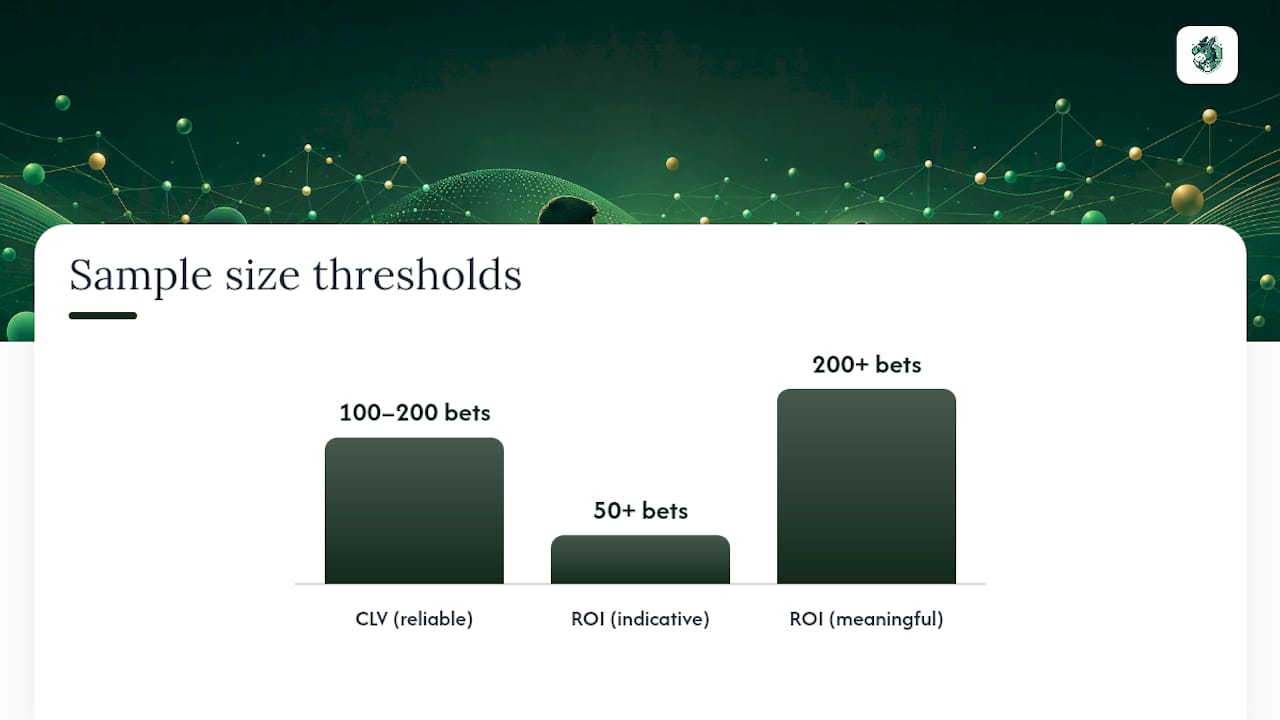
- ROI: profit divided by total staked; meaningful only above 200+ bets per slice
- Units won/lost: normalises stake size so you can compare across periods
- Strike rate: percentage of bets that win; context-dependent by market type
- Turnover: total staked; needed to calculate ROI and assess exposure
Edge and predictive metrics:
- Closing line value (CLV): the difference between your odds and the closing price, expressed as a percentage. CLV is the strongest predictor of long-term betting success; consistently beating the closing line signals +EV process even when short-term ROI is negative
- CLV by slice: CLV broken down by sport, market, or sportsbook reveals where your edge actually lives
- Average odds: tracks whether you are drifting toward shorter or longer prices over time
- Variance: the statistical spread of results; high-odds bettors need larger samples before drawing conclusions
Sample-size guidance: treat 100–200 bets as the minimum for a reliable CLV estimate on any single slice. For basic ROI signals, 50+ bets per slice gives an indicative read, but act cautiously until you have more. Smaller samples produce misleading figures in both directions.
CLV beats short-term ROI as a process measure because it reflects the quality of your price, not the randomness of outcomes. A bettor with positive CLV and negative ROI over 80 bets is almost certainly running well below expectation, not running a losing strategy.
Spreadsheet versus dedicated tracker: two concrete workflows
Choose the method that matches your current volume and commit to it. Switching mid-stream corrupts your historical data.
Spreadsheet/CSV workflow:
- Copy the field schema from the section above into a new Google Sheets or Excel file
- Add dropdown validation on Sport, Market, Bookmaker, and Result columns
- Create a separate Transactions tab for deposits, withdrawals, and balances
- Add a Summary tab with formulas for total P&L, ROI, units, and strike rate
- After each race or event, check the closing line and enter it in the Closing Line column
- At the end of each week, export as CSV and upload to cloud storage (Google Drive or Dropbox)
- Run a monthly filter by sport and market to review CLV by slice
CSV import/export tips: structure your file with a single header row and no merged cells. Use ISO date format (YYYY-MM-DD) so imports parse correctly. When exporting from a tracker, check that commission fields export as negative values, not as a separate column, before reimporting for bulk edits.
Dedicated tracker workflow:
- Create an account and connect your Betfair exchange profile
- Use one-click logging immediately after each bet is placed
- Let the tracker pull closing lines automatically overnight
- Review the P&L dashboard and CLV summary each morning
- Export CSV monthly for offline backup and deeper analysis in Excel or Sheets
Spreadsheets work well at low volume, but once you are placing 50+ bets per month across multiple markets, the manual closing-line step becomes the bottleneck. That is the natural point to move to a dedicated tracker with automatic CLV import and visual dashboards.
How to analyse your tracked results to find a genuine edge
Raw data does not tell you anything until you segment it. The goal is to identify which slices of your betting are genuinely +EV and which are draining your bankroll.
Segmentation approach:
- Split results by sport, competition, market type, bookmaker or exchange, stake tier, and time of day
- Calculate ROI and CLV separately for each slice
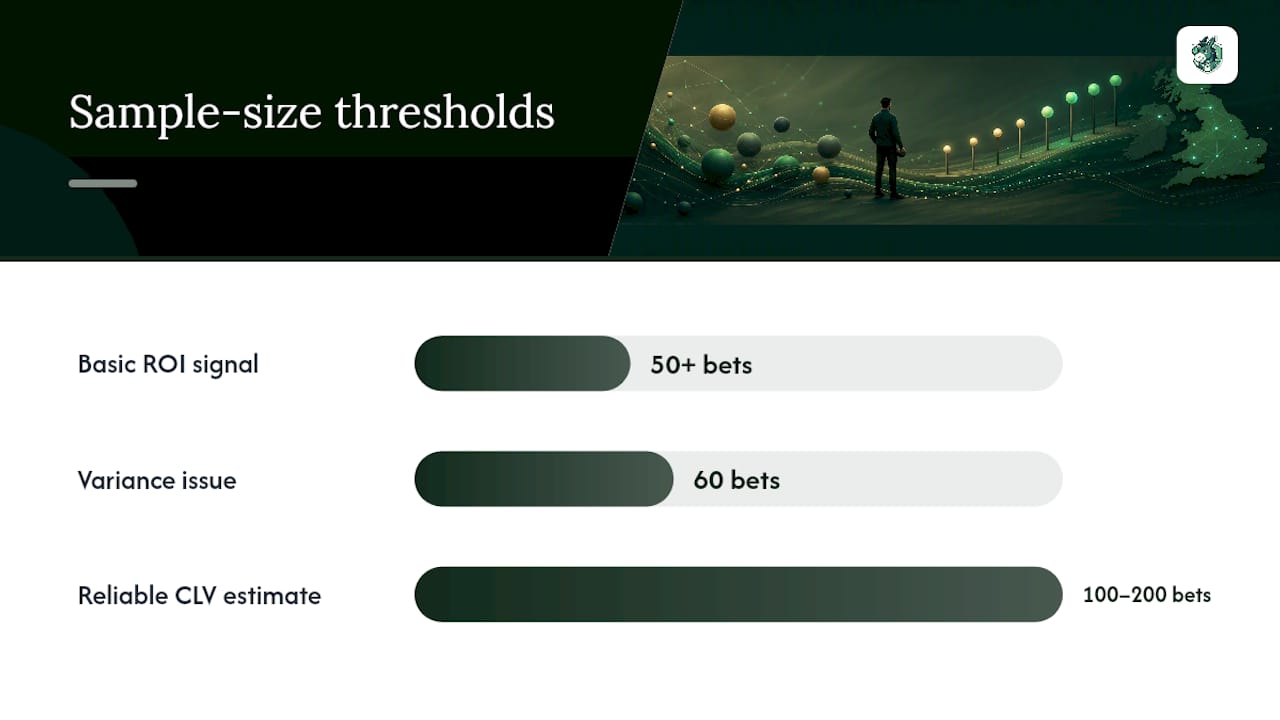
- Compare slices: a market with positive CLV and negative ROI over 60 bets is likely a variance issue; a market with negative CLV and positive ROI is likely a lucky run
Sample-size rules in practice:
- 50+ bets per slice: enough for a basic ROI signal, act with caution
- 100–200 bets per slice: reliable CLV estimate, sufficient to make staking decisions
Using CLV and closing-line movement together:
Combine CLV with the direction of market movement. If you consistently take prices that shorten to the close, your signal is finding value. If prices drift after you bet, review the source of that signal. For lay bettors using data-driven models, tracking CLV by signal source reveals which inputs are generating genuine edge.
Pro Tip: Build an action list with objective thresholds. Any slice above your target CLV gets increased allocation. Remove emotion from the decision by writing the rule before you review the data.
Common tracking mistakes and how to avoid them
Most tracking errors fall into a small number of categories. Each one distorts your analysis in a specific, predictable way.
- Cherry-picking results: logging wins and forgetting small losses or cash-outs is the most damaging habit. Every bet, including the embarrassing ones, must be entered. Selective logging is the most common mistake bettors make and it produces false confidence in a losing strategy
- Omitting closing lines: without closing lines, CLV cannot be calculated. This single omission removes your most reliable performance signal. Set a daily reminder to enter closing prices before they disappear from the exchange
- Skipping fees and commission: Betfair charges commission on net winnings. Omitting it overstates ROI, sometimes significantly on high-turnover accounts. Log commission as a negative P&L entry on each settled bet
- Inconsistent stake units: mixing £ stakes with unit stakes in the same column, or changing your unit size mid-sample, makes ROI calculations meaningless. Fix your unit value at the start of each month and do not change it mid-review
- Sloppy bookmaker names: “Betfair”, “BF”, and “Betfair Exchange” in the same column break filters. Use dropdown validation to enforce a single canonical name per account
- Acting on small samples: a 20% ROI over 15 bets means nothing. Integrate sample-size rules into your monthly review and flag any slice with fewer than 50 bets as “insufficient data” rather than a signal to act on
Why Donkeyradar helps: verified results and UK-ready lay analytics
For UK lay bettors, the tracking workflow described above is only as good as the signal feeding it. Donkeyradar publishes every lay signal before the race starts, then settles and records the result publicly. That pre-race publication is what makes the record independently verifiable.
Platform proof points:
- Public verified results history: every signal, price, and outcome is logged and accessible
- Signals published prior to races, eliminating any possibility of post-race selection
- Direct Betfair exchange links on the dashboard for immediate one-click bet placement
- Staking tier grading so you can match stake size to signal confidence
- CSV export of the full results history for import into your own spreadsheet or tracker
- API access for integration with trading software and automated logging
- Real-time alerts via email and Telegram, reducing manual entry to near zero
Publishing a full, settled record — every pick, price posted before the event, settled results visible to all — is the industry standard for proving signal performance. A service that cannot show you a complete, pre-race-published record is asking you to trust marketing copy instead of data.
UK context: betting profits are tax-free for most recreational bettors in the UK, which means your tracked P&L is your actual return. Donkeyradar covers UK, Australian, and US horse races, with UK coverage as the primary market. The Betfair lay betting strategy guide on the Donkeyradar site explains how the signal methodology integrates with exchange mechanics for those who want the full picture.
For responsible gambling support, GamCare offers free advice, self-exclusion tools, and a helpline for anyone who needs it. This article is general information, not financial or gambling advice; always bet within your means.
How tracked data changes strategy in practice
Here is a concrete example of what acting on tracked data looks like. The ROI figures point the same direction but are noisier.
The decision is straightforward: reduce stakes on sprint handicaps to minimum unit size and reallocate to mile-plus handicaps where the CLV signal is positive and the sample is above the 100-bet threshold. No gut feel involved. The metrics set the rule; the data triggers the action.
That is the practical value of disciplined lay betting performance tracking. Without the segmented CLV data, both market types look like “horse racing lays” in aggregate, and the losing slice quietly erodes the gains from the winning one.
Donkeyradar: automated tracking for UK lay bettors
Verified results and automated exports are where Donkeyradar earns its place in a serious bettor’s workflow. Every signal is published before the race, settled publicly, and available as a CSV download, so your analysis starts with clean, audited data rather than a manually assembled spreadsheet.
Sign up for the free tier and you receive daily lay signals with direct Betfair links from day one. During the first seven days, you get access to sample verified history, automated email and Telegram alerts for immediate logging, and basic CSV export for analysis in your own tracker or spreadsheet. The lay betting calculator helps you size stakes and liabilities correctly from the outset, and the staking tier grading tells you how much confidence each signal carries. Your data stays exportable at every stage. Start your free trial at Donkeyradar and have your first verified results in your spreadsheet before the end of the week.
Sources
- How to Track Your Bets: The Foundation of Profitable Betting | Bet Hero
- How to Track Your Bets: The Spreadsheet Every Bettor Needs | SharkSnip
- Our Verified Betting Record — Every Pick, Tracked | Bet Better
- GamCare