← Blog · 📝 Article · 15 August 2026
Betfair unmatched bets: how to fix and avoid them

An unmatched bet on Betfair Exchange is an open offer that no other user has accepted at your chosen odds. The fastest fix for a fully unmatched bet is to cancel it via My Bets and re-place at current market odds. For a partially matched bet, use a part-lays calculator to cover the remaining exposure.
Quick action checklist:
- Open the My Bets tab and confirm the status (Unmatched, Partially Matched, or Matched).
- Cancel the unmatched portion using the Cancel Unmatched control, then check current market depth before re-placing.
- For partial matches, use a part-lays calculator to compute the remaining lay or back required.
Pro Tip: Never place a replacement bet before confirming the original is cancelled. Duplicate entries can produce multiple matched positions at different prices, leaving you over-exposed without realising it.
Key takeaways
Unmatched bets on Betfair Exchange are open offers that have not been accepted; the fastest fix is to cancel via My Bets and re-place after checking market depth, or use a part-lays calculator for partial matches.
| Point | Details |
|---|---|
| Check My Bets first | Always confirm bet status before placing a replacement to avoid duplicate matched exposure. |
| Cancel and re-place cleanly | Use Cancel Unmatched, verify current liquidity, then re-enter at updated odds or switch to Take SP. |
| Use part-lays for partials | Enter the matched amount in a calculator’s part-lays mode to compute the exact remaining stake required. |
| Edit rather than cancel in fast markets | Adjusting odds on an existing unmatched order reduces race-condition risk compared to cancelling and re-entering. |
| Match stake to available volume | Keep lay stakes below the visible volume at your target price to avoid automatic partial matches. |
Table of Contents
- What do matched, partially matched, and unmatched mean on Betfair?
- Where to find unmatched bets in the Betfair interface
- What happens to your unmatched bet when the market goes off?
- How to fix a fully unmatched Betfair bet
- How to handle a partially matched bet using part-lays
- Why do unmatched and partially matched bets happen?
- Practical tactics to avoid unmatched and partially matched bets
- How Donkeyradar’s lay signals reduce unmatched risk
- The habit that separates disciplined exchange bettors from the rest
- Sources
What do matched, partially matched, and unmatched mean on Betfair?
Understanding the three status labels is the foundation of managing your exchange positions correctly. Each carries a different implication for your liability and your next action.
- Matched: Your bet has been accepted in full by another exchange user at your stated odds. Your liability is locked in and the bet will settle normally. This is the only status where your position is complete.
- Partially matched: Part of your stake has been accepted; the remainder is still sitting as an open offer. The matched portion creates real exposure, while the unmatched portion is held but not yet committed. This split position is where most problems arise, because your lay vs back exposure may no longer match your original intent.
- Unmatched: Your entire stake remains an open offer. No opposing money has accepted your price. The stake is held by Betfair but returns to your account if the market lapses, or if you cancel.
A practical contrast: you place a £50 lay at 5.0. If £30 matches and £20 does not, you carry the liability of a £30 lay while the £20 remains at risk of matching at a potentially worse price if the market moves. That split is the core problem a part-lays workflow solves.
Where to find unmatched bets in the Betfair interface
Locating the right controls quickly matters, especially in fast-moving pre-race markets. The layout differs slightly between desktop and the mobile app, but the logic is the same.
- Desktop: Click My Bets in the top navigation. Select the Unmatched tab to see all open offers. Each row shows the selection, odds, stake, and a Cancel button. The matched portion of a partial match appears in the Matched tab simultaneously.
- Mobile app: Tap the My Bets icon at the bottom of the screen. Swipe to the Open or Unmatched sub-tab. The cancel control appears as a cross or Cancel Unmatched link next to the relevant bet.
- Bet slip (pre-confirmation): Before you confirm a bet, the slip shows available volume at your chosen price. If available volume is lower than your stake, a partial match is likely the moment you confirm.
- Queue position and market depth: On desktop, hovering over the odds ladder shows the total money available at each price. A thin column means low liquidity. For a detailed walkthrough of the execution interface, the step-by-step Betfair lay guide covers the key screens.
Oddsmatcher tools and exchange software typically display an availability filter alongside each market, flagging whether sufficient volume exists at your target price before you commit.
What happens to your unmatched bet when the market goes off?
When a race starts and the market is turned in-play (or suspended), Betfair applies automatic rules to any outstanding unmatched stakes. Your choice of setting determines what happens next.
- Lapse (default): If you have not selected Keep or Take SP, an unmatched bet lapses at off. The stake is returned to your account immediately. No position is created.
- Keep: Selecting Keep instructs Betfair to leave your unmatched offer in the market once it goes in-play. There is a chance it matches during in-play trading, but in-play markets move fast and the odds at which it matches may differ significantly from your original price.
- Take SP: The remaining unmatched stake converts to a Starting Price bet at the moment the market suspends. Betfair’s official guidance on SP options confirms this conversion happens at market suspension, not at the time you placed the original bet.
| Option | What it does | Best used when |
|---|---|---|
| Lapse (default) | Returns stake at off | You want no in-play exposure |
| Keep | Leaves offer open in-play | You are comfortable with in-play price risk |
| Take SP | Converts remaining stake to BSP | You want guaranteed matching at Starting Price |
Non-runners add a further wrinkle. If a non-runner triggers a reduction factor above Betfair’s threshold, unmatched lay bets on other runners may be automatically cancelled; if Take SP is selected, the system may convert rather than cancel. Check the BSP mechanics guide if you use SP options regularly.
How to fix a fully unmatched Betfair bet
A fully unmatched bet has not created any exposure yet, so you have time to act cleanly. Speed matters in pre-race markets, but accuracy matters more.
- Check My Bets first. Confirm the bet is genuinely unmatched before doing anything else. Placing a second bet without checking is the single most common and costly mistake.
- Cancel the unmatched bet. Click or tap Cancel Unmatched next to the relevant row. The stake returns to your account balance immediately.
- Assess current market depth. Look at the available volume at your target price. If volume is thin, consider moving one or two ticks in your favour to attract a match.
- Re-place at updated odds. Enter the revised stake and odds, confirm, and monitor My Bets to verify the new bet matches.
- Consider Keep or Take SP if the race is imminent and you still want exposure. Take SP is the lower-risk route when you need guaranteed matching.
Pro Tip: In fast markets, it is often safer to edit the odds on your existing unmatched order rather than cancelling and re-entering. Cancelling creates a brief window where the market can move further against you before your new order is accepted. The Outplayed guide makes this point clearly: adjusting an existing order reduces race-condition risk.
How to handle a partially matched bet using part-lays
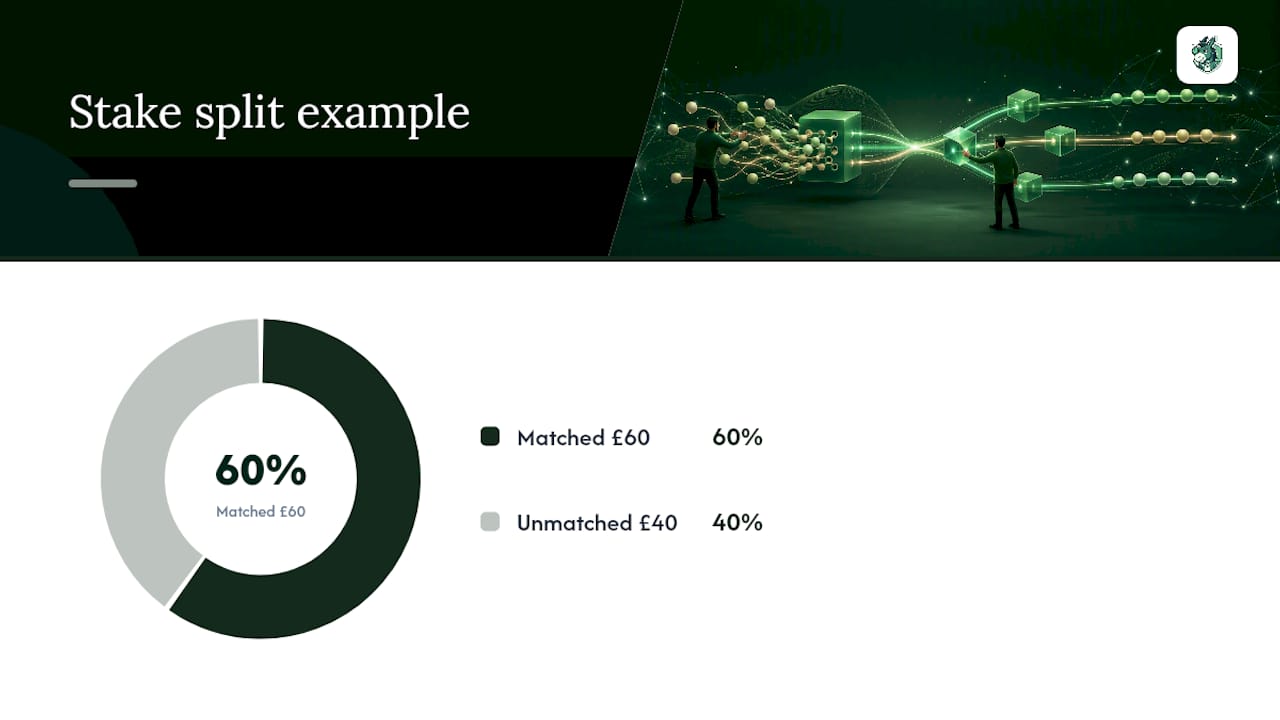
A partial match is more complex because you already carry real exposure on the matched portion. The goal is to cover the unmatched remainder so your total position reflects your original intent.
The core workflow:
- Open My Bets and note the matched amount and the unmatched amount separately.
- Open a matched-betting calculator that has a part-lays toggle. Switch it on and enter the matched stake and the odds at which it matched.
- The calculator outputs the additional lay (or back) required to complete your position. This is the remaining stake you need to place.
- Check current market odds. If the price has moved, the calculator will show the adjusted liability for the new odds.
- Place the remaining lay at the best available price, then confirm both portions appear in My Bets as matched.
Worked example: You intend to lay £100 at 4.0. Only £60 matches. The unmatched £40 sits open. Using the OddsMonkey part-lays workflow, you enter £60 matched at 4.0, then check the current price. If the market has drifted to 4.2, the calculator shows you need to lay approximately £40 at 4.2 to cover the remainder, with a slightly higher liability per unit. Commission on both portions applies at your standard Betfair rate.
- Cancel the unmatched portion if the price has moved significantly and you want a clean re-entry.
- Relay the remainder at current odds if the drift is minor and the calculator confirms acceptable liability.
- Avoid leaving the partial open into in-play unless you have selected Keep deliberately.
Why do unmatched and partially matched bets happen?
Most cases trace back to a handful of predictable causes. Recognising your pattern helps you prevent repeats.
- Insufficient liquidity at your chosen price. The market simply does not have enough opposing money at that odds point. This is the primary cause, particularly in smaller races or exotic markets.
- Odds movement during processing. Betfair markets move in real time. By the time your order reaches the exchange, the price may have shifted and the volume you targeted has gone. Latency and in-play delay are especially pronounced in the final minutes before a race.
- Stake larger than available volume. Placing a £200 lay in a market with only £80 available at your price guarantees a partial match at best.
- Thin or exotic markets. Ante-post markets, minor meetings, or place markets often carry a fraction of the liquidity found in major win markets.
- User errors. Incorrect odds entry, wrong stake, or failing to click Confirm on the bet slip all produce unmatched or void outcomes.
Practical tactics to avoid unmatched and partially matched bets
Prevention is straightforward once you build the right habits into your pre-bet routine.
- Check available volume before placing. The odds ladder on desktop shows money at each price. If your stake exceeds available volume, split it or move your price.
- Use availability filters in oddsmatcher software. Most tools let you set a minimum availability threshold so low-liquidity matches are filtered out automatically.
- Place bets with time to spare. Liquidity is deepest 10–30 minutes before a race. Last-second entries in fast-moving markets carry the highest unmatched risk.
- Edit rather than cancel in fast markets. Adjusting the odds on an existing unmatched order is quicker and safer than cancelling and re-entering when prices are moving rapidly.
- Size stakes conservatively relative to market depth. A rule of thumb: keep your lay stake below 50% of the visible volume at your target price to allow for market movement.
- Use calculators proactively. Running the numbers before you place, not after a partial match occurs, lets you set realistic stakes from the start.
- Verify commission settings. Betfair’s commission rate affects net liability calculations. Confirm your current rate in your account settings before computing stakes.
Pro Tip: Set a minimum availability threshold in your software before each session. Signals that cannot be filled at the required stake are better skipped than partially matched, especially when your strategy depends on precise liability control.
How Donkeyradar’s lay signals reduce unmatched risk
Unmatched risk is not just a UI problem. It is a signal-quality problem. Donkeyradar’s algorithm filters lay signals by historical strike rates and live market liquidity before publishing them, which means the runners flagged tend to attract sufficient opposing volume at the recommended price.
- Pre-race liquidity filtering. Signals are generated using live market prices, so runners in thin or illiquid markets are less likely to appear as high-confidence lay candidates.
- Direct Betfair Exchange links. The dashboard provides direct links to the relevant Betfair market, reducing the time between receiving a signal and placing the bet. Faster execution means less exposure to price drift.
- Staking tier grading. Each signal carries a recommended staking tier, which aligns stake size with the liquidity profile of the market. Oversizing relative to available volume is one of the most common causes of partial matches.
- Verified results history. All signals are published pre-race and tracked publicly, so you can assess historical performance and calibrate your own stake sizing accordingly.
Subscriber workflow: Receive signal via email or Telegram alert, confirm market availability on the dashboard, place at the recommended stake tier, and use the lay betting calculator if a partial match appears. That sequence covers the main failure points most exchange bettors encounter.
If you want a data-driven approach that reduces the guesswork around liquidity and stake sizing, the Donkeyradar lay betting strategy guide is a practical next step.
The habit that separates disciplined exchange bettors from the rest
Most unmatched bets are not a platform problem. They are a discipline problem. The bettors who encounter them repeatedly share a common pattern: they place first and check second.
Checking My Bets before re-entering a stake takes five seconds. Unwinding a double-matched position at the wrong odds can cost multiples of your original intended liability. The maths is not complicated, but the habit requires deliberate repetition before it becomes automatic.
Donkeyradar’s pre-race signal workflow builds that check into the process by design. You receive the signal, you confirm availability, you place. The sequence does not skip the verification step. For bettors who want to manage their time and money responsibly, BeGambleAware and GamCare offer practical tools for setting limits and maintaining control.
Sources
- Exchange: What is the difference between matched and unmatched bets?
- How Do I Fix An Unmatched Or Partially Matched Bet? – OddsMonkey
- Unmatched Bets Explained | Outplayed
- Partially Matched And Unmatched Bets: How to Fix and Avoid them?