← Blog · 📝 Article · 8 August 2026
False favourites horse racing: spot and lay them

A false favourite is the market leader whose form ratings, speed figures, or race conditions say it should not be favourite at all. The immediate action for a lay bettor: run a quick ratings check, confirm the odds are below 3.0 on Betfair, and look for at least three rivals with higher FormRatings HRS scores before placing a lay.
Two signals to check at a glance:
- Rating gap: three or more rivals with a higher HRS or normalised speed figure than the market leader
- Odds threshold: favourite priced below 3.0 (implied probability above 33%) with no clear form justification
Donkeyradar’s algorithm cross-references historical strike rates against live market prices to flag exactly these situations before the off, publishing every signal publicly so you can verify the track record before staking a penny.
Pro Tip: Before you lay anything, check whether the favourite has drifted in the last 30 minutes. Early drift combined with a rating gap is a stronger signal than either alone.
Table of Contents
- What does ‘false favourite’ actually mean in UK racing?
- Which data signals reliably flag a false favourite?
- How to run a five-minute false-favourite check before the race
- How to place a lay bet on Betfair and manage your liability
- Which race types and meetings produce the most false favourites?
- What performance should you realistically expect from a lay strategy?
- How Donkeyradar finds false favourites and proves it works
- Common pitfalls when you start laying false favourites
- Key takeaways
- Laying false favourites takes more discipline than most bettors expect
- Donkeyradar gives you the signals, the proof, and the tools
- Useful sources and further reading
What does ‘false favourite’ actually mean in UK racing?
The terms get used interchangeably, but they describe different problems. A weak favourite is simply underpriced relative to its true winning chance. A false favourite is a step further: it is the market leader when a meaningfully better horse exists in the same race. The distinction matters because the lay case is stronger for a false favourite. You are not just arguing the price is wrong; you are arguing the wrong horse is favourite.
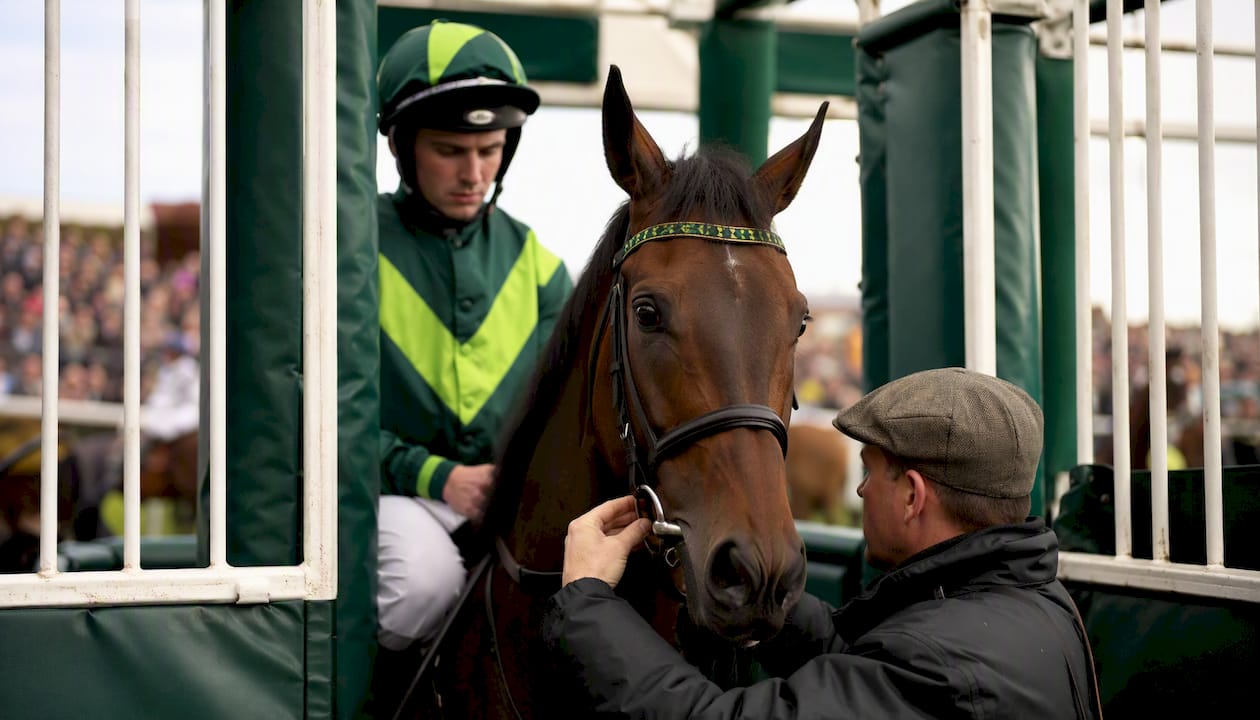
Bookmakers and exchanges display the favourite as the runner with the shortest available odds. That price reflects public money as much as it reflects form. When a horse attracts heavy backing from casual bettors reacting to a recent win or a familiar trainer’s name, the market price can compress well below what the ratings justify.
FormRatings and speed-rating providers assign numerical scores based on past performance, adjusted for class, going, and distance. Different providers use different scales, so a raw comparison across sources is unreliable. The key is to compare horses within the same ratings system on the same day.
Two common causes in UK racing: a trainer stepping a horse up sharply in class after a comfortable win at a lower level, and a horse priced as favourite on good-to-firm form now running on soft ground. Both create a gap between market perception and likely performance.
Which data signals reliably flag a false favourite?
The most reliable single rule comes from FormRatings’ false-favourite system: flag the favourite when three or more rivals carry a higher HRS score. That threshold filters out marginal cases and keeps the strike rate meaningful.
Speed ratings add a second layer. Normalised speed figures must be adjusted for track variant and distance before comparison. A horse that ran a raw figure of 95 at Chelmsford on fast ground is not directly comparable to one that ran 93 at Haydock on soft. Once adjusted, if another runner’s figure exceeds the favourite’s by a clear margin, the favourite’s price deserves scrutiny.
| Signal | What to check | Why it matters |
|---|---|---|
| HRS / FormRatings gap | ≥3 rivals rated higher | Rules-based, removes subjectivity |
| Normalised speed figure | Rival’s adjusted figure exceeds favourite’s | Accounts for track and going variance |
| Trainer/jockey strike rate | Recent form | Flags cold yards or jockey switches |
| Market drift | Favourite drifts in the final hour | Public money may be going elsewhere |
| Going mismatch | Last run on firm, today soft (or vice versa) | Form figures may not translate |
Market behaviour is worth watching separately. A short-priced favourite below 3.0 that drifts in the final hour, while a rival shortens, often signals that informed money has moved. Heavy public support into a horse that ratings do not justify is one of the clearest signs of a media-driven false favourite.
Going and trip are not optional checks. A horse with a strong record on good ground running on heavy going, or stepping up from six furlongs to a mile for the first time, carries form figures that may simply not apply. Folding going bias into your ratings check takes under a minute and removes a significant source of false positives.
Pro Tip: Speed figures from different providers are not interchangeable. Pick one source, learn its scale, and stick to it. Mixing Timeform figures with Racing Post ratings in the same comparison produces noise, not signal.
How to run a five-minute false-favourite check before the race
This checklist runs in order. Each step either confirms or kills the lay case. Stop if the case collapses at any point.
- Pull the racecard and ratings (60 seconds). Open FormRatings or your preferred speed-figure source. Note the favourite’s HRS score and the scores of every other runner.
- Count rivals with higher ratings (30 seconds). If fewer than three rivals score higher, the lay case is weak. Move on to the next race.
- Check going and trip (60 seconds). Does the favourite’s best form come on different going? Is today’s trip outside its proven range? A yes to either strengthens the case. Use Donkeyradar’s going bias guide for quick reference on surface effects.
- Check the live market (60 seconds). Is the favourite below 3.0? Has it drifted since the morning price? A drifting favourite below 3.0 with a ratings gap is the core false-favourite profile.
- Check trainer and jockey form (30 seconds). A trainer with fewer than two winners from their last 20 runners, or a last-minute jockey switch, adds weight to the lay case.
- Confirm field size (15 seconds). Avoid laying in fields of four or fewer runners. Small fields reduce variance and increase the favourite’s win probability regardless of ratings.
- Make the staking decision (45 seconds). If steps 1–6 all point the same way, size your lay stake using the lay betting calculator and confirm your maximum liability before placing.
The essential steps are 1, 2, and 4. Steps 3, 5, and 6 are confirmatory. Running all seven takes under five minutes on a standard racecard.
- Odds threshold: favourite priced at 2.0–3.0 is the sweet spot for liability control
- Rating threshold: three or more rivals with higher HRS scores (FormRatings rule)
- Field size minimum: seven or more runners before laying
- Going check: flag any horse whose best form came on ground two or more categories different from today’s
How to place a lay bet on Betfair and manage your liability
Laying a horse on Betfair means acting as the bookmaker: you accept another bettor’s back bet, and you pay out if the horse wins. The mechanics of lay betting are straightforward once you understand liability.
Step-by-step on Betfair:
- Log in and navigate to the relevant race market.
- Click the pink (lay) price next to the horse you want to lay.
- Enter your lay stake in the “Backer’s Stake” field. This is the amount you stand to win if the horse loses.
- The interface shows your liability automatically. Liability = lay stake × (odds – 1).
- Confirm the bet. Your liability is reserved from your balance immediately.
Worked example: You lay a favourite at odds of 2.5 for a £10 backer’s stake. Your liability is £10 × (2.5 – 1) = £15. If the horse loses, you collect £10 profit. If it wins, you pay £15. That asymmetry is why odds and field selection matter.
For a Betfair lay betting strategy, a sensible starting point is to risk no more than 2–3% of your total bankroll as liability on any single lay. At odds of 2.5, a 2% liability on a £500 bankroll means a backer’s stake of roughly £6.70.
Timing matters too. Taking the early morning price on a false favourite can be advantageous if you expect it to drift. Waiting for drift to confirm before placing reduces the odds available but increases confidence. Liquidity is thinner on midweek cards, so large lay stakes can move the market. Keep stakes proportionate to market depth.
Pro Tip: Always check the “Liability” figure in Betfair’s bet slip before confirming. A misplaced decimal in the stake field can multiply your liability tenfold. One check takes two seconds.
Which race types and meetings produce the most false favourites?
Midweek cards at smaller tracks are where false favourites appear most often. Lower market volume means pricing errors persist longer. Big Saturday meetings at Ascot or Cheltenham attract sharper money that corrects mispricings quickly.
Race types to target:
Race types to avoid:
- Grade 1 and Group 1 races: — Sharp professional money dominates these markets. False favourites are rare and the lay case is usually thin.
Soft and heavy going days produce more favourite upsets across the board. Horses with exposed form on good ground are harder to assess on soft, and the market often underestimates the impact. Draw and course bias can also create a false favourite: a horse with strong form at a track where its draw is statistically disadvantaged may be priced as if the bias does not exist.
A practical approach: focus on one meeting per day rather than spreading across the card. Building familiarity with a single track’s going tendencies, draw statistics, and trainer patterns gives you a genuine edge over a bettor scanning every race nationally.
What performance should you realistically expect from a lay strategy?
Market favourites win roughly 30–35% of races. That means layers win roughly 65–70% of bets on an undiscriminating lay-the-favourite approach. The problem is liability: a single winning favourite at 2.5 wipes out two and a half winning lay bets at the same stake. Profitable laying requires selection, not volume.
A filtered false-favourite method, using the rating and going checks above, targets a subset of those races where the favourite is structurally weaker. The goal is a higher win rate on lays than the base 65–70%, with controlled average liability.
| Metric | What to track | Why |
|---|---|---|
| Strike rate | Wins / total lays | Core performance measure |
| ROI | (Profit / total liability) × 100 | Accounts for stake and odds variation |
| Average liability | Total liability / number of bets | Controls for stake sizing drift |
| A/E ratio | Actual wins / expected wins | Measures selection skill vs chance |
| Sample size | Minimum 100 bets before drawing conclusions | Avoids small-sample noise |
A backtest protocol worth following: select a fixed 12-month historical period, apply your entry rules without adjustment, record every qualifying race, and then test the same rules on a separate out-of-sample period before staking real money. Changing the rules after seeing results invalidates the test.
Trust signals to demand from any published results service: pre-race timestamps on every signal, a public results log that includes losses, and a sample size large enough to be statistically meaningful. A service showing 20 winning lays with no losses is not a track record.
Pro Tip: Track your A/E ratio alongside strike rate. A strike rate of 72% sounds good, but if your expected rate given the odds was 74%, you are underperforming. The A/E ratio catches that; raw strike rate alone does not.
For deeper analytical techniques, Donkeyradar’s horse racing data analysis guide covers how to structure a backtest and which variables to control for.
How Donkeyradar finds false favourites and proves it works
Donkeyradar’s approach is statistical and systematic. The algorithm processes historical strike rates for every runner in a qualifying race, cross-references those against live market prices, and assigns a signal tier before the race starts. The focus is on identifying the runner least likely to win, which in practice often means flagging the market favourite as the lay target when the data does not support its price.
Every signal is published before the off. That is not a marketing claim; it is the mechanism that makes verification possible. The public verified results history shows every signal with a timestamp, the odds at signal time, and the outcome. Losses are included. The overall strike rate sits at 85%, calculated across a substantial sample of UK, Australian, and US races.
You can replicate a simplified version of the check using public FormRatings data and a Betfair market snapshot:
- Pull the HRS scores for every runner from FormRatings
- Identify the market favourite on Betfair
- Check going and trip against the favourite’s best form
That five-step check mirrors the core logic Donkeyradar automates. The platform adds live market monitoring, staking tier grading, and real-time alerts via email and Telegram, which removes the manual effort and reduces the risk of missing a signal.
The data-driven checklist guide on Donkeyradar walks through the full selection process with worked examples. The lay betting calculator handles liability maths instantly. Both are available on the free tier.
Common pitfalls when you start laying false favourites
The most expensive mistake is indiscriminate laying: backing the method without running the checklist. A horse is not a false favourite simply because it is short-priced or because you dislike the trainer. The rating gap and going check must both be present.
Red flags before placing any lay:
- Heavy late support into the favourite in the final 15 minutes, contradicting earlier drift
- Field of five or fewer runners
- Last-minute jockey booking upgrade (a top jockey replacing a claimer is a negative signal for layers)
- Favourite running on going it has never encountered before (unknown, not unfavourable)
- Race is a Group 1 or Grade 1 with a full field of proven performers
Media-driven false favourites are a specific trap. A horse that won impressively last time out against weak opposition attracts coverage, which attracts casual money, which compresses the price. The ratings may show three rivals with higher HRS scores, but the narrative is so strong that the market ignores it. That is precisely the situation the checklist is designed to catch.
Overtrading after a winning run is a psychological trap. Three consecutive winning lays does not mean the fourth is lower risk. Each race is independent. Increasing stake size after a run of wins is how a single large liability wipes out accumulated profit.
Poor liability control is the technical equivalent. Laying a horse at 4.0 for a £20 backer’s stake means £60 in liability. At 6.0, the same stake means £100 in liability. Odds creep upward without a corresponding increase in selection quality is a common drift that destroys bankrolls quietly. The ten rules for profitable lay betting on Donkeyradar addresses this directly.
Key takeaways
False favourites in horse racing are most reliably identified by combining a FormRatings HRS gap of three or more rivals, an odds threshold below 3.0, and a going or trip mismatch, then managing lay liability to no more than 2–3% of bankroll per bet.
| Point | Details |
|---|---|
| Rating gap rule | Flag a false favourite when three or more rivals carry a higher HRS score than the market leader. |
| Odds threshold | The lay sweet spot is a favourite priced between 2.0 and 3.0 for manageable liability. |
| Race type priority | Large-field handicaps and maidens at midweek meetings produce the most false favourites. |
| Liability discipline | Risk no more than 2–3% of total bankroll as liability on any single lay bet. |
| Donkeyradar signals | Donkeyradar publishes pre-race lay signals with a verified results history and a strike rate of 85% across UK, Australian, and US races. |
Laying false favourites takes more discipline than most bettors expect
The data case for laying false favourites is solid. The execution case is harder. Most bettors who try it and fail do so not because the method is wrong, but because they abandon it after a run of losses or scale up stakes after a run of wins. Both responses are understandable and both are costly.
The asymmetry of lay betting is the part that catches people out. You win small and lose large. A strike rate above 70% still produces losing weeks when the losses cluster. That is not a flaw in the method; it is the statistical reality of any lay strategy. The answer is not to find a method with a higher strike rate. It is to size stakes so that a losing run does not threaten the bankroll.
There is also a tendency to over-engineer the selection process. More signals do not always mean better selections. The FormRatings HRS gap, a going check, and a market drift confirmation are three signals. Adding five more does not necessarily improve the strike rate; it often just reduces the number of qualifying bets to a point where the sample size becomes meaningless.
Responsible gambling matters here. Lay betting involves real financial risk. If you are concerned about your gambling, GambleAware and GamCare both offer free, confidential support. This article is general information, not financial or gambling advice. Always verify current exchange rules and confirm your own risk tolerance before staking.
Donkeyradar’s transparent signal publication and public results history make it a practical tool for bettors who want a data-driven starting point without building the model themselves.
Donkeyradar gives you the signals, the proof, and the tools
Skip the manual ratings pull. Donkeyradar’s algorithm runs the false-favourite check across UK, Australian, and US races before every card, publishing tiered lay signals with direct Betfair Exchange links so you can act without delay.
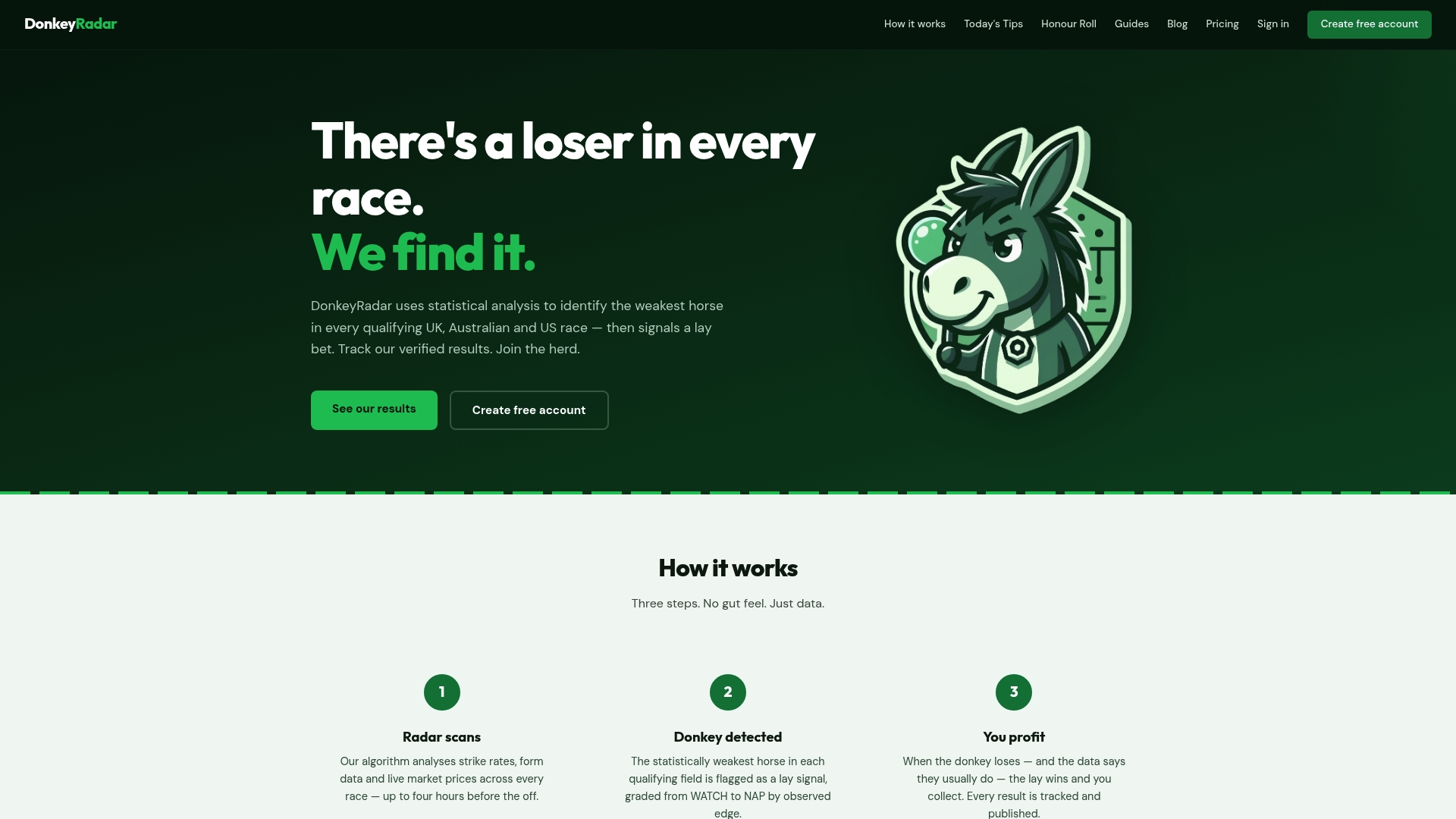
The verified results history is public and includes every loss. No cherry-picked runs. The strike rate is 85%, calculated across a large, documented sample. Three features that matter most for false-favourite laying:
- Lay betting calculator — for instant liability and profit figures before you confirm a bet
Start with the free tier to review live signals and the full results log. The seven-day trial unlocks premium alerts and API access. See how the signals work and check the verified results before committing to anything.
Useful sources and further reading
The following sources informed this article and are worth bookmarking for ongoing research:
- Horse Racing: When to Lay the Favourite - Matchbook Insights
- Laying the Favourite in Horse Racing: Expert Guide for 2025
- Spotting False Favorites in Horse Racing - EZ Horse Betting
- 4 Signs That a Horse is a False Favourite - Betting Kingdom
- Laying Favourites Strategy: When and How to Oppose Market Leaders
- False Favourite System - Form Ratings For UK & Irish Horse …
- How to Pick Horses to Lay — A Data-Driven Checklist | DonkeyRadar
- Lay Betting Explained Simply — How Betting Against a Horse Works | DonkeyRadar
Responsible gambling: If betting is affecting you or someone you know, contact GambleAware or GamCare for free, confidential support. Always bet within your means.