← Blog · 📝 Article · 15 September 2026
2.0–6.0 Odds Band: Cap Liability for Horse Racing Lay Predictions

Lay a horse only when two or more independent signals point the same way, and keep the odds inside the 2.0 to 6.0 band. That range keeps liability manageable and the required strike rate realistic once exchange commission is factored in. Outside it, either the liability grows too large for a single bet or the required win rate becomes unrealistic. Everything below explains why, and gives you a checklist to run before you place one.
TL;DR:
- Placing a lay bet requires two or more independent signals within the 2.0 to 6.0 odds range to keep liability manageable and win rates realistic.
- Common pre-race signals include weak recent form, unanticipated class rises, and suspicious late market drifts driven by public sentiment.
- In-running entries should focus on visual distress, front-runners being passed early, or sudden market drifts, with strict stop-loss rules for quick reaction.
- Proper stake sizing involves limiting liability to 1-2% of bankroll, using a quarter Kelly approach, and avoiding correlated bets within the same race.
- Consistent validation of signals through extensive historical data, working in defined race types like sprints or handicaps, enhances long-term profitability.
Table of Contents
- What signals justify a horse racing lay prediction?
- Where is the odds sweet spot for lay bets?
- How do you size a lay bet without wrecking your bankroll?
- A step-by-step checklist for placing a lay
- How DonkeyRadar’s verified signals support lay predictions
- How do you validate a lay signal against historical data?
- When is the best time to place a lay bet?
- What are the biggest risks in lay betting?
- What does a successful lay prediction look like in practice?
- Author perspective: the discipline that makes lay predictions survive variance
- DonkeyRadar: putting these lay rules into practice
- Sources
- FAQ
What signals justify a horse racing lay prediction?
A lay prediction works best when the market and the form book disagree, or when something visible tells you a horse won’t finish the job it was priced to do. Chasing a hunch is not a strategy. Stacking two or three confirming signals is.
Pre-race signals worth weighing:
- Weak recent form: three or more runs without a competitive finish, especially over the same distance and surface.
- A class rise with no obvious positive context, such as a step up from a handicap win against weaker fields.
- Suspicious late shortening driven by public sentiment rather than informed money, often visible as small, scattered bets rather than one large market move.
In-running signals worth acting on:
- Visible distress: a horse under pressure earlier than the pace of the race should demand.
- A front-runner caught and passed with more than half the race remaining.
- Sudden wide drift in the in-play market or a jockey losing position on the rail.
In-running lays exploit a short window before the market catches up, which is exactly why pre-set stop-loss rules matter so much once you’re in in-running territory. Reversals in a close finish can happen fast, and a lay that looked safe with 300 metres to run can unwind in seconds.
The strongest lay predictions combine a pre-race signal with an in-running confirmation, or two independent pre-race signals pointing the same direction. One flag alone is noise more often than not.
Pro Tip: Write your lay signal down before the race starts, including the odds and your reasoning. If you can’t explain the bet in one sentence before the flag drops, don’t place it.
Where is the odds sweet spot for lay bets?
The 2.0 to 6.0 odds band is where liability, required win rate, and market liquidity all sit in workable proportion. Below 2.0, you’re risking a large liability to win very little, and the required strike rate to stay profitable climbs uncomfortably high. Above 6.0 or 7.0, the liability shrinks, but variance widens: a 20/1 outsider that gets there ruins your week even though the odds felt “safe” to lay.
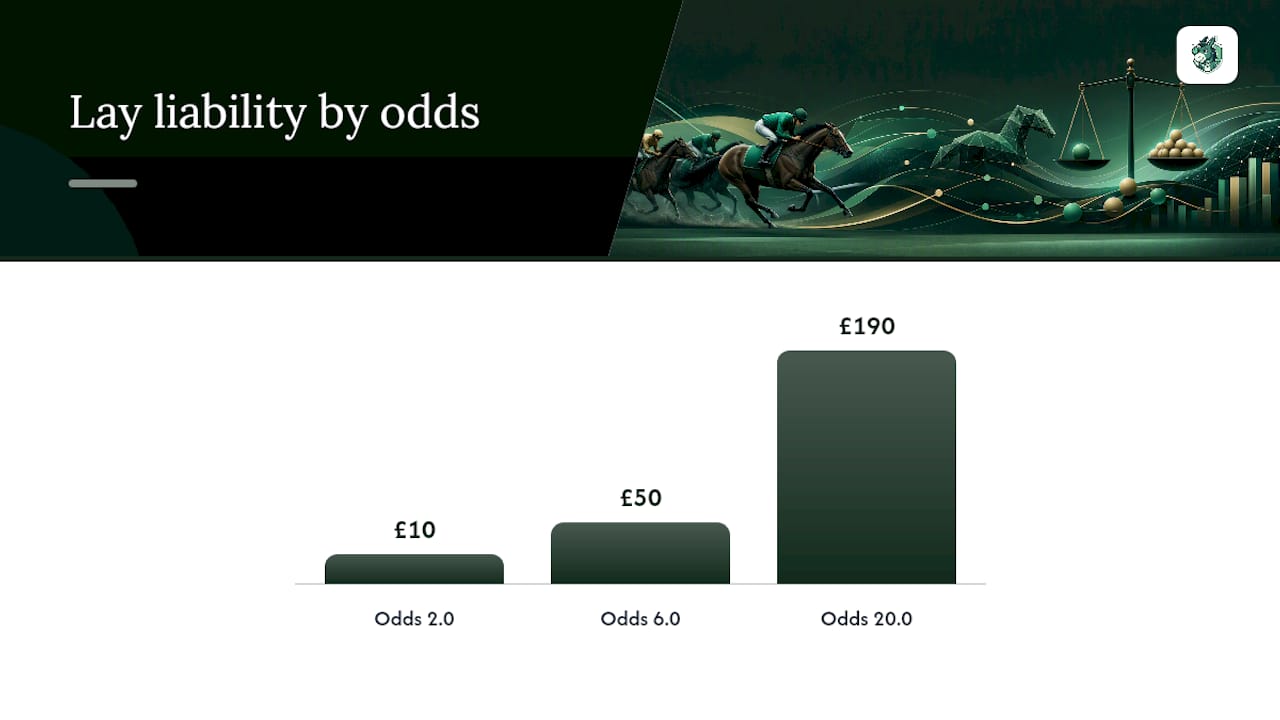
The liability reality: at 2.0, a £10 lay stake carries £10 of liability. At 6.0, the same £10 stake carries £50 of liability. At 20.0, it’s £190. The odds you lay at decide how much a single loser costs you, which is why professionals mostly concentrate their activity in the 2.0 to 7.0 range where liability stays manageable.
Race types that suit lay predictions:
- Sprints, where pace collapses expose weak finishers quickly and predictably.
- Handicaps, where class and weight assignments create genuine form mismatches to exploit.
- Juvenile races, where inexperience shows up as visible in-running weakness more often than in mature fields.
Avoid races with enormous outsider fields and no clear market leader; the variance in those markets resembles picking a first goalscorer in a cup match with thirty possible outcomes. Independent reviews of tested lay approaches consistently point to sprints, handicaps, and juvenile races as the more reliable hunting ground, precisely because the fields are more legible.
One more thing that catches newer layers out: exchange commission eats into thin edges fast, and lay expected value calculations must account for commission before you decide a bet is worth placing. A signal that looks like a 3% edge before commission might be break-even after it, especially in a market with poor liquidity where you can’t get matched at your target price.
How do you size a lay bet without wrecking your bankroll?
Liability, not stake, is what should drive your sizing decisions. Get this wrong and one bad lay can undo weeks of careful profit.
The formula is simple: liability = lay stake × (lay odds − 1). Lay £20 at odds of 4.0, and your liability is £60, not £20. That’s the number that should govern how big you go, because the liability figure is what actually gets debited if the horse wins.
Here’s a practical sizing process:
- Set your bankroll cap first. Most disciplined layers cap liability at 1% to 2% of total bankroll per bet, never per stake.
- Work backwards from the cap. If your bankroll is £1,000 and your cap is 1.5%, your maximum liability for any single lay is £15. At odds of 4.0, that limits your stake to £5.
- Apply a quarter-Kelly adjustment for lays. Full Kelly sizing assumes precise edge estimates you rarely have in racing, so scaling down to a quarter of the Kelly-suggested stake helps you survive the inevitable stretches where your model is wrong.
- Set a stop-loss before the race, not during it. Decide the liability level at which you cash out for a loss and stick to it, especially in-running.
Never lay two or more horses in the same race if their outcomes are correlated. Laying both the favourite and the second favourite in a small field means one winner takes out both bets, and your true liability is the sum, not the larger of the two.
A step-by-step checklist for placing a lay
Run through this before every lay, whether it’s pre-race or in-running:
- Validate the signal. Confirm at least two independent flags align, whether that’s weak form plus a class rise, or a caught front-runner plus visible distress.
- Calculate liability. Use the formula above and check it against your 1 to 2% bankroll cap before you touch the bet slip.
- Check commission and liquidity. Confirm there’s enough matched volume at your target price and factor the exchange’s commission rate into your break-even calculation.
- Place the lay and set your stop-loss immediately, not after watching the race for a few minutes.
- Record the result. Note the odds, liability, signal type, and outcome.
What to log for post-race review:
- The signals that triggered the lay (pre-race, in-running, or both).
- Odds taken and liability committed.
- Whether the stop-loss was triggered, and if so, at what price.
- Result and running profit and loss.
That log is what turns a one-off bet into a genuine lay betting system you can refine over months, not guesswork you repeat blindly.
How DonkeyRadar’s verified signals support lay predictions
Building a lay signal by hand, race by race, is exactly the kind of repetitive statistical work software does better than a human eyeballing a racecard. Donkeyradar’s algorithm processes historical strike rates alongside live market prices to flag the runner most statistically likely to lose, before the race starts rather than after the fact.
What matters when judging any signal provider, Donkeyradar included, comes down to a short list:
- Pre-race publication. Signals published before the off, not adjusted retrospectively to look better.
- A public, verified results record. A trackable results history that lets you see the profit and loss path over time is a far stronger trust signal than a single headline strike rate figure.
- Transparent staking guidance. Tiered staking grades that map to liability caps, not vague “bet big” tips.
- Continuous tracking. Results verified and updated race by race, not batched and polished after the fact.
Donkeyradar publishes results this way, which is the standard any lay research tool should be held to.
How do you validate a lay signal against historical data?
A single winning lay proves almost nothing. Validation means checking a signal type across enough historical races to know whether the pattern holds, or whether you got lucky once and mistook it for a system.
Start by isolating one signal type at a time; say, “favourites rising in class from a maiden handicap win.” Pull the last 100 to 200 qualifying races if you can, and check the actual win rate of that specific category against the implied win rate the market’s odds suggested. If the market says 40% and the historical win rate for that exact pattern is closer to 25%, you’ve found a genuine edge worth building around.
The trap most bettors fall into is testing too small a sample and drawing conclusions from twenty races, which is nowhere near enough to separate skill from noise in a sport with this much natural variance. Racing form is noisy by nature. A signal needs to survive contact with a few hundred races, several trainers, and more than one season before you trust it with real liability.
Cross-check across race types too. A signal that works brilliantly in handicaps might do nothing in maiden races, because the underlying mechanism (weight and class mismatches) simply isn’t present in a field of first-time runners. Independent tested reviews of lay approaches back this up: strategies that generalise across very different race types tend to be weaker than ones built for a specific, well-understood scenario.
Keep a running tally as you go, updated after every qualifying race, not retrospectively. That discipline is what separates a validated lay betting system from a story you tell yourself after a good week.
When is the best time to place a lay bet?
Timing changes both your price and your risk profile, and getting it wrong is one of the quieter ways lay bettors leak money.
Placing a lay too early, hours before the off, exposes you to price drift you can’t control. A horse trading at 4.0 in the morning might firm to 2.5 by the time the market settles, and you’ve missed the price you wanted. Placing too late, in the final seconds before the start, risks getting no match at all if liquidity is thin, particularly in smaller meetings.
The practical window most experienced layers work within is 15 to 30 minutes before the off, once the bulk of informed money has entered the market but before the final scramble of in-running money distorts prices. That’s usually when genuine market drift becomes visible rather than speculative, separating horses being quietly supported from ones being abandoned by smart money.
In-running timing is a different discipline entirely. The value window opens the moment a visible problem appears, a horse getting outpaced on the home turn, for instance, and it closes fast, often within seconds, as the market corrects. This is precisely why your stop-loss needs to be set before you place the in-running lay, not decided in the heat of the moment while watching the race unfold.
One further point on timing: avoid placing lays in the last thirty seconds before the start on illiquid markets. Matched volume tends to spike unpredictably right at the jump, and you can end up with a worse price than you intended, or a partial match that leaves your liability calculation wrong.
What are the biggest risks in lay betting?
Lay betting carries a structural risk that back betting doesn’t: your liability can dwarf your stake, and that asymmetry is where most account blow-ups start.
The most common pitfall is laying at odds that feel psychologically safe but aren’t. A horse at 12.0 feels unlikely to win, so the lay feels comfortable, but the liability on even a modest stake is substantial, and outsiders do win often enough to hurt. This is exactly why staying inside the 2.0 to 6.0 band matters more than instinct does.
The second major risk is correlated exposure within a single race. Laying the favourite and the second favourite together might feel like spreading risk, but if either wins, you lose both bets, and your combined liability is far higher than it looks bet by bet.
A third pitfall is chasing losses by increasing stake size after a bad result. This is the fastest route from a manageable drawdown to a wrecked bankroll, and it’s a psychological trap rather than a statistical one.
Finally, ignoring commission and liquidity costs bettors more than they realise over a season. A raw edge that looks solid before commission can evaporate once the exchange’s cut and a poor matched price are factored in, particularly in thinner markets where you’re forced to accept a worse price than your target.
What does a successful lay prediction look like in practice?
Consider a sprint handicap where the favourite has won its last two starts, but both wins came against weaker fields at a lower class level than today’s race. That’s a class-rise signal on its own; not yet a strong bet.
Add a second signal: in the final ten minutes before the off, the favourite drifts from 2.8 to 3.6 despite no obvious market-moving news. Two independent signals now align, class rise plus unexplained drift, which is exactly the combination that justifies a lay. A bettor sizing to a 1.5% bankroll cap at those odds keeps liability proportionate regardless of the outcome, and the bet is judged on the process, not the single result.
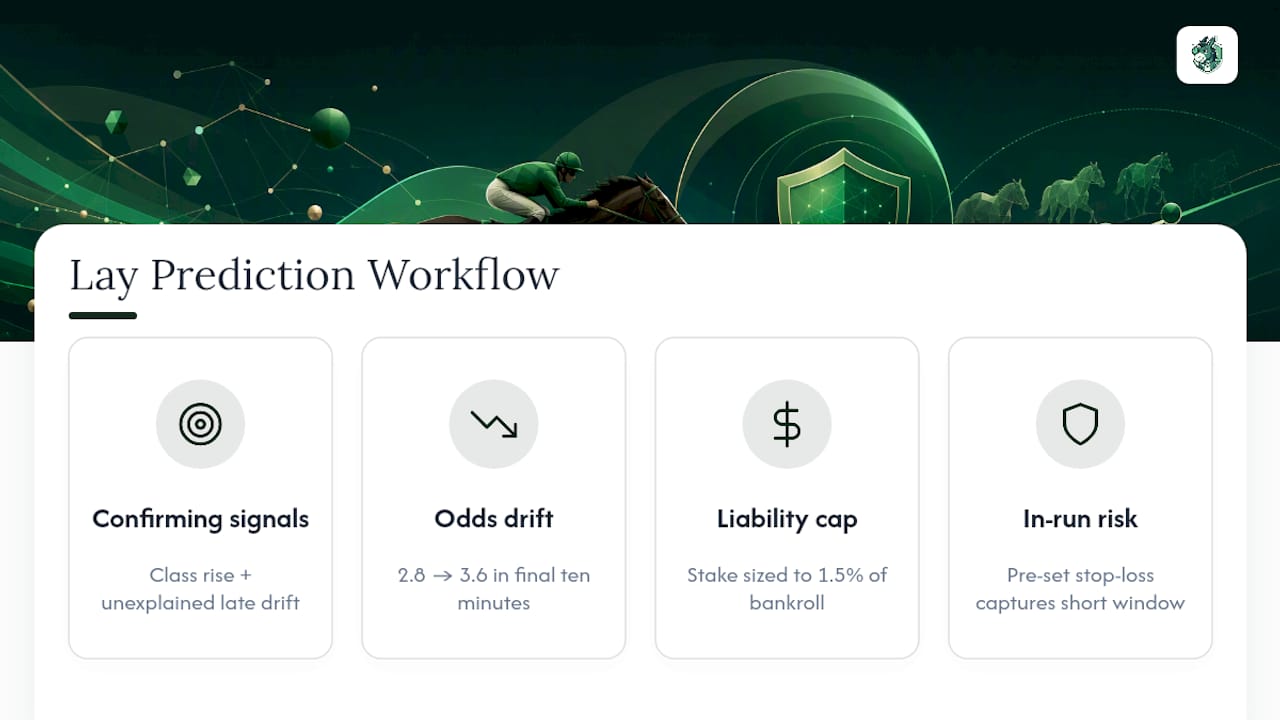
Now consider an in-running scenario: a well-fancied juvenile leads for the first half of a six-furlong sprint, then visibly flattens with two furlongs to run as a chasing pack closes. The in-play price on that horse can move sharply in seconds. A layer with a pre-set stop-loss captures the value in that window without waiting to see how the finish unfolds, because by the time the result is confirmed, the best price is long gone.
Neither scenario guarantees a winning lay. What both share is a repeatable structure: multiple confirming signals, a defined odds band, and liability calculated before the bet was placed, not after. That’s the difference between a lucky call and a process you can run again next Saturday.
Author perspective: the discipline that makes lay predictions survive variance
Most account blow-ups I see traced back come from over-leveraging a single race, laying correlated runners without realising the combined exposure, or chasing a loss with a bigger stake straight after. None of that is a market problem. It’s a discipline problem.
The habits that work are unglamorous: review every result daily, stick to fixed liability caps without exception, and log everything publicly if you can bear the accountability. Trial any new signal source on small stakes for a few weeks before trusting it with real bankroll. And keep BeGambleAware bookmarked. Variance in racing is real, and knowing your limits before a bad run finds them is worth more than any single signal.
— Donkey
DonkeyRadar: putting these lay rules into practice
If you’ve read this far, you already know the theory: two confirming signals, the 2.0 to 6.0 odds band, liability capped at 1 to 2% of bankroll. The harder part is doing it consistently, race after race, without the emotional drift that creeps in after a losing week. That’s the practical gap Donkeyradar fills.
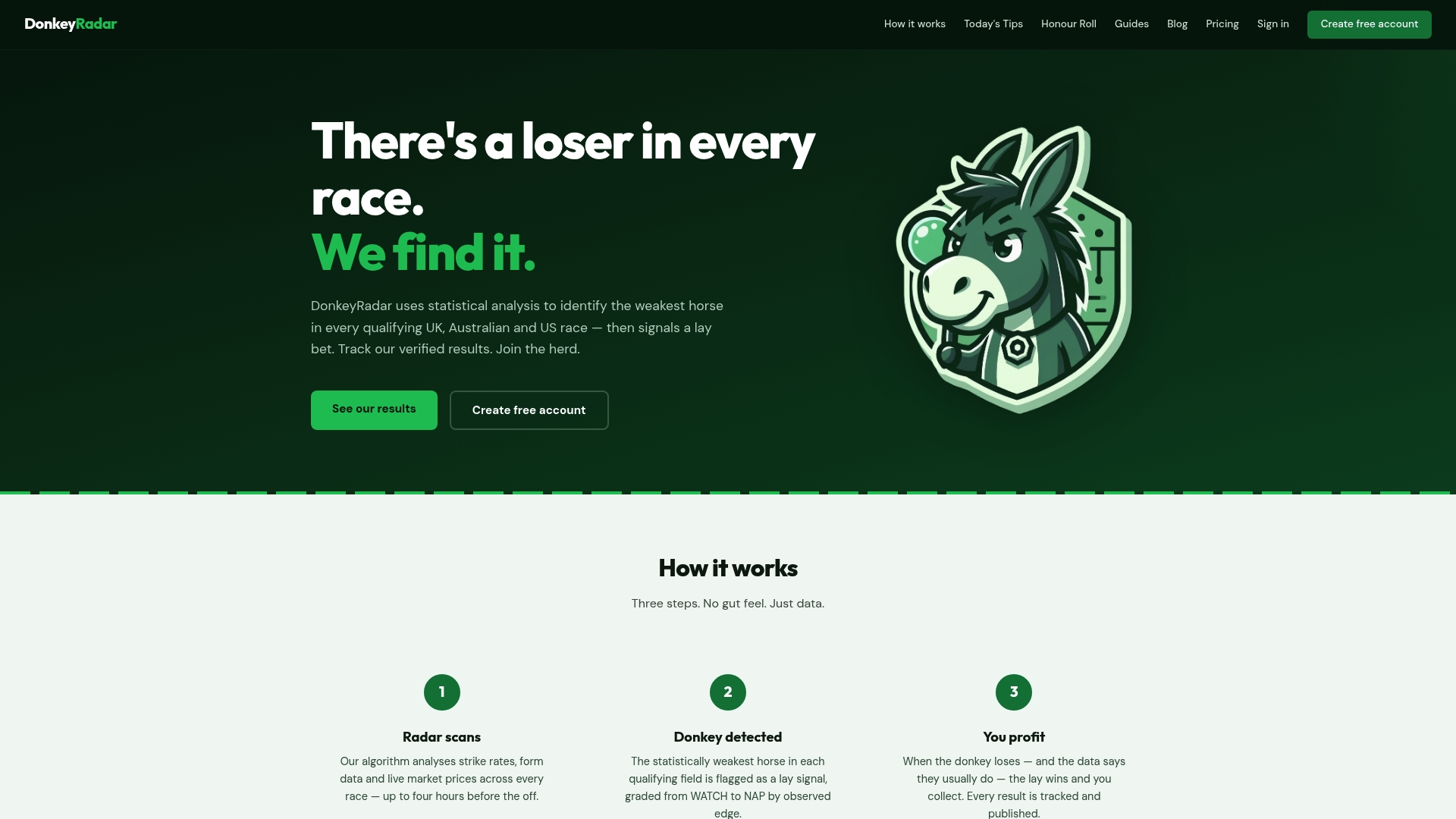
A lay signal dashboard can link to Betfair Exchange prices, grade each signal by staking tier to help match it to your bankroll cap, and send real-time alerts by email or Telegram so you don’t have to manually scan racecards. Signals can be published pre-race and tracked publicly afterwards, so you can judge the lay betting approach on its verified record rather than a claimed one. Profits from betting in the UK are tax-free, which can improve the edge once you’ve got a process worth trusting.
Start with the seven-day trial, run it against the liability caps you’ve just learned, and check the lay betting calculator before you size your first bet.
Sources
- Lay betting strategy: 5-step EV framework
- Laying horses on Betfair: when and how (strategy guide)
- Lay betting strategies that actually work on Betfair tested approaches
- BeGambleAware
FAQ
What is the best lay bet strategy?
The strongest approach combines two or more confirming signals, weak form plus market drift, or visible in-running distress plus a caught leader, and stays inside the 2.0 to 6.0 odds band with liability capped at 1 to 2% of bankroll.
Can I use AI to predict horse racing?
Statistical models can process historical strike rates and live market prices far faster than manual analysis, which is how services like Donkeyradar generate pre-race lay signals, though no model removes the need for disciplined staking.
Does laying the favourite work?
Favourites lose more often than casual bettors assume, but blind laying without a model-based fair price is risky; it works best when combined with a specific weakness signal like an unexplained class rise or late drift.
Is laying the field profitable?
Laying the field, effectively backing the favourite by laying every rival, carries very different liability dynamics to a single lay and depends heavily on market efficiency in that specific race; it’s a distinct strategy from the single-horse lay predictions covered here and demands its own liability calculations before staking.