← Blog · 📝 Article · 13 August 2026
What odds to lay: a practical UK guide for 2026

For most new and intermediate UK bettors, the practical answer is to target lay odds between 2.0 and 4.0. The exception: if you are matched betting against a bookmaker free bet, the lay odds are dictated by the qualifying offer, not your preference, so you follow the calculator rather than a target range.
Before placing any lay, check two things: your calculated liability and the commission rate on your exchange account. Both affect your net P&L, and neither is optional.
Quick reference: lay odds bands
- Conservative (2.0–2.5): Low liability per bet, lower profit per win. Suits absolute beginners and matched betting qualifiers.
- Balanced (2.5–4.0): The practical sweet spot. Liability is predictable, edges are findable, and commission has less relative impact.
- Opportunistic (4.0–6.0): Higher liability per bet. Suitable for intermediate bettors with a clear statistical edge and a larger bankroll buffer.
- Avoid for most lays (under 2.0 or above 6.0): Very short odds eat profit after commission; very long odds create large liabilities that can damage a bankroll on a single loss.
Key takeaways
Laying odds between 2.5 and 4.0 gives most UK beginners the best balance of manageable liability, findable edges, and enough margin to absorb exchange commission without eroding small profits.
| Point | Details |
|---|---|
| Target the 2.5–4.0 band | This range keeps liability predictable and leaves margin after typical 2–5% exchange commission. |
| Always calculate liability first | Use (lay odds − 1) × backer’s stake before opening the bet slip on Betfair. |
| Size by liability, not backer stake | Cap each lay’s liability at 5–10% of your bankroll; use quarter-Kelly for a more precise limit. |
| Avoid odds under 2.0 or above 6.0 | Short odds are eroded by commission; long odds create large liabilities relative to potential profit. |
| Donkeyradar signals | Pre-race statistical lay signals with verified results help you find selections in the right odds range faster. |
Table of Contents
- What is a lay bet, and how does it differ from backing?
- How to calculate lay liability, profit and break-even
- How to use a lay calculator and place a lay on Betfair
- Which odds are worth laying, and why does the range matter?
- Which markets and strategies work best for laying?
- How to size lay stakes and limit your liability
- Three worked examples to run in a calculator
- How data-driven lay signals help you find the right odds faster
- A candid take on starting out without blowing your bank
- Donkeyradar gives you verified lay signals to act on today
- Sources
What is a lay bet, and how does it differ from backing?
When you back a selection, you are betting that it wins. When you lay a selection, you are betting that it does not win. On a betting exchange such as Betfair, laying puts you in the role of the bookmaker: you accept a backer’s stake, and if their selection loses, you keep that stake as profit. If it wins, you pay out the difference.
Back vs lay in one line each:
- Back: You win if the selection wins; you lose your stake if it does not.
- Lay: You win the backer’s stake if the selection loses; you pay out (lay odds − 1) × backer’s stake if it wins.
UK exchanges quote odds in decimals. Fractional odds of 2/1 are the equivalent, though exchanges almost always display decimals. OddsMonkey’s beginner guide is a solid primer if you want a deeper walkthrough of the vocabulary before moving on to the calculations.
How to calculate lay liability, profit and break-even
The core formula is straightforward. Liability is what you stand to lose if the lay loses (i.e., the selection wins):
Your profit when the lay wins (the selection loses) equals the backer’s stake you accepted. After commission, net profit is slightly lower:
Worked example 1: football pre-match lay
A backer wants to stake £20 on a team at lay odds of 3.5.
- Liability = (3.5 − 1) × £20 = £50.00
- If the lay wins (team does not win): profit = £20 × (1 − 0.05) = £19.00 (at 5% commission)
- If the lay loses (team wins): you pay out £50.00
The lay liability formula confirms this logic: laying £20 at 5.0 creates an £80 liability, so at 3.5 the £50 figure is proportionally correct.
Worked example 2: horse racing lay
A backer stakes £10 on a horse priced at lay odds of 7.0.
- Liability = (7.0 − 1) × £10 = £60.00
- If the lay wins (horse does not win): profit = £10 × (1 − 0.05) = £9.50
- If the lay loses (horse wins): you pay out £60.00
Notice how liability scales sharply at longer odds. A £60 liability for a £9.50 potential profit is a ratio that demands a high strike rate and a well-sized bankroll.
Pre-bet calculation checklist
- Calculate liability using the formula above.
- Confirm your exchange balance covers that liability plus a buffer.
- Check your current commission rate (it varies by account tier on Betfair).
- Verify the backer’s available stake matches what you intend to accept.
- Recalculate net profit after commission before confirming.
How to use a lay calculator and place a lay on Betfair
Calculator inputs and what they change
A lay bet calculator, such as the one on Betfair’s own calculator page, asks for four core fields:
- Back stake: the amount the backer is wagering (what you stand to win if the lay wins).
- Back odds: the odds the backer accepted at the bookmaker (relevant for matched betting).
- Lay odds: the price available on the exchange.
- Commission rate: your exchange’s percentage cut on net winnings (typically 2–5% on Betfair UK).
Change the lay odds and the liability figure moves immediately. Change the commission rate and the net profit shifts. The Matched Betting Blog’s free calculator mirrors this logic and is widely used for qualifying free-bet calculations.
Step-by-step Betfair lay checklist
- Open the relevant market on Betfair Exchange and locate your selection.
- Click the blue lay price (not the back price) to open the bet slip.
- Enter the backer’s stake you want to accept in the “Backer’s stake” field.
- Betfair displays your liability automatically. Confirm it matches your pre-calculated figure.
- Check the market’s available liquidity: if the matched amount is thin, your bet may not fill fully.
- Verify your commission rate in your account settings.
- Click Place Bets only after confirming liability, liquidity, and commission.
Pro Tip: Always calculate liability in a separate calculator before opening the bet slip. Betfair’s interface shows the figure, but doing the maths yourself first means you will not be surprised by a number that exceeds your bankroll.
Which odds are worth laying, and why does the range matter?
The 2.0–4.0 band is widely cited as the practical sweet spot for new and intermediate layers. Here is why each zone behaves differently.
Odds zones and their trade-offs
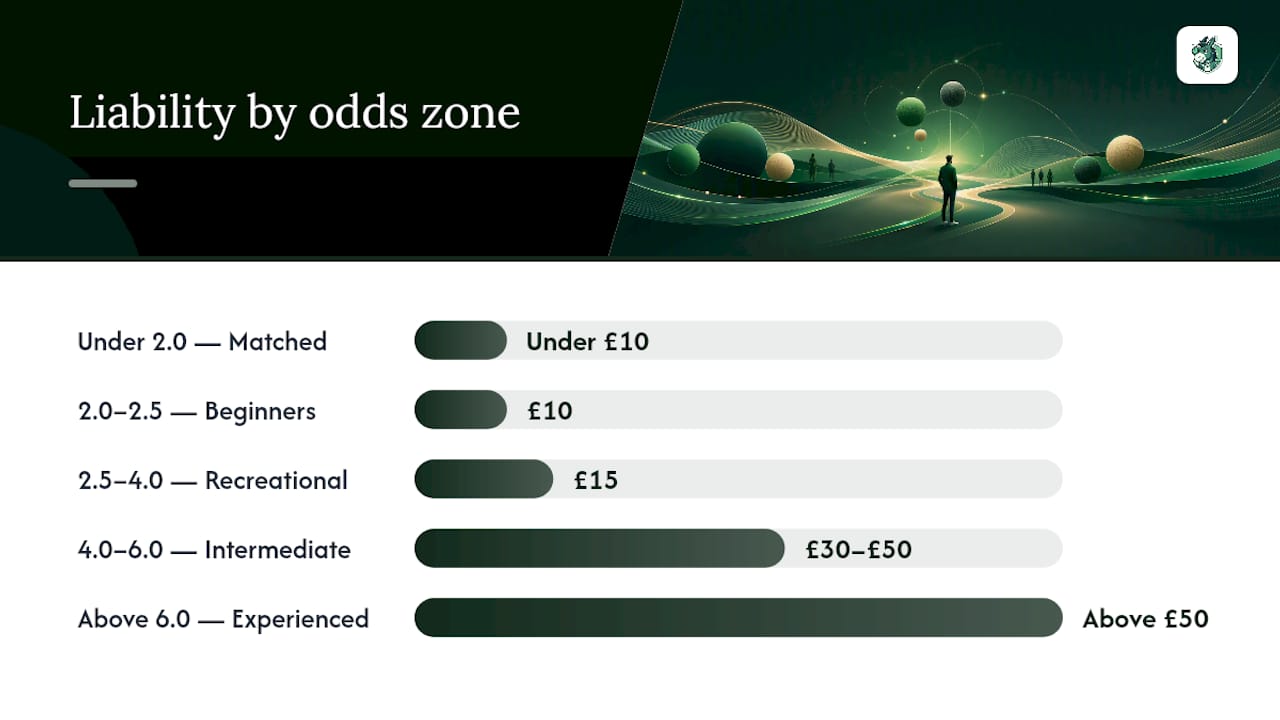
| Odds range | Liability per £10 backer stake | Who it suits |
|---|---|---|
| Under 2.0 | Under £10 | Matched bettors following a calculator; poor value for discretionary lays after commission |
| 2.0–2.5 | £10 | Beginners; low liability but commission eats a larger share of small profits |
| 2.5–4.0 | £15 | Most recreational layers; manageable liability, findable edges |
| 4.0–6.0 | £30–£50 | Intermediate bettors with a statistical edge and larger bankroll |
| Above 6.0 | Above £50 | Experienced bettors only; one loss can be costly relative to potential profit |
A single loss at 1.5 costs you £5 for every £10 accepted, and you need a very high strike rate just to break even. The commission effect at short odds is one of the most underestimated risks for beginners.
Very long odds (above 6.0) create the opposite problem: the potential profit is modest relative to the liability. Laying a horse at 8.0 for a £10 backer stake means risking £70 to win £9.50. That ratio only makes sense if your model gives the horse a materially lower chance of winning than the market implies.
Which markets and strategies work best for laying?
Best markets for lay bets
- Match odds (football): High liquidity, predictable price behaviour, and a draw outcome that creates natural lay opportunities. The most beginner-friendly market.
- Over/under goals: Binary outcomes with clear statistical patterns. Over 2.5 goals lays in low-scoring leagues can offer consistent edges.
- Both teams to score (BTTS): Similar logic to over/under; statistical form data translates well to lay selections.
- Horse racing place lays: Laying a horse to finish outside the places carries lower implied probability than a win lay, which often means shorter lay odds and lower liability. Betfair’s horse-laying guides show how liability scales across different race types.
Common lay strategies
Lay-to-back: Lay a selection pre-event at a high price, then back it in-play if the odds shorten (the selection performs well). The difference between lay and back prices is your profit, regardless of the final result. This requires good in-play judgement and fast execution.

Lay-the-draw: Lay the draw in a football match before kick-off, then back the draw in-play once a goal is scored and the draw price has drifted. Works best in matches where one team is expected to score early. Price drift and market overreaction to public money are the engine behind this strategy.
Matched-betting lays: Use a free bet or enhanced offer from a bookmaker, back the selection at the bookmaker, and lay it on the exchange. The calculator determines the exact lay stake to lock in a near-guaranteed profit regardless of outcome.
Markets and situations to avoid
- First goalscorer: Highly random, thin liquidity, and wide spreads. Edges are very hard to find.
- Very thin markets: If fewer than a few thousand pounds are matched, your lay may not fill, or the price may move against you mid-placement.
- Unstable in-play moves: Laying in-play during chaotic moments (red cards, VAR reviews) without a pre-planned exit point is a common source of large, unplanned losses.
Pro Tip: Check how odds drifting works before attempting lay-to-back trades. A drift signals weakening market confidence in a selection, which is exactly the condition a lay-to-back strategy relies on.
How to size lay stakes and limit your liability
Why you size by liability, not backer stake
The backer’s stake is what you win. Your liability is what you risk. Sizing a lay by the backer’s stake ignores the actual exposure, which scales with odds. At odds of 5.0, a £20 backer stake creates an £80 liability. At odds of 2.5, the same backer stake creates only a £30 liability. Always size by liability.

Quarter-Kelly applied to lay betting
The Kelly Criterion calculates the optimal fraction of your bankroll to risk on a bet with a known edge. For lay betting, Kelly sizing should be applied to liability, not to the backer’s stake.
A simple illustration:
- Estimate your edge: you believe the true probability of the selection losing is 70%, but the lay odds of 2.5 imply only 60%.
- Full Kelly fraction = (0.70 − 0.30) / (2.5 − 1) = 0.40 / 1.50 = 0.267 (26.7% of bankroll as liability).
- Quarter-Kelly = 0.267 × 0.25 = 6.7% of bankroll as maximum liability per bet.
For a £500 bankroll, that is a maximum liability of £33.50 per lay. At odds of 2.5, that translates to a backer’s stake of £22.33.
Practical bankroll rules
- Cap any single lay’s liability at 5–10% of your total bankroll until you have at least 50 settled bets in your log.
- Set a daily or weekly stop-loss: if you lose 20% of your starting bankroll in a session, stop and review.
- Keep a simple results log: date, selection, lay odds, backer stake, liability, outcome, net P&L. Patterns only emerge from data.
- Review commission rates quarterly. Betfair’s Premium Charge and tiered rates can shift your break-even point materially.
For more structured rules, the lay betting tips guide covers ten practical rules for beginners, including record-keeping templates.
Three worked examples to run in a calculator
The table below gives three reproducible examples. Copy the inputs into a lay bet calculator and verify the outputs yourself.
The horse racing place lay illustrates why the 2.0–2.5 band suits beginners: a £36 liability for a £28.50 net profit is a ratio that only requires a modest strike rate to be profitable over time. The tennis in-play example shows how liability grows quickly as odds rise, even with a smaller backer’s stake.
How data-driven lay signals help you find the right odds faster
Knowing which odds to target is one thing. Identifying the specific selections that sit in that range and carry a genuine statistical edge is another. That is where a signal service adds practical value.
Donkeyradar uses statistical analysis of historical strike rates and live market prices to identify the weakest runner in UK, Australian, and US horse races before they start. Signals are published before each race, and every result is tracked publicly so you can verify the record yourself. The Betfair lay betting strategy guide explains how those signals integrate with exchange markets.
How to combine a signal with your own calculations
- Receive the signal: selection name, race, and the suggested lay odds range.
- Open the Betfair Exchange market and confirm the current lay price falls within the signal’s range.
- Run the liability calculation: (lay odds − 1) × intended backer’s stake.
- Check that liability against your bankroll cap (5–10% rule or your quarter-Kelly figure).
- Confirm commission rate and recalculate net profit.
- Place the lay only if all five checks pass.
What transparency looks like in practice
A credible signal service publishes results before the race outcome is known, not after. Look for a public results history with sample sizes large enough to distinguish skill from luck, stated strike rates, and a running P&L in units rather than cherry-picked winners.
UK betting profits are tax-free for recreational bettors, which means every pound of net P&L stays in your pocket. The Gambling Commission and GambleAware both provide guidance on responsible play and pre-commitment limits, which apply regardless of how you source your selections.
Pro Tip: Before subscribing to any signal service, check whether results are published before or after races settle. Post-race publication is a red flag. Donkeyradar publishes signals prior to race commencement.
A candid take on starting out without blowing your bank
The single most common mistake beginners make is not the maths. It is skipping the maths entirely and placing lays based on gut feel or a tip from a forum. The liability formula is simple, and running it takes thirty seconds. There is no good reason to skip it.
Start with the 2.5–4.0 band, stakes small enough that a full liability loss does not sting, and a calculator open on every bet. Keep a log from day one, even if it is a spreadsheet with five columns. After fifty bets, you will have real data on your own strike rate and P&L, which is the only honest basis for deciding whether to scale up.
Patience matters more than most beginners expect. A stop-loss prevents those normal runs from becoming account-ending ones.
Scale up to paid tools or higher stakes only when your free-tier or small-stake results show a consistent edge over at least a few months. One good week is not a signal. A verified, consistent P&L across a meaningful sample is.
Donkeyradar gives you verified lay signals to act on today
Knowing the right odds band is the foundation. Finding selections that consistently sit in that band with a genuine edge is where most bettors spend hours each week with mixed results.
Donkeyradar does that work statistically, publishing lay signals for UK, Australian, and US horse races before each race starts. Every signal includes a direct Betfair Exchange link, a staking tier grade, and a verified results history you can check before you commit a penny. The seven-day trial gives you access to live signals and the full results archive so you can run the numbers against the calculation framework in this article and see the strike rate for yourself. Start the trial at Donkeyradar and use the lay bet calculator alongside each signal to confirm liability before placing.
Betting carries financial risk. Set a budget before you start and use the pre-commitment tools available through the Gambling Commission and GambleAware.
Sources
- Gamblingcommission
- Begambleaware
- Lay Betting Strategies That Actually Work on Betfair Tested Approaches - Tipster Reviews
- Lay Bet Calculator
- Lay Betting on Betfair — Complete Strategy Guide (2026)