← Blog · 📝 Article · 4 September 2026
1–2% Bankroll Caps: Liability First Lays for Handicap Race Favourites

Selective lay betting in handicap races can be a sustainable edge, provided you insist on a commission-adjusted expected value threshold and cap liability on every single bet. The two conditions that justify a lay are a mispriced favourite in a competitive field and race conditions, such as big-field sprints or valuable handicaps, that reliably compress true winning chances. Everything below covers the maths, the market signals, the staking rules, and the execution discipline needed to turn that edge into a repeatable process.
TL;DR:
- Big-field handicaps, sprint handicaps, and juvenile races with public bias often produce mispriced favourites, creating profitable lay opportunities.
- Effective laying depends on multiple factors including recent form, market movement, race shape, and avoiding pools with very short odds or unpredictable conditions.
- Staking should prioritize liability management, using fixed caps or quarter-Kelly to control risk and prevent large losses during variance swings.
- In-running lays capitalize on visual signals like poor horse performance or interference, with discipline and firm stop-loss settings crucial for success.
- Verified pre-race signals, real-time calculators, and strict checklist adherence are essential tools for maintaining consistency and reliability in the betting process.
Table of Contents
- Why handicap races create lay opportunities
- When to lay: pre-race criteria and selection checklist
- The maths: liability, EV, and commission-adjusted thresholds
- Watching the race: in-running signals and timing rules
- Building a staking plan that survives variance
- Which handicaps and conditions deserve your time
- Turning your model into a lay: tools and the DonkeyRadar workflow
- Mistakes that wreck a lay strategy
- Legal considerations and bookmaker rules for laying handicaps
- How this strategy actually gets applied in practice
- Put these rules into practice with DonkeyRadar
- Sources
Why handicap races create lay opportunities
A handicap assigns weight to each runner based on official ratings, with the theoretical aim of giving every horse an equal winning chance. In practice, that weight compression rarely works perfectly, and it is precisely that imperfection that gives layers something to exploit. The British Horseracing Authority’s handicapping guide confirms that handicaps are the most common race type in British racing and typically produce larger, more competitive fields than conditions or maiden races.
Bigger fields matter enormously to a layer. When 16 runners go to post rather than six, the market has more work to do and more room to get the favourite wrong. Public money still piles onto a well-known name or a horse with a fashionable trainer, even when the ratings say four or five others have a near-identical chance. That gap between “popular” and “probable” is where lay value lives.
Not every handicap offers the same opportunity. Some classes and field sizes consistently produce better mispricing than others:
- Big-field handicaps (14+ runners): more variables, more scope for the market to misjudge a short-priced favourite.
- Competitive sprint handicaps: tight ratings bands and unpredictable early pace often punish the market leader.
- Valuable/feature handicaps: heavy public interest inflates the favourite’s price beyond its true chance.
- Juvenile handicaps: sparse form data on inexperienced horses makes the market more prone to error.
Small-field handicaps with a standout top-rated horse tend to be priced efficiently and are usually not worth your time as a layer.
When to lay: pre-race criteria and selection checklist
Laying a favourite only makes sense when several signals line up together, not when a single one looks tempting in isolation. Treat the following as a sequential filter, not a menu to pick from.
- Check recent form context. Look for finishing positions that flatter the horse (fortunate run, soft yard, weak field) rather than genuine improvement, and check whether the trend at this trip or surface actually supports today’s price.
- Check the weight change. A favourite stepping up several pounds in the ratings off a single flattering run is a stronger lay candidate than one carrying a fair or falling weight.
- Check the market move. A price that shortens suspiciously early, well before the standard flow of money, can indicate short-term hype rather than genuine informed backing.
- Check the crowd bias. Favourite-longshot bias, where short-priced favourites are backed beyond their statistical strike rate, shows up repeatedly in big, busy markets.
- Check the race shape. Large fields, sprint distances, and a vulnerable top weight combine to increase the odds that the favourite gets no clear run or simply meets more traffic than a smaller field would produce.
- Check for early non-triers. Horses with a pattern of underperforming relative to market expectation are red flags worth cross-referencing against today’s price.
Pro Tip: Run through this checklist before you even open the odds screen. Deciding “is this a candidate” using form and race shape first, then checking the price second, stops you rationalising a lay just because the odds look tempting.
No single signal above is sufficient on its own. It is the combination, form plus market plus race shape, that turns a hunch into a qualified lay.
The maths: liability, EV, and commission-adjusted thresholds
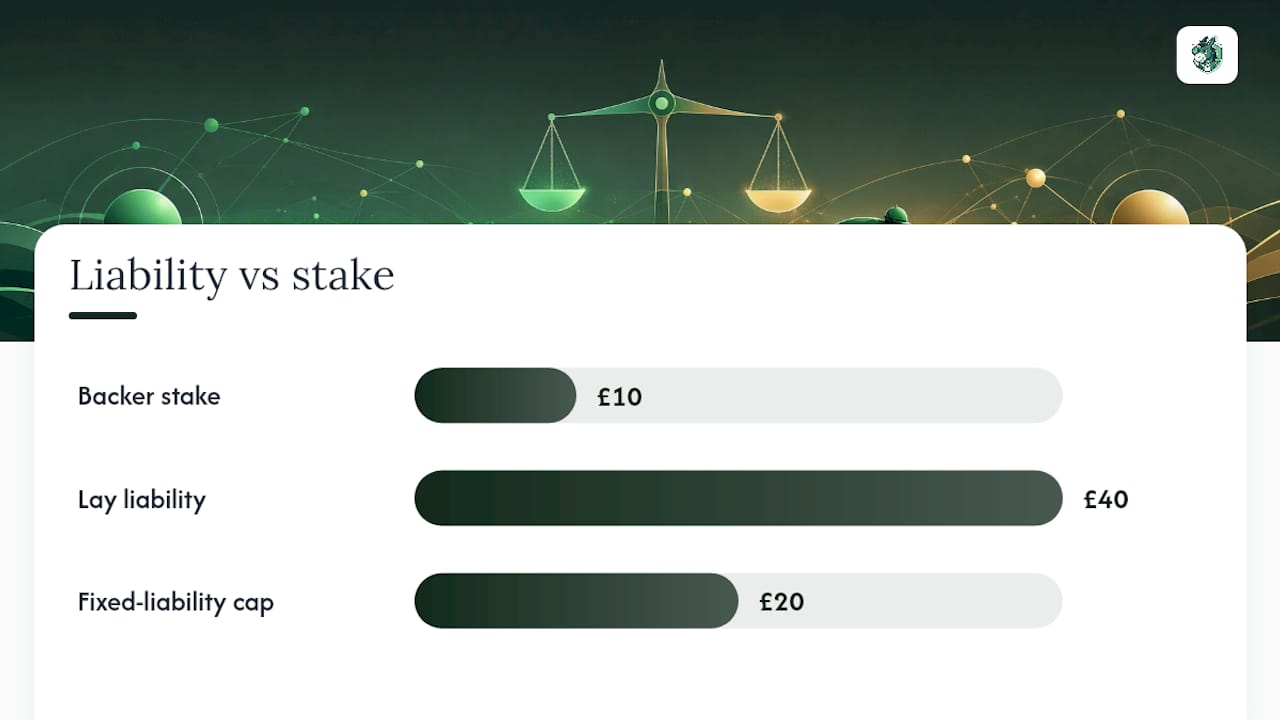
Liability is what you actually risk on a lay, and it is not the same as your stake. The formula is straightforward: liability = backer stake × (lay odds − 1). Lay a horse at 5.0 for a £10 backer stake and your liability is £40, not £10. That £40 is what disappears from your account if the horse wins, so it is the number that should drive every staking decision.
Expected value works from the other direction. The KiqIQ EV framework sets out the core formula: Lay EV = (1 − P) − P × (D − 1), where P is your estimated true probability of the horse winning and D is the decimal lay odds you can actually get matched at. Commission, typically 2 to 5% on winnings depending on the exchange, then eats into that raw figure, so you must convert to a post-commission EV before deciding anything.
Here’s a worked example. Say you rate a favourite’s true winning chance at 28% (P = 0.28), and the market is offering lay odds of 3.0.
| Metric | Value |
|---|---|
| True probability (P) | 0.28 |
| Lay odds (D) | 3.0 |
| Raw EV | (1 − 0.28) − 0.28 × (3.0 − 1) = 0.72 − 0.56 = 0.16 |
| Commission (assume 5%) | Applied to winning outcome only |
| Post-commission EV (approx.) | still positive |
That gap between raw and post-commission EV is exactly why a marginal edge on paper can disappear once fees are stripped out. A sensible working rule is to only act when post-commission EV clears a comfortable minimum, rather than trading anything that is barely above zero, since your probability estimate is never perfect to begin with.
Staking should follow liability, not stake size. Two approaches work well in practice:
- Fixed-liability staking: cap every lay at a set amount, for example £20 liability regardless of the odds, which keeps risk consistent across a card full of different-priced favourites.
- Quarter-Kelly on liability: take the full Kelly-optimal liability suggested by your edge and divide it by four, which dampens the wild swings that full Kelly produces when your probability estimate is even slightly wrong.
Full Kelly assumes your edge estimate is precise. It rarely is in racing, so quarter-Kelly or a flat liability cap is the more forgiving choice for most bettors working through a season of results.
Watching the race: in-running signals and timing rules
Pre-off analysis gets you to the start line, but some of the best lay opportunities appear once the tapes go up. In-running lays exploit the fact that the betting market reacts to visual information with a delay, often just a handful of seconds, and that delay is your execution window.
Clear signals worth acting on include a horse travelling poorly and off the bridle much earlier than its running style suggests, a runner getting checked or badly hampered in a bunched field, or a horse being eased and pulled up. The BetfairSquare laying guide notes that this kind of visible distress is one of the more reliable in-running indicators precisely because the market has not yet caught up.
Price movement backs up what your eyes tell you. Before entering an in-running lay, look for confirmation through drift, meaningful ticks against the horse, alongside genuine traded volume, not just a single small bet nudging the price. A drift with no volume behind it can reverse just as quickly as it appeared.
Discipline here matters more than in almost any other part of the strategy:
- Set a hard stop-loss in ticks or price terms before you enter, and honour it regardless of how the race unfolds.
- Never lay more than one runner in the same race unless you have deliberately worked out the combined liability, since two winning outcomes are not independent risks.
- Walk away after your stop-loss triggers. Chasing a reversal with a second lay on the same horse is how a manageable loss becomes a damaging one.
Pro Tip: If you find yourself hovering over the “lay” button waiting for “just a bit more” confirmation, that hesitation is usually the market telling you the window has already closed.
Building a staking plan that survives variance
Liability-first staking is the single habit that separates bettors who last a season from those who blow up in a month. Size every position by what you stand to lose, not by the pound amount you put down.
- Cap liability per lay as a fixed percentage of your total bankroll. A working range of 1 to 2% keeps any single bad result from doing serious damage, even across a losing run of five or six lays in succession.
- Choose fixed-liability staking for consistency, or quarter-Kelly when you want stake size to track the strength of your edge. The Betfair strategy guide points out that most disciplined layers favour the 2.0 to 4.0 odds band precisely because liability stays manageable in that range.
- Set an account-level stop-loss, not just a per-bet one. If your bankroll drops by a set percentage in a week, stop laying and review your selection criteria rather than trying to trade your way back.
- Scale stakes up only after a proven run, and scale down immediately after a losing stretch. Treat stake size as something that responds to evidence, not to how confident today’s selection feels.
- Keep a results log for every lay: date, odds, liability, outcome, and your reasoning at the time. Without this, you cannot tell whether your edge is real or whether you have been running on a lucky streak.
Bankroll management is not a constraint on your strategy. It is what allows the strategy to keep operating long enough for its actual edge to show up in the numbers.
Which handicaps and conditions deserve your time
Not every handicap on the card deserves the same scrutiny, and prioritising correctly saves time as much as it saves money.
Top priority goes to large-field handicaps, sprint handicaps, and juvenile handicaps where the public has clearly over-backed a fashionable name. These conditions combine wide fields, tight ratings, and crowd bias, exactly the mix that produces mispriced favourites. Documented tactics such as laying a short-priced favourite to place, or a lay-to-back approach once the price has moved, tend to work best in exactly these races according to the Tipster Reviews strategy breakdown.
Medium priority covers moderate-field handicaps where the favourite’s profile looks suspect on close inspection, or where the top-weighted horse carries a rating that looks generous relative to the field. These are worth checking but do not automatically clear your selection bar the way big-field sprints do.
Some conditions should simply be avoided:
- Sub-2.0 favourites, where the odds are so short that even a correct lay carries disproportionate liability for the return.
- Extreme or unpredictable ground conditions, where form is genuinely hard to read and your probability estimate becomes guesswork.
- Tiny fields (six runners or fewer), where the market is usually efficient and there is little room for a genuine mispricing to hide.
Turning your model into a lay: tools and the DonkeyRadar workflow
Three types of tool do the heavy lifting for a systematic layer: a probability model that estimates a horse’s true winning chance from form and ratings data, a lay calculator that converts that estimate into liability and break-even figures, and a live odds feed that tells you whether the market price still supports your edge.
DonkeyRadar publishes its lay signals ahead of every race, alongside a verified results history you can check against the actual outcomes rather than taking performance claims on trust.
Verified signals published before the race, checked against results after. That published-before, verified-after structure is the detail worth checking on any lay service, since results claimed only after the fact are worth far less than a track record you can audit.
Here’s how the workflow runs in practice. Suppose your model rates a favourite at 30% to win, and the market is offering 3.2. Plug both numbers into a lay betting calculator to get liability for your intended stake and confirm the post-commission EV clears your threshold before you commit. If it does not clear the bar, the calculator has just saved you a bet you would otherwise have talked yourself into.
Mistakes that wreck a lay strategy
The gap between a profitable layer and a losing one is rarely about picking selections. It is almost always about discipline.
- Skipping the stop-loss. A single unchecked lay at long odds can wipe out weeks of small, steady wins in one race.
- Sizing by stake instead of liability. Two lays that look similar in stake terms can carry wildly different real risk depending on the odds.
- Staking emotionally after a loss. Doubling up to “get it back” is how a manageable drawdown turns into a damaging one.
- Ignoring cancelling red flags. A big field with a shaky favourite still isn’t a lay if the ground has turned unpredictable or the price has already drifted past your entry level.
Before every lay, run through a short checklist: does the post-commission EV clear your threshold, is your liability capped at your standard percentage, have you set a stop-loss, and does the race avoid your exclusion list? If any answer is no, skip the bet. The lay betting checklist is worth keeping open on a second screen until this becomes automatic.
Legal considerations and bookmaker rules for laying handicaps
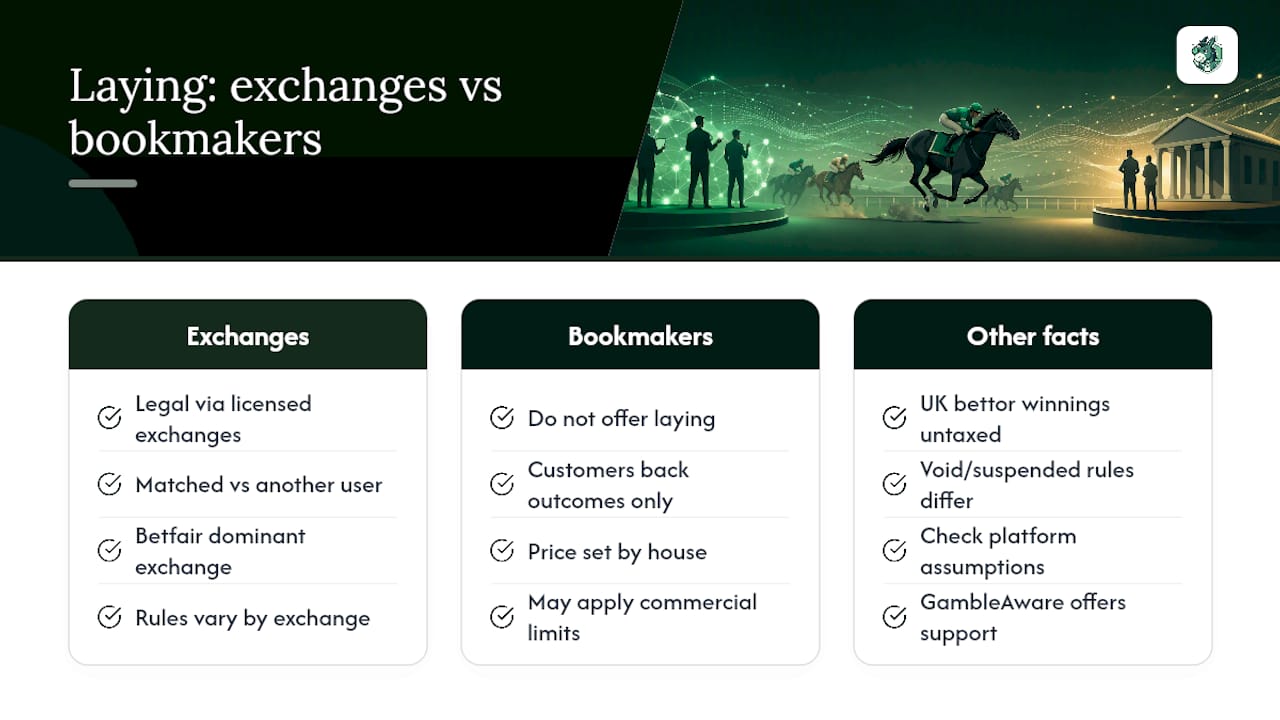
Lay betting itself is legal in the UK and is offered through licensed betting exchanges rather than through traditional fixed-odds bookmakers, who do not let customers bet against a runner. Betfair is the dominant exchange for this kind of trading, and using it means you are matched against another user’s back bet rather than against the house.
Traditional bookmakers generally prohibit laying outright on their own platforms, since their entire pricing model depends on customers only backing outcomes. Some also apply restrictions or account limits to customers whose betting patterns suggest they are trading professionally, though this is a commercial decision by each firm rather than a legal restriction on the customer.
Exchange terms and conditions vary on specific points, such as in-running trading rules during suspended markets or the handling of void races, so check the terms of whichever exchange you use before relying on assumptions carried over from another platform. Profits from betting in the UK are not subject to tax for the individual bettor, which is a genuine structural advantage over markets where gambling winnings are taxed.
If lay betting starts to feel less like a disciplined activity and more like something you cannot stop or control, GambleAware offers free, confidential support and is worth contacting before the pattern gets worse.
How this strategy actually gets applied in practice
The core idea behind DonkeyRadar’s approach is simple: publish the lay signal before the race, then let the results speak for themselves afterwards. That order matters. A service that only shows you its winners after the fact is not offering verification, it is offering marketing.
None of this removes variance. Even a well-calibrated model will produce losing runs, and no signal service, DonkeyRadar included, promises a winner every time out. What discipline actually buys you is consistency of process: the same EV check, the same liability cap, the same stop-loss, applied whether you have just won five in a row or lost three.
The bettors who do well with this approach are the ones who treat the checklist as non-negotiable, not the ones with the sharpest opinion on the day’s form.
— Donkey
Put these rules into practice with DonkeyRadar
Everything covered above, the EV threshold, the liability caps, the stop-loss discipline, works far better with the right tools doing the arithmetic for you in real time. DonkeyRadar exists for exactly that gap between knowing the rules and applying them consistently, race after race, without the mental fatigue of running the numbers by hand every time.
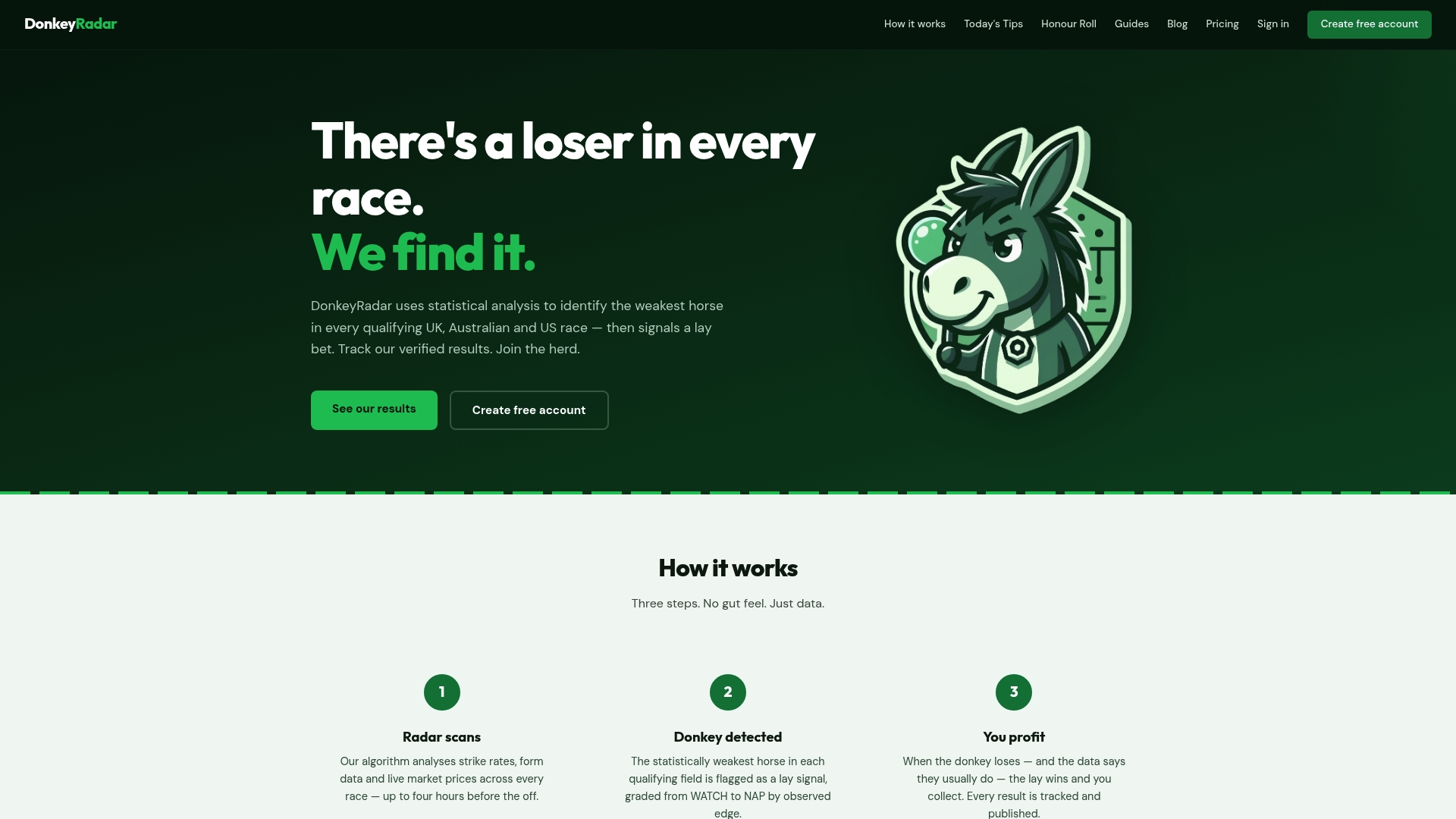
The platform’s core products map directly onto what this article has covered:
- Published lay signals flag mispriced favourites before the race, so you are not starting your form study from a blank page.
- A lay betting calculator converts your stake and the current price straight into liability and break-even figures.
- Real-time alerts via email and Telegram flag market moves worth checking against your own criteria.
- A public, verified results history lets you check performance claims against actual outcomes rather than taking them on trust.
If the maths and checklists here made sense to you, the Betfair lay betting strategy guide shows how DonkeyRadar’s signals apply the same EV and liability principles at scale, and the lay betting calculator is the fastest way to check whether today’s price on a shaky favourite actually clears your threshold before you commit a penny.
Sources
For deeper background on how handicaps work, the BHA’s official handicapping guide explains the ratings system that creates the mispricing opportunities covered above. For the EV maths behind every lay decision, the KiqIQ five-step EV framework sets out the formulas in full. For staking discipline and odds-band selection, the Betfair complete strategy guide is worth reading alongside this article. If lay betting ever stops feeling like a controlled activity, GambleAware provides free, confidential support.
- Guide to handicapping — British Horseracing Authority
- Lay betting strategy: 5-step EV framework | KiqIQ
- Lay betting strategies that actually work on Betfair — Tipster Reviews
- GambleAware