← Blog · 📝 Article · 24 September 2026
Lay Betting Kelly Sizing: Half Kelly, 2% Cap and Spreadsheet Workflow

The Kelly staking plan for lays computes the exact fraction of your bankroll to risk, as liability or stake, using your calibrated win probability against the market price. It suits bettors with a genuine, tested edge rather than a hunch. Without solid calibration, run fractional Kelly and a liability cap, because estimation error and exchange friction punish full Kelly hard.
TL;DR:
- Using fractional Kelly with a liability cap of around 1-2% of bankroll helps manage estimation errors and market friction in lay betting.
- Always decide whether your Kelly fraction applies to liability or stake before calculating your bet, and recalculate for partial matches to avoid oversizing.
- Running out-of-sample calibration and tracking results are essential to verify your edge before trusting Kelly formulas for live betting.
- Kelly’s effectiveness relies on accurate probability estimates; overconfidence or miscalibration can lead to significant bankroll drawdowns.
- DonkeyRadar provides verified pre-race signals and tools to help bettors implement disciplined Kelly staking practices effectively.
Table of Contents
- What is Kelly staking for lays and how does the formula work?
- Should you size by stake or by liability?
- Why fractional Kelly beats full Kelly for most lay bettors
- A worked example: from probability to placed stake
- What actually goes wrong when you apply Kelly to lay betting
- How do you prove an edge before trusting Kelly with it?
- Building a Kelly spreadsheet or calculator for lays
- Staking rules and caps that protect your bankroll
- How Donkey applies fractional Kelly to live lay signals
- DonkeyRadar: signals and tools built for staking discipline
- Sources
- FAQ
What is Kelly staking for lays and how does the formula work?
The Kelly criterion exists to answer one question: given a repeatable edge, how much of your bankroll should you risk on each bet to grow it as fast as possible without ruining yourself along the way? John Kelly’s original 1956 paper framed this as maximising expected logarithmic wealth rather than expected wealth itself. Log growth punishes large drawdowns disproportionately, which is exactly the behaviour you want when a single bad liability can wipe out weeks of grinding profit.
For a standard back bet, the familiar formula is f* = (bp − q) / b, where b is the net odds, p is your estimated win probability, and q is 1 − p. Stanford’s exposition of the criterion shows why this balance of edge against odds falls out of maximising expected log wealth rather than being an arbitrary rule of thumb.
Lay betting flips the position. You are effectively backing the selection to lose, so the roles of p and q swap, and the “odds” you are working against are the lay price rather than a back price. The lay Kelly fraction becomes:
- f* = (q − p·(b − 1)) / (b − 1), where b is the lay odds, p is your estimated probability the selection wins (the outcome you are betting against), and q = 1 − p
- f* is expressed as a fraction of bankroll, and critically, you must decide up front whether that fraction represents liability or stake, because the two are not interchangeable
- A positive f* only exists when your estimated p is lower than the price implies, meaning the market is overvaluing the selection’s chances of winning
That last point matters more for lays than for backs. Because a lay bet has liability rather than stake as its capped downside, a poorly calibrated p can quietly generate an oversized liability fraction that looks fine on paper but risks damaging your bank the first time the selection wins. The formula is only as good as the probability you feed it, a theme that resurfaces throughout the practical sections below.
Should you size by stake or by liability?
This is the decision most bettors get wrong, and it’s the single biggest source of accidental oversizing when applying Kelly to lays. Liability is what you actually stand to lose if the selection wins: liability = (odds − 1) × stake, a relationship confirmed by standard exchange guidance on lay betting. Stake is what you receive if the selection loses. Kelly’s f* gives you a bankroll fraction, but it does not tell you automatically which of these two figures that fraction refers to.
Here’s how to convert cleanly between the two, once you’ve decided on your convention:
- Calculate f* using the lay Kelly formula and treat it as your target liability fraction of bankroll (this is generally the safer, easier-to-audit choice).
- Multiply f* by your bankroll to get your target liability in pounds.
- Divide that liability by (odds − 1) to get the stake to place on the exchange.
- If you prefer to size by stake instead, simply multiply your stake fraction by (odds − 1) to check the implied liability before you click confirm.
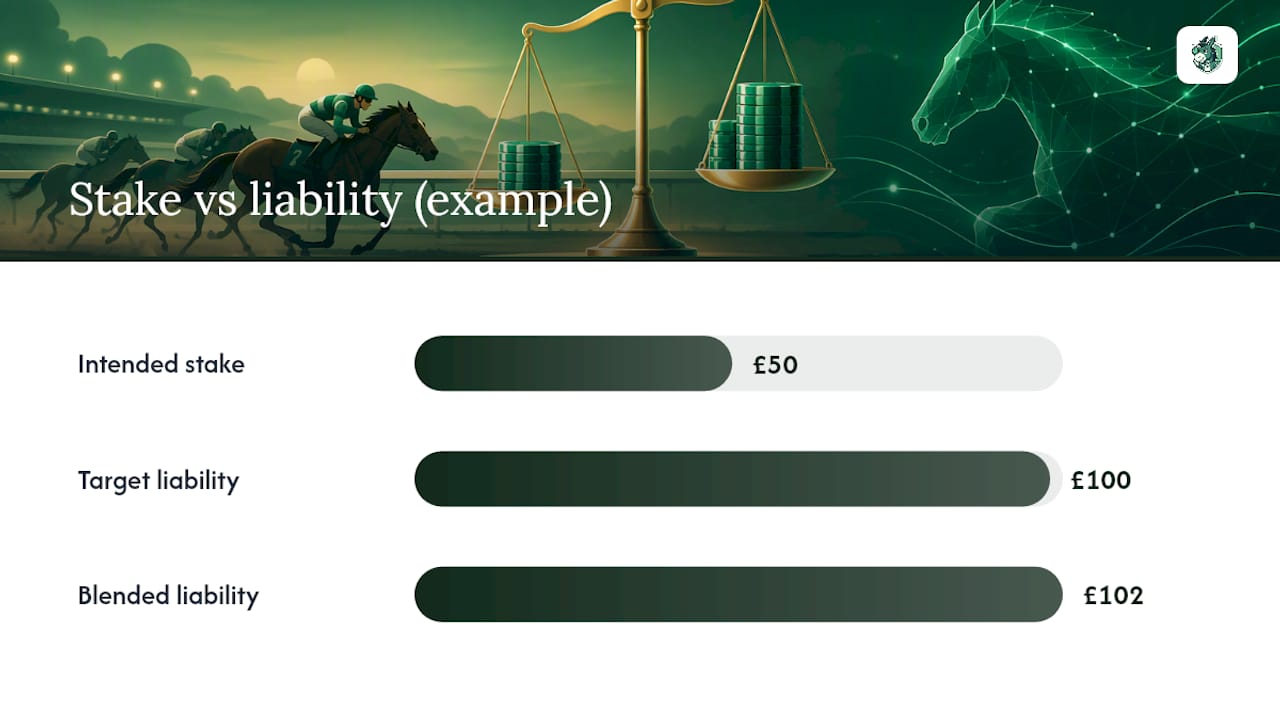
Partial matching complicates this. If your £50 stake at odds of 3.00 only fills £30 at that price and the remainder matches at 3.10, your blended liability is no longer a clean multiple of your original stake. Recalculate liability separately for each matched slice and sum them, rather than assuming your intended stake and intended liability stayed in lockstep.
Pro Tip: Round stakes down, never up, when a partial match leaves an awkward remainder. Overshooting your liability cap by a few pounds because of a rounding habit defeats the entire purpose of Kelly sizing.
Why fractional Kelly beats full Kelly for most lay bettors
Full Kelly assumes your probability estimate is exactly right. It never is. Even a small overestimate of your edge inflates f* and drags your bankroll through violent swings that full Kelly’s maths simply doesn’t account for. Practical work on Kelly’s weaknesses is explicit that fractional Kelly exists precisely to absorb this estimation error, and racing lays carry plenty of it: form is noisy, fields change late, and strike rates over small samples lie more than they tell the truth.
Common divisors and what they buy you:
- Half Kelly cuts liability roughly in half versus full Kelly while giving up a comparatively small share of long-run growth, making it the standard starting point for anyone with a reasonably tested model.
- Quarter Kelly is the conservative choice for newer signals or smaller samples, trading more growth for a much smoother equity curve while you build confidence in your calibration.
- Third Kelly sits between the two and suits bettors who trust their edge but still want a meaningful volatility cushion during a live testing phase.
The decision rule is simple: the less confident you are in your probability estimates, the larger the divisor. A model backed by hundreds of logged, out-of-sample predictions can justify half Kelly. A brand-new approach with fifty results behind it belongs at quarter Kelly or smaller, combined with a hard liability cap regardless of what the formula says, a point Bayesian treatments of Kelly reinforce by showing how much caution uncertain probabilities actually warrant.
A worked example: from probability to placed stake
Take a bankroll of £1,000, a lay price of 3.00, and an estimated win probability for the selection of 25% (so p = 0.25, q = 0.75). Full Kelly here produces a liability fraction that translates to a liability of £250 and a stake of £125, following the standard worked conversion from Kelly liability to exchange stake. Halve that for half Kelly, and quarter it for quarter Kelly.
| Sizing basis | Liability fraction of bankroll | Liability | Stake at odds around 3.00 |
|---|---|---|---|
| Full Kelly | About a quarter of bankroll | About a quarter of liability | About a quarter of stake |
| Half Kelly | About half that fraction | Half the liability | Half the stake |
| Quarter Kelly | About a quarter of that fraction | Quarter the liability | Quarter the stake |
The number that should stop you before you click confirm: a full-Kelly liability of £250 on a £1,000 bank is 25% of your entire bankroll on one race. Even seasoned bettors rarely accept that kind of exposure on a single outcome, which is exactly why fractional Kelly and liability caps exist alongside the formula rather than instead of it.
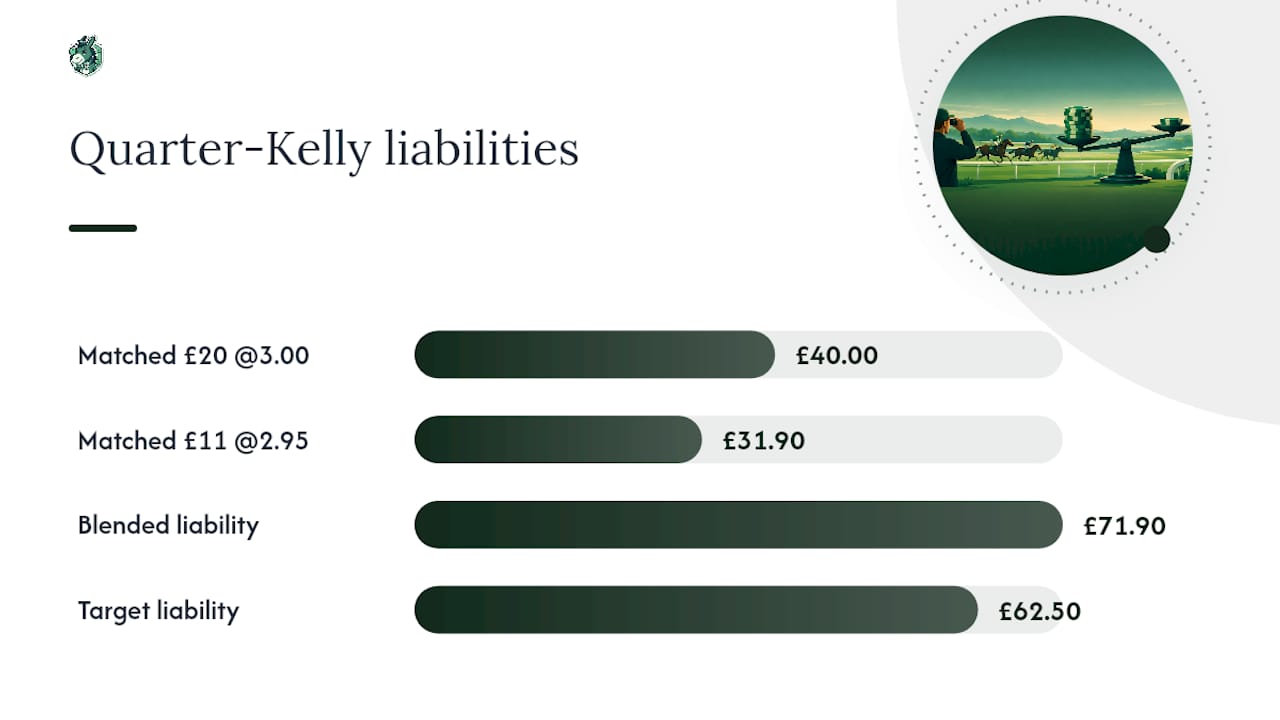
Rounding and partial fills change the final numbers in practice. If your quarter-Kelly stake of £31.25 only matches £20 at 3.00 and £11 at 2.95, recalculate liability for each slice: £40 on the first, £31.90 on the second, giving a blended liability of £71.90 against a target of £62.50. Small overshoots like this compound if you don’t check them, which is why liability-first calculation, checked bet by bet, beats trusting a single upfront stake figure.
What actually goes wrong when you apply Kelly to lay betting
Kelly’s maths is clean. Racing markets are not, and the gap between the two is where most Kelly-sized lay accounts get hurt. A few frictions deserve specific attention:
- Estimation error compounds fast. Feed the formula a probability that’s off by even a few percentage points and f* moves more than intuition suggests, especially at shorter lay odds where the (odds − 1) denominator is small.
- Selection bias inflates strike rates. A model that looks 85% accurate on the races you remember laying is not the same as one tested blind across every eligible race, published in advance.
- Liquidity and price movement eat into edge. Thin markets mean your intended price isn’t always available in size, and prices can drift against you between signal and settlement.
- Commission reduces realised edge on every winning lay, so your Kelly inputs should use net returns, not the gross price shown on screen.
- Non-runners return your stake but not your time or opportunity cost, and a portfolio of same-race-card lays can be more correlated than the formula assumes, since one unexpected result often moves the whole field’s pricing.
Pro Tip: Treat every lay on the same card as partially correlated, not independent. If three of your five active lays are in races run within twenty minutes of each other, a single stewarding delay or weather shift can hit all three at once.
Anyone concerned that staking discipline is slipping, rather than just the maths, should also look at general safer-gambling resources such as BeGambleAware, which covers risk awareness beyond pure staking theory.
How do you prove an edge before trusting Kelly with it?
Kelly only rewards a genuine, repeatable edge. Feed it a false one and it will size up losses just as efficiently as it sizes up wins. Before any live Kelly deployment, run through a testing protocol rather than trusting a strike rate you noticed after the fact.
- Separate your training and test periods. Build your probability model on one block of historical races, then validate it on a later block it has never seen, not the same data used to tune it.
- Log every prediction before the race runs, not after. Research on calibration and testing for Kelly-style models is blunt about this: historical strike rate alone is not a safe input, because hindsight quietly inflates it.
- Wait for a meaningful sample. Roughly 200 or more logged, out-of-sample bets gives a reasonable read on whether your calibration is stable rather than a lucky run.
- Check calibration directly, not just accuracy. A reliability diagram or a Brier score tells you whether your “30% probability” selections actually win around 30% of the time, which is the input Kelly actually needs.
- Require positive expected log growth in backtesting, not just positive average profit, before sizing anything close to full Kelly live.
Our guidance on validating an edge before staking covers the sample-size and logging discipline behind this in more depth, and it’s worth reading before you size a single live bet against a new model.
Building a Kelly spreadsheet or calculator for lays
You do not need complex software to run this properly, a spreadsheet with the right columns does the job. Structure it so liability is the primary calculated output, since that is what an exchange actually caps you on:
- Inputs column: bankroll, lay odds, estimated win probability, commission rate, chosen Kelly divisor.
- Calculated column: q (1 − p), full-Kelly liability fraction, fractional liability fraction after applying your divisor, resulting liability in pounds, and the stake that liability implies at the quoted odds.
- Placed-bet column: actual matched stake, actual matched price (which may differ slightly from your target), recalculated actual liability, and a variance flag if actual liability exceeds your cap.
Decide your convention once, liability first is usually easier to audit for racing lays, and stick with it across every tool you use. Practical operating guidance on Kelly implementation flags mixed stake and liability conventions across spreadsheets and APIs as a routine cause of accidental oversizing, and it’s an easy trap to fall into when moving between a personal spreadsheet and an exchange’s own bet slip.
If you’re automating through an API, test on small stakes first, log every placed bet with its actual matched price, and audit the conversion from liability to stake weekly rather than assuming your formula stayed accurate as odds moved. Our note on Betfair liability conventions walks through how the exchange itself handles this distinction.
Staking rules and caps that protect your bankroll
Kelly gives you a number. Sensible guard rails decide whether you actually use it. Most experienced lay bettors run Kelly alongside, rather than instead of, a set of fixed rules:
- Cap liability at 1 to 2% of bankroll per bet, overriding Kelly’s output whenever the formula suggests more, regardless of how confident the model feels.
- Limit simultaneous exposure across correlated races (same card, same meeting) to a fixed percentage of total bankroll, not just per-bet.
- Review calibration monthly, comparing predicted probabilities against actual outcomes, and drop your Kelly divisor immediately if a reliability check shows drift.
- Keep a full record of every signal, price taken, stake, and result, since this record is what lets you catch calibration slippage before it costs real money rather than after.
Pro Tip: If your last fifty logged predictions show your “20% probability” selections winning closer to 30% of the time, halve your Kelly divisor immediately rather than waiting for a bigger sample to confirm what you already suspect.
Our fixed-liability staking guide and five-step liability staking plan both work well as the fixed-rule half of this pairing, giving Kelly a ceiling it cannot exceed no matter what the maths suggests on a given day.
How Donkey applies fractional Kelly to live lay signals
Half Kelly, capped at 2% liability per bet regardless of what the formula outputs, is the setting worth defaulting to until a signal has proven itself across a genuine out-of-sample sample. Grading signals by confidence tier before publishing them, rather than after seeing results, is what actually improves calibration over time, not the strike rate alone. Publish every signal before the race, track every result whether it wins or loses, and let that public record, not a claimed accuracy figure, be the thing that earns trust.
— Donkey
DonkeyRadar: signals and tools built for staking discipline
DonkeyRadar exists to give lay bettors a pre-tested edge to size, rather than a hunch to guess at. The DonkeyRadar Free tier delivers daily lay signals with direct Betfair Exchange links, so you can move straight from signal to stake calculation without hunting for the right race. DonkeyRadar Pro, priced at £29 per month, adds real-time alerts by email and Telegram, full verified results history, staking tier grading, and API access for anyone automating their Kelly workflow.
Every signal is published before the race runs, and results are tracked and verified publicly afterwards, which is exactly the kind of out-of-sample, pre-logged record that makes calibration checks meaningful rather than hopeful. Staking tier grading gives you a starting confidence level for each signal, so you’re not applying the same Kelly divisor to a well-tested pick as you would to a marginal one. If you want to see how these signals convert directly into liability and stake, the lay betting calculator walks through the maths on real prices, and the Betfair lay betting strategy guide covers how the approach fits together in practice. Start with the free tier at Donkeyradar and see whether the verified track record holds up against your own staking rules.
Sources
- Good and bad aspects of Kelly betting (Aldous / Thorp papers collection)
- Probability — The Kelly Criterion (Stanford)
- Portfolio choice and the Bayesian Kelly criterion — Columbia Business School paper
- Kelly criterion — Wikipedia
- Lay odds: liability, matching and commission — SportSignals
FAQ
Does the Kelly staking method actually work?
Kelly works mathematically for maximising long-run growth when your probability inputs are accurate, a result Kelly’s original framing established for repeatable-edge situations. It fails badly when probabilities are miscalibrated, which is why experienced bettors run fractional Kelly rather than the full formula in live lay betting.
How do I calculate a lay stake from a Kelly liability figure?
Divide your target liability by (odds − 1) to get the stake: stake = liability ÷ (odds − 1), a relationship confirmed in standard exchange guidance. At odds of 3.00, a £250 liability converts to a £125 stake.
How do I calculate the Kelly criterion for a lay bet?
Use f* = (q − p·(b − 1)) / (b − 1), where b is the lay odds, p is your estimated probability the selection wins, and q = 1 − p. Multiply f* by your bankroll to get a target liability, then convert that to stake using the formula above.
Does Warren Buffett use the Kelly criterion?
There’s no confirmed, sourced account of Buffett formally applying the Kelly criterion to his investing decisions, and the claim circulates more as investing folklore than documented fact. What’s well established is that Kelly-style thinking, sizing positions according to edge and avoiding ruin, underpins a lot of professional bankroll management, including the fractional approach recommended for lay betting here.
Can DonkeyRadar help me apply Kelly staking to lay bets?
Yes. DonkeyRadar publishes lay signals before races with a verified results history, giving you the calibrated, out-of-sample track record that Kelly sizing depends on. The lay betting calculator converts those signals directly into liability and stake figures.