← Blog · 📝 Article · 16 August 2026
Betfair lay liability explained for exchange users

When you place a lay bet on Betfair, your liability is the maximum amount you pay out if the selection wins. The formula is straightforward:
Liability = (lay odds − 1) × backer’s stake
So if you lay a horse at odds of 4.0 for a backer’s stake of £10, your liability is (4.0 − 1) × £10 = £30. That £30 is reserved from your exchange balance the moment the bet is matched. If the horse loses, you keep the £10 stake as profit. If it wins, you pay out £30.
- Your liability is NOT the same as the backer’s stake — it is always larger when odds exceed 2.0.
- Betfair reserves the full liability from your available balance before the bet is accepted.
- Before placing any lay, check that the liability shown on your bet slip matches your manual calculation.
Key takeaways
Lay liability is the single figure that determines whether your exchange bank can support a bet — get it right before every lay, not after.
| Point | Details |
|---|---|
| Core formula | Liability = (lay odds − 1) × backer’s stake; calculate this before checking profit. |
| Funds requirement | Your exchange balance must cover the full liability before Betfair accepts the lay. |
| Odds and liability | Higher odds multiply liability fast — laying at 10.0 costs nine times more than laying at 1.5 for the same profit. |
| Bankroll control | Keep your exchange bank at least three times your average single-lay liability at all times. |
| Donkeyradar signals | Every signal includes a staking tier that caps liability to your bank size, with verified results published publicly. |
Table of Contents
- How does Betfair lay liability work?
- How to calculate lay liability: formula and worked examples
- Lay bet calculators and tools worth using
- Why liability matters for your matched betting bankroll
- Common mistakes and how to avoid them
- How professionals manage liability: controls and staking tiers
- Lay signals with liability already factored in
- Sources
How does Betfair lay liability work?
When you lay a selection, you take on the bookmaker’s role. A backer bets that the outcome happens; you bet it does not. If the selection wins, you pay the backer their winnings. If it loses, you collect their stake.
The exchange sits in the middle, matching layers with backers and collecting commission on net winnings. It does not absorb any risk itself. To protect backers, Betfair holds your full liability in reserve from the moment a lay is matched — you cannot spend those funds on another bet until settlement.
| Outcome | Who wins | Who pays | What the exchange does |
|---|---|---|---|
| Selection wins | Backer | Layer pays liability | Transfers liability to backer |
| Selection loses | Layer | Backer forfeits stake | Transfers stake to layer |
| Bet unmatched | Neither | No funds move | Returns reserved funds |
Commission is charged on your net market winnings after settlement. It does not reduce your headline liability figure — the full amount is still reserved regardless. On Betfair Exchange, the standard commission rate varies by market and your Betfair Premium Charge status, so always check your current rate in your account settings.
One more nuance worth knowing: if your lay is matched in parts at different odds, each matched portion carries its own liability. SportSignals notes that you must calculate each portion separately and sum them, because the pre-match headline figure may differ from the actual settled liability.
How to calculate lay liability: formula and worked examples
The core formula, as documented by Smarkets, is:
Liability = backer’s stake × (lay odds − 1)
Step-by-step arithmetic
- Take the decimal lay odds shown on the exchange.
- Subtract 1.
- Multiply the result by the backer’s stake.
- The answer is the amount reserved from your balance.
Three worked examples
The profit column is the same in all three rows because the backer’s stake does not change. The liability column tells the real story: laying at 10.0 requires nine times more capital reserved than laying at 1.5 for identical profit. This is why Betfair’s own guidance stresses that laying short-priced favourites gives you far greater control over exposure.
Reversing the formula
Need to work backwards from a maximum liability you can afford? Rearrange:
Backer’s stake = target liability ÷ (lay odds − 1)
Example: you can afford £50 liability at odds of 6.0. Maximum backer’s stake = £50 ÷ (6.0 − 1) = £10.
A note on exchange display settings
Smarkets allows accounts to display either the backer’s stake or the layer’s stake in the bet entry field. Always confirm which setting is active before entering a figure, because entering the layer’s stake where the formula expects the backer’s stake will produce a wrong liability calculation.
Lay bet calculators and tools worth using
A reliable lay calculator accepts two inputs — lay odds and backer’s stake — and returns liability, layer’s profit, and sometimes a break-even implied probability. The Betfair lay bet calculator is the official tool and the natural first check before placing any lay.
How to use it in three steps:
- Enter the lay odds and the backer’s stake you intend to offer.
- Read off the liability figure and compare it to your manual calculation using the formula above.
- If the two figures match, you have the right inputs; if they diverge, recheck which stake field you used.
Donkeyradar’s lay betting calculator covers the same inputs and also shows break-even probability, which is useful when sizing lays against a signal’s implied strike rate.
Watch for these interface traps:
- Partial matching: if your lay fills in parts, the calculator’s pre-match figure may not reflect the final blended liability. Check your “Matched bets” report after placement.
- Average matched price: a lay placed at 4.2 that fills partly at 4.0 and partly at 4.5 carries a blended liability. Recalculate each portion separately.
- Unmatched portion: funds reserved for an unmatched portion are returned, but the matched portion’s liability stays locked until settlement.
Pro Tip: Run the manual formula alongside any calculator output at least once per session. The habit takes ten seconds and catches data-entry errors before they become costly.
Why liability matters for your matched betting bankroll
Liability ties up capital. The exchange reserves the full amount from your available balance the instant a lay is matched, meaning those funds cannot be used elsewhere until the market settles. For matched bettors running multiple lays simultaneously, this can lock up a significant portion of the exchange bank.

When a sportsbook free bet and an exchange lay are correctly hedged, the liability is a temporary hold rather than a net loss — the sportsbook position offsets the exchange exposure. The key word is correctly: an under-hedged position leaves real downside.
Bankroll rules to apply before every session:
- Keep your exchange bank at a minimum of three times your average single-lay liability.
- Never lay odds above 6.0 unless your bank can absorb the full liability without dipping below that three-times buffer.
- Maintain a separate exchange bank — do not mix it with sportsbook bonus funds.
- Use a set-and-forget approach where possible to avoid reactive decisions mid-session.
- Commission reduces your net profit but does not reduce the liability reserved. Factor it into profit targets, not into your balance check.
Laying a short-priced favourite is the most capital-efficient way to generate lay profit per pound of liability. The odds-on lay strategy covers this in detail, but the principle is simple: at odds of 1.5, every £10 of backer’s stake costs only £5 in liability.
Common mistakes and how to avoid them
The most frequent error is confusing the backer’s stake with the layer’s liability. They are different numbers. The backer’s stake is what the backer risks; the liability is what you risk. At odds above 2.0, your liability always exceeds the backer’s stake.
Pre-lay checklist:
- Confirm the liability displayed on the bet slip matches your manual calculation.
- Check your available balance exceeds the liability before submitting.
- Recalculate for partial match risk if the market is thinly traded.
- Never add funds mid-session to cover a losing position — repeated top-ups signal a staking plan that does not fit your bank.
- Set a per-market maximum liability before the session starts and do not override it.
Responsible gambling matters. If you feel your betting is becoming difficult to control, the Gambling Commission publishes guidance and tools, and BeGambleAware and GamCare both offer free, confidential support.
How professionals manage liability: controls and staking tiers
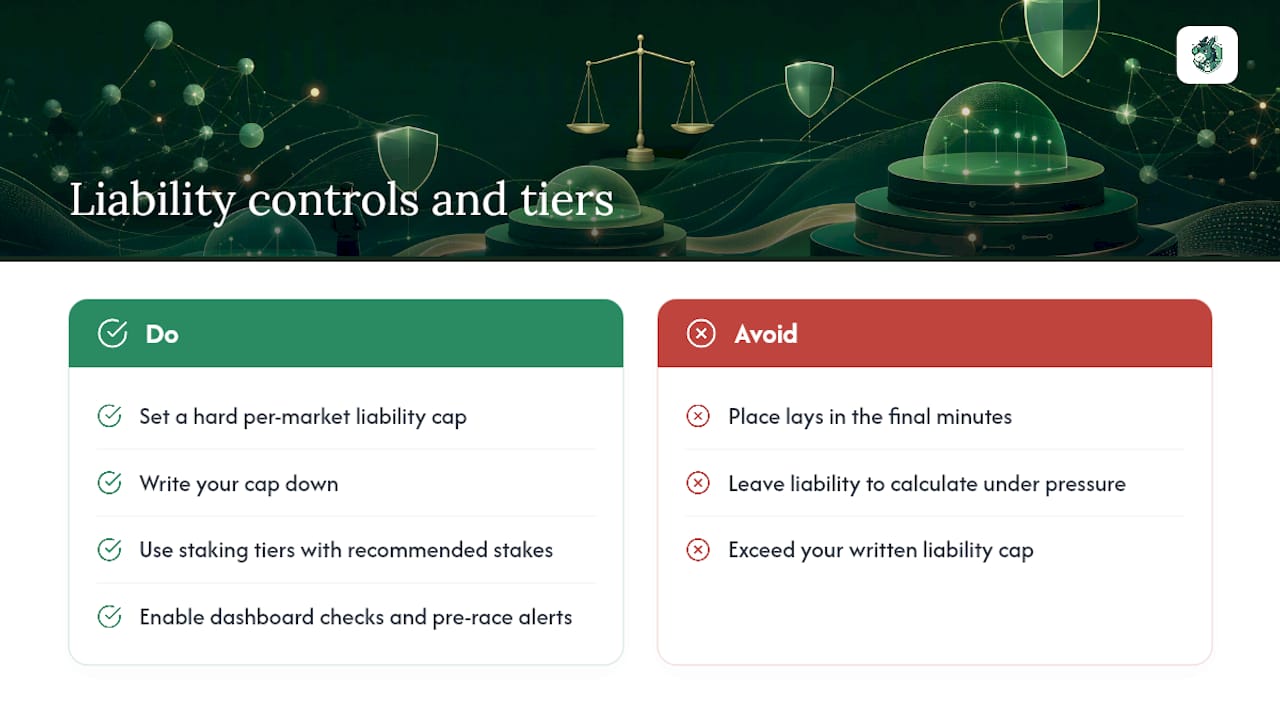
Professional signal services treat liability as an operational variable, not an afterthought. The standard approach involves staking tiers — pre-defined bands that cap the backer’s stake (and therefore the liability) for each signal grade. A tier-one signal might permit a £20 backer’s stake; a tier-three signal might cap at £5, purely because the implied liability at longer odds would otherwise breach the bank’s buffer.
Donkeyradar grades every lay signal by staking tier before publication. Each signal carries a recommended backer’s stake calibrated to the signal’s confidence level and the typical odds range, so the liability is sized to the bank rather than left to the user to calculate under pressure. Verified results are published publicly so users can check historical strike rates against the stated tiers.
Automated dashboard checks and pre-race alerts prevent late liabilities — placing a lay in the final minutes before a race, when liquidity drops and prices move, is one of the fastest ways to end up matched at worse odds than intended. Donkeyradar’s dashboard links directly to the Betfair Exchange for each signal, and alerts go out via email and Telegram before the market tightens.
One practical control you can adopt today: set a hard per-market liability cap in your staking plan — a number you will not exceed regardless of how confident you feel about a selection. Write it down. It is the single most effective guard against the compounding effect of a few large liabilities in a short session.
The part most guides skip
Liability feels abstract until the exchange balance drops. The formula is simple, but the discipline of checking it every single time is where most matched bettors lose ground — not to bad selections, but to avoidable data-entry errors and under-funded accounts.
The practical learning: calculate liability before you look at the potential profit. Profit is what you hope for; liability is what you must be prepared to pay. Sizing the bank around the liability, not the profit, is what keeps a matched betting operation running through a losing run.
Lay signals with liability already factored in
Calculating liability manually on every signal is manageable for one or two bets. Across a full card of races in the UK, Australia, and the US, it becomes the task that most often gets skipped — and that is when errors happen.
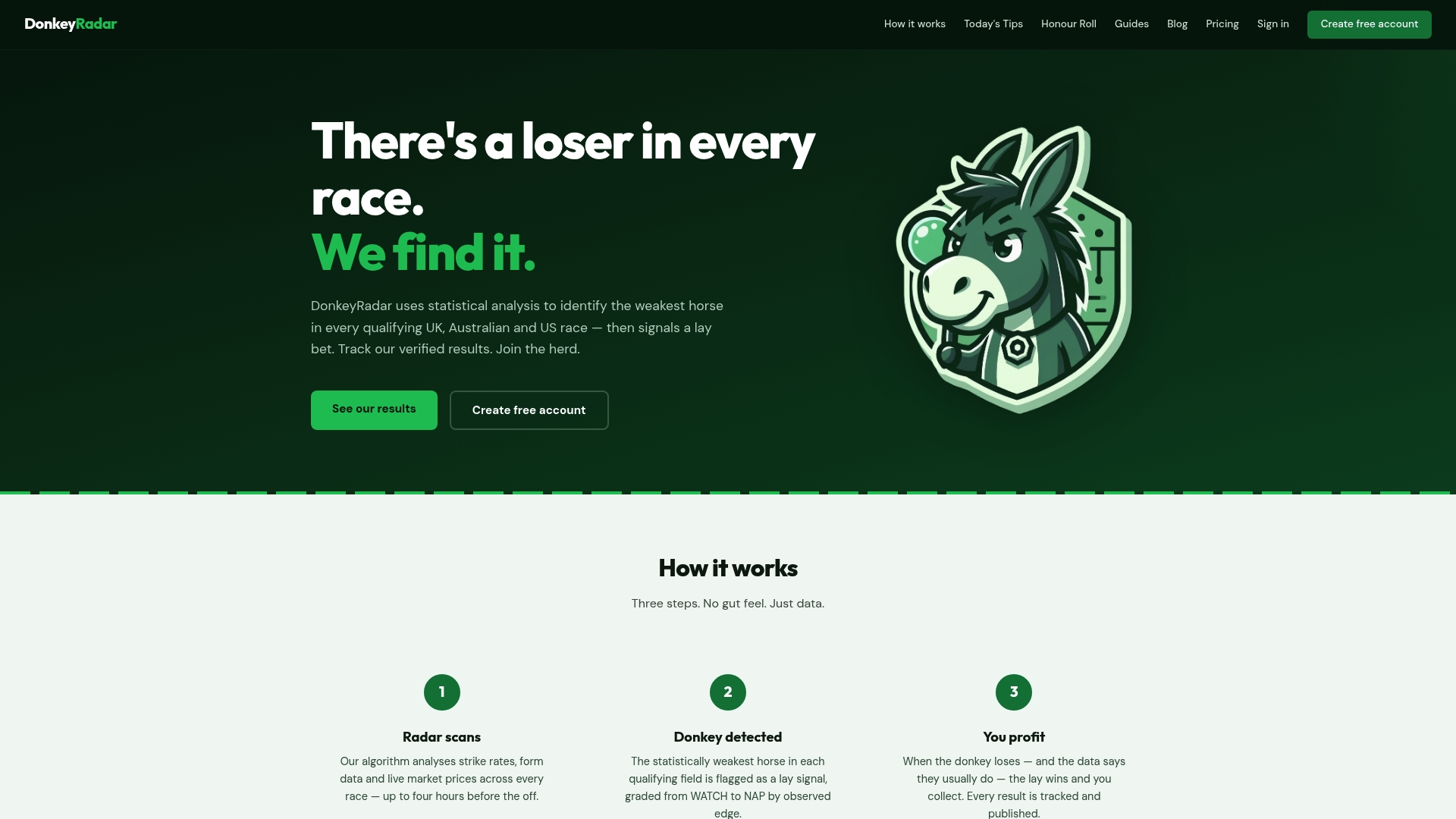
Donkeyradar builds liability awareness into every signal it publishes. Staking tiers cap the backer’s stake to match your bank size, verified results show the historical P&L against those tiers, and the dashboard links directly to Betfair Exchange so you move from signal to placement without switching tabs. The seven-day trial gives you full access to premium alerts and the complete results history.
- Staking tiers: every signal carries a recommended stake calibrated to its confidence grade.
- Verified results: all signals are published before races and tracked publicly.
- Direct Betfair links: the dashboard connects straight to the relevant exchange market.
Start your seven-day trial at Donkeyradar’s lay betting guide and place your first liability-aware lay today.
Sources
- Exchange: What does the term “Lay” mean and what is a Lay bet?
- How to calculate the liability of a lay bet – Smarkets Help Centre
- Lay Bet Calculator
- Lay odds: liability, matching and commission | SportSignals
- Safer gambling | Gambling Commission
Always verify the final matched liability in your “My bets / Matched bets” report after placing a lay — the pre-match figure and the settled figure can differ when partial matching occurs.