← Blog · 📝 Article · 16 September 2026
Lay Betting Stop Loss That Sizes by Liability Not Stake
Set a liability cap per trade, a hard-stop for the session, and enforce both before you place a bet. Liability is not your stake, and stops need setting pre-trade, not once a price is already moving against you. The calculator and pre-trade checklist further down give you the exact numbers to plug in and a routine to run before every lay.
TL;DR:
- Limiting liability per trade and session, set before betting, is crucial because liability varies with odds and ensures consistent risk management.
- Using fixed liability caps for sizing bets is more reliable than percentage-of-stake rules, as it reflects the real worst-case loss.
- Combining different stop-loss types, such as tick, trailing, or event stops, improves risk control in liquid markets versus relying on a single trigger.
- Building buffers into automated stops accounts for market slippage and partial fills, which can cause trades to close at worse prices than expected.
- Regularly logging and verifying each trade’s odds and liability helps maintain discipline and optimize stop strategies over time.
Table of Contents
- What is a lay betting stop loss, and what’s the right one to start with?
- Which type of stop loss suits your trading style?
- How do you calculate liability and size your stop?
- How do you set stops in trading tools without getting caught out?
- What stop-loss templates can you copy today?
- What should you check before every lay bet?
- How does DonkeyRadar build stop-loss discipline into its signals?
- Why strict stop-loss discipline actually matters
- DonkeyRadar as your data-driven stop-loss partner
- Primary sources and further reading
- Sources
- FAQ
What is a lay betting stop loss, and what’s the right one to start with?
A lay betting stop loss is a pre-agreed exit point that closes your position once liability or losses hit a threshold you set before the race starts. It exists because a lay bet’s downside is not capped at your stake. It’s tied to how far the odds move against you.
Start with this framework and adjust once you have a track record:
- Per-trade cap: risk a small percentage of your betting bank in liability on any single lay, not stake.
- Session cap: stop for the day once losses reach a modest portion of your bank.
- Warning line: flag yourself halfway to that session cap, so you get a pause before the hard stop.
- Take-profit pairing: set a profit target alongside the stop, so you’re not only defining the exit on the downside.
Fixed liability staking beats percent-of-stake rules because it sizes the bet from your actual worst-case exposure, not from the number you happened to type into the stake box. Two bets with identical stakes can carry wildly different liability depending on price, so anchoring your limit to liability keeps every trade genuinely comparable. The Betfair risk management guide makes the same case: liability, not stake, is the number that determines whether one bad race wrecks your week.
Which type of stop loss suits your trading style?
Different stop types solve different problems, and lay bettors typically mix at least two:
- Tick or price stop: exits once the lay price moves a set number of ticks against you, for example six ticks from your entry price. Simple, mechanical, and good for beginners.
- Trailing stop: trails the market as it moves in your favour, locking in profit as the price drifts. It works well in trending pre-race markets but struggles in-play, where a sudden price spike can trigger an exit before the market settles.
- Time stop: exits after a set period if the market hasn’t moved, useful when a price stalls near the off and ties up capital you’d rather deploy elsewhere.
- Event stop: closes the position the moment a specific event happens, a horse being withdrawn, a doubtful runner declared fit, or a sudden weight of money on one side.
Fixed session stops suit anyone new to lay betting. Trailing stops suit more experienced traders working liquid, high-volume races. Layering more than one type is standard practice, according to Sportsbook Software’s modelling analysis, which recommends combining stop types rather than relying on a single trigger.
How do you calculate liability and size your stop?
Two formulas do almost all the work here:
Liability = stake × (odds − 1)
Net profit = stake − (stake × commission%)
Rearrange the first formula and you get the one that actually protects your bank: Max stake = Max liability ÷ (odds − 1). Decide your maximum acceptable liability first, then let that number dictate your stake, never the other way round.
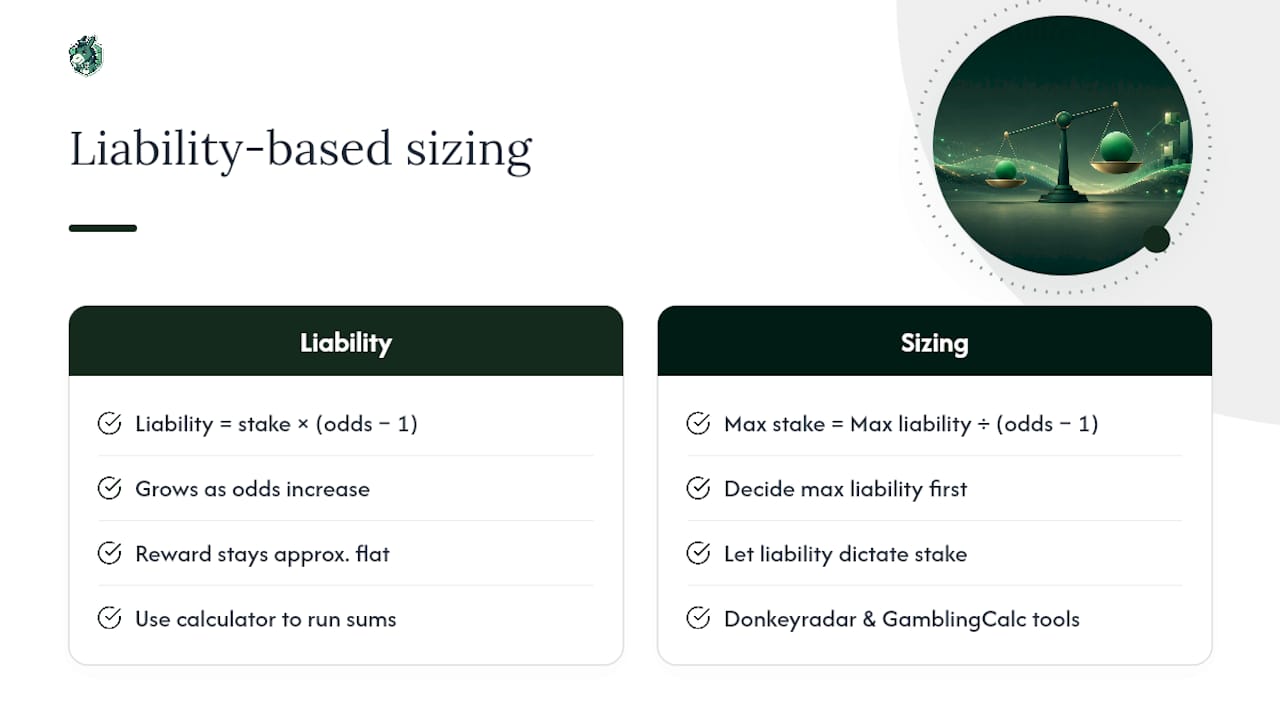
The liability grows significantly as odds increase, making liability-based sizing critical since the reward remains approximately flat while downside exposure multiplies. GamblingCalc’s lay calculator runs these sums instantly, and it’s worth bookmarking. Donkeyradar’s own lay betting calculator does the same job with liability caps built in, and the liability guide walks through reading projected P&L on the ladder before you commit.
How do you set stops in trading tools without getting caught out?
Third-party stop tools watch the market and fire an order once your trigger price hits, but that order still has to queue and match on the exchange like any other. It isn’t sent early, and it isn’t guaranteed to fill at your exact price. In-play delay, thin liquidity, and partial fills all mean your “stop” might close at a worse price than the one you set, especially in fast-moving markets.
Before relying on any automated trigger:
- Confirm the tool shows projected P&L and required funds, not just the raw stake.
- Check the order book for enough matched volume at your stop price before you trust it to fill cleanly.
- Verify the stop still runs if you close the browser tab. Some tools need the session open; others run server-side.
- Test with small stakes first, in a liquid market, before trusting automation with real size.
Pro Tip: Never assume a stop will fill at the exact tick you set. Build a small buffer into your liability cap, so a slippage-affected fill still keeps you inside your session limit.
Practitioners who monitor liability in real time on the exchange ladder, rather than trusting stake alone, catch these gaps before they become losses, a point Betfair’s own risk guide makes directly.
What stop-loss templates can you copy today?
- Two-tier stop: set a warning at 50% of your session cap and a hard stop at 100%. If your session cap is £50, the warning fires at £25 lost, giving you a cooling-off window before the hard stop shuts trading down entirely.
- Daily rule: cap losses at 5% of bank per day, reviewed weekly rather than adjusted mid-session.
- Weekly rule: cap cumulative losses at 15% of bank per week; hit that and you stop trading until Monday, no exceptions.
- Volatility adjustment: widen your tick stop in high-variance events (big-field handicaps, unpredictable going) and tighten it in low-variance markets (small-field races with a clear favourite). Widening preserves capital during genuine noise; tightening protects you when a move is more likely to be real information.
A two-tier structure like this reduces snap decisions under pressure, because the warning threshold forces a pause before the money actually stops flowing.
What should you check before every lay bet?
Run this before you click confirm, every time:
- Entry price, stop price, and calculated liability, all written down or logged.
- Whether this trade keeps you inside today’s session cap, including the trade you’re about to place.
- Liquidity at your stop price, so you’re not relying on a fill that may not exist.
- Projected P&L displayed and checked, not estimated in your head.
- Automation switched on if you’re using it, and confirmed it survives a closed tab.
- The trade logged, win or lose, before you move to the next race.
That log matters more than it sounds. Bettors who record every stopped trade with odds, P&L, and timing can test their stop settings against real variance later, rather than guessing whether a rule is actually working.
How does DonkeyRadar build stop-loss discipline into its signals?
Lay signals are published before races start, with staking tiers graded by confidence and a lay calculator that turns a liability cap into a stake in seconds. Results are tracked publicly and verified, so the numbers you work from aren’t retrospective guesswork.
The discipline that keeps a lay betting account alive rarely comes from a better tip. It comes from knowing your liability before you place the bet, not after the price has moved.
None of that replaces your own stop-loss rules. The signals and staking tiers give you a data-driven starting point, but the session cap and hard stop still have to come from you.
Why strict stop-loss discipline actually matters
Surviving variance beats chasing one big win, every time, over a long enough run. Rules only work if you test them and log the results. Write down every stopped trade this week and see whether your limits are protecting you or just getting in the way.
— Donkey
DonkeyRadar as your data-driven stop-loss partner
Manual stop-loss discipline works, but it demands constant attention to prices, liquidity, and your own nerve under pressure. A different starting point is offered: lay signals published before the race, staking tiers that scale stake to confidence, and a track record you can verify rather than take on trust.
It’s not a replacement for the rules in this guide. It’s a way to walk into each race with a graded signal and a calculated stake already worked out, so your stop-loss decisions start from better information instead of a blank card. Run your numbers through the lay betting calculator before your next session, set your liability cap, and see what DonkeyRadar’s tracked signals would have meant for your bank this week.
Primary sources and further reading
For responsible gambling controls and pre-commitment tools, see BeGambleAware. For liability formulas and worked calculations, see GamblingCalc’s lay calculator.
Sources
- BeGambleAware
- Lay betting calculator — GamblingCalc
- Betfair risk management & money strategy guide
- General modeling risk analysis (2026) — Sportsbook Software
FAQ
What happens if you lose a lay bet?
You pay out the liability amount, stake × (odds − 1), to the person who backed the selection, which is why sizing by liability rather than stake matters so much.
Is a trailing stop-loss a good strategy?
Trailing stops work well in trending, liquid pre-race markets where they lock in profit as the price moves your way, but they’re vulnerable to in-play spikes and execution delays, so they suit specific conditions rather than every market.
When should I use lay betting?
Lay betting suits markets where you can identify a selection with a low likelihood of winning, such as a horse with poor recent strike rates, and where the exchange offers enough liquidity to enter and exit your position at your intended price.