← Blog · 📝 Article · 29 August 2026
Bettors, Stop the Bleed: Losing Streak Plan Cuts Stakes to 25–50%

Stop betting now. Cut your unit size to a survival level, roughly a quarter to a half of what you were staking before the run started, and set a fixed stop-loss for the next 7 to 14 days with a calendar date to review the whole approach. Nothing else matters until that’s done.
TL;DR:
- Reducing your stake size to a quarter or half of your previous level and setting a fixed stop-loss for 7 to 14 days helps prevent bankroll destruction during a losing streak.
- Implementing a three-step stake reduction, from a 25% cut after three losses to stopping after eight units lost, limits exposure and encourages disciplined betting.
- Staking with 1 to 2% of your current bankroll per bet offers a sustainable way to survive long losing runs, avoiding harmful strategies like Martingale escalation.
- Logging every bet, including odds, stakes, and market conditions, is essential for identifying whether losses are due to variance or process failure.
- Building a habit of daily logging and strict unit sizing maintains long-term betting health, allowing honest evaluation of strategy success over time.
Table of Contents
- What is a losing streak betting plan?
- What’s the staged recovery plan after a bad run?
- How should you stake your bankroll during a losing run?
- Why do bettors chase losses, and how do you stop?
- Is it variance or is your strategy broken?
- How Donkeyradar’s tools help you manage a losing run
- One habit worth keeping after any bad run
- Try the calculator behind your next lay
- Sources
What is a losing streak betting plan?
A losing streak betting plan is a predefined set of rules that dictates exactly what you do the moment your bankroll starts dropping, so you’re not making decisions in the heat of the loss. It covers three things: how far you’re willing to let the bankroll fall before you stop, how much you reduce your stakes along the way, and when you allow yourself to bet at full size again.
Most bettors don’t have one. They find out what their real risk tolerance is by breaching it, which is exactly backwards. The plan exists so the hard decisions get made in advance, on a calm day, rather than at 11pm after your fourth loser in a row.
The next 24 to 72 hours matter more than any long-term strategy tweak, because this is where most bankrolls actually get destroyed.
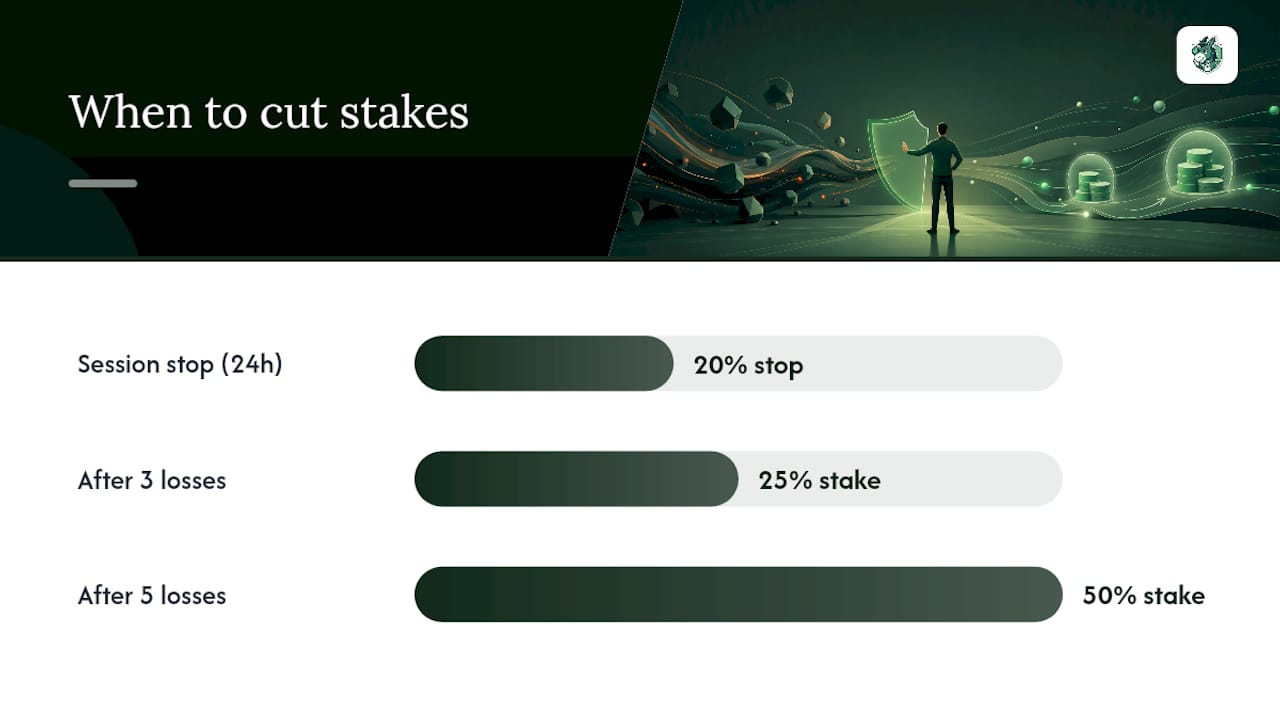
- Set a hard stop-loss for the day. A workable rule is: stop for 24 hours once you’re down 20% of your session bankroll. Most betting apps let you set daily deposit or loss limits directly in account settings, so use that feature rather than relying on willpower.
- Apply a three-step stake reduction ladder. After losing 3 units in a row, cut stakes by 25%. After 5 units down, cut by 50%. After 8 units down, drop to your minimum stake and stop opening new positions until you review.
- Enforce a 30-minute cooling rule after three consecutive losses. Step away from the screen entirely and disable quick-deposit or one-tap top-up methods on your betting accounts during this window.
- Log every bet immediately. Record the odds you took, the stake, a closing line value (CLV) note if you can get one, and the actual reason you placed the bet. This record becomes the raw material for the audit later.
What’s the staged recovery plan after a bad run?
Recovery from a losing run works in stages, not in one dramatic reset. Trying to fix everything in a single weekend is how bettors dig the hole deeper.
- Stage 1, days 0 to 7: survival. Cut betting volume hard, reduce unit size to the minimum you defined in your stop-loss rule, and set a strict daily limit. The only goal here is to stop the bankroll falling further.
- Stage 2, week 1 to 2: audit. Paper-trade, meaning track selections without staking real money, and pull your last 50 to 200 recorded bets. Check them against your original selection criteria: were the losses in line with your usual strike rate, or did the process itself break down?
- Stage 3, weeks 3 to 6: phased resumption. Return to real staking at reduced units, with fixed checkpoints (say, every 20 bets) where you decide whether to increase stakes back towards normal or stay reduced for another block.
Escalate to a full stop and outside help when any of the following apply:
- The drawdown exceeds a threshold you set in advance, for example 30% of peak bankroll.
- You’ve broken your own stop-loss rule more than once in a week.
- You notice yourself increasing stakes specifically to “get back” losses rather than because the value improved.
- Betting is affecting sleep, mood, or money set aside for essentials.
Sports betting losing streak recovery guidance backs this staged structure: reduce exposure first, audit second, resume only once the review has actually happened rather than once you simply feel ready.
How should you stake your bankroll during a losing run?
Staking rules decide whether a losing run is survivable or terminal. Flat staking, where every bet is the same fixed amount, is simple but doesn’t adjust as your bankroll shrinks. Percentage staking, where each bet is a fixed proportion of current bankroll, scales down automatically as you lose, which is exactly the protection you want mid streak.
Betting bankroll survival tip: even with a genuine long-term edge, sequences of 10 to 20 losses will happen over a large enough sample. The Betting Scout’s guide to surviving losing runs makes the point plainly: unit size, not confidence, is what determines whether you’re still betting after the sequence ends.
A conservative, professional standard is to stake 1 to 2% of bankroll per bet, which gives you enough runway to absorb a long losing run without needing to stop.
- Avoid Martingale-style escalation. Doubling your stake after every loss to “recover” it looks fine on paper until a realistic 8 to 10 loss run wipes out a bankroll that flat staking would have survived comfortably.
- Fractional Kelly staking can be defensible, but only if you have a genuinely tracked edge with real historical data behind it, not a hunch.
- Re-base after any significant drawdown. Recalculate your unit size against the new, smaller bankroll rather than staking as if the money you lost is still there.
Full guidance on ratio staking and drawdown maths sits in our lay betting bankroll guide and our risk of ruin survival guide.
Why do bettors chase losses, and how do you stop?
Chasing losses almost always comes from the gambler’s fallacy, the mistaken belief that a run of losses makes a win “due.” Outcomes on independent events don’t work that way, but the brain treats them as connected, and that’s exactly what pushes bettors towards bigger, riskier stakes right when they’re least equipped to absorb another loss. Psychology Today’s analysis of online gambling links this bias directly to worse long-term outcomes.
Pre-commitment devices work better than willpower because they remove the decision entirely:
- Session timers that force a break after a set period.
- Deposit locks set during a calm moment, not mid-session.
- Mandatory cooling-off periods enforced by the platform, not self-imposed.
Pro Tip: Build a two-second pause before every bet: breathe once, glance at your written reason for the bet, and only place it if that reason still holds up out loud.
Professional bettors often set explicit tripwires, such as three consecutive losses triggering an automatic 30-minute pause, precisely because rebound staking after a loss is a predictable, avoidable failure mode rather than bad luck. If betting starts affecting your sleep, mood, or money you can’t afford to lose, GambleAware offers confidential support worth using early rather than as a last resort.

Is it variance or is your strategy broken?
Not every losing run means your process is broken. Most are ordinary variance, and mistaking one for the other is how bettors abandon a working method or, worse, keep persisting with a genuinely broken one.
What to log on every bet: the odds at placement, your stake, the closing price, the resulting CLV, and a short note on the market conditions.
- Read your CLV carefully. Consistently beating the closing price suggests your selections have genuine value even if recent results have been poor, since price movement reflects where informed money ended up.
- Don’t judge on small samples. A run of 10 to 15 bets tells you almost nothing statistically; wait for a meaningful sample, ideally 100 or more, before making structural changes.
- Watch for real process failure. Consistently negative CLV over a large sample, a market that’s become noticeably sharper, or selection criteria that no longer fit current conditions are the signals that justify retiring a strategy rather than riding out the variance.
Our Betfair lay betting strategy guide walks through CLV tracking in more depth if you want to build this audit into your routine.
How Donkeyradar’s tools help you manage a losing run
Transparency makes the audit above far quicker to run. When lay signals are published before the race rather than claimed after the fact, you can check your own CLV against a fixed, independently verifiable benchmark instead of trusting memory or a screenshot taken after the result.
- Published, pre-race signals let you compare your entries against a documented benchmark rather than a retrospective claim.
- Tracked, verified results history gives you a large enough sample to judge whether a run is variance or a genuine edge problem.
- The lay betting calculator clarifies liability, break-even price, and the stake you can survive on before you place the lay, which matters most exactly when you’re rebuilding after a drawdown.
One habit worth keeping after any bad run
If you take one thing from this, make it daily logging paired with strict unit sizing. It’s unglamorous, but it’s the habit that actually keeps bettors in the game long enough for their edge, if they have one, to show up in the numbers.
Losing runs happen to good processes and bad ones alike. Judge yourself on the process you followed, not on the last ten results.
— Donkey
Try the calculator behind your next lay
Working out what you can actually survive matters more than working out what you might win. Donkeyradar’s lay betting calculator does the liability and break-even maths for you in seconds, so you know your exact worst-case stake before you place a single lay during a drawdown.
Every signal on the platform is published before the race, not claimed afterwards, and every result sits in a tracked, verified history you can check against your own bets. That combination is what turns “am I just unlucky?” into a question you can actually answer with numbers rather than a gut feeling. If lay betting itself is still new to you, our lay betting explained guide covers the mechanics of liability and stake before you touch the calculator. Once you’ve reviewed your process, check today’s lay tips and start your next lay with your survival stake already worked out, not guessed.
Sources
- Surviving losing runs – The Betting Scout
- Bankroll management guide: How to stake for long-term profit | BetBot
- Sports betting losing streak recovery: Bankroll rebuilding guide | The Best Bet on Sports
- GambleAware