← Blog · 📝 Article · 19 September 2026
Eight Step Audit for Bettors: Tipster Proofing Explained

Tipster proofing means a tip was lodged with an independent platform before the race or match started, then time-stamped, priced, and settled automatically against the real result. That single detail stops a tipster editing history after the fact. It doesn’t confirm you could have got the same odds, and it doesn’t tell you whether the sample size behind those results means anything statistically. The checklist below covers both halves of that equation.
TL;DR:
- Proofing platforms independently timestamp tips before the event and record odds at the time, ensuring tips cannot be retroactively edited or manipulated.
- They verify only the existence of a tip at a specific price prior to the event and do not confirm actual availability or profitability from following the tip.
- Recording over 1,000 settled bets provides a more reliable sample size to assess a tipster’s consistency than smaller counts, which can be misleading.
- Comparing the posted odds at the time of the tip with the closing market price helps identify closing-line value, a key indicator of potential skill.
- Examining lengthier record histories, including losing periods and stake transparency, is crucial for accurately evaluating a tipster’s performance.
Table of Contents
- How tipster proofing platforms capture and record tips
- What a proofed record actually proves, and what it doesn’t
- Step-by-step checklist to audit a proofed tipster record
- Common limitations and red flags you can still encounter
- Applying the checklist: proof points you can verify yourself
- Official guidance and independent explainers to consult
- A pragmatic note on trusting proofed records
- Sources
- FAQ
How tipster proofing platforms capture and record tips
A proofing platform follows a fixed sequence: a tip goes in, it gets time-stamped, the odds on offer at that moment are logged, and the result settles the bet automatically once the event finishes. No human touches the outcome. That’s the whole point.
This matters because manual reporting invites manipulation. A tipster running their own spreadsheet can quietly delete a losing month or round a price up from 5/2 to 3/1. A platform that time-stamps independently and settles by automated feed removes that temptation, because the tipster never controls the final record. Proofing sites time-stamp tips at publication, capture the quoted odds, and then settle automatically against real results, which is precisely why regulators and serious bettors treat proofed data differently from a tipster’s own claims.
When you’re checking a service, look for these forms of evidence rather than taking a headline strike rate at face value:
- A timestamped public feed showing tips posted before the advertised event, not after
- Odds captured at the moment of posting, stored alongside the result
- Automated settlement logs rather than manually updated totals
- API or export access that lets you (or a third party) pull the raw bet-by-bet history
The BCAP Code actually requires this kind of advance proofing before a tipster can advertise past performance claims, so a legitimate operator has regulatory reasons to make this evidence easy to find.
What a proofed record actually proves, and what it doesn’t
Proofing answers one question well: did this tip exist, at this price, before the event happened? It does not answer whether you’d have made money following it.
- It proves the tip wasn’t invented after the result was known. Independent time-stamping closes the door on retrospective editing and cherry-picked selections, which is the most common form of dishonesty in this market.
- It doesn’t prove the odds were obtainable. A tip logged at 4/1 might have been available for thirty seconds before the market moved. Proofing captures the quoted price, not whether a follower with a standard account could actually place it there.
- It doesn’t confirm the sample is statistically meaningful. A hundred proofed bets and a thousand proofed bets are both “verified,” but only one of them tells you much about repeatable skill.
- It says nothing about closing-line value on its own. You have to check separately whether the tipster’s prices consistently beat the market’s closing odds, which is one of the strongest indicators of genuine edge rather than a strike rate that happened to run hot.
Treat a proofed badge as a floor, not a ceiling. It rules out fraud in the record-keeping. It says nothing about whether the strategy behind it is any good.
Step-by-step checklist to audit a proofed tipster record
Work through this in order. Each step either confirms trust or gives you a reason to walk away before you subscribe.
- Find the independent timestamped record. Confirm the tips sit on a third-party platform, not just the tipster’s own website, and check the posting timestamps genuinely predate the events.
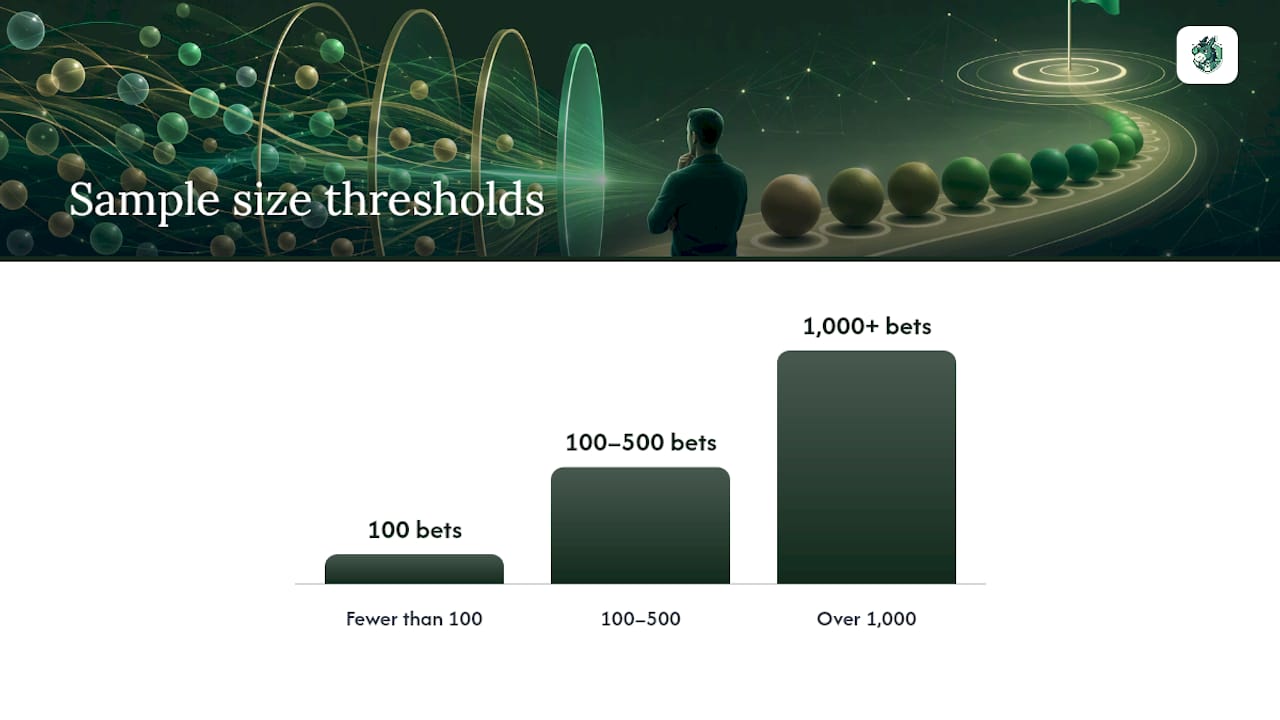
- Check the total number of settled bets. Fewer than 100 is mostly noise. Between 100 and 500 is suggestive but not conclusive. Over 1,000 settled bets gives you something closer to real evidence.
- Compare posted odds against the closing line. Look for CLV disclosure. A tipster who consistently beats the closing price is showing you something a strike rate alone can’t.
- Inspect how stakes are reported. Proper records state pound amounts or a clearly defined unit size, never a vague “1pt” with no stated value.
- Look at the drawdown history, including losing months. A record showing only winning streaks with no visible dips is incomplete, whatever the topline P&L says.
- Search for gaps or deleted posts. Cross-check suspicious periods against the Wayback Machine or archived social posts if the platform’s own history looks patchy.
- Run the subscription economics. Convert declared units into money, subtract the subscription fee, and calculate the realistic net return, not the headline ROI.
- Corroborate with independent reviews or community discussion. Forums and third-party write-ups often surface complaints or confirmations that the tipster’s own page won’t mention.
Pro Tip: Do steps 2 and 3 before anything else. A tipster can survive a bad month, but a small sample with no CLV data is a coin flip dressed up as a system.
Our own guide to picking horses to lay walks through the equivalent process specifically for lay selections, where sample size and odds movement work slightly differently from back betting.
Common limitations and red flags you can still encounter
Even a genuinely proofed service can mislead you if you don’t read the record critically.
- Selective date ranges. A tipster might link only to their best six-month stretch, quietly omitting a losing run from the year before.
- Retroactive stake edits and unit obfuscation. “1 unit” that’s never defined in pounds lets a tipster imply bigger or smaller stakes than actually used.
- A gap between advised and obtainable odds. If the tip was posted at a price that vanished within seconds, your real returns will trail the published figures badly.
- Small-sample volatility at long odds. A few big-priced winners can produce a flattering ROI that has little to do with skill and everything to do with variance.
- Marketing that oversteps advertising rules. Claims of guaranteed profit or cherry-picked stats can fall foul of ASA/BCAP requirements around substantiated performance claims.
Applying the checklist: proof points you can verify yourself
The service publishes lay signals before races start and maintains continuously updated results with clearly defined staking tiers. That structure exists precisely so readers can run the checklist above against it rather than take any claim on trust.
A dashboard time-stamp satisfies the pre-event requirement in a literal sense: the signal appears with a recorded time, before the race off, and stays visible afterwards rather than being edited once the result is known. If you want your own record of it, screenshot the dashboard or pull it via API before the race, so you have an independent snapshot that doesn’t rely on the platform’s own history staying intact.
A few small experiments will tell you more than any headline strike rate:
- Track the free daily signals for 30 days and log your own results independently
- Note the published price at the moment of the signal, then check it against the Betfair Exchange closing price
- Calculate your net return after any subscription cost, not before
Pro Tip: Run this experiment on the free tier first. Thirty days of logged prices against the closing line will tell you more about achievable value than a month of trusting someone else’s ROI graph. Our results tracking guide walks through setting this up in a spreadsheet if you want a repeatable method.
Official guidance and independent explainers to consult
- The ASA’s BCAP Code on betting tipsters sets out what tipsters must prove before making advertising claims
- The Gambling Commission covers licensing and consumer protection for UK betting services
- BeGambleAware offers support if your betting behaviour needs a second look
- TipsterCheck’s explainer goes deeper into the technical mechanics behind proofing sites
A pragmatic note on trusting proofed records
Proofing is one of the better defences against outright fraud in this market, but it was never designed to prove profitability on its own. Treat it as step one, not the final word: run a small trial, log the odds yourself, check closing-line value, and size your bank sensibly. If betting stops feeling like a hobby, BeGambleAware is worth a visit before your next stake.
— Donkey
Sources
- The BCAP Code: Betting tipsters (ASA)
- How Tipster Proofing Sites Work | TipsterCheck
- How to pick a betting tipster · Spectral
- How to Audit a Tipster’s Record: 7 Red Flags Exposing Losing Tipsters (2026) | Krok Odds
FAQ
Can I use AI to predict horse racing?
Statistical models can process historical strike rates and market prices to flag likely outcomes, and platforms like Donkeyradar apply this to identify probable losers for lay betting rather than trying to pick winners outright. No model removes the need to verify the resulting signals against a proofed, timestamped record.
What is the most profitable horse racing strategy?
There’s no single strategy that guarantees profit, but lay betting against the weakest runner, backed by a large proofed sample and disciplined bank management, tends to produce more consistent results than picking outright winners. Checking closing-line value is one of the more reliable ways to judge whether a strategy has genuine edge rather than lucky variance.
Is a Lucky 15 better than a Yankee?
A Lucky 15 includes 15 bets across four selections, including four single bets, whereas a Yankee excludes the singles, so a Lucky 15 pays out even if only one selection wins. Neither is inherently “better”; a Yankee suits bettors confident all four picks will place, while a Lucky 15 offers a safety net at a higher total stake.
What is the smartest bet in horse racing?
The smartest bet is whichever one you can properly evidence beforehand: a defined stake, a proofed price, and a clear rationale rather than a hunch. For lay bettors specifically, our lay betting checklist sets out the confirmations worth running before every bet.
How many settled bets do I need before trusting a tipster’s record?
Fewer than 100 settled bets is largely noise, while 1,000 or more gives you a much stronger signal about whether the results reflect skill. Anything in between is worth watching, but shouldn’t be treated as proof either way.