← Blog · 📝 Article · 18 September 2026
Bettors: Use £29/mo Signals to Trade Algorithmic Lay Betting

Algorithmic lay betting means using rules or statistical models to bet against outcomes on an exchange, rather than picking selections by eye. It works only when your model’s probabilities systematically diverge from market odds, and when execution costs don’t erase the gap. Data, disciplined testing, and firm risk controls decide whether that edge survives contact with a live market.
TL;DR:
- Successful algorithmic lay betting depends on models that identify market mispricings caused by public biases, especially in favourites and longshots.
- Liquidity constraints and commission significantly reduce expected edge, requiring high matched volume markets and backtested profit margins that account for these costs.
- Risk management techniques like fractional Kelly, fixed liability, and predefined exit points are essential to prevent losses during drawdowns and bad runs.
- Proper data, feature engineering, walk-forward testing, and real-time logging are critical to building resilient, live, and profitable lay betting systems.
- Using tested signals from services like DonkeyRadar can save time, ensure transparency, and help focus on disciplined execution rather than model development.
Table of Contents
- What algorithmic lay betting actually is (and why it works)
- How lay betting works: liability, commission and liquidity
- Algorithmic strategies suited to lay systems
- Building and validating an algorithmic lay system
- Staking and risk controls for lay algorithms
- Execution and automation: APIs, order management and monitoring
- DonkeyRadar’s approach to data-driven lay signals
- What actually trips up algorithmic lay bettors
- Try DonkeyRadar’s signals instead of building your own model
- Sources
- FAQ
What algorithmic lay betting actually is (and why it works)
Lay betting flips the usual bet on its head. Instead of backing a horse to win, you take the other side of that bet, effectively acting as the bookmaker. The edge doesn’t come from picking winners. It comes from finding where the market has got a price wrong, usually because public money piles onto fancied runners and inflates their apparent chance of winning. That favourite/longshot bias is well documented, and it’s precisely the kind of systematic mispricing an algorithm is built to hunt for, rather than a human scanning a racecard on gut feel.
The word “algorithmic” here isn’t a buzzword. It means the selection, sizing, and often the execution of every lay bet follow coded rules rather than a hunch at the paddock rail. That’s the standard industry term for what’s sometimes loosely called “automated lay betting” or “lay betting systems”. They’re the same thing: a repeatable, rules-based process applied to lay markets, ideally validated before a penny of real stake goes near it.
How lay betting works: liability, commission and liquidity
Every algorithmic strategy has to respect the same arithmetic. When you lay a horse, your liability, the maximum you can lose, is calculated as lay stake × (lay odds − 1). Lay £10 at odds of 5.0 and your liability is £40. Get the maths wrong at scale and an algorithm will happily compound that mistake a hundred times over before you notice.
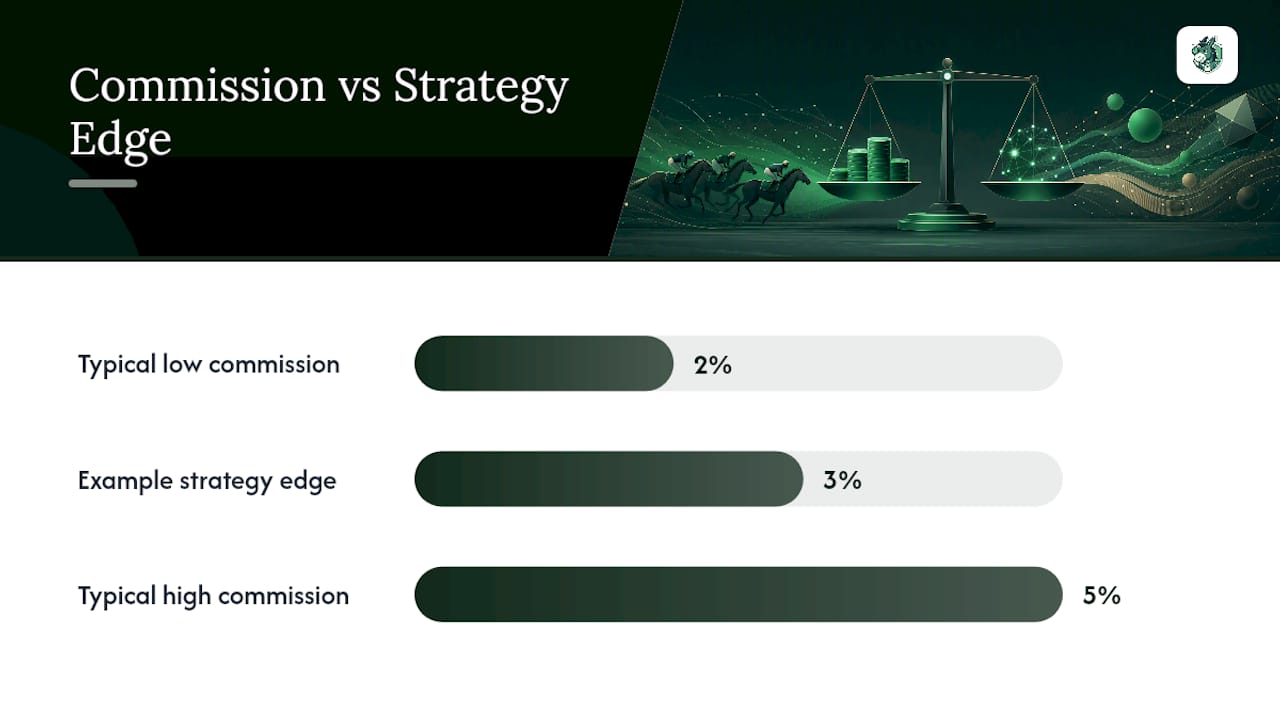
Exchanges then take a cut of your net winnings, typically 2 to 5 percent commission, which quietly erodes edge that looked solid on paper. A strategy showing a 3% edge before commission can slip into loss once that’s deducted, so every backtest needs commission baked in from day one, not bolted on afterwards.
Liquidity is the other constraint algorithms tend to ignore until it costs them money:
- Thin markets mean your lay order may only get partially matched, leaving you with a smaller position than planned.
- Chasing a price in a shallow market causes slippage, where the price moves against you before the full stake fills.
- Automate only where matched volume is consistently high enough that your model’s edge survives the gap between the price you wanted and the price you got.
Algorithmic strategies suited to lay systems
Some lay strategies translate cleanly into code because their entry and exit rules are objective and repeatable. Others rely on judgement calls that resist automation. Four stand out.
- Lay the draw. Enter pre-match when the Draw price sits in the 3.8 to 5.0 band, then hedge the position the moment either side scores. The critical rule is a planned exit, commonly the 70-minute mark, where the algorithm accepts a capped loss rather than riding a scoreless draw to full liability.
- Laying short favourites. Target runners priced below a threshold, often 1.5 to 2.5, where market sentiment tends to overstate the true chance of winning. Selection cues, such as a lack of recent form data or a jump in matched volume without a corresponding price move, help filter out the genuinely strong favourites from the merely popular ones.
- Sequential laying for accumulators. Rather than laying every leg of an acca simultaneously, the algorithm waits for each prior leg to settle before laying the next. This cuts peak liability by roughly three to four times on a treble or four-fold, at the cost of accepting price drift between legs.
- Scalping and lay-to-back patterns. Small, frequent edges captured by laying at one price and backing back shortly after at a lower one, banking the difference regardless of the final result.
Pro Tip: Higher strike rate strategies like laying short favourites usually carry higher liability per bet. Lower strike rate, high-frequency strategies like scalping need far tighter execution but smaller position sizes. Match your staking rules to which trade-off you’re actually running, not which one sounds better.
Building and validating an algorithmic lay system
A workable model starts with the right data: historical market odds, matched volume, form figures, trainer and jockey statistics, going conditions, and withdrawal records. Feed a model raw prices alone and it will miss most of what actually moves markets.
Useful engineered features include:
- The gap between a runner’s implied probability and its recent historical strike rate at similar odds.
- In-play price momentum in the minutes before the off, which often signals informed money moving.
- Matched volume normalised against total market size, so a £5,000 trade means something different in a big field than a small one.
On modelling choice, calibrated probability models tend to outperform raw classifiers for lay betting, because you need a genuine probability estimate to size stakes correctly, not just a win/lose label. Probability calibration matters more here than in most machine learning tasks.
Backtesting is where most systems quietly fail. Frameworks like SPORTSBET, built specifically for exchange strategy testing, use event-driven simulation and market re-construction to replay order books and matched volume rather than relying on closing odds alone, which understate real execution risk.
Walk-forward analysis is the single most reliable defence against overfitting. Instead of optimising parameters on one dataset and hoping they hold, you roll the test window forward in time, re-optimising and re-validating at each step. Track P&L, maximum drawdown, and strike rate after commission, not before it. A parameter set that only works on one narrow slice of historical data is a warning sign, not a discovery.
Staking and risk controls for lay algorithms
Sizing decides whether a genuine edge survives a losing streak. The Kelly criterion sizes stakes proportional to edge and odds, but full Kelly assumes your probability estimate is exact. It rarely is. Fractional Kelly, typically betting a quarter to a half of the full Kelly stake, absorbs estimation error and leaves room for commission without blowing up the bank on a bad run.
Fixed liability staking is the simpler alternative: cap every lay at a set maximum loss regardless of odds, which is easier to code and audit than a dynamically shifting Kelly stake.
| Control | What it does | Typical setting |
|---|---|---|
| Fractional Kelly | Scales stake to edge, reduced for estimation error | a fraction of full Kelly |
| Fixed liability | Caps loss per bet at a flat amount | 1 to 2% of bank per bet |
| Planned-loss exit | Forces exit at a set point rather than riding to full liability | e.g. 70th minute for lay the draw |
| Bank-level stop-loss | Halts trading after a defined drawdown | about 10% of bank |
Every one of these calculations needs commission and price drift built in, not treated as an afterthought. A system that looks profitable on gross odds and turns marginal once commission is applied isn’t a small rounding error. It’s the difference between a viable strategy and a losing one, and it needs checking before any real stake goes near it, using proper bankroll planning.
Execution and automation: APIs, order management and monitoring
Two broad routes exist for turning a validated strategy into live bets. API-based systems offer full programmatic control, ideal for complex conditional logic, but demand real development skill. Rule-editor bots trade some flexibility for a much shorter setup time, letting you configure conditions like target liability, price bands, and matched volume thresholds without writing code.
Order management matters more than most bettors expect:
- Limit orders guarantee your price but risk partial fills in thin markets.
- Market orders fill fast but at whatever price is available, which can be costly in a fast-moving book.
- Cancelling logic needs to be explicit: an unfilled order sitting in a market for too long is a liability nobody’s tracking.
In-play markets move fastest of all, and latency between your signal firing and your order reaching the exchange can turn a good price into a bad one. If your infrastructure can’t guarantee sub-second execution, avoid in-play automation entirely and stick to pre-match entries.
Before running live capital, confirm you have real-time logging, alerting on failed or partial fills, and a dashboard showing verified results against your backtested expectations. If those three things aren’t in place, you’re not automating a strategy. You’re gambling on infrastructure you haven’t tested.
DonkeyRadar’s approach to data-driven lay signals
Donkeyradar applies these principles directly: statistical models flag the weakest runner in UK, Australian, and US races, with every signal published before the race and results tracked publicly afterwards. That structure lets the platform take on the data-gathering and signal-generation stages of the workflow described above. Readers evaluating any signal service should still demand public, auditable results, and treat any past strike rate as indicative history, never a guarantee of future performance.
What actually trips up algorithmic lay bettors
The single most common failure isn’t a bad model. It’s a good one, run without discipline. Overfitting a backtest to one lucky data slice, then doubling stakes after a short winning run, kills more accounts than any genuine edge decay does. Liquidity and commission are the quiet killers, eating margins that looked healthy on paper. Start small, verify against real published results rather than backtest numbers alone, and hold your exit rules as firmly on a losing day as a winning one.
— Donkey
Try DonkeyRadar’s signals instead of building your own model
Building the system described above from scratch takes real data engineering time before you place a single live lay. Donkeyradar offers a shortcut for bettors who’d rather trade on tested signals than assemble their own pipeline: DonkeyRadar Free covers daily lay signals at no published cost, while DonkeyRadar Pro adds real-time alerts via email and Telegram, full verified results history, and API access for £29 per month, letting you plug signals straight into your own execution setup.
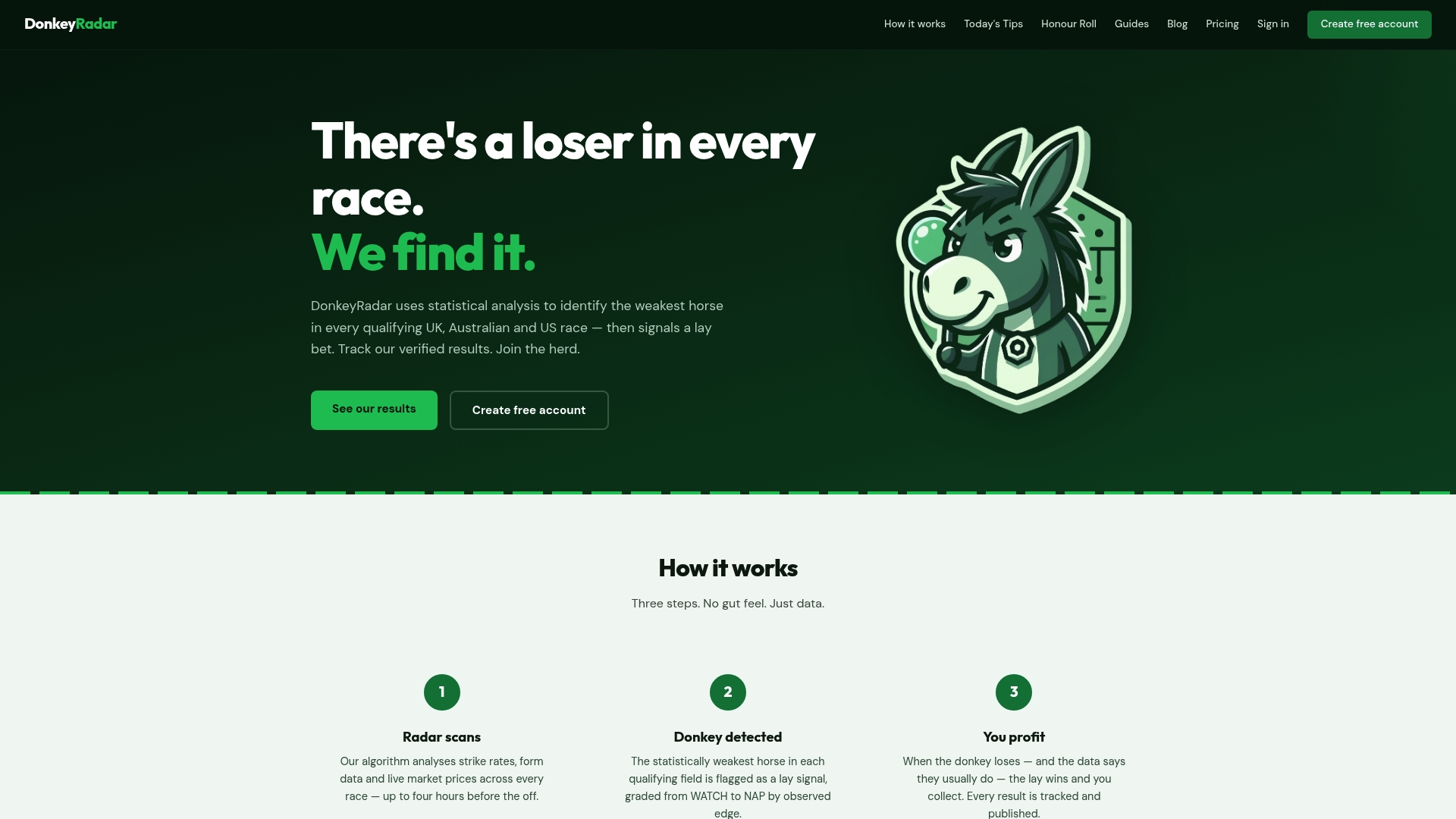
That maps directly onto the workflow covered here: Donkeyradar handles data gathering and signal generation with staking tier grading built in, while you retain control over execution and bankroll rules. Every signal is published before the race and every result stays trackable afterwards, so you can audit strike rate for yourself rather than take a claim on trust. Start with the free tier and check the staking calculator before sizing your first live position, and always bet within what you can afford to lose.
Sources
- Lay betting guide (OddsPortal)
- SPORTSBET framework (Tsirimpas et al.)
- Sequential laying explained (Better Bet Group)
- Lay the Draw guide (BetfairSquare)
- Kelly staking for laying (MarketFeeder Pro)
FAQ
What is the best lay bet strategy?
No single strategy wins outright; lay the draw, laying short favourites, and sequential laying on accumulators each suit different risk appetites and liquidity conditions. The “best” one is whichever your backtesting and live-verified results confirm holds up after commission.
Can I use AI to predict horse racing outcomes?
Yes, calibrated statistical models can process historical strike rates, market prices, and form data to flag likely mispricing, which is exactly what services like Donkeyradar do for lay signals. No model guarantees a result; treat outputs as probability estimates, not certainties.
What is the most profitable betting method?
There’s no universally most profitable method. Sustainable profit tends to come from consistently exploiting market bias, such as the favourite/longshot effect, combined with disciplined staking and low execution costs, rather than any single “system”.
How much does DonkeyRadar cost?
DonkeyRadar Free carries no published cost, while DonkeyRadar Pro is £29 per month and adds real-time alerts, full results history, and API access.
Is lay betting profit taxable in the UK?
Betting profits, including from lay betting on exchanges, are tax-free for UK bettors, which is part of what makes a verified algorithmic edge worth pursuing seriously rather than treating as a side curiosity.