← Blog · 📝 Article · 26 August 2026
Automated lay betting: signals, risk rules and setup

Automated lay betting is algorithmic lay-betting signals that identify the most likely losing runner and deliver pre-race alerts you can follow or consume via an API. It is not a bot that places bets on your behalf. A model scores every runner, flags the weakest favourite, and publishes that signal before the race, leaving the decision and the click with you.
The verdict, upfront: with disciplined liability control and selective signal use, this approach is genuinely tradable. Laying every favourite tends to lose money, but laying only the ones showing statistical weakness can be profitable.
Here’s what the rest of this guide covers:
- The data signals and red flags that separate a strong lay candidate from a coin flip
- The exact liability maths and staking rules that keep variance from wrecking your bankroll
- How to receive signals and, where you want it, wire them into your own trading tools via API
- What Donkeyradar publishes, verifies, and claims, so you can judge the evidence yourself
Key Takeaways
Automated lay betting works when selective, red-flag-based signals replace blanket favourite-laying and strict liability caps control the downside.
| Point | Details |
|---|---|
| Selectivity beats volume | Laying only favourites with three red flags returned +9.8% ROI versus −4.2% for laying all favourites. |
| Liability grows with price | Liability = stake × (odds − 1); a £10 lay at 5.0 carries £40 of risk, not £10. |
| Cap risk per bet | Limit liability to 1–2% of bankroll and set a price ceiling around 5.0 to 6.0. |
| Verify before you trust | Check any strike rate claim against a public, race-by-race results history. |
| Donkeyradar as the option | Donkeyradar publishes signals pre-race, tracks results openly, and reports a verified strike rate above 85%. |
Table of Contents
- How automated lay signals work
- Risk and staking: the maths that actually protects your bankroll
- What Donkeyradar’s signals are built on
- Automation and API integration: consuming signals safely
- Practical setup checklist: getting started this week
- Try Donkeyradar’s signals before you scale up
- Sources
How automated lay signals work
A lay signal is only as good as what feeds it. Donkeyradar and similar systems pull from five main inputs: historical strike rates for the horse and its connections, live market prices on the exchange, speed and sectional ratings, pedigree and going fit, and recent trainer form. None of these alone tells you much. Combined, they build a probability estimate you can compare against what the market is actually pricing.
The real work happens in spotting red flags. Three matter most:
- Bounce candidates — horses running a career-best effort last time out, which historically regress the next run rather than improve again.
- Surface or distance mismatch — a favourite stepping into ground or a trip that its recent form doesn’t actually support.
- Negative stable signals — a yard showing a cold run of form, which tends to depress the strike rate of every horse it sends out, favourite or not.
Each red flag independently trims a favourite’s realistic win probability. A horse showing all three might look like a 3/1 shot to the market but carry a model probability closer to 5/1 or longer against it.
Market-overbet detection is the trigger that turns analysis into a signal. When the live exchange price implies a shorter probability than the model’s estimate, that gap is the edge. A study of vulnerable favourites detected through exactly these three red flags produced a +9.8% ROI across 500 UK favourites, against a −4.2% loss from laying every favourite in the same sample. That gap between blanket laying and selective laying is the entire argument for using signals instead of gut instinct.
Pro Tip: A favourite showing one red flag is worth watching. Two or three stacked together is where the edge tends to concentrate, not just add up linearly.
Risk and staking: the maths that actually protects your bankroll
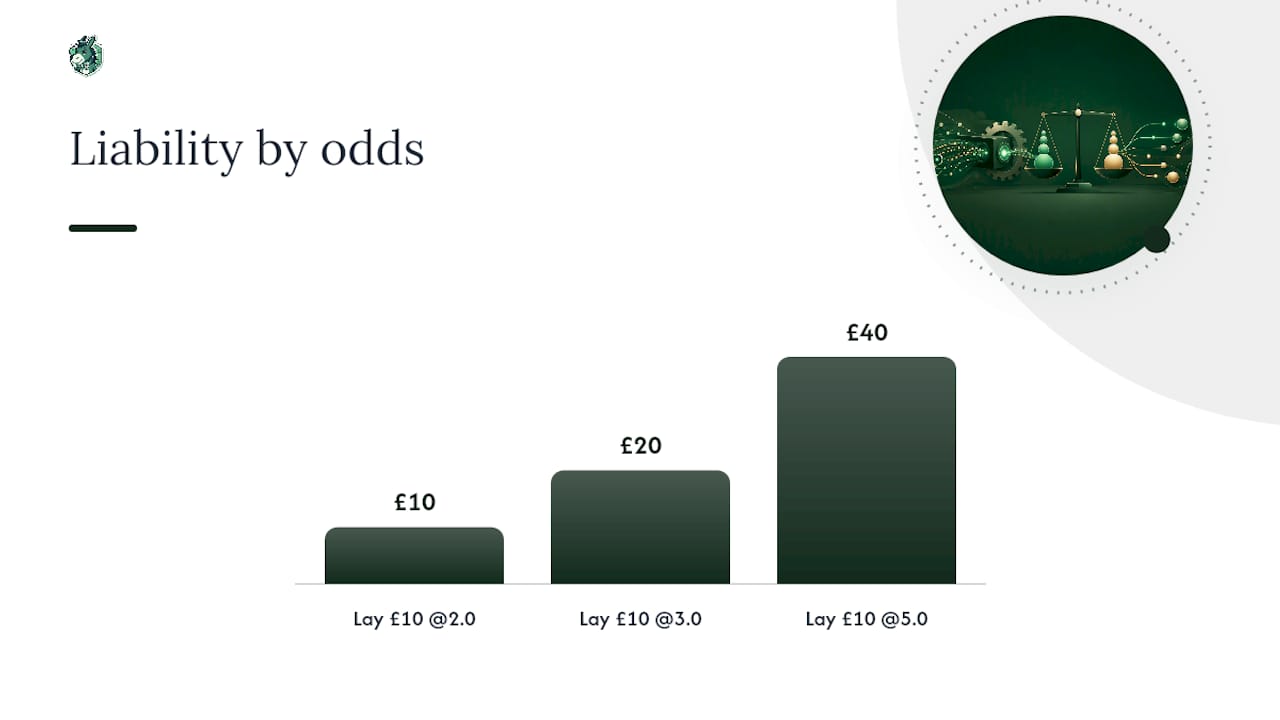
Lay betting inverts the usual risk profile. You’re not risking your stake, you’re risking your liability, and that number grows fast as prices lengthen. The formula is simple: liability = stake × (odds − 1). Lay £10 at 2.0 and your liability is £10. Lay the same £10 at 3.0 and it jumps to £20. At 5.0, you’re on the hook for £40 from a £10 stake, as exchange documentation confirms.
That arithmetic dictates the rules serious layers follow:
- Cap liability at 1–2% of your total bankroll per bet, never per stake.
- Set a price ceiling around 5.0 to 6.0. Beyond that, occasional losses get large enough to erase a long run of small wins.
- Use a daily or weekly stop-loss so a bad session doesn’t compound into a bad month.
Commission changes the target you’re aiming at. Exchange commission of around 5% on net winnings means your win-rate needs to clear a higher bar just to break even, an effect practitioner analysis flags repeatedly. A Lay Betting Calculator removes the guesswork here, showing exact liability and break-even points before you commit real stakes. Check your bankroll plan against these numbers before scaling anything up.
What Donkeyradar’s signals are built on
Donkeyradar scores every declared runner using the same category of inputs discussed above: historical strike rates, live market prices, and automated detection of the three red flags rather than a human eyeballing form. The output is a vulnerability score per horse, published before the race rather than after the result is known.
Three proof points worth understanding before you rely on any signal service:
- Pre-published signals. Every lay signal goes live before the race, not retrofitted afterwards to look accurate.
- Continuous verification. Results are tracked and published against the original signal, win or lose.
- Strike rate above 85%. Donkeyradar reports a verified signal strike rate exceeding 85%, a figure the platform attributes to itself and publishes alongside the underlying results history.
Delivery runs through a dashboard with direct links into the Betfair Exchange, staking tiers that grade signal confidence, and real-time alerts via Telegram and email. Power users can pull the same signals through API access, feeding them straight into their own trading software rather than checking a dashboard manually.
Pro Tip: Cross-check any published strike rate against the platform’s own results history, not just the headline number. A verified track record you can scroll through beats a claim you can’t audit.
Automation and API integration: consuming signals safely
Wiring signals into your own systems doesn’t mean handing over execution to a script. The safer pattern looks like this: webhook delivers the signal, a listener on your end picks it up, a stake calculator applies your liability rules, and only then does a human or an authorised trading tool confirm execution.
- Subscribe to the signal feed and set up a webhook or polling listener.
- Receive the JSON payload: runner, race, model probability, current market price, red-flag tags.
- Run the payload through your own liability calculator, applying your 1–2% cap and price ceiling.
- Confirm execution manually, or route it to an authorised trading tool if you’ve built that layer.
A few technical caveats matter more than they first appear. Exchange APIs carry rate limits, so polling too aggressively risks throttling right when a signal needs acting on. Latency between signal publication and your execution window can matter in thinner markets. Liquidity checks are essential too. Weekend festival cards carry far deeper liquidity than a midweek all-weather meeting, which affects whether you can actually get matched at the price a signal assumes. Conditional order patterns, entering only if the price stays within a defined band, help protect against that gap between theoretical and tradable edge.
Pro Tip: Build your liability check as a hard stop, not a warning. A calculator that only flags an oversized bet is worth less than one that refuses to submit it.

Practical setup checklist: getting started this week
Starting small beats starting confident. Here’s the sequence:
- Open and verify an account with your exchange of choice.
- Allocate a modest starting bankroll, separate from money you need elsewhere.
- Configure staking at 1–2% maximum liability per lay before you place a single bet.
- Set alerts to your phone or Telegram so signals reach you before the off, not after.
- Paper trade for a week, or run genuinely tiny stakes for two to four weeks.
- Log every result against the published signal history to check your execution matches the claimed performance.
Discipline beats conviction
Variance in lay betting doesn’t feel fair. You can follow every red flag correctly and still watch a 25/1 shot win because a jockey found the perfect gap on the rail. That’s not a flaw in the method, it’s the nature of an asymmetric bet: small wins often, occasional large losses. The evidence-based approach exists precisely because gut feel breaks down under that kind of variance, and a published, verifiable track record is the only honest way to judge whether a system’s edge is real.
— Donkey
Try Donkeyradar’s signals before you scale up
Donkeyradar gives you what a spreadsheet of form guides never will: pre-published lay signals scored against live market prices, a dashboard linked straight into the Betfair Exchange, staking tiers matched to signal confidence, and API access if you want signals feeding your own trading setup directly. Every result gets tracked publicly against the original signal, so the strike rate you see is checked against a real history, not a highlight reel.
Start with the seven-day trial and treat the first fortnight as your own paper-trading window. Before you place a single lay, run the numbers through the Lay Betting Calculator so your liability and break-even point are fixed before the race, not worked out after. If you want the full mechanics first, the lay betting explained guide walks through the basics before you commit a live stake.
Sources
- Horse Racing: When to Lay the Favourite - Matchbook Insights
- What is lay betting on an exchange (Smarkets help)