← Blog · 📝 Article · 19 August 2026
Lay betting signals: how to spot profitable lays

A lay betting signal is a repeatable, evidence-led indicator that a runner is overpriced on an exchange, not a hunch dressed up as confidence. The recommended next step is simple: confirm your liability, require two to three independent signals (form, market movement, trainer or gear change) before committing, then size the bet by liability rather than stake. Do this on the Betfair Exchange, keep the maths honest, and lean on a responsible-gambling resource if the numbers start to feel personal rather than professional.
Key Takeaways
Profitable lay betting depends on combining multiple independent signals with strict liability-based staking, not on following a single tip or price move in isolation.
| Point | Details |
|---|---|
| Require multiple signals | Confirm 2 to 3 independent factors (form, market, trainer/gear) before committing liability. |
| Size by liability, not stake | Liability equals backer stake multiplied by lay odds minus one, and it drives your real risk. |
| Stick to workable odds bands | Concentrate lays between 2.5 and 6.0, where liquidity and required win rates stay realistic. |
| Set stop-losses in advance | Fix per-race and per-day liability limits before the card starts, and never renegotiate mid-session. |
| Choose a research-first provider | Donkeyradar publishes signals pre-race with public verified results, staking tiers and direct exchange links. |
Table of Contents
- What makes lay betting signals different from tips
- What are the core signals that justify a lay?
- How do you read market signals on the exchange?
- How much liability should a lay bet carry?
- How do you vet a lay betting signals service?
- What does a practical lay betting workflow look like?
- How Donkeyradar applies this checklist in practice
- Do weather and late scratches affect signal reliability?
- How do you manage risk specifically for lay signals?
- What are the legal considerations around lay betting signals?
- What do real lay betting outcomes actually look like?
- Why discipline matters more than the signal itself
- Get vetted lay signals with public verification
- Sources
What makes lay betting signals different from tips
A tip gives you a name. A signal gives you a reason.
That distinction sounds small until you’ve followed a few “banker” tips that collapsed because nobody checked whether the price was actually wrong. Research-led signals work from a reproducible checklist rather than a gut feeling, and that reproducibility is what lets you judge whether a provider’s edge is real or lucky. Sample size matters here: a strike rate from 20 races tells you almost nothing, while one built on hundreds of settled bets, published and verifiable, tells you something you can actually bank on.
A workable signal checklist looks like this:
- Market-implied probability versus your own model’s probability, with the gap large enough to survive commission
- Recent form issues that explain why the market may be over-trusting a name (class rise, wrong-trip runs, a break from racing)
- Trainer and jockey context, including yard form and any change in intent signalled by booking a different rider
The logic is the same one used in Betfair’s own strategy material: if your fair-price model gives a lower win probability than the market implies, that gap is your signal to lay, not the horse’s name on a tip sheet.
What are the core signals that justify a lay?
Course and going mismatches sit near the top of any credible checklist. A horse stepping onto ground it has never handled, or a track shape that exposes a stamina doubt, is a stronger reason to lay than raw recent form alone. Class changes matter almost as much: a runner dropping in grade off a hot market position, or rising sharply after one soft win, both create pricing tension worth investigating.
Other reliable pre-race signals include:
- Course or surface form that doesn’t match the horse’s profile
- Going conditions historically unsuitable for the runner
- A class drop or rise that inflates market confidence beyond the evidence
- Headgear added or removed without a clear explanation
- Weak or hollow recent form dressed up by a big-name trainer or jockey
- Draw and pace shape that leaves the horse boxed in or without cover
- Large public money backing a short price with no supporting form angle
- Unexplained shortening with no news to justify it
Pro Tip: Never act on one signal alone. Require at least two or three independent factors pointing the same way, and write down the evidence before you place the lay, not after it wins or loses.
How do you read market signals on the exchange?
Price movement tells its own story, separate from form. A steady drift over 20 minutes usually reflects informed money leaving quietly. A rapid drift in the final few minutes often means something sharper, a stable whisper, a visible warm-up issue, or simply panic selling. Shortening is the opposite signal, and it needs scrutiny rather than automatic trust, because public money piling into a fancied runner is not the same as informed money.
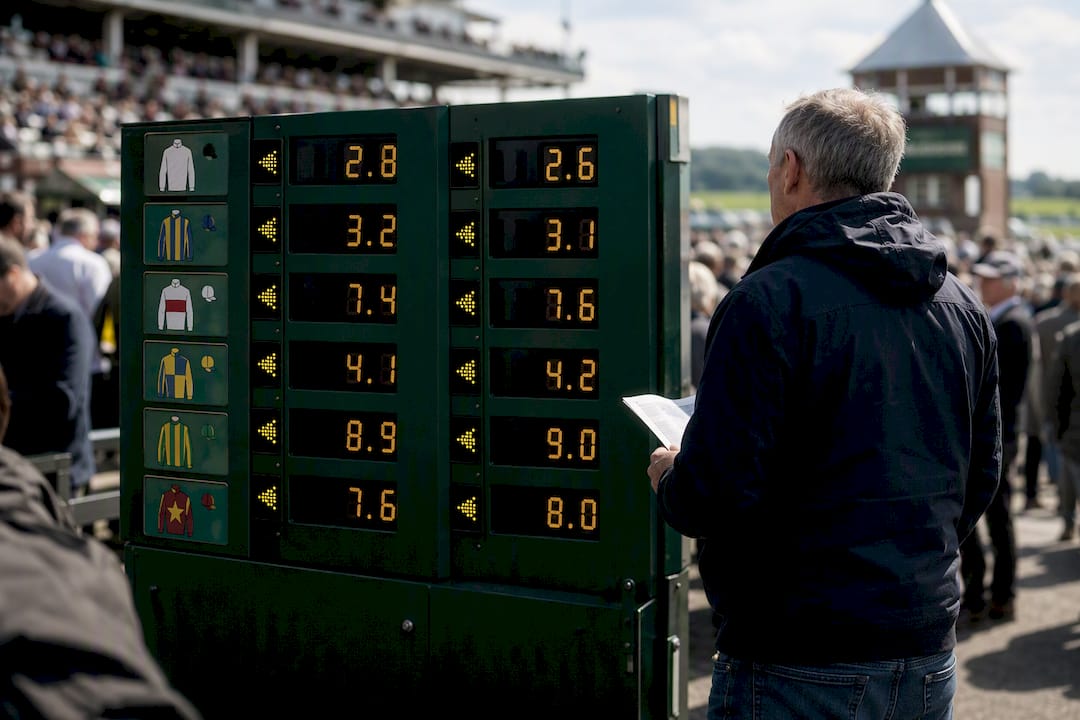
Picture a horse trading at 4.0 at T-30 that drifts to 5.5 by T-10 with no obvious market support behind the move. That drift, unexplained by news, is exactly the kind of pattern that strengthens a lay case when it’s already backed by a form-based red flag.
Watch for these market red flags before committing liability:
- Thin liquidity that could leave you unable to exit cleanly
- Sudden late shocks in price with no accompanying news
- In-play recovery that suggests the drift was a temporary market inefficiency, not a genuine problem
How much liability should a lay bet carry?
Liability, not stake, is what actually puts your bankroll at risk when you lay. The formula is straightforward: liability equals the backer’s stake multiplied by the lay odds minus one. Lay a horse at 5.0 against a £10 backer stake and your liability is £40, four times the number that might have caught your eye first.
Most experienced layers concentrate their activity in the 2.5 to 6.0 odds range, where liability stays manageable and liquidity remains strong enough for a clean exit, according to Betfair Square’s laying guide. Avoid laying at very short odds, sub 2.5, where commission and the required win rate make consistent profit difficult even when your form read is correct.
Three rules keep the bankroll intact:
- Cap liability at 2 to 5% of your total bankroll per lay, never per stake
- Set one hard stop-loss per race and honour it regardless of how confident the signal felt
- Factor commission into every expected-value calculation before you place the bet, since small raw edges often disappear once commission is deducted
Some providers apply a quarter-Kelly formula to liability sizing, a way of taking a fraction of the mathematically “optimal” bet to reduce variance while still compounding a genuine edge over time.
How do you vet a lay betting signals service?
Most of what separates a genuine signals service from noise comes down to what it’s willing to show you. Verified results with a real sample size matter more than any single headline strike rate, because ten winning lays proves nothing and five hundred settled bets proves quite a lot. Look for a public, continuously updated archive of settled results, not a curated highlight reel refreshed only when things go well.
Check these points before trusting any provider with real liability:
- A stated strike rate paired with sample size, not a bare percentage
- Public tracking of settled bets that anyone can inspect, not screenshots on request
- Methodology transparency: what signals are checked, and when they’re published relative to the off
- Clear staking guidance and an accessible liability or staking calculator
Treat unrealistically high strike rates without sample data, the absence of a public results archive, and vague or “proprietary” methodology as immediate red flags. A service worth trusting explains its reasoning the way a decent racing analyst would, not the way a tipster sells a subscription.
What does a practical lay betting workflow look like?
Turning a signal into a placed bet, and then closing it out properly, follows a consistent sequence:
- Verify the signal pre-race against current form and market data
- Check market depth and liquidity on the Betfair Exchange
- Confirm liability and size the bet against your bankroll rules
- Place the lay, or schedule an in-play entry if the plan calls for one
- Set a hard stop and a planned exit point before the race starts, not during it
A worked example: laying a horse at 4.0 against a £20 backer stake creates £60 of liability. If the price drifts further in your favour in-play, a partial cash-out locks in profit; if it shortens against you past your stop level, you exit rather than hope. Most published signals appear a set window before the off, and in-play entries demand faster execution because the exchange’s in-play delay changes how quickly you can react. Avoid trading thin markets or races with late non-form news you haven’t had time to assess.
How Donkeyradar applies this checklist in practice
Donkeyradar runs its algorithm through the same discipline outlined above before any signal reaches a subscriber. Every lay signal is published before the race, cross-checking historical strike rates against live market prices rather than reacting after the fact.
The system’s public-facing structure includes:
- Pre-race algorithmic checks across UK, Australian and US racing
- Published staking tiers so the required liability is clear before you act
- A public, verified results history that updates continuously
- Direct links into the Betfair Exchange for fast execution
Readers can review the ongoing track record on the Donkeyradar homepage and the lay betting guide. None of that replaces your own judgement, though. Check the liability and the underlying signals yourself before every single bet.
Do weather and late scratches affect signal reliability?
Weather and late scratches don’t invalidate a signal, but they change the conditions it was built on, and ignoring that is one of the quieter ways layers lose money on otherwise sound reasoning.
Rain arriving after declarations can turn a form-based edge upside down. A horse flagged as vulnerable on quick ground suddenly looks far more competitive on softening turf, and the market usually adjusts faster than a static pre-race signal can. The same applies in reverse: a runner whose profile depends on cut in the ground becomes a stronger lay candidate if the forecast dries out unexpectedly.
Late scratches carry a different kind of risk. Withdrawals reshape the pace shape of a race entirely. A signal built around a runner being short of galloping cover, for instance, can become irrelevant if the two pace-setters ahead of it are both withdrawn an hour before the off, handing it an easier lead it never had in the model.
The practical response is to treat any signal as time-stamped rather than fixed. Check the declared runners, the going update, and the forecast again as close to the off as your workflow allows, and be willing to discard a signal that no longer matches current conditions. A signal that was correct at publication can become wrong within the hour, and that’s not a flaw in the method. It’s exactly why timing and re-verification are part of the discipline, not an optional extra.
How do you manage risk specifically for lay signals?
Risk management for laying differs from back betting in one crucial way: your downside isn’t capped at your stake, it’s capped at your liability, and that changes how stop-losses need to work.
A sensible stop-loss framework sets limits at three levels. Per race, decide your maximum acceptable liability before you look at the price, and don’t let a strong signal talk you into exceeding it. Per day, set a total liability ceiling across all lays and stop once you hit it, regardless of how the day is going. Per week or month, track cumulative drawdown and treat a defined loss threshold as a hard signal to pause and review your process rather than push through it.
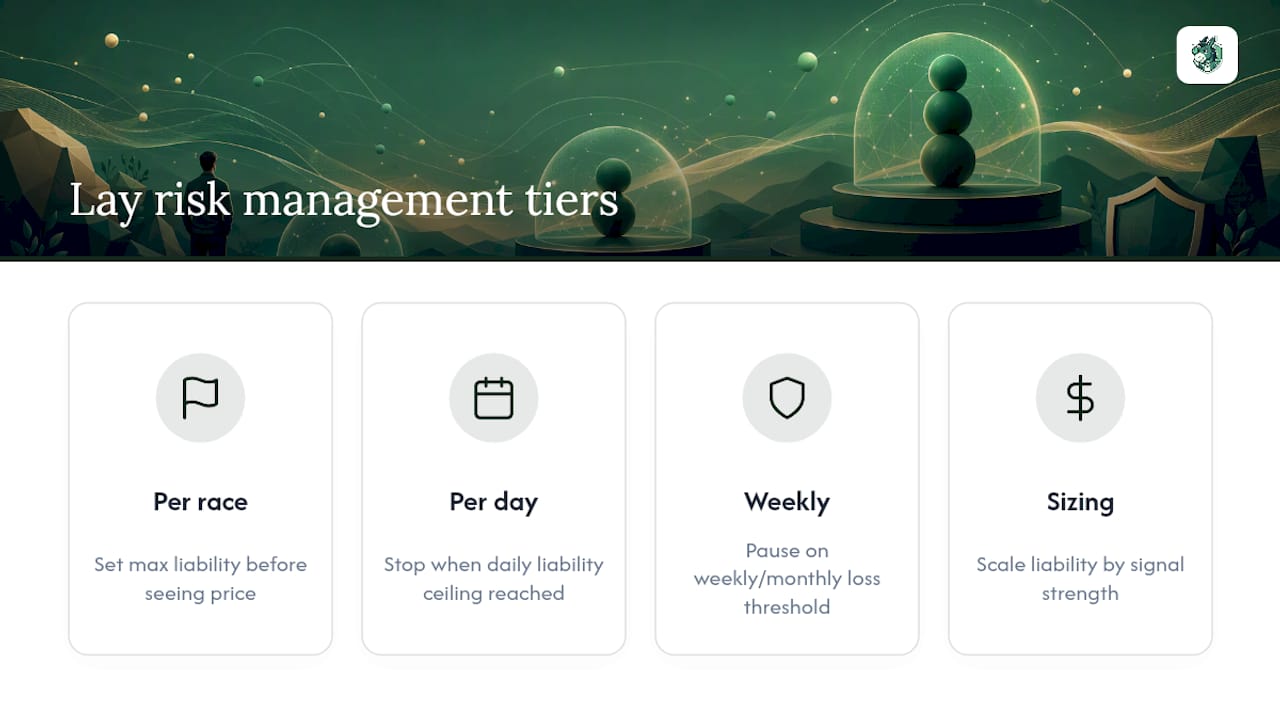
Position sizing should scale with signal strength, not confidence. A lay backed by three independent, evidence-based signals deserves a different liability allocation than one supported by a single market anomaly. Treat these as separate tiers rather than a flat stake across every bet, and use a liability calculator to check the actual exposure before, not after, you commit.
The psychological risk is often larger than the financial one. Chasing a losing run by increasing liability on the next signal is how a manageable drawdown becomes a damaging one. A fixed daily or weekly stop, set in advance and followed regardless of mood, protects you from your own reasoning on a bad day far more effectively than any signal ever will.
What are the legal considerations around lay betting signals?
Laying is a legitimate, regulated activity on licensed betting exchanges in the UK, where betting profits are also tax-free for the individual bettor, which is one of the reasons exchange laying has grown as a strategy for serious bettors. Using a signals service to inform those decisions carries no separate legal complication in itself. You’re simply using research to decide when to lay, in exactly the way a form-study or ratings service informs a back bet.
The considerations that actually matter are practical rather than legal. Any exchange account you use should be with an operator licensed by the UK Gambling Commission, and any signals provider you subscribe to should be transparent about what it is: an information and research service, not a guaranteed-profit scheme. No legitimate provider, Donkeyradar included, can promise outcomes on individual bets, because horse racing carries genuine uncertainty regardless of how strong the underlying signal is.
Age verification and identity checks on exchange accounts exist for the same regulatory reasons they exist on sportsbooks. If gambling ever starts to feel less like a research-led activity and more like a compulsion, tools like GamStop allow self-exclusion from UK-licensed sites, and organisations such as GamCare offer direct support. Treating those resources as part of a sensible toolkit, not a last resort, is simply good practice for anyone betting with real liability at stake.
What do real lay betting outcomes actually look like?
Consider two contrasting scenarios that illustrate the difference between disciplined and undisciplined application of the same checklist.
In the first, a layer identifies a well-backed favourite dropping in class after two below-par runs, with the market shortening despite no positive news. Two independent signals align: a form-based red flag and an unexplained market move. The horse finishes fourth. The signal worked because it combined evidence with disciplined sizing, not because the horse was obviously bad to the naked eye.
In the second, a layer spots a single market anomaly, a horse shortening slightly with no form-based justification, and lays it anyway at 8.0 liability without a second confirming signal. The horse wins. The liability was five times the layer’s usual limit, and the loss wipes out three weeks of otherwise sound results. The lesson isn’t that the signal was wrong; it’s that one unconfirmed signal at an aggressive price is a discipline failure, not a research failure.
The pattern across both cases holds regardless of outcome: signals confirmed by multiple independent factors and sized by liability tend to produce sustainable results over a large sample, while single-factor lays at stretched odds expose the layer to exactly the kind of variance that erases an otherwise sound long-term edge.
Why discipline matters more than the signal itself
The research checklist matters, but it only works if you follow it after a losing run as strictly as after a winning one. The trap I see most often is bettors increasing liability after a good week, treating recent form as proof of skill rather than a normal run of variance.

The countermeasure is boring but effective: fix your liability rules before the week starts, and don’t renegotiate them with yourself mid-session. Evidence beats confidence, every time.
Get vetted lay signals with public verification
Donkeyradar gives you what most tip lists never offer: signals published before the race, with a continuously updated public results history you can check against your own judgement rather than take on trust. Where a name-only tip asks you to believe, a research-led signal shows you the evidence and lets you decide the liability. Start by working through the lay betting calculator to understand your exposure, then review the verified lay tips and their published strike rate before staking anything. Always size by liability, not stake, and use BeGambleAware if betting ever stops feeling like a research exercise.
Sources
- Lay Betting on Betfair — Complete Strategy Guide (2026)
- Lay Betting Strategy: 5-Step EV Framework for Picking Lay Value | KiqIQ | KiqIQ
- Lay Betting Strategies That Actually Work on Betfair Tested Approaches - Tipster Reviews
- Begambleaware