← Blog · 📝 Article · 18 August 2026
Australian racing lay strategy for advanced bettors
The best Australian racing lay strategy combines data-led lays of short-priced favourites and drifters with strict liability caps, executed through a service such as DonkeyRadar that publishes signals before races go off.
Three actions matter more than any other tactical detail:
- Market selection: target match odds and place markets in the 2.0 to 4.0 odds band, on liquid metropolitan meetings.
- Staking rule: cap liability per lay using quarter-Kelly, never full stake.
- In-running trigger: act only on visible signals (off the bridle, caught at the furlong), not gut feel.
Pro Tip: Write your entry and exit rules down before the race, not during it. Markets move fast once a horse goes off the bridle, and hesitation costs more than a wrong call.
Key Takeaways
An effective Australian racing lay strategy pairs disciplined market selection in the 2.0 to 4.0 odds band with fractional Kelly staking and hard liability caps.
| Point | Details |
|---|---|
| Target the right band | Concentrate lays on favourites priced 1.50 to 2.50 and general market activity in the 2.0 to 4.0 range. |
| Calculate liability first | Liability equals stake × (odds − 1); confirm this before confirming any lay. |
| Use quarter-Kelly by default | Scale up staking only after logging 200 or more graded bets against outcomes. |
| Watch in-running cues, not hunches | Act on off-the-bridle and furlong-marker signals, with a one to two tick stop-loss rule. |
| Factor in commission early | Build the 2% exchange commission into every profit projection, not after the fact. |
| Use verified signals to scale | DonkeyRadar’s pre-race published signals and public results history support faster, better-informed selection. |
Table of Contents
- Core lay strategies that actually work in Australian racing
- What in-running signals should you watch, and how do you act on them?
- How do you size stakes to survive an asymmetric loss?
- Which markets and race types give the strongest lay edges?
- A worked example: liability, profit, and a lay-to-back exit
- How verified signal services help you scale lay trading
- Is lay betting on Australian racing actually legal?
- What do commissions actually cost you over a season?
- Treat it like trading, not a flutter
- Put verified signals to work on your next lay
- Frequently asked questions
- Sources
Core lay strategies that actually work in Australian racing
Laying the overpriced favourite is the foundation strategy, and it works best inside a defined odds band rather than opportunistically. Favourites priced between 1.50 and 2.50 that carry soft form, an awkward barrier draw, or a step up in class are the standard target. The edge isn’t in spotting a short-priced runner; it’s in filtering for the ones the market has misjudged given track bias, recent trial times, or jockey bookings.
Lay-to-back and lay-to-BSP trades sit apart from pure directional lays. Here you’re not betting the horse loses, you’re trading the price. Lay a drifter early, then back it later at a bigger price if it keeps drifting, and you lock in profit regardless of the result. This is a genuinely different discipline from a “hold to the finish” lay, and conflating the two is where a lot of bettors lose clarity on their own risk.
Laying to place deserves separate attention. Automated place-market pricing on Australian exchanges often misprices outcomes in bigger fields, particularly in sprints and handicaps where four or five placegetters are plausible. A favourite that’s fairly priced for the win market can be significantly overpriced (or underpriced) in the place market once field size and pace scenario are accounted for.
Not every market signal deserves action. Genuine drifters, late scratchings that reshape the market, and sudden liquidity withdrawal are all worth responding to. A single large bet moving the price by one tick on a thin market is not a signal, it’s noise, and reacting to it is how disciplined lay betting strategy turns into gambling on volatility instead of on form.
- Lay favourites 1.50 to 2.50 with a form or context flag against them.
- Use lay-to-back when the goal is locking a price move, not predicting the result.
- Target place markets in bigger fields where pricing models are more likely to misjudge overlap.
- Ignore single-tick moves on thin markets; wait for confirmed drift or volume.
Pro Tip: Cross-check your shortlist against race previews and local tip sheets before committing. Cross-referencing form notes from outlets covering meetings like Wyong or Caulfield can flag a barrier or track bias your model missed.
What in-running signals should you watch, and how do you act on them?
In-running lays work because certain visual cues appear before the market fully absorbs them. A horse that’s off the bridle in the back straight, one that’s caught at the furlong marker after leading too soon, or a runner that jumps awkwardly and loses two lengths at the start, all produce a short window where the odds haven’t yet caught up with what’s happening on the track. These signals are the entire basis of in-play lay trading.
The operational side matters as much as spotting the signal. Use “Keep” bets so your order stays live once the race starts, know your hot keys so you’re not hunting through menus mid-race, and size your in-play lay relative to the market’s live liquidity, not your usual pre-race stake. A £50 lay that’s easy to match pre-race can be impossible to get filled at a fair price three furlongs from home on a thin card.
Timing rules keep you honest. Enter on the confirmed signal, not the anticipation of one. If the price reverses by one or two ticks against your position immediately after you’ve laid, that’s your cue to hedge or exit, not to hold and hope.
Australian racing carries specific execution constraints. Broadcast delay on some in-play feeds means the visual signal you’re watching may already be reflected in the price by the time you act. Country meetings often show thin liquidity, which makes in-play lays there riskier to enter and harder to exit cleanly. Restrict in-play activity to metropolitan and well-attended provincial cards where the order book has genuine depth.
- Off the bridle, caught at the furlong, and awkward jumps are the three most reliable in-running cues.
- Use Keep bets, pre-set hot keys, and size orders to visible liquidity, not habit.
- A one to two tick reversal against your lay is a stop-loss signal, not a hold signal.
- Avoid in-play trading on thin country cards and broadcast-delayed feeds.
Pro Tip: Practise your hot key sequence on a demo or low-stakes race before relying on it live. The half-second you lose fumbling for the right button is often the half-second that separates a good fill from a bad one.
One figure worth internalising: in-running trading exploits the gap between a visible event and market repricing, and that gap closes fastest on liquid, well-broadcast meetings, which is exactly why thin cards punish slow reactions more severely.
How do you size stakes to survive an asymmetric loss?
Lay betting inverts the usual risk profile. When you back a horse, your maximum loss is the stake. When you lay one, your liability is stake multiplied by (odds minus one), which means a $20 lay at odds of 6.0 carries a $100 liability, not a $20 one. Treating the interface stake as your real exposure is the single most common and most expensive misunderstanding among newer lay bettors.
Fractional Kelly, adapted so that liability rather than stake is the unit being sized, gives you a defensible starting framework. Quarter-Kelly is the sensible default until your probability estimates have proven themselves against real results, because full Kelly assumes your edge estimate is accurate, and early on it rarely is.
Hard rules protect you from your own confidence. Record every prediction against its outcome and only scale up staking once you’ve logged 200 or more graded bets, enough volume for the model’s real strike rate to separate from noise.
Full Kelly staking on an unproven edge is how a single bad run turns a good model into a blown bankroll. Quarter-Kelly costs you some upside in exchange for surviving the variance long enough to find out if your edge is real.
- Calculate liability, not stake, before every lay: stake × (odds − 1).
- Default to quarter-Kelly and only scale up after 200+ logged, graded bets.
- Set a fixed maximum liability per lay and a daily drawdown stop.
- Never increase stake size to chase a losing run.
A practitioner who tightened pre-race filters around distance, barrier, and recent form saw a measurable lift in lay performance once records were kept consistently, which is the case for treating staking discipline and record-keeping as inseparable, not two separate habits. DonkeyRadar’s staking tier system is built on this same logic: grade the signal, size the liability, log the result.
Which markets and race types give the strongest lay edges?
Match odds and selected place markets on Australian racing offer the clearest edges, particularly in sprints and mid-class handicaps where field size creates genuine pricing complexity for automated models. Novelty-style markets with heavy randomness, the racing equivalent of first-goalscorer betting, work against lay strategies rather than for them, because outcome variance swamps any statistical edge you might hold.
Liquidity should shape your calendar before form does. Metropolitan meetings, Saturday cards, and popular provincial fixtures show market depth that lets you get in and out at fair prices. Thin country cards look tempting because the mispricing can be larger, but if you can’t get matched at a reasonable level, that theoretical edge is worthless in practice.
Avoid markets with heavy late withdrawals; a scratching close to the jump reshapes the whole market and can strand a lay you placed against outdated assumptions. The practical sweet spot for most lay trades sits in the 2.0 to 4.0 odds band, where liability stays manageable relative to potential profit and genuine mispricing is easiest to identify.
- Target match odds and place markets in sprints and mid-class handicaps.
- Trade metropolitan and popular provincial meetings for liquidity, not thin country cards.
- Skip races with late heavy withdrawals or novelty-style markets.
- Keep most lays inside the 2.0 to 4.0 odds band.
Pro Tip: Check the scratching list ten minutes before jump time as a matter of routine. A single late withdrawal can flip a favourite from fairly priced to a trap.
A worked example: liability, profit, and a lay-to-back exit
Take a lay at odds of 3.0 with a $30 stake. Liability is stake × (odds − 1), so $30 × 2.0 = $60.
Now the lay-to-back exit: the price drifts to 4.0 before the race. You back the same horse for a stake that locks in profit regardless of outcome, for example backing $22.50 at 4.0. If it wins, you collect from the back bet and pay out on the original lay; if it loses, you keep a smaller locked profit from the spread between the two prices, again reduced by commission on the winning side.
- Always calculate liability before confirming the lay, not after.
- Use a lay betting calculator to model the lay-to-back exit before the race, not during it.
How verified signal services help you scale lay trading
Running this strategy manually across dozens of races a week is unrealistic for most bettors holding down a job. This is where a verified, data-driven signal service changes the maths. DonkeyRadar publishes lay signals before races start, tracks every result publicly, and reports historical strike rates so you can judge the model on outcomes rather than promises.
Verified signals feed directly into staking tiers, meaning each signal carries a suggested liability weighting rather than a flat stake, and direct exchange links plus API access let you automate execution instead of manually hunting for the right race.
None of this replaces staking discipline. Signals assist selection and timing; the liability caps, drawdown stops, and record-keeping described above remain entirely the bettor’s responsibility.
- Pre-race publication removes the “too late to verify” excuse behind most tipster scepticism.
- Staking tiers translate a signal’s confidence into a liability weighting.
- API and exchange links cut execution lag between signal and bet.
Pro Tip: Treat any signal service’s strike rate as a starting point, not a guarantee. Run your own log alongside it for at least a few weeks before scaling stakes.
Is lay betting on Australian racing actually legal?
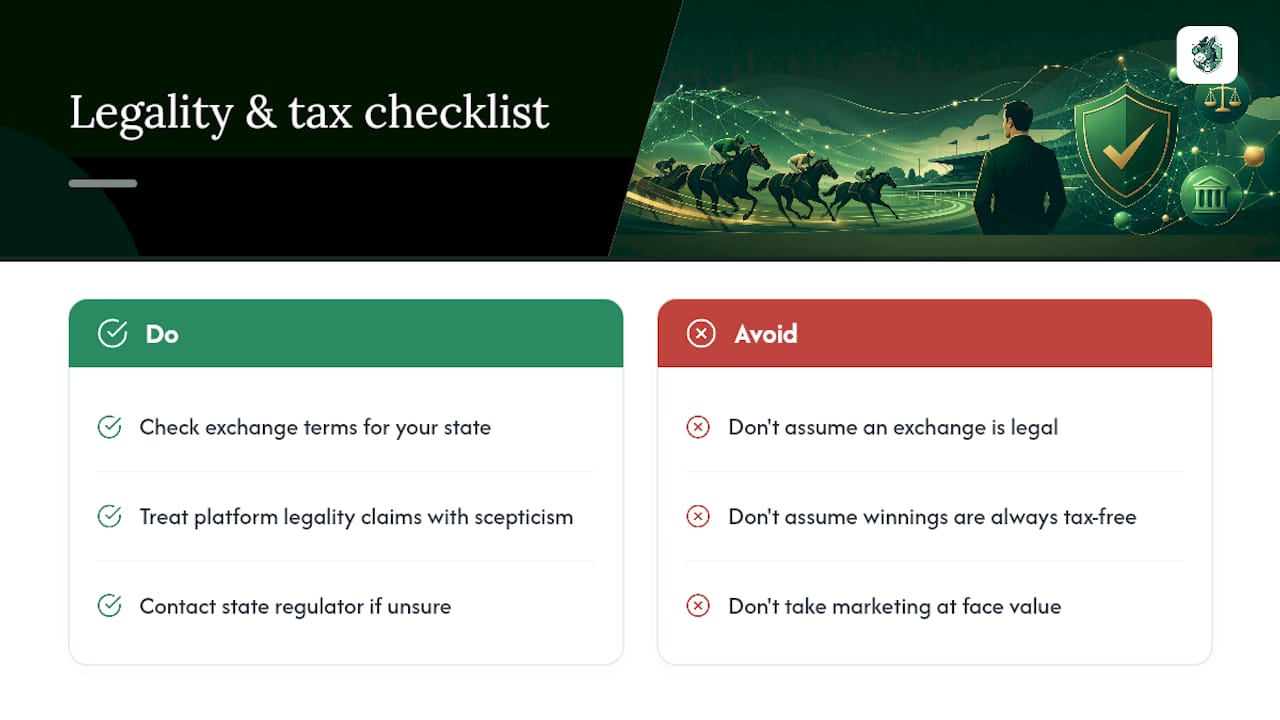
Lay betting through licensed exchanges is legal for adult bettors in Australia, but the regulatory picture is more fragmented than most guides admit. Wagering is regulated at state and territory level, and exchange-style betting has faced specific restrictions in some jurisdictions historically, so the exact permissions can vary depending on where you’re placed and which exchange operates the market.
Winnings from betting are generally not subject to income tax for Australian recreational bettors, on the basis that gambling is treated as a matter of chance rather than a taxable trade, though this depends on individual circumstances and professional-level activity can be assessed differently by the Australian Taxation Office. This is a separate question from whether an exchange is licensed to accept your bet in the first place.
Always check the exchange’s own terms for your state of residence before depositing funds, and treat any platform’s marketing claims about legality with the same scepticism you’d apply to a tipster’s strike rate. Regulatory settings shift, and a workaround that was fine two years ago is not a guarantee of anything today. If you’re unsure about your specific situation, a quick check with your state’s racing or gambling regulator is worth the ten minutes it takes.
What do commissions actually cost you over a season?
Commission is the quiet tax on every winning lay, and it compounds faster than most bettors expect.
Over a season of frequent trading, that range makes a real difference to your bottom line. Some exchanges also run tiered commission structures that reduce the rate for higher-volume bettors, which rewards exactly the kind of disciplined, frequent trading this strategy is built around.
Other costs are easy to overlook. Currency conversion fees apply if you’re funding an account in a different currency, and premium charges exist on some platforms for consistently successful bettors, a detail worth checking before you scale volume aggressively. Build commission into every profit projection at the worked-example stage, not as an afterthought once you’re reconciling a month’s results. A strategy that looks profitable before commission can turn marginal, or worse, once the real rate is applied consistently across every winning lay.
Treat it like trading, not a flutter
My checklist before every lay: confirm the signal, set the liability cap, define the stop-loss, log the outcome. Overconfidence, not bad luck, is what ruins accounts. Stay conservative until your own numbers prove otherwise.
Put verified signals to work on your next lay
There are other ways to build a shortlist, form guides, tip sheets, manual model-building, but they all cost time you could spend actually trading. DonkeyRadar gives you pre-race lay signals published before the jump, with results tracked publicly so you can check the strike rate yourself rather than take a marketing claim on faith.
- Live alerts via email and Telegram the moment a signal is graded.
- Staking tiers that translate each signal’s confidence into a liability weighting.
- A public, verified results history you can audit race by race.
- Direct exchange links and API access for faster execution.
Start with the lay betting calculator to model your own liability and commission before you place a cent, then check today’s graded signals against your shortlist.
Frequently asked questions
What is the best Australian racing lay strategy for beginners?
How much liability should I risk per lay?
Is lay betting profitable on Australian racing exchanges?
What’s the difference between laying to lose and lay-to-back trading? Laying to lose holds the position to the result and profits if the horse loses; lay-to-back locks in profit from a price move alone, regardless of the final result.
Which markets suit lay betting best in Australian racing? Match odds and place markets on liquid metropolitan meetings, particularly sprints and mid-class handicaps, tend to offer the clearest mispricing for lay trades.
Sources
- Kelly Criterion Lay Calculator: What Most Bettors Miss — Sports Command
- How a punter took the plunge THE LAY GAME OF BETFAIR
- Laying Horses on Betfair: When and How (2026 Strategy Guide)