← Blog · 📝 Article · 5 September 2026
Lay 3.0 Needs 66.67%: Break Even Lay Odds Calculator and Examples

Lay a horse at 3.0 and you need it to lose more than two-thirds of the time to break even. That single number, the implied probability derived from the lay price, is the benchmark every layer needs before deciding whether a bet has value. Get the strike rate above that figure and you profit; drop below it and, over time, you lose.
TL;DR:
- Laying at 3.0 requires a win rate of more than 66.67% to break even, meaning the horse must lose at least two-thirds of the time.
- Shorter odds like 2.0 demand a 50% loss rate for break-even, while longer odds like 10 require an almost 90% loss rate, increasing liability risk.
- Liability calculations depend on stake, odds, and commission, with higher commissions pushing the effective break-even point upward.
- Realistic expected value assessments must compare personal loss probability estimates against the calculated break-even, adjusting for market overround.
- Always verify available liquidity and use calculators to determine stake sizes and associated risks before placing a lay bet.
Table of Contents
- What is the break-even strike rate for lay odds?
- Worked examples: common prices and required strike rates
- Liability and commission: how they change the break-even maths
- Using break-even to assess value and expected value
- Tools and calculators: what to use and how to use them
- Common mistakes and a quick checklist before you lay
- Author perspective: practical habits from a lay-betting service
- Try DonkeyRadar’s calculator before your next lay
- Sources
What is the break-even strike rate for lay odds?
The break-even strike rate comes straight from the odds themselves. For decimal odds, the formula is:
- Implied probability = 1 ÷ decimal odds
- Break-even win % for the layer = 1 − (1 ÷ decimal odds), shown as a percentage
That second figure is what matters when you’re laying, because you win when the selection loses, not when it wins. So a lay price of 2.0 implies a 50% chance of winning for the backer, which means the layer needs the selection to lose at least half the time to break even.
For fractional odds, convert to decimal first (fraction + 1), then apply the same formula. American odds need a two-case conversion: negative odds use 100 ÷ (100 + |odds|), positive odds use 100 ÷ (odds + 100). PropsBot’s break-even calculator shows this producing figures like -110 converting to roughly 52.38%.
If you prefer the algebraic route, break-even is simply the point where expected profit equals expected liability. GamblingCalc’s implied probability tool offers a quick reference table if you want to skip the mental arithmetic entirely.
Worked examples: common prices and required strike rates
Run the formula against real prices and the pattern becomes obvious fast:
- Lay 2.0 → 1 − (1 ÷ 2.0) = 50%. The horse needs to lose half the time for you to break even. This is the classic coin-flip price.
- Lay 2.5 → 1 − (1 ÷ 2.5) = 60%. A modest shortening of the odds pushes your required strike rate up ten points.
- Lay 3.0 → 1 − (1 ÷ 3.0) = 66.67%. Now two-thirds of your lays need to lose.
- Lay 1.5 (short price) → 1 − (1 ÷ 1.5) = 33.33%. You only need the selection to lose a third of the time, but the liability per pound staked is small, so wins are frequent but modest.
- Lay 10.0 (long price) → 1 − (1 ÷ 10.0) = 90%. You’ll be right almost every time, but one loser at that price wipes out nine winners’ worth of profit if your liability isn’t sized properly.
The extremes matter because they show the trade-off: short prices demand a lower strike rate but carry disproportionate liability risk if the layer misjudges stake size.
Liability and commission: how they change the break-even maths
Break-even strike rate tells you the win frequency you need. It doesn’t tell you what you stand to lose if the bet goes wrong, and that’s where liability comes in.
- Liability = (lay odds − 1) × backer stake. For example, laying a bet with odds of 3.0 and a backer stake of £10 results in a liability calculated by this formula, as explained by Betfair’s exchange help.
- Commission only applies to net winnings, never to liability. If you win that lay and pocket £10 before commission, a 5% rate takes 50p, leaving £9.50 profit. Your £20 liability was never touched by the commission rate.
Commission on a winning lay can shift the equivalent back odds by a meaningful margin. The lay-to-back conversion formula is: back odds = 1 + (1 − commission) ÷ (lay odds − 1). Tofiko’s lay betting calculator walks through this arithmetic in more detail, and the gap between a 2% and 5% commission rate can move the equivalent back price by a few hundredths on short prices, more on longer ones.
Using break-even to assess value and expected value
Break-even is a line in the sand, not proof of a good bet. What decides value is comparing your own estimated probability of the selection losing against that break-even threshold.
Expected value for a lay works like this:
- EV = (probability of losing × profit if it loses) − (probability of winning × liability if it wins)
Run the maths and the EV turns negative, because your estimate sits below what the price demands. Lay the same horse at 3.0 when you believe it has a 75% chance of losing, and the EV turns positive.
One catch: raw market-implied percentages carry the bookmaker’s overround, so the true probability is usually a touch lower than the naive calculation suggests. Strip that margin out before trusting your comparison.
Tools and calculators: what to use and how to use them
Three calculator types cover most of what a layer needs:
- Break-even calculators take lay odds and return the required strike rate, useful for a quick sanity check before staking.
- Liability calculators take lay odds and stake, returning the amount you risk if the selection wins.
- Lay-to-back or matched-betting calculators, like the one on Beating Betting, take lay odds, commission and stake together to find the equalising back stake.
A typical workflow: enter the lay price, your exchange’s commission rate, and your stake into a combined tool such as DonkeyRadar’s lay betting calculator, and it returns both the liability and the break-even percentage in one pass. Always double-check liquidity at the quoted price before trusting the output. A calculator can’t match a stake that isn’t actually available on the exchange, as Outplayed’s lay betting guide points out.
Common mistakes and a quick checklist before you lay
The most common error is confusing the backer’s implied probability with your own required win rate as a layer. They’re mirror images, not the same number, and mixing them up leads to badly sized stakes.
- Don’t assume commission reduces your liability. It doesn’t; it only trims net winnings.
- Don’t lay without checking your exchange balance covers the full liability figure, not just the stake.
- Don’t skip a liquidity check. A price that looks matchable on paper can vanish the moment you try to place it.
- Confirm five things before you click: stake, liability, commission rate, your estimated true probability, and available liquidity.
Pro Tip: Keep a simple log of lay odds, liability and result for every bet. After fifty or so entries, you’ll see whether your actual strike rate is tracking above or below your break-even line, which tells you far more than any single result.
A printable version of this checklist sits in DonkeyRadar’s lay betting checklist if you want something to run through before every stake.
Author perspective: practical habits from a lay-betting service
Break-even maths is simple. Sticking to it under pressure is the hard part. At Donkeyradar, signals are built by comparing historical strike rates against live market prices, flagging selections where the layer’s required win rate looks achievable given past form. That’s a description of the approach, not a guarantee of any single outcome.
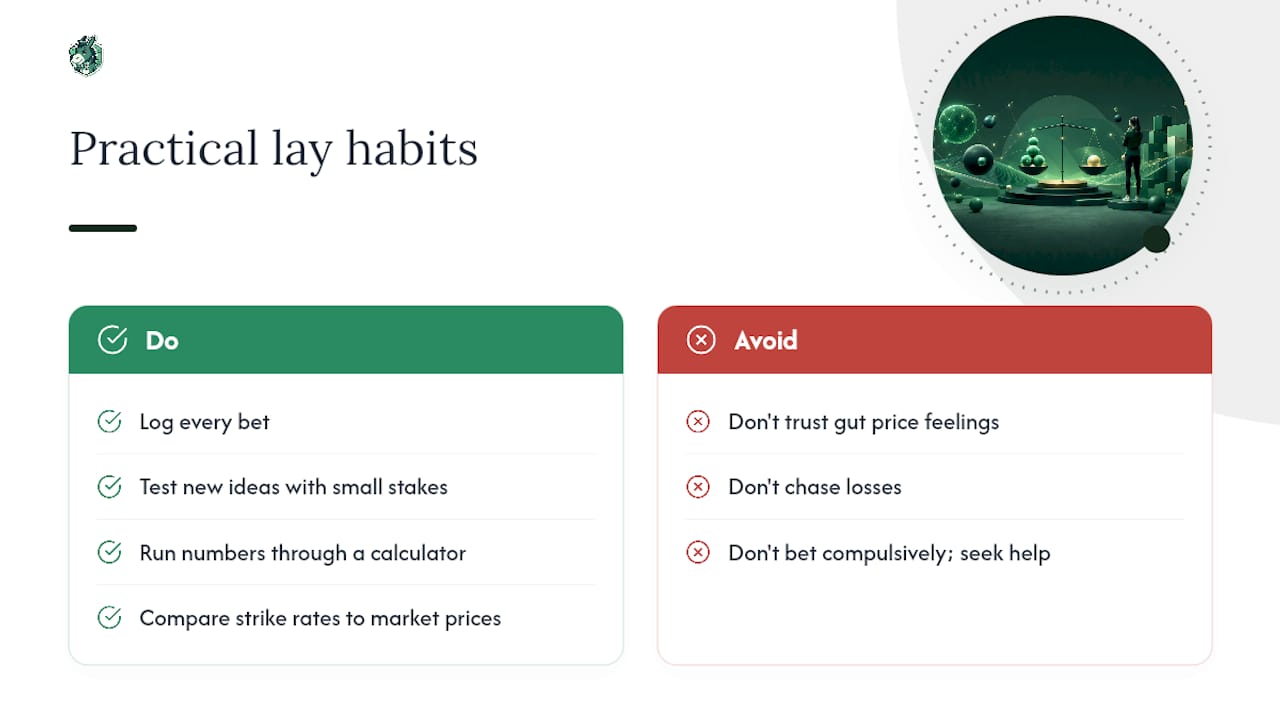
The habits that matter day to day are unglamorous: log every bet, test new ideas with small stakes first, run the numbers through a calculator rather than trusting a gut feeling on price. Losses happen even to a well-reasoned lay. That’s the nature of probability, not a flaw in the method. If betting stops feeling like a calculated decision and starts feeling compulsive, GambleAware offers free, confidential support.
— Donkey
Try DonkeyRadar’s calculator before your next lay
Working out break-even percentages by hand is fine once. Doing it for every race on a Saturday card gets old fast. Donkeyradar’s lay betting calculator does the liability, commission adjustment and break-even percentage in one go, so you spend your time judging value instead of doing arithmetic.
Pair that with the lay betting explained guide if you want the fuller mechanics behind the numbers, or the Betfair lay betting strategy page for a data-driven look at how signals get flagged before a race starts. Every signal on the platform is published ahead of time and tracked publicly, so you can check the maths against real results rather than take anyone’s word for it. Start with the free tier, run a few lays through the calculator, and see how your own strike rate compares with the break-even line.
Sources
For verifying the maths yourself, Betfair’s exchange help confirms how liability is calculated and displayed. PropsBot’s break-even calculator and Tofiko’s lay calculator both let you cross-check formulas against your own figures. If betting ever feels less like a decision and more like a habit you can’t stop, GambleAware is a genuinely useful place to start.
- Exchange: what does the term ‘lay’ mean and what is a lay bet? · Betfair support
- Break-Even Calculator: The Win Rate You Need at Any Price · PropsBot
- Lay Betting Calculator — Liability, Commission and Green-Up · Tofiko
- Lay bet implied probability explained · SharkBetting
- GambleAware