← Blog · 📝 Article · 11 August 2026
Lay dutching strategy: the practical Betfair guide

A lay dutching strategy means placing lay bets on several mutually exclusive selections in the same market so you profit if none of them wins. The industry term is reverse dutching, and it is the structural inverse of backing dutching, where stakes are split across multiple backed runners to return the same profit whichever one wins. Reverse dutching is most useful when you can confidently rule out a small group of favourites and want a steady stream of small wins, accepting that a single wrong call produces a larger, asymmetric loss. The detailed maths, a Betfair execution checklist, and Donkeyradar’s signal tools are all covered below.
Key takeaways
A lay dutching strategy produces consistent small profits when none of your laid selections wins, but requires strict liability caps and verified selection criteria to remain profitable over time.
| Point | Details |
|---|---|
| Run the maths first | Calculate lay stake, liability, and net profit after 5% commission before placing any bet. |
| Cap liability per event | Limit combined liability to 2–3% of your active bankroll to protect against asymmetric losses. |
| Confirm mutual exclusivity | All laid selections must be in the same single-outcome market; cross-market lays break the exposure logic. |
| Backtest before scaling | Use at least 100 historical events and track EV, strike rate, and maximum drawdown before increasing stakes. |
| Donkeyradar signals | Donkeyradar’s verified lay signals and exportable results history give you a ready-made backtesting dataset. |
Table of Contents
- How lay dutching differs from regular dutching
- The core maths: lay stakes, liability and commission
- Worked examples: two-selection and three-selection lays
- What are the real risks of lay dutching?
- How to execute lay dutching on Betfair
- Which tools help you calculate lay dutching stakes?
- How do you backtest a lay dutching strategy?
- The discipline lay dutching actually demands
- Donkeyradar gives you signals, stakes and verified results
- Sources
How lay dutching differs from regular dutching
Backing dutching splits stakes across several selections so the payout is equal whichever one wins. Lay dutching inverts that: you lay several selections so your liability is equal whichever one of them wins, and you collect if none of them wins.
Key structural differences:
- Objective: backing dutching targets a fixed profit from one winning selection; lay dutching targets a fixed profit from all laid selections losing.
- Payout symmetry: in backing dutching, one outcome pays you; in lay dutching, every outcome except an unlaid runner pays you.
- Liability shape: backing dutching risks only the stake; lay dutching risks a multiple of the stake (lay odds minus 1), so losses can be substantially larger than wins.
Lay dutching fits markets where only one outcome can win and the full field is covered by the exchange. Horse racing win markets on Betfair are the cleanest fit. Football correct-score markets and other single-outcome exchange markets also qualify, provided you are laying within a single market. The mutual exclusivity requirement is non-negotiable: equalised-exposure logic only holds when exactly one outcome can win. Applying the method across separate events destroys the math entirely.
The core maths: lay stakes, liability and commission
The staking formula for reverse dutching starts with a target gross lay receipt, then works backwards to individual lay stakes.
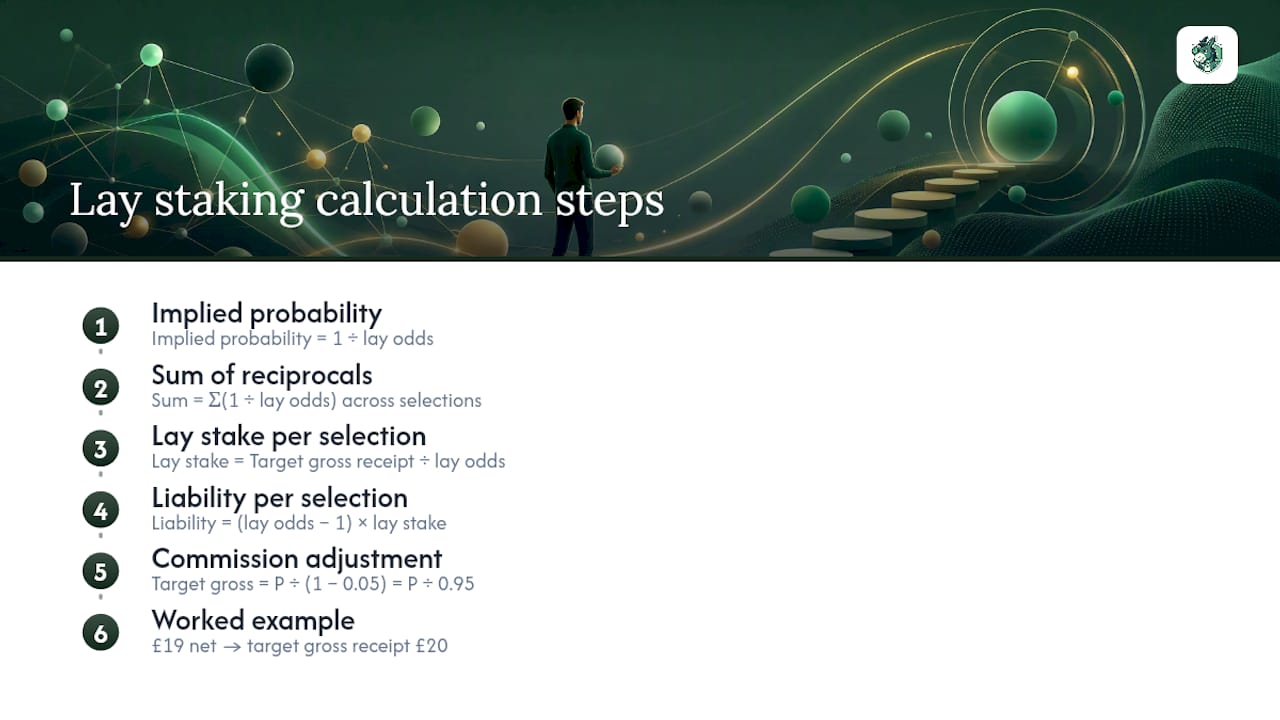
Step 1 — implied probability
Implied probability for each selection = 1 ÷ lay odds
Step 2 — sum of reciprocals
Sum of implied probabilities across all laid selections = Σ (1 ÷ lay odds)
Step 3 — lay stake per selection
Lay stake = Target gross receipt ÷ lay odds
This ensures that if any one of the laid selections wins, your total payout to the backer equals the same target gross receipt, keeping losses equal across all laid runners.
Step 4 — liability per selection
Liability = (lay odds − 1) × lay stake
Step 5 — commission adjustment
To receive a net profit of £P after commission, set:
Target gross receipt = P ÷ (1 − 0.05) = P ÷ 0.95
So if you want £19 net profit, your target gross receipt is £20.
The Sharkbetting dutching calculator mirrors this logic and is a useful manual check. Betfair’s own liability-entry button applies the same formula in real time, which removes the need for a separate calculator in straightforward two-selection lays.
Worked examples: two-selection and three-selection lays
Two-selection example (Betfair, 5% commission)
Target net profit and gross receipt are example values illustrating commission adjustment
Outcome if neither A nor B wins: you collect £20 gross, pay £1 commission, net profit = £19.00.
Outcome if Horse A wins: you pay out £13.34 to A’s backer, lose £4.00 stake on B (unmatched bets returned), net loss = £13.34.
Outcome if Horse B wins: you pay out £16.00 to B’s backer, net loss = £16.00.
Maximum market exposure is £16.00 against a potential net gain of £19.00. The asymmetry is modest here because the odds are relatively low.
Three-selection example (Betfair, 5% commission)
Target net profit and gross receipt are example values illustrating commission adjustment
If none win: gross receipt £20, commission £1, net profit = £19.00.

If Horse C wins: loss = £17.50. Note that Horse C’s higher odds produce the largest single liability, even though its stake is the smallest.
If Horse A wins: loss = £13.34.
Partial fills matter here. If Horse C’s lay is only half-matched (£1.25 staked instead of £2.50), your gross receipt drops to roughly £17.50 and your net profit falls to about £16.63 after commission. Always confirm matched amounts before the off. The GamblingCalc multi-lay calculator models partial fills and commission together, which is particularly useful when mixing high and low odds in a three-selection lay.
What are the real risks of lay dutching?
Lay dutching looks clean on paper. In practice, several risks can erode or reverse the edge.
Asymmetric liabilities. Your maximum loss is always larger than your maximum gain. A single short-priced favourite winning at 3.0 costs you more than several winning events return. This is the strategy’s defining characteristic, not a flaw to be engineered away.
Market movement. Odds shift between the moment you place your first lay and the moment your last lay is matched. If a selection drifts out, your liability on that runner increases relative to your original calculation. Staggered entry across a moving market can leave your book unbalanced.
Low liquidity and unmatched lays. Thin markets mean partial fills. A partially matched lay changes your P/L profile for every outcome. Set alerts for unmatched stakes and decide in advance whether to chase the price or accept a reduced position.
Failing to build commission into your target gross receipt turns a marginal positive EV into a negative one. A Betfair-specific worked example shows that EV can be negative unless your assessed probabilities diverge strongly from market-implied probabilities.
Correlated markets and non-mutual exclusivity. Laying selections across different races or different markets is not lay dutching. It is simply multiple independent lays with no shared exposure logic.
Voids and cancellations. A voided runner on Betfair reduces the field. Your remaining lays stay active, but the gross receipt target no longer reflects the original book. Review open lays immediately after any void is declared.
For a £1,000 bank, that means a maximum combined liability of £20–£30 per race. This fraction-based cap, loosely analogous to Kelly-style sizing, prevents a single bad result from materially damaging your bank.*
How to execute lay dutching on Betfair
Follow this checklist on race day:
- Select the market. Open the Betfair win market for the race. Confirm it is a single-outcome market (one winner declared).
- Confirm mutual exclusivity. All selections must be in the same race. Never combine lays from separate events.
- Check matched volume. Review the available lay size at each target price. If available volume is less than your required lay stake, adjust your target gross receipt downward or reduce the number of selections.
- Calculate stakes. Use the formula (Lay stake = Target gross receipt ÷ lay odds) or Betfair’s liability-entry mode. Enter your target net profit and let the exchange calculate stakes automatically.
- Enter lays using liability mode. Betfair’s liability button lets you specify the maximum you are willing to lose on a selection rather than the stake. This reduces input errors on high-odds runners.
- Confirm matched amounts. After placing, check each lay is fully matched. Note any partial fills before the off.
- Monitor for late movement. If a selection shortens significantly, your liability on that runner increases. Decide whether to cancel and re-enter or accept the revised exposure.
- Set pre-race alerts. Use Betfair’s notification settings or a third-party tool to flag unmatched stakes at five minutes before the off.
In-play considerations. Lay dutching is a pre-race strategy. In-play markets move too quickly for balanced multi-lay entry unless you are using automated trading software. For manual execution, close or hedge any open positions before the race starts if your book is not fully matched.
Pro Tip: Test the full workflow on minimum stakes (£2 per selection) across five races before scaling. This confirms your stake calculations, commission handling, and alert setup without meaningful financial exposure.
Which tools help you calculate lay dutching stakes?
Several options are available, each suited to a different level of complexity.
- Betfair liability-entry mode. Built directly into the exchange interface. Sufficient for two- or three-selection lays when liquidity is adequate and odds are stable. No external tool needed.
- GamblingCalc multi-lay calculator. Distributes lay stakes to equalise liability, models commission, and shows P/L for partial fills. Best for three or more selections or when mixing wide odds ranges.
- Sharkbetting dutching calculator. Mirrors exchange liability logic and is useful for checking manual calculations. Weights stakes by liability rather than payout.
- Donkeyradar’s lay betting calculator. Covers liability, profit, and break-even in a single workflow, with guidance calibrated to UK exchange markets.
- Spreadsheet templates. A simple Excel or Google Sheets model using the formulas above gives full transparency and is easy to adapt for different commission rates or bankroll caps.
A calculator is mis-specified if it omits commission from the net profit figure, applies the wrong liability formula (stake × odds rather than stake × (odds − 1)), or allows selections from different markets. Check the output against a manual calculation on your first use.
How do you backtest a lay dutching strategy?
Backtesting validates whether your selection criteria produce a genuine edge before you risk real money.
Essential metrics to track:
- Strike rate: the fraction of events where none of your laid selections wins.
- Average profit per winning event (none win) and average loss per losing event (a laid selection wins).
- Expected value (EV) per event: (strike rate × average profit) − ((1 − strike rate) × average loss).
- Maximum drawdown: the largest consecutive loss run in your test sample.
- Win/loss variance: how much individual results deviate from the average.
Simple test plan:
- Use at least 100 historical events to get a statistically meaningful sample.
- Source historic exchange prices from Betfair’s own data products or from horse racing data analysis tools that record pre-race lay prices.
- Simulate fills at the recorded price, apply 5% commission to each winning event, and record every outcome in a spreadsheet.
- Review EV and strike rate together. A strike rate above 70% with a modest average profit and a contained maximum drawdown is a workable combination. A high strike rate paired with very large average losses produces negative EV regardless of how often you win.
Donkeyradar’s verified historical signals provide a ready-made dataset for this process. The public results history and exportable data mean you can run a backtest against real, independently verified lay signals rather than reconstructed prices.
The discipline lay dutching actually demands
Experienced layers tend to favour reverse dutching because the win frequency is high. That frequency is psychologically comfortable, which is precisely where the danger lies.
The occasional large loss is not a system failure. It is the price of the strategy’s structure. Accepting that mathematically is straightforward; accepting it emotionally after a run of wins is harder. Layers who increase stake size after a winning streak are the ones who get hurt badly when a short-priced favourite lands.
A few habits that matter in practice: run your stake calculations before the market opens, not during it. Cap liability per event before you place a single bet, not after you see the odds. Keep a results log updated after every race, not weekly. Review P/L weekly and check whether your strike rate is tracking your backtest projection. If it diverges by more than a few percentage points over 50 events, revisit your selection criteria rather than adjusting stakes.
Donkeyradar gives you signals, stakes and verified results
Lay dutching requires two things most bettors underestimate: reliable selection criteria and a clean staking workflow. Donkeyradar delivers both. The platform publishes lay signals for UK, Australian, and US horse races before each race starts, with staking tier grades so you know how much weight to give each signal. Every result is publicly tracked and verified, giving you a real dataset for backtesting rather than reconstructed prices.
The free tier provides daily lay signals with direct Betfair exchange links. A premium subscription adds real-time alerts via email and Telegram, full results history, and API access for trading software integration. The lay betting calculator handles liability, profit, and break-even in one place, and the Betfair lay betting strategy guide covers exchange-specific execution in detail. Start with the free tier, run the maths against your own backtest, and scale only when the numbers support it.
Sources
- Dutching on Betfair: Cover Multiple Outcomes (2026)
- Multi Lay Calculator: Exchange Dutching & Liability Tool
- Dutching Calculator & Formula: Equal-Profit Stakes
- All About “REVERSE DUTCHING” On Betfair – Sports Trading Life
Lay dutching is general information about a betting method, not financial or professional advice. Confirm current Betfair commission rates and exchange rules directly with Betfair before placing bets.