← Blog · 📝 Article · 10 September 2026
Cap Liability 2–5%: Lay Place Strategy With DonkeyRadar Signals

A disciplined lay place strategy can turn a genuine edge, but only when liability caps, price selection and market liquidity are treated as fixed rules, not guidelines. The single most reliable approach is selective laying against mispriced short odds in liquid, well-matched races, with liability capped before the race, not after. The rest of this guide covers the price zones, the liability maths, market selection and the in-running signals that make that approach repeatable.
TL;DR:
- Focus on placing lay bets against long odds favorites in competitive handicaps with 12 or more runners, using odds between 1.80 and 2.80.
- Balance liability carefully by limiting each lay to 2% to 5% of your bankroll, and use fixed-liability staking to prevent chasing losses.
- Prioritize liquidity checks on the specific horse and race, with a minimum of a few thousand pounds matched, especially in larger fields with four or more paid places.
- Enter pre-race positions 15 to 5 minutes before the start, and use in-running signals like early pacing issues for quick exit opportunities.
- Rely on verified signals to identify weak field contenders, then confirm matched volume, odds, and liquidity before executing each approach.
Table of Contents
- What is the best lay place strategy for consistent results?
- Which odds bands actually work for lay place strategy?
- How much of your bankroll should one lay place bet risk?
- Which races have enough liquidity for place lays?
- How do you time entries and exits when laying to place?
- What mistakes wreck a lay place strategy fastest?
- How does DonkeyRadar’s signal approach sharpen place-laying decisions?
- Place markets pay multiple positions. Here’s why that changes everything
- Why discipline breaks down faster than the maths does
- What are the legal considerations for lay betting?
- My own routine for keeping this honest
- How DonkeyRadar helps you apply this in practice
- Sources
What is the best lay place strategy for consistent results?
There is no single tactic that works in every race. What works is matching the right tactic to the right race type, then applying it with the same discipline every time.
- Lay the overpriced favourite to place: works best in competitive handicaps of 12+ runners where the market favourite is drifting on the back of public sentiment rather than form. Target odds around 1.80 to 2.80 on the place market.
- Lay drifters pre off: a horse whose price lengthens steadily in the final 30 minutes is telling you something the crowd hasn’t priced in yet. Best applied in the last 10 to 15 minutes before the off.
- In-running lay on visible distress: a horse struggling for early pace, boxed in, or being niggled along by the jockey before halfway. This needs fast reflexes and short liability, since the window closes quickly.
- Lay the field (selective): laying two or three weak runners in the same race to spread liability, rather than betting everything against one horse. Suits large fields with genuine depth of ability.
- Back to lay: back a horse at a shorter price, then lay it off at a longer price if it drifts, locking in a small guaranteed return regardless of the result. Works well on well-matched races where prices move but the favourite rarely collapses completely.
Each tactic answers a different question: is the market wrong before the race, or is the horse wrong during it? Knowing which question you’re asking changes everything about timing and stake size.
Which odds bands actually work for lay place strategy?
Price is the single biggest variable in whether a place lay pays off, and treating all odds bands as equal is the fastest way to bleed a bankroll.
- 1.50 to 2.50: high win probability for the horse means high liability relative to stake, and margins get eaten fast by commission. Only worth it on the clearest mispricing.
- 2.50 to 4.00: the sweet spot most exchange guides converge on, offering a workable balance between win-rate needed and liability size. This is where selective place laying tends to deliver the steadiest results.
- 4.00 to 7.00: lower liability per pound staked, but you need a sharper read on genuine weakness, since a wider field of live contenders makes place finishes harder to predict.
The break-even probability for any lay is 1 divided by the lay odds. At odds of 3.00, the horse needs to place less than one third of the time for the lay to be profitable before commission.
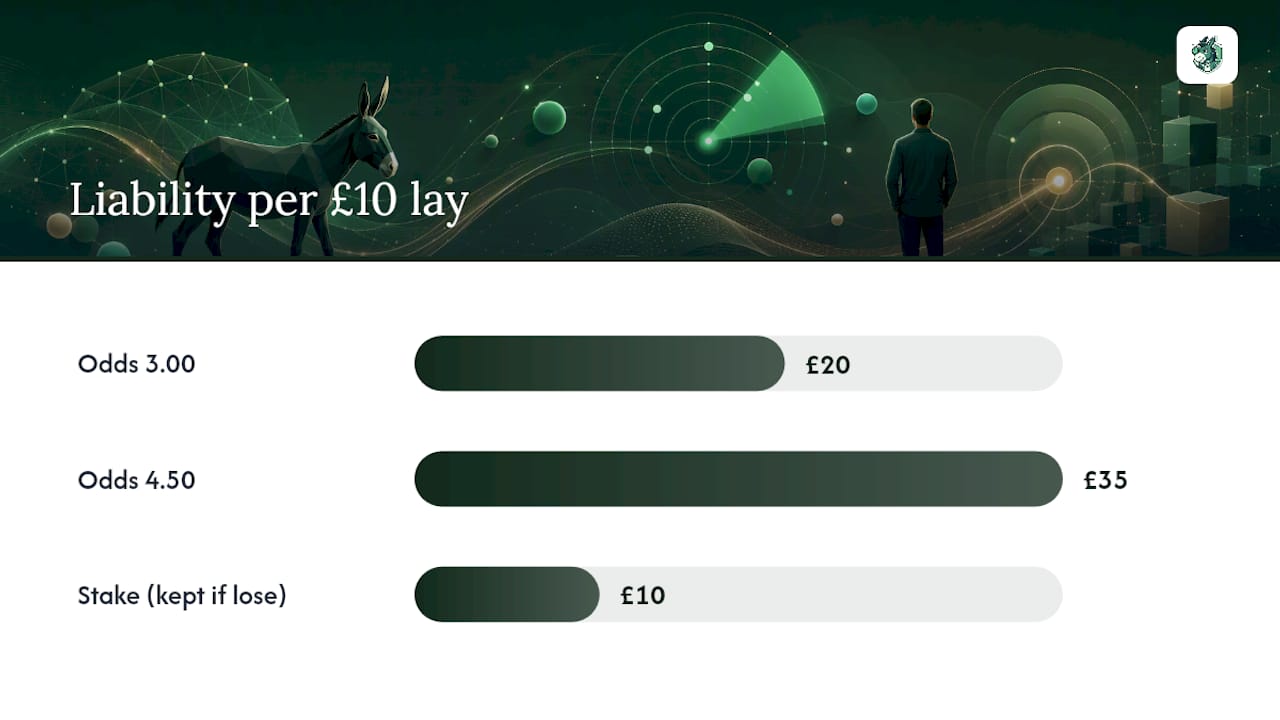
Worked example: lay £10 at odds of 3.00. Liability is £20 (stake multiplied by odds minus 1). If the horse doesn’t place, you keep the £10 stake minus commission. If it does place, you pay out the £20 liability. At odds of 4.50, a £10 lay carries £35 liability, which is why price selection and liability sizing are the same decision, not two separate ones.
How much of your bankroll should one lay place bet risk?
Liability is what actually leaves your account if the lay loses, and it’s always larger than your stake. The formula is simple: liability equals stake multiplied by (odds minus 1). A £20 lay at odds of 4.00 carries £60 of liability, not £20.
Most exchange-focused guides recommend keeping liability at 2% to 5% of total bankroll per lay, which gives you room to absorb a losing run without threatening your ability to keep trading. On a £1,000 bankroll, that means capping liability at £20 to £50 per bet, regardless of how confident you feel.
- Decide your maximum liability first, then work backwards to the stake the odds allow.
- Never increase stake size to “chase” a loss within the same session.
- Use fixed-liability staking so every lay carries the same maximum downside, which makes your results genuinely comparable week to week.
- Log every lay: odds taken, stake, liability, result, and commission paid.
Place lays are asymmetric. Most bets return a small profit, and the occasional loss is large by comparison. That’s normal, not a sign the strategy has failed.
Pro Tip: Run your numbers through a lay betting calculator before you enter a lay, not after. Seeing the actual liability figure in pounds, rather than just the odds, changes how confidently you size the bet.
Which races have enough liquidity for place lays?
Liquidity determines whether you can actually get matched at your chosen price, and whether you can exit cleanly if the market moves against you.
- Check matched volume on the specific selection before entry. Guides on exchange laying commonly point to a minimum of a few thousand pounds matched on the horse itself as a rough liquidity floor, not just the race total.
- Favour fields of 10 or more runners with three or four paid places. Larger fields dilute any single horse’s place probability, which works in the layer’s favour.
- Premier fixtures and festival cards carry deeper order books than midweek regional cards, meaning tighter spreads and faster fills.
- Before entering, run through: matched volume on the horse, number of paid places, time to the off, and whether the price has been stable or volatile in the last ten minutes.
Weekday cards with thin fields and shallow order books are where inexperienced layers get caught unable to hedge at a fair price.
How do you time entries and exits when laying to place?
Timing decides whether a sound selection turns into a profitable trade or an avoidable loss.
- Pre-off window: enter the bulk of your position 15 to 5 minutes before the off, scaling in rather than committing all liability at once if the price is still moving.
- In-running signals: watch for a horse being scrubbed along early, losing position on the rail, or getting caught flat-footed at the top of the home straight. These moments often create a brief re-pricing lag of roughly 10 to 20 seconds before the market fully reacts.
- Exit rules: set a hard stop-loss in ticks before you enter, not during the race. If the horse is travelling well and the price shortens against you, either hedge by backing at the new price to lock in a smaller loss, or let the stop trigger automatically.
Manual execution works for pre-off lays where you have minutes to decide. In-running lays reward automation and alerts, since a 15-second window doesn’t leave time to scroll through a race card.
What mistakes wreck a lay place strategy fastest?
Most losing lay runs share the same handful of causes, and each has a straightforward fix.
- No liability cap before entry: fix by deciding maximum liability first, odds second, stake last.
- Chasing losses with bigger stakes: fix with a fixed-liability rule that never changes regardless of the previous result.
- Ignoring commission in the maths: exchange commission trims every winning lay, so build it into your break-even calculation rather than treating it as an afterthought.
- Laying into thin markets: fix by checking matched volume before entry, every time, not just when a price looks obviously wrong.
- Treating place lays as insurance in multi-leg bets without checking non-runners: a non-runner can change the number of paid places partway through a multi-leg bet, creating double exposure. Place any insurance-style lay as close to the off as practical once runners are confirmed.
Cap consecutive losing lays per session at two or three, and set a daily loss limit in pounds before you start, not while you’re already down.
How does DonkeyRadar’s signal approach sharpen place-laying decisions?
Signal-based selection removes the guesswork from picking which horse to lay, which is the hardest part of the whole exercise. DonkeyRadar publishes its lay signals before races start and tracks every result publicly, so the record is auditable rather than promised after the fact.
A published signal doesn’t replace your liability cap or your liquidity check. It replaces the guesswork in deciding which horse is actually the weak link in the field.
Use a verified signal as the first filter, then run it through the same checklist covered above: matched volume, field size, price band, and your fixed liability limit. The lay betting calculator turns the signal into an actual stake and liability figure in seconds.
Place markets pay multiple positions. Here’s why that changes everything
A win market has one outcome that matters: first past the post. A place market pays out on two, three, or sometimes four positions depending on field size, and that single difference changes the entire risk profile of laying.
Laying to win means you only lose if that one specific horse finishes first. Laying to place means you lose if the horse finishes anywhere inside the paid positions, which in a 16-runner handicap with four places is a considerably easier bar for the horse to clear. That’s precisely why place lay odds sit so much closer to evens than win lay odds for the same horse: the market is pricing in a genuinely higher probability of the layer losing.
This has a direct consequence for selection. A horse can be a poor bet to win outright while still being a reasonable danger to sneak into fourth in a weak field, so “the horse won’t win” is not the same judgement as “the horse won’t place.” Effective place-laying means assessing whether a horse can realistically finish outside the paid positions altogether, which usually means looking for genuine weakness (a poor recent form line, an unsuitable pace setup, a step up in class) rather than just doubting the favourite’s chances of winning.
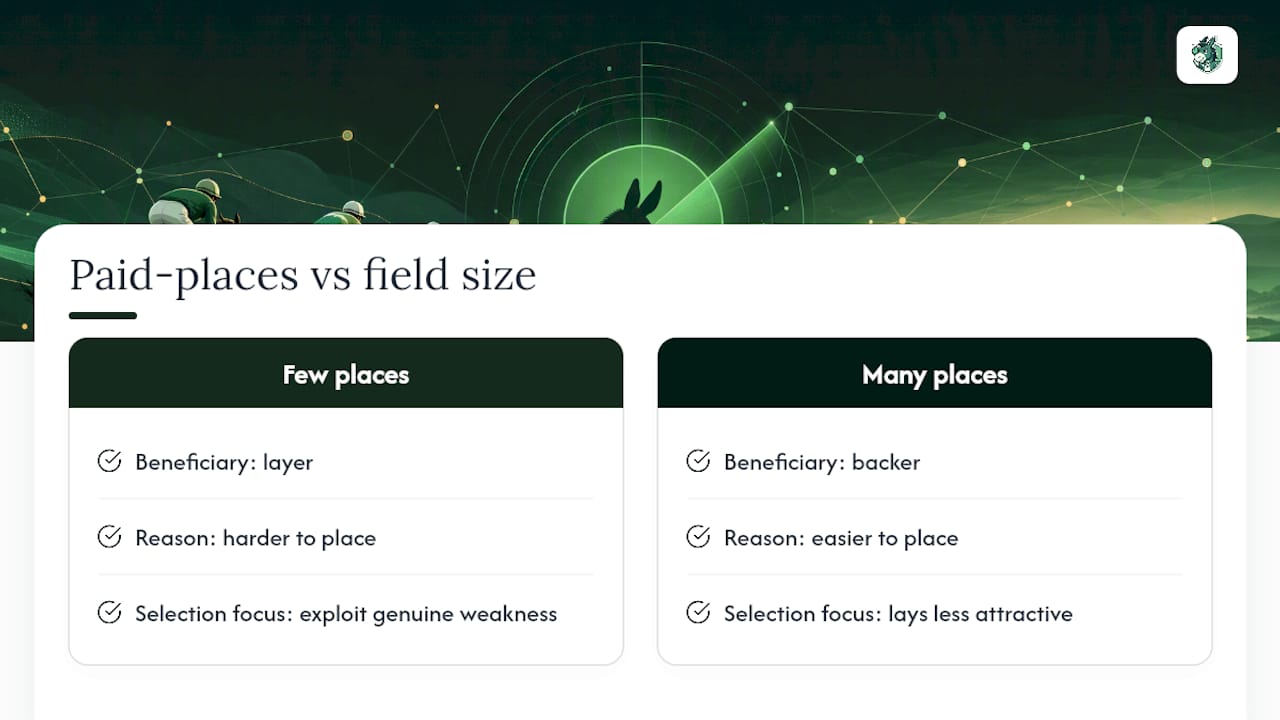
Field size and the number of paid places interact directly. Fewer paid places relative to field size favours the layer; more paid places relative to runners favours the backer. That ratio is worth checking before odds, because it sets the ceiling on how good any lay can realistically be.
Why discipline breaks down faster than the maths does
The maths behind lay place betting is straightforward. Sticking to it under pressure is where most bettors actually fail. A losing run of three or four lays in a row, even when each one was correctly priced and properly sized, can trigger the urge to raise stakes “to get it back,” which is precisely how a sound strategy turns into a damaging session.
The asymmetry of laying makes this worse than backing. A backer’s losses are capped at their stake, so a losing run feels linear. A layer’s losses are variable and sometimes large relative to the stake, so a single bad result can look, emotionally, like proof the whole method has failed, even when it’s well within expected variance for the odds being laid.
The fix isn’t willpower, it’s structure decided in advance. Set your daily loss limit, your consecutive-loss stop, and your per-lay liability cap before you place a single bet, and treat those numbers as fixed regardless of how the session is going. Reviewing results weekly rather than after every race also helps separate genuine pattern from short-term noise; a sample of five or ten lays tells you almost nothing statistically, while fifty or more starts to show whether the edge is real.
If a session starts to feel personal, that’s usually the signal to stop, not to double down. BeGambleAware offers tools for setting deposit and session limits that can help keep this discipline in place even on days when the numbers alone aren’t enough.
What are the legal considerations for lay betting?
Lay betting is legal for private individuals using licensed betting exchanges in the UK, and profits from private betting are not subject to Income Tax or Capital Gains Tax. That tax treatment applies specifically to private bettors and does not automatically extend to anyone whose betting activity is judged to constitute a trade or business, so it’s worth understanding which category applies to your own situation rather than assuming it does.
Exchanges themselves are regulated by the UK Gambling Commission, which sets rules around identity verification, responsible gambling tools, and fair market operation. Using an unlicensed or offshore exchange to lay bets removes those protections entirely, including dispute resolution and deposit safeguards, so sticking to a licensed UK exchange isn’t just a preference, it’s the safer route by a wide margin.
Signal services and tipster tools that recommend lay bets are not regulated in the same way exchanges are, since they provide information rather than take bets themselves. That makes transparency and a verifiable track record the main things worth checking before trusting any signal source with real stakes.
My own routine for keeping this honest
Every session starts the same way: check the card for fields of 10 or more with clear place markets, confirm matched volume on any horse I’m considering, and cap liability at a fixed percentage of bankroll before looking at a single price. I rarely place more than four or five lays in a day, and I review the log at the end of each week rather than each race, because a single afternoon tells you almost nothing about whether an approach actually works. Expect genuine variance for weeks before drawing firm conclusions.
— Donkey
How DonkeyRadar helps you apply this in practice
DonkeyRadar is built around the exact discipline this guide argues for: published signals before the race, tracked results afterwards, and no guesswork about which horse is the weak link in the field. Instead of scanning form guides yourself, you get a filtered shortlist of place-lay candidates with the price zone and staking tier already flagged, so your own checklist, matched volume, field size, and liability cap, becomes the only extra work required.
The free tier gets you daily signals to test the method without committing to anything, and additional features are available on a trial basis for those wanting more detailed access before paying. A sensible first step is running one small, capped-liability lay through the lay betting calculator against a published signal, then comparing the result against your own log. If the lay betting explained guide raised questions about mechanics along the way, that’s the place to get them answered before staking anything larger.
Sources
- Laying Horses on Betfair: When and How (2026 Strategy Guide)
- The Practical Guide To Profit From Laying In Horse Racing
- Lay Betting Strategies That Actually Work on Betfair Tested Approaches - Tipster Reviews
- BeGambleAware