← Blog · 📝 Article · 23 September 2026
Protect your bankroll laying longshots with DonkeyRadar signals
Laying longshots works as a long-term edge only for disciplined bettors running strict fixed-liability staking, and it fails badly for anyone chasing the favourite–longshot bias without a plan. The single biggest reason: liability on a long-priced horse balloons fast, and one unexpected win can wipe out a dozen previous gains. If you can’t stomach that maths, this isn’t your strategy.
TL;DR:
- Laying longshots requires strict fixed-liability staking to prevent large losses from shock winners that can wipe out weeks of profits.
- Market signals such as late money, volume spikes, ground suitability, and trainer or jockey changes help identify genuine weaknesses in longshots.
- A liability cap of around £50 at 50/1 odds means a longshot win can outweigh multiple successful lays, emphasizing disciplined bankroll management.
- Avoid risking more than five times your total bankroll on a single lay, and stop after two or three consecutive losses to prevent gambler’s ruin.
- Automated tools like DonkeyRadar can support disciplined pre-race checks, but consistent success depends on individual judgment and strict discipline.
Table of Contents
- What is a longshot, and why does the favourite–longshot bias matter?
- Why is laying longshots risky? Liability, variance and gambler’s ruin
- Practical checklist: pre-race rules for laying a longshot
- Staking and bankroll rules for lays: fixed liability in practice
- What market signals suggest a longshot is a weak runner?
- How does this look in practice? Two worked examples
- Author perspective: rules, discipline and knowing when to stop
- How DonkeyRadar puts data-driven laying into practice
- Sources
- FAQ
What is a longshot, and why does the favourite–longshot bias matter?
A longshot is a horse priced well above its realistic winning chance, typically 20/1 or bigger on the exchanges. When you lay one, you’re not staking a small amount to win big. You’re risking a large liability (the payout you owe if it wins) to win a small, fixed profit equal to your backer’s stake.
That asymmetry is exactly what makes longshots tempting to lay. The favourite–longshot bias describes a well-documented pattern in racing markets: punters systematically overvalue longshots and undervalue favourites, pushing the price of rank outsiders below their true probability of losing. In plain terms, the crowd makes longshots go off shorter than they should, which is precisely where a lay bettor can find value.
Here’s what that bias actually means for your approach:
- Longshots attract emotional, hope-driven money from backers chasing a big payout.
- This demand pushes prices down from where statistical models would set them.
- The gap between market price and “true” price is where laying longshots strategy finds its edge.
- The bias is well-established, but it doesn’t guarantee any single lay wins.
Spotting the bias is the easy part. Turning it into consistent profit means respecting the risk that comes with every lay, which is where most bettors get it wrong.
Why is laying longshots risky? Liability, variance and gambler’s ruin
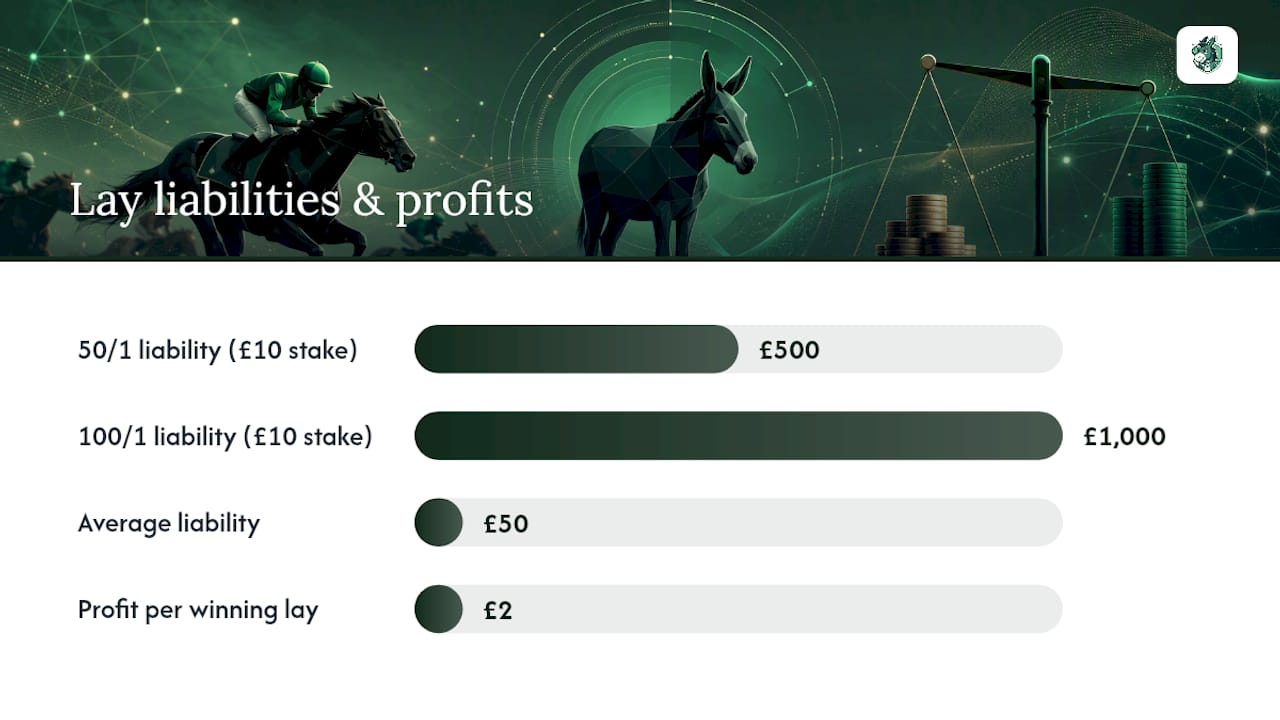
Laying a horse at 50/1 means you’re liable for 50 times your backer’s stake if it wins. Lay a £10 stake at 50/1 and you owe £500 if that horse crosses the line first. At 100/1, the same £10 stake carries a £1,000 liability. The profit on a loser (a winning lay) is small and fixed; the loss on a winner is large and only capped by the odds you accepted.
That imbalance is the entire risk profile of laying longshots strategy in three steps:
- You collect small, steady profits on the vast majority of lays that lose.
- Every so often, a longshot wins, and you pay out a liability many multiples of your usual stake.
- Without a cap, that single payout can erase the profit from dozens of winning lays in one race.
One winner can undo weeks of work. If you’re laying at an average liability of £50 and banking roughly £2 profit per winning lay, it takes 25 successful lays just to cover a single 50/1 shock result. Get the sizing wrong and the maths turns against you fast.
This is a textbook case of what statisticians call gambler’s ruin: a bettor with a finite bankroll, exposed to variable-sized losses, will eventually hit a losing run large enough to wipe them out, unless liability is controlled. Variance in horse racing is high. Outsiders win often enough, and unpredictably enough, that a long enough sequence of lays will include a shock winner. The question isn’t whether that happens. It’s whether your staking survives it.
Practical checklist: pre-race rules for laying a longshot
Treat every lay as a decision with a checklist attached, not a hunch. Running through the same sequence before every race removes the guesswork that gets recreational bettors into trouble.
- Work out a fair price fast. Compare the horse’s recent form, class, and finishing positions against its current market price. If the market has it at 33/1 but its recent runs suggest 60/1 or longer is closer to fair, that gap is your potential edge.
- Check market liquidity. Thin markets with wide back/lay spreads are harder to trade out of if the price moves against you. A longshot with almost no matched volume is a signal to be cautious, not confident.
- Read late-money patterns. A horse quietly shortening in the final 15 minutes before the off often means informed money is arriving. Laying into that move is far riskier than laying a price that’s been stable or drifting all morning.
- Apply race filters. Smaller fields, lower-class handicaps, and unfamiliar going conditions all change how reliably a longshot’s form translates. A big field on soft ground adds unpredictability that cuts against tight lay margins.
- Apply runner filters. Check trainer and jockey combinations, distance suitability, and whether the horse has any believable claim given the conditions. Practical lay betting strategy is built on spotting weakness in a runner, not just backing the strongest horse in the race, so focus your search on why this horse can’t win rather than why the favourite can.
- Decide: genuine weakness or market noise? If every filter points the same way, form, ground, trainer record, and price, that’s a stronger signal than any single factor alone.
Pro Tip: Never lay a longshot purely because the price “looks big.” A 66/1 shot with a legitimate course-and-distance win two runs ago is a completely different proposition to a 66/1 shot that has never finished inside the top ten. The price tells you the market’s opinion; the form tells you whether that opinion is justified.
Running this checklist takes a few minutes per race. Skipping it is how disciplined bettors turn into gamblers.
Staking and bankroll rules for lays: fixed liability in practice
Two staking approaches dominate lay betting discussions, and only one of them suits laying longshots strategy sensibly.
- Percentage-of-bank staking sizes your bet as a fixed share of your current bankroll. It works reasonably well for backing, where losses are capped at your stake. For laying, it’s dangerous, because your liability, not your stake, is the real exposure, and a percentage rule doesn’t automatically control that.
- Fixed-liability staking flips the logic: you decide the maximum amount you’re willing to lose on any single lay, then work backwards to set your stake at whatever odds are on offer. This keeps every lay’s worst-case outcome identical, regardless of price.
Here’s how fixed liability plays out at realistic odds. Suppose you set a liability cap of £50 per lay.
- At 50/1, a £50 liability allows a stake of roughly £1. Your profit if the lay wins is around £1, minus commission.
- At 100/1, that same £50 cap allows a stake of roughly 50p, for a smaller profit per successful lay.
- Break-even at 50/1 means winning at least 50 lays to absorb one loser; at 100/1, you need around 100 winning lays to cover a single loss.
Those numbers are the entire argument for capping liability tightly on the longest shots. A liability calculator takes the guesswork out of this, letting you set your cap and see the exact stake instantly rather than doing mental arithmetic under time pressure before the off.
Reduce your stakes, or stop entirely for the day, after two or three losing lays in a session. That’s not superstition, it’s just respecting variance: a cluster of losses can happen entirely by chance, and chasing it by increasing stakes to “get it back” is how gambler’s ruin actually happens in practice, rather than staying a theoretical risk.
What market signals suggest a longshot is a weak runner?
Markets talk before races start, if you know how to listen. Odds movement, volume, and timing all carry information that raw form figures miss.
- Steady or drifting price with low volume often means the market genuinely rates the horse poorly, supporting a lay.
- Sharp shortening with rising volume in the last 10 to 15 minutes usually signals informed backers moving in, a warning sign against laying.
- Short-lived or fluky form (one good run buried among a string of poor ones) inflates a horse’s price appeal without matching its real chance.
- Unsuitable ground or trip shown in past runs but ignored by the betting public creates exactly the kind of overpricing worth laying.
- Trainer or jockey booking changes, particularly a downgrade in jockey or a yard with a poor recent strike rate, often point to a below-market chance.
- Thin liquidity on the exchange makes it harder to trade out if you’re wrong, so factor this into your confidence, not just your selection.
Pro Tip: Cross-reference the “why” before you lay. If the price is big and the volume is tiny, ask whether the market has genuinely assessed this horse or simply hasn’t bothered. An unfancied outsider that nobody’s traded is a different risk to one the market has actively marked down.
How does this look in practice? Two worked examples
Example one. A 40/1 outsider in a 14-runner handicap has one placed run from six starts, all on ground firmer than today’s forecast. Market price sits at 40/1 with steady volume and no late drift. Pre-race checks flag unsuitable ground and a jockey booking downgrade. A £25 liability cap gives a stake of around 63p. The horse finishes ninth. Profit: roughly 62p after commission, small but exactly as planned.
Example two. A 66/1 shot with no recent form drifts out to 80/1 in the morning before shortening sharply to 33/1 in the final ten minutes, with volume spiking. That late move is the signal to walk away rather than lay into it. Skipping the bet here protects the bankroll from a horse the market has just decided it likes.
The service publishes lay signals before races go off, not after, and keeps every result on permanent public record so bettors can check historic accuracy rather than take strike-rate claims on trust.
What a subscriber actually receives is a signal, a suggested staking tier, and a direct link into the Betfair Exchange, so the pre-race checklist above is largely automated rather than done by hand for every race.
Author perspective: rules, discipline and knowing when to stop
The recreational bettors who lose money laying longshots almost never lose because their selection was wrong. They lose because they sized the bet as if the price were the only thing that mattered. My rule of thumb: never accept a liability I couldn’t comfortably lose five times in a row, because variance doesn’t care about my confidence.
Losing streaks demand a return-to-bank check, not bigger stakes. If your bankroll drops below a set threshold, BeGambleAware and GamCare both offer practical tools worth using before, not after, a session spirals. Emotional decisions made late at night, chasing a bad afternoon, cause more damage than any single wrong selection ever will.
— Donkey
How DonkeyRadar puts data-driven laying into practice
Laying longshots profitably comes down to discipline most bettors don’t maintain alone: checking form, ground, market movement, and liability caps on every single race, every single day. DonkeyRadar automates that checking process rather than replacing your judgment with a black box.
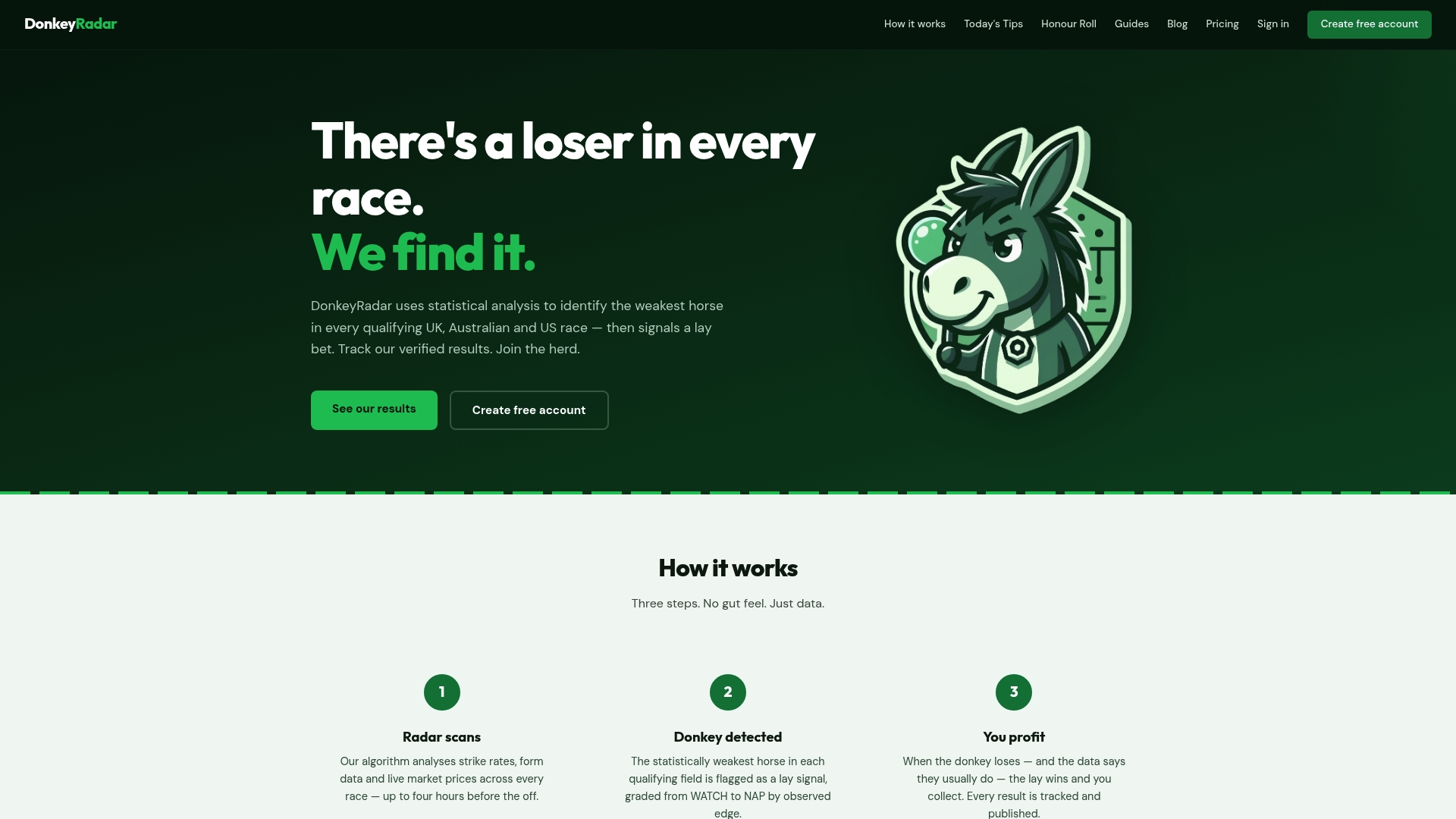
DonkeyRadar Free gives you daily lay signals at no published cost, so you can test the approach against your own bankroll rules before committing further. DonkeyRadar Pro, at £29 per month, adds real-time alerts by email and Telegram, full verified results history, staking tier guidance, and API access for anyone running their own trading software. Every signal goes live before the race, and every result stays public and checkable afterwards, which is the whole point of a transparent, data-driven Betfair lay strategy rather than a tipping service you have to trust blindly.
None of this guarantees returns. A high historic strike rate doesn’t remove variance from any individual race, and liability discipline remains entirely on you. What it does give you is a consistent, evidenced starting point instead of a guess. If you want to see how the signals work before staking anything, the DonkeyRadar dashboard is the place to start, and profits from UK betting remain tax-free regardless of which tier you use.
Sources
- The practical guide to profit from laying in horse racing
- Gambler’s ruin (probability primer)
- BeGambleAware
- GamCare
- Favourite long shot bias (and how to profit from it!)
FAQ
Is laying the field profitable?
Laying the field (laying multiple runners in a race) can be profitable if liability is capped and selections target genuine weaknesses rather than every outsider indiscriminately. Without strict staking, the combined liability across several lays multiplies your exposure to a single shock winner.
How often do longshots actually win?
Longshots win far less often than their backers expect, which is exactly what drives the favourite–longshot bias. Even so, they win often enough that laying without a liability cap remains genuinely risky over time.
What is the 80/20 rule in horse racing?
There’s no single agreed definition of an “80/20 rule” specific to horse racing, and claims of a fixed ratio should be treated cautiously. The more useful principle from this article is that a small number of poor-quality runners account for a large share of profitable lay opportunities, if you filter for genuine weakness rather than price alone.
Can you make money laying bets?
Yes, disciplined bettors can profit from laying by combining the favourite–longshot bias with strict fixed-liability staking and pre-race checks on form, ground, and market movement.