← Blog · 📝 Article · 14 September 2026
Under 200 ms Real Time Betting Alerts for In Play Bettors
Real-time betting alerts flag odds moves, line shifts, and live-stat triggers the moment they happen, so you can act before a bookmaker or exchange price corrects. Their main advantage over checking apps manually is speed: a well-built alert system reaches you in seconds, not the minutes it takes to refresh a screen. Choose a service built on low-latency data with filters you control, delivered to a channel you check constantly, and pair it with a fixed staking rule. Speed without discipline just moves your losses faster.
TL;DR:
- Speed of alerts is crucial, with direct data feeds under 200 milliseconds supporting time-sensitive betting, especially in esports and live sports markets.
- Precise trigger filters including percentage drift, fixed odds, and live stats reduce irrelevant alerts and focus your actions on genuine market movements.
- Alerts delivered through instant channels like Telegram or app push notifications are essential for acting swiftly during in-play betting, unlike slower email or SMS options.
- Validating alert prices against live market data immediately and sticking to fixed staking rules can prevent costly mistakes under time pressure.
- High alert volume can erode discipline and profits; setting daily limits and controlling betting activity ensures risk remains manageable.
Table of Contents
- What are real-time betting alerts, and how do pre-match and in-play alerts differ?
- How do real-time betting alerts actually work?
- What triggers and filters can you set for smarter alerts?
- Which delivery channels get alerts to you fastest?
- How do you turn an alert into a placed bet without costly mistakes?
- How do you manage risk when alerts fire constantly?
- How does DonkeyRadar generate and verify its alerts?
- Are your alerts secure, and who can see your betting activity?
- Do alerts work with the platforms and automation tools you already use?
- When are paid alerts worth it, and when should you just track odds yourself?
- How DonkeyRadar puts these principles into practice
- Primary sources and further reading
- Sources
- FAQ
What are real-time betting alerts, and how do pre-match and in-play alerts differ?
A betting alert is a notification triggered when a market meets a condition you set in advance. That condition might be an odds threshold, a percentage drift from an opening price, or a live-stat event like a red card or a break of serve. The alert fires, you check the market, you decide. What separates a genuinely useful alert service from noise is how tightly you can define that trigger.
Pre-match alerts and in-play alerts do different jobs, and mixing them up is where a lot of bettors go wrong.
- Pre-match alerts track how a price moves in the hours or days before an event starts, useful for spotting steam moves or mispriced markets before liquidity firms up.
- In-play alerts fire during the event itself, when stat triggers or momentum shifts cause exchange prices to move faster than a bookmaker’s odds compiler can react.
- Market coverage matters as much as speed. A service that only watches match odds misses the micro-markets, like next-goal or total-games, where mispricing tends to persist longest.
In horse racing specifically, pre-match alerts dominate because the bulk of price movement happens before the stalls open. In football and tennis, in-play alerts carry more weight, since scorelines and momentum change the picture minute by minute.
How do real-time betting alerts actually work?
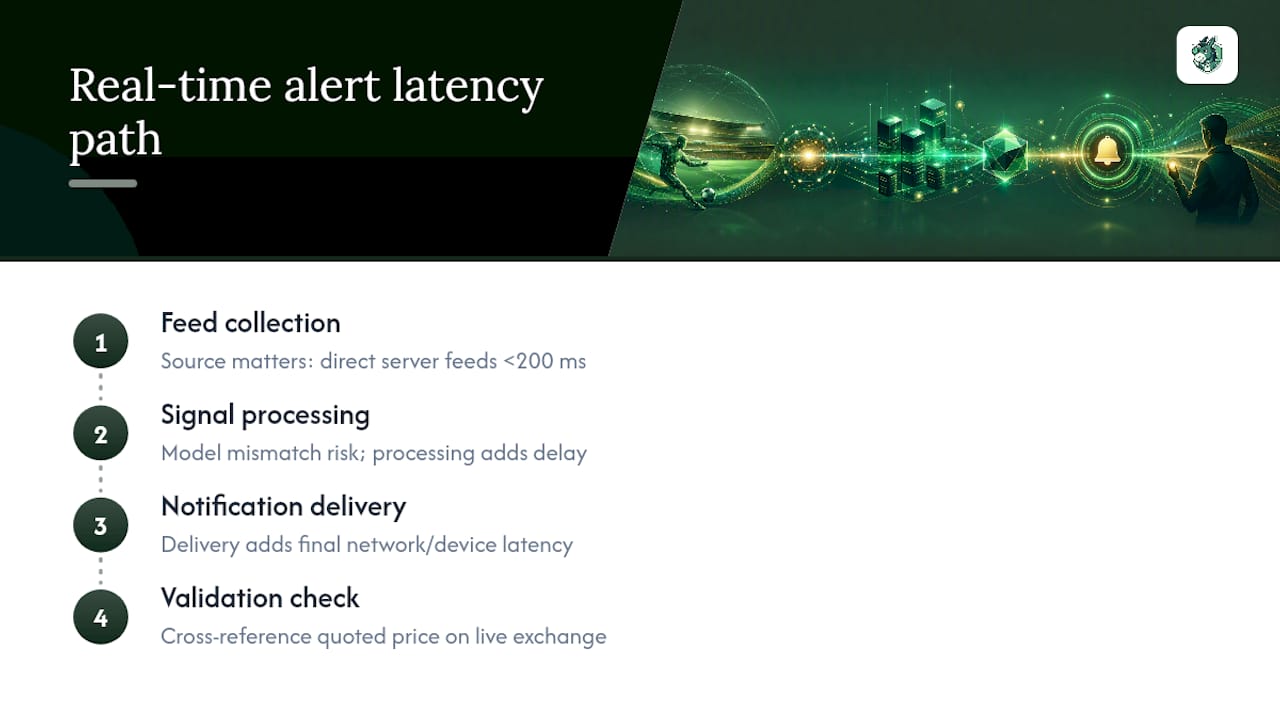
Every alert traces back to a data feed, and the feed’s origin determines how trustworthy the signal is. Some services pull directly from bookmaker odds APIs, others from exchange order books like Betfair, and some blend both with third-party aggregators that scrape multiple sources at once. Direct server telemetry, where available, tends to beat scraped data because it skips a layer of processing.
Latency creeps in at three points: feed collection, signal processing, and notification delivery. Each stage adds delay, and in-play betting has almost no tolerance for it.
Statistic: In esports betting, direct server feeds running under 200 milliseconds of latency now support micro-market pricing that slower feeds simply cannot match, and the majority of esports wagers happen live rather than pre-match. The same principle applies to any live sport: the faster the underlying feed, the narrower the window where an alert stays genuinely actionable.
Two failure modes catch bettors out repeatedly. A stale feed shows you a price that has already moved on the exchange, meaning you act on information that is technically already wrong. A model mismatch happens when the alert’s trigger logic doesn’t reflect real market behaviour, firing on noise rather than genuine value. A simple check for either: cross-reference the alert’s quoted price against the live exchange screen the moment it lands. If they don’t match, the feed is lagging.
What triggers and filters can you set for smarter alerts?
Vague alerts flood your phone with irrelevant pings. Specific triggers cut that volume down to moves worth acting on. Alert tools typically let you set numeric thresholds and time windows so a notification only fires when a market matches an exact, pre-defined condition, rather than every minor fluctuation.
- Percentage drift flags a market when its price moves by a set percentage from where you first tracked it, useful for catching steam moves without reacting to normal drift.
- Absolute odds thresholds trigger when a price crosses a fixed number, handy for bettors who only want to know when a specific horse or team hits, say, 3.0 or shorter.
- Implied probability thresholds convert odds into a percentage chance and alert you when the market’s implied view shifts past a level you’ve defined.
- Live-stat checks tie the alert to an event, like a sending-off, a break of serve, or a key injury substitution.
- Time-window filters restrict alerts to a set number of minutes elapsed, which matters because a price move at minute 10 means something different from the same move at minute 80.
Combining filters with AND/OR logic sharpens things further.
Which delivery channels get alerts to you fastest?
The channel matters almost as much as the trigger itself. A perfectly timed signal that sits unread in an email inbox for twenty minutes is worthless for in-play betting.
- Telegram and push notifications deliver near-instantly and work well for in-play alerts where every second counts.
- Email suits pre-match alerts or record-keeping, where a permanent, searchable log matters more than speed.
- SMS carries a real cost per message for providers and can lag behind app-based push depending on network conditions, so it rarely makes sense as your primary in-play channel.
- API access and direct exchange-linked bet URLs cut out the step of searching for the market yourself, taking you straight from alert to bet slip.
Many professional bettors run third-party alert tools alongside their sportsbook or exchange app precisely because native apps prioritise a clean interface over the granular, high-frequency notifications a serious strategy needs.
Pro Tip: Turn off battery-optimisation settings for your alert app on Android, and disable “Focus Mode” restrictions on iOS during racing or match hours. A signal delayed by your phone’s power-saving settings defeats the entire point of real-time delivery.
How do you turn an alert into a placed bet without costly mistakes?
An alert is only the first step. What you do in the next thirty seconds decides whether it makes you money or costs you.
- Validate the alert immediately. Compare the quoted price against the live exchange screen, check market liquidity is deep enough to match your stake, and glance at match context (weather, team news, going) for anything the alert can’t see.
- Apply a fixed staking rule before you click. Exchange bettors laying a runner need to check their liability, not just their stake, since a lay bet’s downside scales with the odds. A lay betting calculator removes the mental arithmetic under time pressure.
- Log every alert-driven bet. Note the odds at alert time, the odds you actually got, and the outcome. Reviewing that log weekly tells you which filters are earning their keep and which are just generating noise.
Pro Tip: Keep a simple spreadsheet column for “seconds between alert and bet placed”. If that number keeps climbing past 30 to 40 seconds, your delivery channel or validation process is the bottleneck, not the alert service itself.
How do you manage risk when alerts fire constantly?
More alerts do not mean more profit. Left unchecked, high alert volume nudges you toward overtrading, which erodes discipline faster than any single bad price.
- Set a hard daily cap on how many alert-driven bets you’ll place, regardless of how many signals arrive.
- Fix your stake or liability limit in advance and stick to it, even when an alert looks unusually strong.
- Build in a pause rule: if you’ve hit three losing alert-bets in a row, stop for the session rather than chasing.
- Check that your alert activity stays within the terms of your bookmaker or exchange account, since some operators restrict automated or high-frequency wagering.
- Watch liquidity on the markets you’re betting into. A signal is worthless if the exchange can’t match your size at the quoted price.
If live-alert-driven betting starts to feel compulsive or the volume becomes hard to control, GambleAware provides recognised, practical guidance and support for managing that risk.
How does DonkeyRadar generate and verify its alerts?
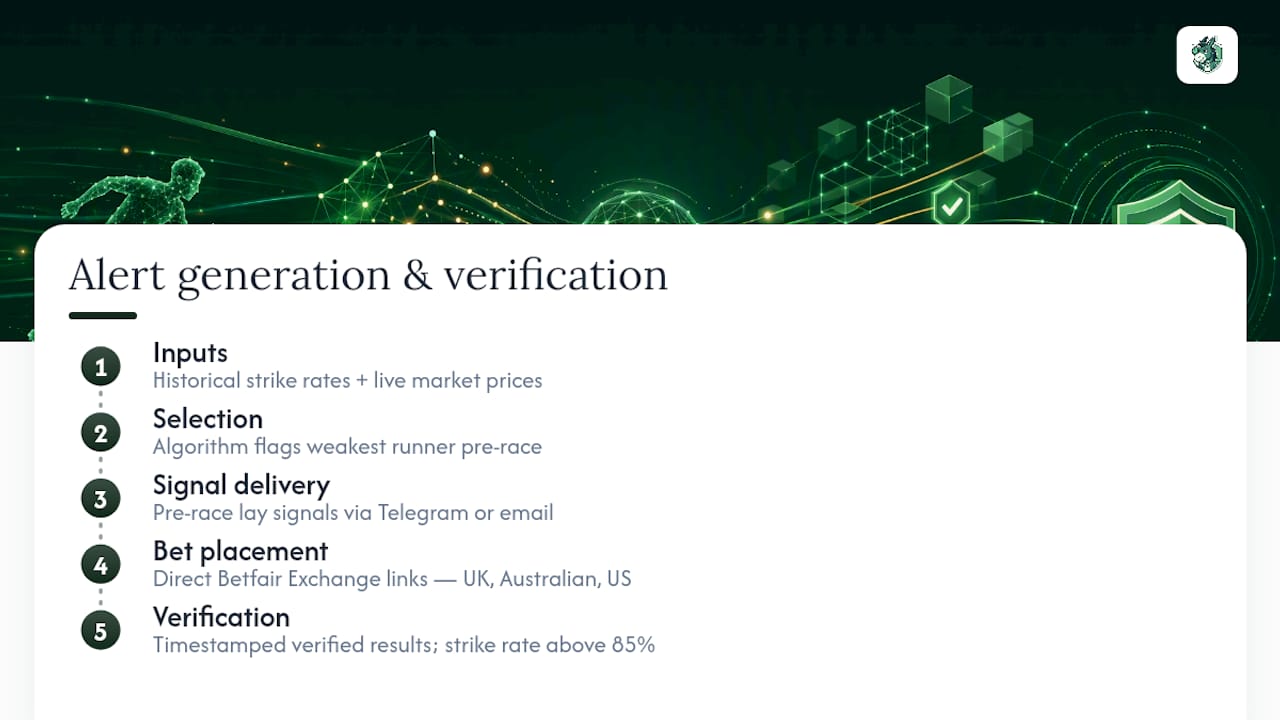
DonkeyRadar’s algorithm processes historical strike rates and live market prices to flag the weakest runner in a race, generating lay signals before the race starts rather than reacting after the fact. The platform publishes a verified results history with a strike rate above 85%, so you can check performance against real, timestamped outcomes rather than a marketing claim. Signals reach you by Telegram or email, and direct Betfair Exchange links cut the step between notification and bet slip for UK, Australian, and US races.
Are your alerts secure, and who can see your betting activity?
Alert services typically need access to your notification preferences and, if you’re using API integration, a level of connection to your exchange account. That makes a few checks worth doing before you sign up for anything.
Look for two-factor authentication on the alert provider’s own login, since that account often sits connected to your betting activity even if it never touches your funds directly. Check whether the service stores your exchange API keys with read-only permissions or whether it can place bets on your behalf. Read-only access is safer by default, because it limits what happens if the alert provider’s own systems are ever compromised.
Telegram delivery raises a specific question: alerts sent through a bot are visible to anyone with access to that chat, so avoid running alert bots in shared or public groups if the signals carry real commercial value. Email delivery, by contrast, sits behind whatever security your own inbox provider offers, which for most major email services now includes two-factor login as standard.
Data privacy matters too. A provider that publishes results transparently, as DonkeyRadar does, gives you a way to judge performance without needing to hand over more account access than necessary. Before connecting any third-party tool to a betting or exchange account, check exactly what permissions it requests and decline anything beyond what the service genuinely needs to function.
Do alerts work with the platforms and automation tools you already use?
Compatibility comes down to two things: whether the alert service links directly to your exchange or bookmaker, and whether it exposes an API for automation software.
Exchange-linked alerts, the kind DonkeyRadar provides through direct Betfair Exchange links, take you from notification straight to a pre-filled bet slip rather than leaving you to search the market manually. That matters most in-play, where a Betfair in-play delay can already cost you several seconds against a fast-moving price. API access extends this further, letting the same signals feed into third-party trading software or your own automated staking rules rather than requiring a manual click every time.
Not every alert provider offers both. Some are Telegram-only, with no API, which suits a bettor who wants a manual decision point before every bet. Others are built API-first for users running semi-automated staking through third-party trading terminals. Neither approach is wrong, but the choice should match how you actually bet: manual and considered, or systematic and rules-based.
When are paid alerts worth it, and when should you just track odds yourself?
High-volume, time-sensitive bettors gain the most from paid alerts. Casual punters often do fine tracking odds manually. Run any trial with a fixed bankroll and a strict staking rule, and judge it on logged hit rate, not gut feel, before committing further.
— Donkey
How DonkeyRadar puts these principles into practice
Everything covered above, low-latency delivery, tight custom filters, and direct exchange links, is what DonkeyRadar builds into every signal. Its algorithm processes historical strike rates and live market prices to flag the weakest runner in UK, Australian, and US races, with signals published before races start and results tracked publicly afterwards.
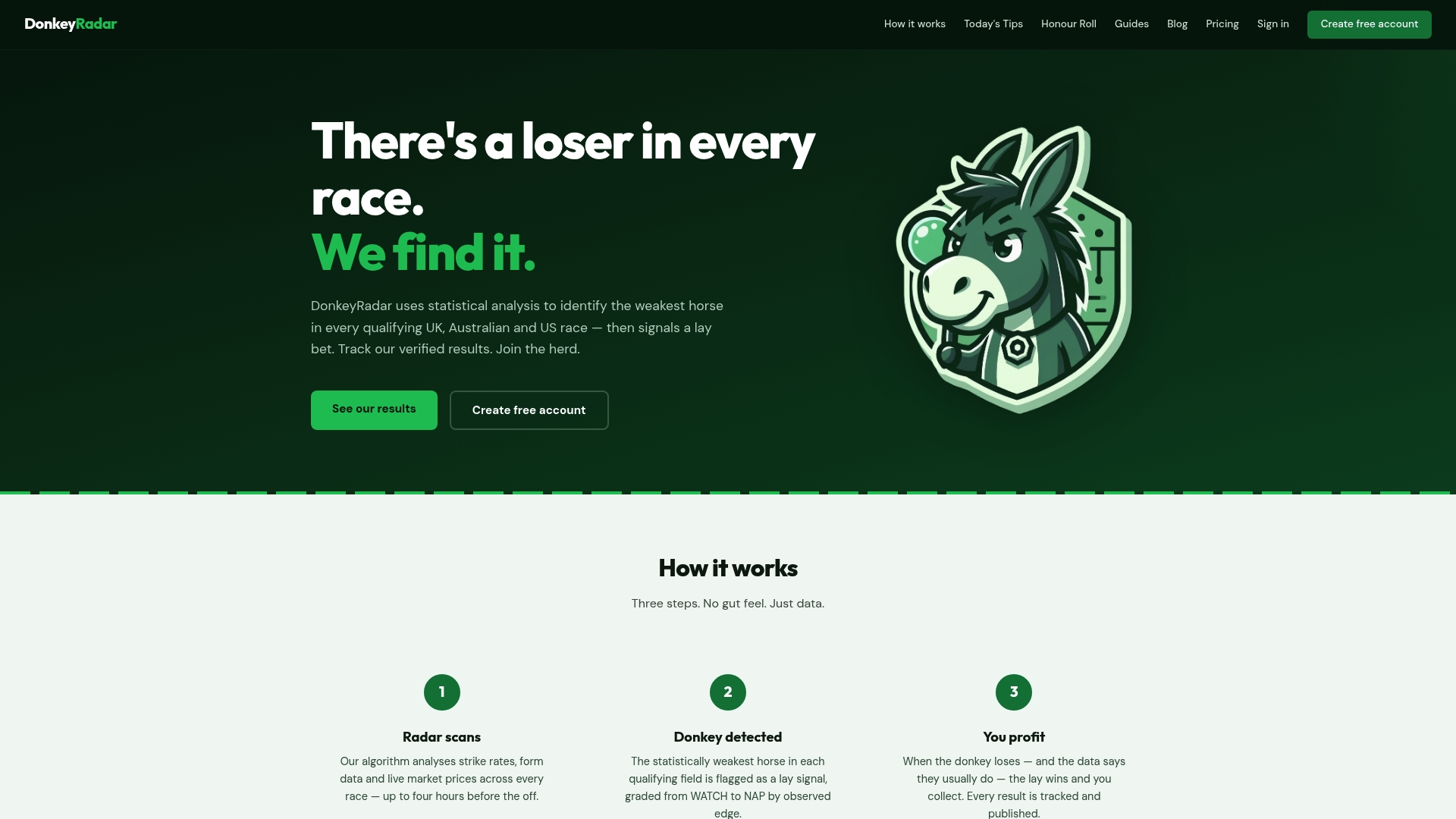
Delivery runs through Telegram or email, so signals reach you the moment they’re generated rather than sitting buried in an app. Every alert links directly to the relevant market on Betfair Exchange, cutting the gap between notification and bet slip that costs slower bettors their edge. Staking tier grading helps you match position size to signal strength instead of guessing, and profits from betting in the UK remain tax-free, which sharpens the appeal of a disciplined lay strategy.
If the workflow described in this guide, validate, stake, log, review, sounds like how you want to bet, read the Betfair lay betting strategy guide and start a seven-day trial to see the signals against your own bankroll rules.
Primary sources and further reading
For deeper reading on the topics covered here: Fox Sports on top sportsbook apps covers why professional bettors supplement native apps with third-party alerts; esports.net on GRID Odds explains low-latency data feeds; and GambleAware offers safer-gambling guidance for anyone whose alert-driven activity needs a check.
Sources
- Best sports betting apps | Fox Sports
- GRID just cut out the middleman to price esports bets straight from the server with GRID Odds
- GambleAware
FAQ
Is there an AI that can predict sports betting outcomes?
No tool reliably predicts outcomes with certainty. Statistical models, including DonkeyRadar’s algorithm, identify probability edges from historical and live data, which is different from prediction and still carries risk.
What is the best betting tracker app for logging alert-driven bets?
The best tracker is whichever one you’ll actually update consistently, whether that’s a dedicated app or a simple spreadsheet logging odds at alert time, odds achieved, and outcome for every bet.
What is the 80/20 rule in horse racing betting?
It’s a rough heuristic suggesting a small share of runners or signals account for most of your profitable opportunities, which is why tight, specific alert filters tend to outperform broad ones that flag every market move.
Are real-time betting alerts legal to use alongside my bookmaker or exchange account?
Using a third-party alert service is generally fine, but automated betting or bot-driven staking may breach some bookmaker terms, so check your provider’s rules before connecting any API-linked tool.
How fast do real-time betting alerts need to be to matter?
For in-play markets, delivery within a few seconds of the trigger event is the practical standard; anything slower risks the price having already moved by the time you act.