← Blog · 📝 Article · 11 October 2026
AI Horse Racing Tips: UK Lay Signals Need Proof Before the Race

In this article, AI horse racing tips mean algorithmic lay signals: alerts generated by statistical models that flag which horse is likely to lose, so you can lay it on a betting exchange. Used well, these signals are practical and actionable, provided they are published before the race and tracked afterwards so you can check them. We built DonkeyRadar to deliver exactly that: data-driven lay signals you can verify against a public results history.
TL;DR:
- Before placing a lay, check matched liquidity and current odds; thin markets can leave orders partially filled, while price drift may erase the signal’s edge.
- Set a fixed liability per race, size stakes to current odds, and cap losses in advance; at odds of 5.0, a £10 stake risks £40.
- Betfair charges commission on net winnings across a market, not each bet, so multiple positions in one race may reduce commission drag.
- Every signal should be timestamped before the race, with wins, losses, and voids retained in a public results history for auditing.
- Set deposit and stake limits through the exchange before following signals, and use its cooling off tools if your betting pattern begins to rise.
Table of Contents
- How AI and machine learning create lay signals from exchange data
- Which market patterns lay signals exploit and why that matters
- Step-by-step: receive, verify and place a pre-race lay signal on an exchange
- Staking rules, commission and liability management for lay bettors
- Regulatory pointers and safer-gambling steps for exchange users
- What laying a horse means on an exchange and how liability and profit are calculated
- Signal transparency and verification: publish-before-race, tracked results
- How our algorithmic approach differs from typical AI racing tips
- How live market prices shift signals before the off
- Best practices for integrating AI lay tips into a betting strategy
- Common pitfalls and how AI systems guard against bias
- Why verified, pre-race lay signals matter more than any single pick
- How to try DonkeyRadar Free or upgrade to Pro
- FAQ
- Sources
How AI and machine learning create lay signals from exchange data
A lay signal is only as good as what feeds it. Our models draw on several layers of data before producing a recommendation:
- Current ladder prices and how they have moved in the hours and minutes before the off
- Available lay liquidity at each price point on the exchange
- Traded volume, which shows how much money has actually backed a view rather than just sat on the书 order book
- Historical form, finishing positions and class changes for each runner
- Trainer and jockey statistics, including recent strike rates at the track or distance
Gradient boosting models handle this kind of structured, tabular data well because they can weigh dozens of variables (form, price drift, liquidity) without assuming a simple linear relationship between them. For the order book itself, attention-based architectures are useful because they can track how prices and volumes shift relative to each other across the whole race card, not just for one horse in isolation.
None of this matters if a signal is only verified with hindsight. We timestamp every signal at the moment it is generated and publish it before the race starts, which rules out look-ahead bias: the trap where a system appears accurate only because it was built or checked using information that would not have been available at the time. For a closer technical breakdown of the inputs we use, see our guide to horse racing data models.
Which market patterns lay signals exploit and why that matters
Lay strategies work because exchange markets are not perfectly efficient. The best-documented pattern is the favourite–longshot bias: bettors systematically overbet long-priced outsiders and underbet favourites, a pattern confirmed across large samples of races and generally put down to bettors misjudging genuine probability rather than pricing it accurately.
AI-based automated betting systems combining market depth with pre-live data can identify exploitable price movements that static, manual handicapping tends to miss, according to research on automated betting and market-depth analysis. That matters for lay bettors specifically, because a horse sitting at a short price on thin lay liquidity is often more exposed to a correction than its odds suggest, and that is precisely the kind of mispricing a model built on order-book depth is designed to flag. You can see how this plays out in practice in our piece on spotting false favourites.
Step-by-step: receive, verify and place a pre-race lay signal on an exchange
A signal is a starting point, not an instruction to click blindly. Work through it in order:
- Read the selection and staking tier. Each alert names the horse to lay, a suggested liability or stake tier, and a recommended price range and timing window.
- Check liquidity before you touch anything. Look at the matched size available at your target lay price; thin liquidity means you may only get partially matched or have to accept a worse price.
- Watch for recent price drift. If a horse has already drifted out significantly since the signal was generated, the edge may have already been priced in by the market.
- Place the lay, splitting liability if needed. On larger stakes, laddering your lay across two or three price points often gets a better average price than one large order at the current best price.
- Confirm your liability, not just your stake. The amount at risk on a lay bet is your liability, which is usually larger than the stake itself, so check it before confirming.
Our own step-by-step Betfair lay guide walks through the exchange interface itself. A lay betting calculator, mobile alerts via Telegram or e-mail, and API access for trading software all help you act on signals quickly rather than hunting for the right screen manually.
Pro Tip: Set a price alert a few minutes before the suggested window closes, since the best lay price can move fast in the final run-up to the off.
Staking rules, commission and liability management for lay bettors
Lay betting inverts the usual stake-and-return relationship: your liability, not your stake, is what you risk. Say you lay a horse at odds of 5.0 with a £10 stake; your liability if it wins is £40 (stake × (odds−1)). If it loses, as expected, you win your £10 stake minus commission.
That commission detail matters more than many bettors assume. Betfair charges commission on your net winnings across a market, not on each individual bet, so holding several lay positions in the same race can reduce your overall commission drag compared with treating each bet in isolation.
Workable staking rules for lay bettors:
- Use fixed-liability staking: decide a maximum liability per race, then size your stake to fit the current odds rather than staking a flat amount regardless of price.
- Tier your stakes by signal strength rather than betting the same amount on every alert.
- Cap your loss per lay at a level you have set in advance, and review your results weekly rather than reacting to single outcomes.
Our breakdown of fixed-liability staking under exchange rules covers worked examples in more depth.
Regulatory pointers and safer-gambling steps for exchange users
A betting exchange is an intermediary matching backers and layers, and a lay signal service sits alongside that as an information provider rather than the bookmaker itself. Operators are expected to help you manage risk directly. Under RTS 12 guidance from the Gambling Commission, operators must give customers facilities to set financial limits and prompts to use them.
In practice, that means:
- Set deposit and stake limits on your exchange account before you start following any signal service.
- Use the operator’s own limit-setting and cooling-off tools rather than relying on memory or willpower.
- Review your activity regularly and take a break if your pattern of staking starts drifting upward.
What laying a horse means on an exchange and how liability and profit are calculated
Laying a horse means betting that it will not win. Instead of backing a runner to finish first, you take the other side of that bet, acting as the bookmaker for that single selection. As Betfair defines it, a lay bet means offering odds on an outcome not happening, with the layer accepting liability if it does happen.
Your liability is the amount you stand to pay out if the horse wins, and it depends on both your stake and the odds: liability equals stake multiplied by (odds minus one). Lay a horse at 4.0 with a £20 stake and your liability is £60. Your profit if the horse loses, which is the outcome you want, is your £20 stake, minus the exchange’s commission on that winning position.
Displayed lay prices also show the matched size available at each point on the ladder, which tells you how much liability other layers are currently willing to accept at that price. Thin liquidity near your target price can mean you only get partially matched, or have to accept a slightly worse price to fill your full stake. Our plain-language primer on lay betting covers the mechanics with more worked examples for anyone new to the format.
Signal transparency and verification: publish-before-race, tracked results
A lay signal is only useful if you can check whether it actually worked, and whether it was genuinely available before the race rather than assembled afterwards to look accurate. Every signal we issue carries a timestamp and is published ahead of the race it concerns, which means there is no scope to adjust a pick with the benefit of hindsight.
Results are then tracked publicly and kept available on an ongoing basis, win, lose or void, rather than curated after the fact. We report a strong strike rate across our tracked history, which we publish so it can be checked against the record rather than taken on trust. Our verified lay tips results page carries the full history for anyone who wants to audit it race by race.

This kind of verification matters more in lay betting than in ordinary tipping, because a lay signal that only looks good in a curated highlight reel tells you nothing about how it performs on an average Tuesday card. A full, continuously updated results log is the only honest way to judge a system over time.
How our algorithmic approach differs from typical AI racing tips
Most AI-branded racing tip services are built to predict winners: they rank runners by probability of finishing first and present a shortlist of fancied horses. Our approach runs in the opposite direction. We train specifically to identify the weakest runner in a race, the one statistically least likely to win, rather than the strongest.
That distinction changes what the underlying model actually needs to get right. A winner-picking model has to separate a small number of live contenders from each other, often a difficult task in a competitive field. A model built to flag weak runners has an easier statistical target: identifying horses whose form, class or market support clearly mark them as unlikely winners, which tends to produce a more consistent signal across different field sizes and race types.
The other practical difference is what happens to a signal once it is generated. Rather than delivering a static list of picks, our signals plug into a dashboard with direct exchange links, staking tier guidance, and real-time alerts by e-mail or Telegram, alongside API access for anyone running their own trading software. The goal is a signal you can act on inside your existing exchange workflow, not a tip sheet you have to interpret and translate manually.

How live market prices shift signals before the off
A signal generated hours before a race is not fixed. Prices on the exchange move constantly as money enters the market, and those movements carry information: a horse drifting steadily outwards is attracting lay support or losing backing, while one shortening sharply is attracting money that may reflect inside knowledge or simply a shift in public opinion.
Our models treat the live price as a continuously updated input rather than a one-off reading taken at signal generation. As the market moves in the run-up to a race, the same statistical framework reassesses the gap between a runner’s modelled probability and its current market price, which can confirm an original signal, strengthen it, or in some cases withdraw it if the market has moved to erase the original edge.
This is also why timing matters when you act on a signal. A suggested price range reflects conditions at the point of publication, and checking the current ladder before you lay, rather than acting purely on the original alert, keeps you aligned with where the market actually sits at the moment you place your bet.
Best practices for integrating AI lay tips into a betting strategy
Treat algorithmic signals as one input into a wider approach rather than a complete strategy on their own. A few habits make the difference between following signals productively and following them carelessly:
- Cross-check every signal against current liquidity and price before placing it, since conditions can shift between publication and the off.
- Size your stake by signal tier and your own bankroll rules, not by how confident a single alert feels.
- Keep a simple log of your own results alongside the published verified history, so you can see how the signals perform against your specific staking pattern.
- Treat commission as part of your return calculation from the outset, not an afterthought once a bet has settled.
Combining signals with a data-driven lay betting strategy and a consistent staking plan tends to produce steadier results than treating each race as an isolated decision.
Common pitfalls and how AI systems guard against bias
The most common mistake in lay betting is chasing losses by increasing stake size after a losing run, which turns a statistically sound long-run edge into an emotionally driven gamble. A second common error is ignoring liquidity: laying into a thin market can mean accepting a worse price than the signal assumed, eroding the edge before the race even starts.
Survivorship bias is a subtler trap: a tipping service that only shows its wins looks far stronger than one that publishes everything. That is precisely why we publish every signal before the race and keep the full results history public and continuously updated, win and lose alike, so the real strike rate is always checkable rather than curated.
Recency bias affects bettors too: a short losing streak can feel like proof a system has stopped working, even when the underlying statistical edge is intact over a larger sample. Judging a lay signal service over single races or even single days, rather than a tracked sample across weeks, is one of the quickest ways to draw the wrong conclusion from a sound approach.
Why verified, pre-race lay signals matter more than any single pick
I built DonkeyRadar around one principle: a lay signal is only trustworthy if you can check it against reality. Every alert we issue is timestamped and published before the race, and the full results history, tracked and verified, stays public rather than curated after the fact.
Publishing first and verifying afterwards closes off the main way tipping services mislead people: quietly dropping the losers from the record. It also means the tail risk of following a system blindly is lower, because the pattern of results is there to check at any time, not just the highlights. Build a routine around the verified results history and a lay betting calculator, and you are working from evidence rather than a sales pitch.
— Donkey
How to try DonkeyRadar Free or upgrade to Pro
Getting started costs nothing. DonkeyRadar Free gives you daily lay betting signals, so you can see how the approach works before committing to anything further. DonkeyRadar Pro, at £29 per month, adds real-time alerts by e-mail and Telegram, full access to the tracked results history, and API access for anyone running their own trading software.
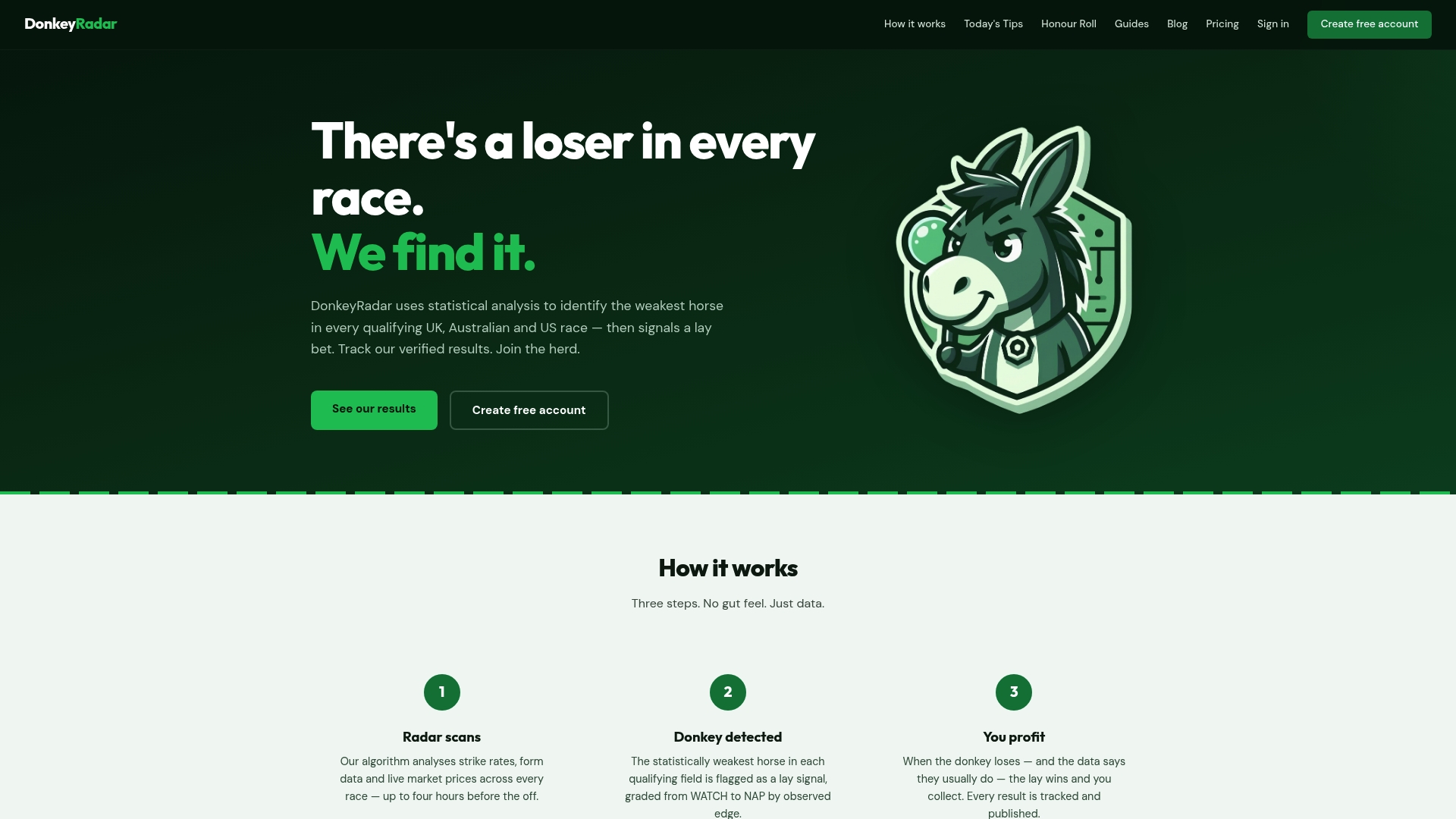
Sign up through the DonkeyRadar homepage to start on the free tier, and work through our lay betting tips and rules alongside the liability and profit calculator to get your staking approach sorted before your first signal arrives.
FAQ
What does “AI horse racing tips” mean in this context?
Here, it refers to AI-generated lay signals: algorithmic alerts that flag which horse is statistically likely to lose, so you can lay it on an exchange. It is distinct from AI tips that predict winners to back.
How accurate are AI-powered lay betting signals?
Accuracy varies by provider and depends on whether results are published before races and tracked transparently afterwards.
Does commission affect lay betting profit?
Yes. Exchange commission is charged on your net winnings across a market rather than on each individual bet, which can reduce the effective cost of holding several related positions in the same race.
Is lay betting legal and regulated in the same way as normal betting?
Lay betting through a licensed exchange operates within standard gambling regulation, and operators must offer tools to set financial limits under Gambling Commission guidance. A tip or signal service itself is an information provider, not the regulated exchange.
How much does DonkeyRadar cost?
DonkeyRadar Free carries no published price and gives daily signals, while DonkeyRadar Pro costs £29 per month and adds real-time alerts, full results history, and API access, available through DonkeyRadar.
Sources
The quality of a lay signal depends heavily on the breadth and depth of data feeding the model that produces it. The core inputs tend to fall into a few groups: exchange market data (ladder prices, matched volume, liquidity at each price point), historical race results (finishing position, margins, sectional times where available), and context data (going, distance, class, weight carried).
Form and connections data adds another layer: a horse’s recent finishing pattern, how it has performed for its current trainer, and jockey strike rates at the specific track or distance all shift the probability a model assigns to a runner. None of these signals is decisive alone, which is why combining them statistically, rather than reading them individually, tends to surface patterns a human eye would miss.
Market data carries particular weight in a lay-focused model, because the exchange price itself reflects the aggregated view of everyone currently betting that race. A model that treats the live price purely as one more input, rather than the final word, can catch cases where the crowd has mispriced a runner relative to its underlying form and conditions. We go through this in more detail in our guide to horse racing data models for readers who want the fuller technical picture.
- Research on favourite–longshot bias
- Automated betting systems and market-depth analysis (thesis/report)
- Betfair charges and commission explanation
- RTS 12: Financial limits guidance - Gambling Commission