← Blog · 📝 Article · 6 September 2026
Exchange Layers: Hedging Lay Bets With Formulas, 3 Examples & Signals

Exchange Layers: Hedging Lay Bets With Formulas, 3 Examples & Signals
Yes, hedging a lay bet can lock in profit or cap your loss, but only if you get the sums right. The two practical routes are back-to-lay and lay-to-back, and both hinge on the same details: the exchange’s commission rate and the liability sitting against your account. Get either wrong and your “guaranteed” green book turns red.
TL;DR:
- Ensuring the correct hedge amount requires accurate input of your original stake, odds, current opposing odds, and the exchange’s commission rate.
- Cross-exchange hedging complicates calculations because each platform charges its own commission and settlement rules, increasing the risk of errors.
- Place hedges only when market liquidity supports full execution at the calculated price, and always verify your account can cover the maximum liability beforehand.
- Using automation tools like hedging calculators and limit orders helps manage fast-moving markets but requires careful attention to fill proportions and timing.
- Profits from hedged lay bets are tax-free for UK residents unless betting activity is deemed a trade, which is rare for recreational players.
Table of Contents
- What is hedging lay bets and how does it work on exchanges?
- Using a hedging calculator and worked examples you can reproduce
- Commission, liability and execution risks: a pre-execution checklist
- When to hedge: timing rules, decision criteria and sizing partial hedges
- Practical tools and quick workflows for executing a hedge
- Donkey’s data-driven perspective: how high-probability lay signals change hedging choices
- Tax implications of hedging lay bets
- Author perspective: risk discipline and record keeping for layers
- How Donkeyradar helps: signals, calculators and verified results
- Sources
What is hedging lay bets and how does it work on exchanges?
Hedging means taking an opposing position to the one you already hold, so the result is fixed whichever way the market or the race goes. On a betting exchange, that means either backing a runner you originally laid (lay-to-back), or laying a runner you originally backed (back-to-lay). Once both positions are matched, you have created what traders call a green book: a locked outcome, profit or loss, regardless of the result.
The mechanics are simple once you see the numbers. Say you laid a horse at odds of 5.0 for a £20 stake. Your liability was £80. If the price later drifts to 8.0, you can back it at that price to hedge out and guarantee a profit no matter what happens in the race. This is the same principle used in matched betting, where bettors balance back and lay positions to strip risk from bookmaker offers.
Two formulas do all the heavy lifting:
- Lay stake = (back stake × back odds) ÷ current lay odds — this is the core hedge calculation used across exchanges, as Smarkets explains in its hedging guide.
- Liability = (lay odds − 1) × lay stake — the amount that must sit in your account before the lay bet is accepted, according to BetfairSquare’s breakdown of exchange risk management.
Commission changes both sides of this equation. Most exchanges only charge commission on net winnings within a market, so you need to build that percentage into your calculation rather than bolt it on afterwards. Cross-exchange hedges (laying on one platform, backing on another) are trickier still, because each exchange charges its own commission independently and settles the bet under its own rules. A partial hedge, where you only cover part of your original stake, reduces your liability without fully cancelling your position. It leaves some upside on the table in exchange for reduced risk.
Using a hedging calculator and worked examples you can reproduce
A hedging calculator needs five inputs to do anything useful: original stake, original odds, current opposing odds, exchange commission, and matched proportion (how much of your original bet actually got filled). Feed those in and the calculator returns your hedge stake, your liability, and the profit or loss locked in on both outcomes.
Pro Tip: Always check the “matched proportion” field before trusting a calculator’s output. An unmatched partial bet skews every downstream number, and the tool has no way of knowing your stake wasn’t fully filled unless you tell it.
Here are three examples that show the maths in practice:
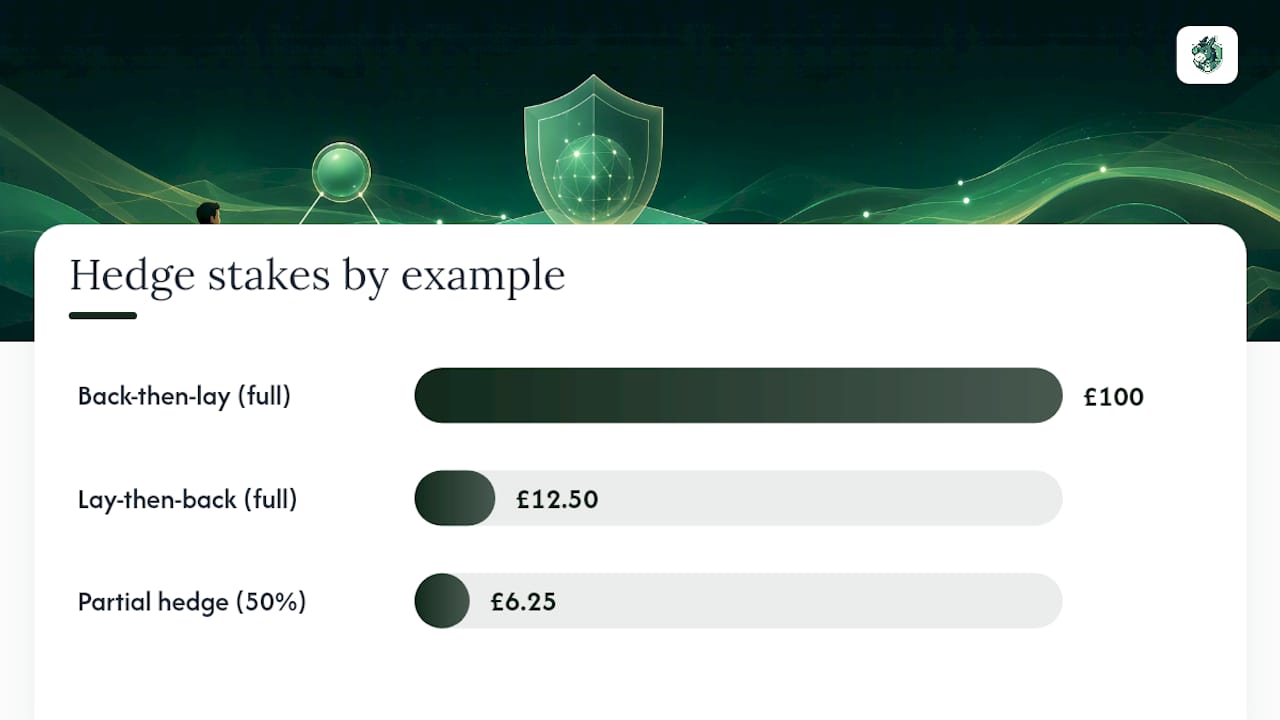
- Back then lay (full hedge). You back a horse for £50 at odds of 4.0. The price shortens to 2.0. Hedge stake = (£50 × 4.0) ÷ 2.0 = £100. Lay that £100 at 2.0 and you lock a profit of roughly £50 minus commission, whichever horse wins.
- Lay then back (lay-to-back). You lay a horse for £20 at odds of 5.0, giving a liability of £80. The price drifts to 8.0. Hedge stake = (£20 × 5.0) ÷ 8.0 = £12.50. Backing £12.50 at 8.0 locks a profit of around £7.50 before commission, regardless of the result.
- Partial hedge. Using the same lay-to-back scenario, you hedge only 50% of the position by backing £6.25 instead of £12.50. If the horse loses, you keep more of your original lay profit; if it wins, your loss is smaller than doing nothing, but larger than a full hedge.
Every one of these examples assumes the hedge bet gets fully matched and that both markets settle under compatible rules. When either assumption breaks, as GamblingCalc’s calculator guide notes, the green book on paper and the result in your account can diverge.
Commission, liability and execution risks: a pre-execution checklist
Commission is where most home calculations go wrong. Same-exchange hedges are usually the simplest case, since one commission rate applies across both legs of the trade within that market. Cross-exchange hedging means applying two separate commission rates to two separate settlement systems, which changes your break-even price on each side.
Liability is the other figure that catches people out. It must be sitting in your account balance before the lay bet is accepted, calculated as (lay odds − 1) × lay stake. If you’re hedging across multiple runners or multiple markets, your exchange balance needs to cover the largest simultaneous liability, not just the average.
Before you place a hedge, run through this:
- Check market liquidity at the price you need. A calculator can produce a perfect hedge stake that simply isn’t available to match.
- Use a limit order rather than a market order when the price is moving quickly, so you don’t chase a worse price than your calculation assumed.
- Confirm your account balance covers the liability with room to spare.
- If liquidity is thin, reduce your intended hedge size rather than force a partial match at a poor price.
Unmatched stakes are the single most common cause of a hedge failing to lock what it promised. A full liability primer is worth reading before you rely on liability figures under time pressure. Market suspensions (common in-running when a horse falls or a stewards’ enquiry is called) and differing settlement rules between exchanges can also strand one leg of your hedge while the other settles, turning a calculated green book into an unplanned loss.
When to hedge: timing rules, decision criteria and sizing partial hedges
The decision rule is straightforward: hedge when the after-commission green book is positive and you’d rather have certainty than upside, or hedge partially when you want to lock some of that profit while still leaving room to win more.
Three timing cues tend to trigger a hedge:
- In-play swings. A goal, a fall, or a big price move mid-event often creates a short window where hedging locks a profit that wasn’t there pre-match.
- Pre-event price crushes. When a price shortens sharply in the hours before an event, often on team news or market information, hedging captures that move before it potentially reverses.
- Liquidity-driven exits. Sometimes the smartest reason to hedge isn’t the price at all. It’s that liquidity is drying up and you may not get matched later.
Sizing is the real skill here. A full hedge removes all risk and all upside. A percentage hedge, laying or backing only part of your position, keeps some exposure to the outcome while banking a portion of profit. Staged hedges go further still: greening up gradually as the price continues to move in your favour, a technique BetfairSquare’s risk management analysis describes as useful for reducing timing and matching risk in fast-moving in-play markets.
Practical tools and quick workflows for executing a hedge
A dedicated hedging calculator beats mental maths every time odds are moving. Most exchanges also offer a built-in “trade out” or cash-out button, plus standalone liability calculators and one-click trading tools favoured by more active traders.
The workflow that keeps you out of trouble:
- Check how much of your original bet is actually matched.
- Compute the required hedge stake using the formula above.
- Confirm the commission rate that applies to this market.
- Place a limit order at your calculated price, or a market order if speed matters more than precision.
- Verify the hedge bet has matched in full.
- Record the trade, including both legs and the commission paid.
Re-check liquidity and settlement rules one final time before you consider the position closed.
Donkey’s data-driven perspective: how high-probability lay signals change hedging choices
Lay signals can be built from historical strike rates and live market prices, with signals published before races and results tracked publicly for verification. Signals may be organised in staking tiers, with paid users receiving real-time alerts and API access for trading software.
A high strike-rate signal shifts the hedging threshold. If a lay has performed strongly across a large sample, holding it to full settlement can make more sense than locking a smaller hedged profit early, provided your liability stays within your own risk limits.
Tax implications of hedging lay bets
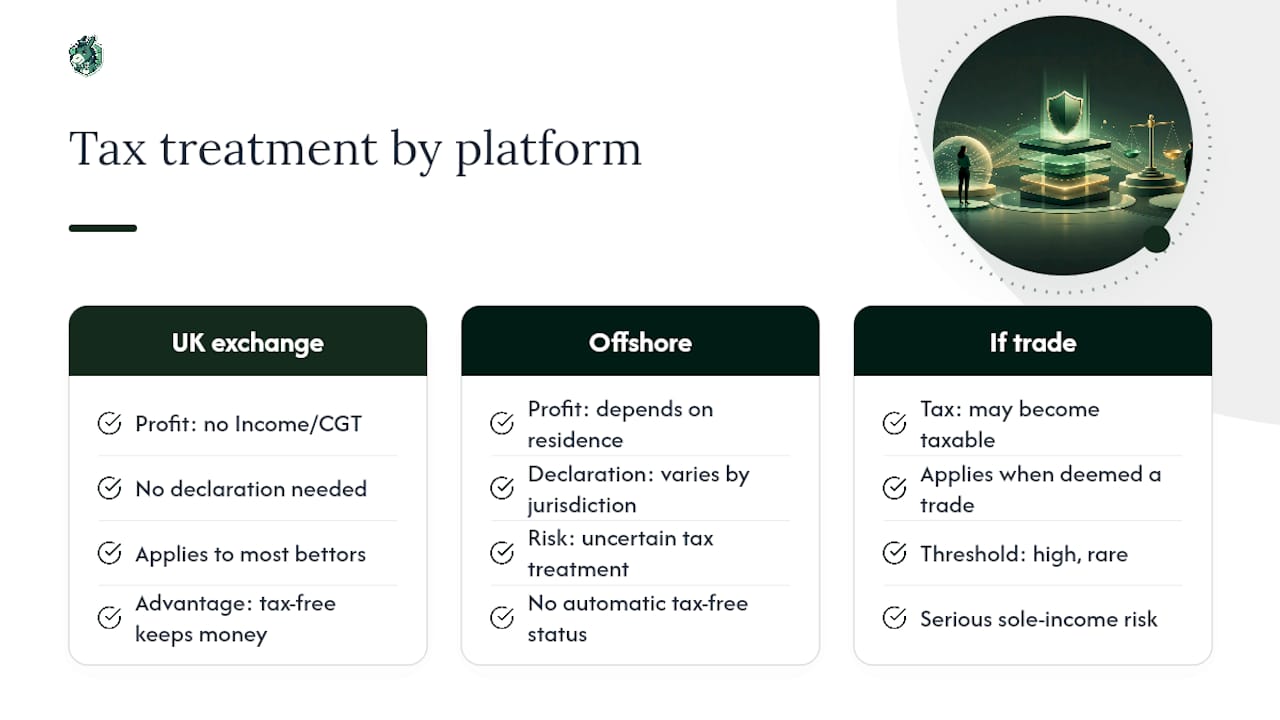
Betting and gambling profits, including winnings from hedged lay and back positions, are not subject to Income Tax or Capital Gains Tax for individual bettors in the UK. This applies whether you hedge every bet, hold positions to full settlement, or mix the two approaches across a season. HMRC treats betting as gambling rather than a trade for the overwhelming majority of recreational and semi-professional bettors, so there’s no need to declare exchange profits on a tax return.
This tax-free status is one of the more overlooked advantages of trading on a UK-regulated exchange rather than through offshore or unregulated platforms, where the tax treatment of any profit can depend entirely on your country of residence. It also means the maths in every worked example above (the £50, the £100, the £7.50) represents money you actually keep, not a pre-tax figure that shrinks once you file a return.
The one caveat worth flagging: if betting becomes your sole source of income and HMRC deems your activity a trade rather than gambling, the tax position can change. That threshold is high and rarely applies to hobbyist or even serious semi-professional layers, but it’s worth knowing the line exists rather than assuming every scenario is automatically exempt.
Author perspective: risk discipline and record keeping for layers
Liability control is where most layers come unstuck, not the maths of hedging itself. Cap liability at a fixed percentage of your bankroll (2 to 5% is the range most disciplined traders work within) and treat that as a hard stop, not a suggestion. A fixed liability staking approach removes the temptation to size up after a bad run, which is when most damage gets done.
Keep records of every trade, both legs, commission included. Without them, you’re guessing at your real edge rather than knowing it.
If betting stops feeling like a calculated activity and starts feeling compulsive, BeGambleAware offers free, confidential support.
— Donkey
How Donkeyradar helps: signals, calculators and verified results
Donkeyradar is the alternative to guessing which horse to lay: its algorithm processes historical strike rates and live market prices to flag the weakest runner before the race starts, with every signal published in advance and every result tracked publicly for verification.
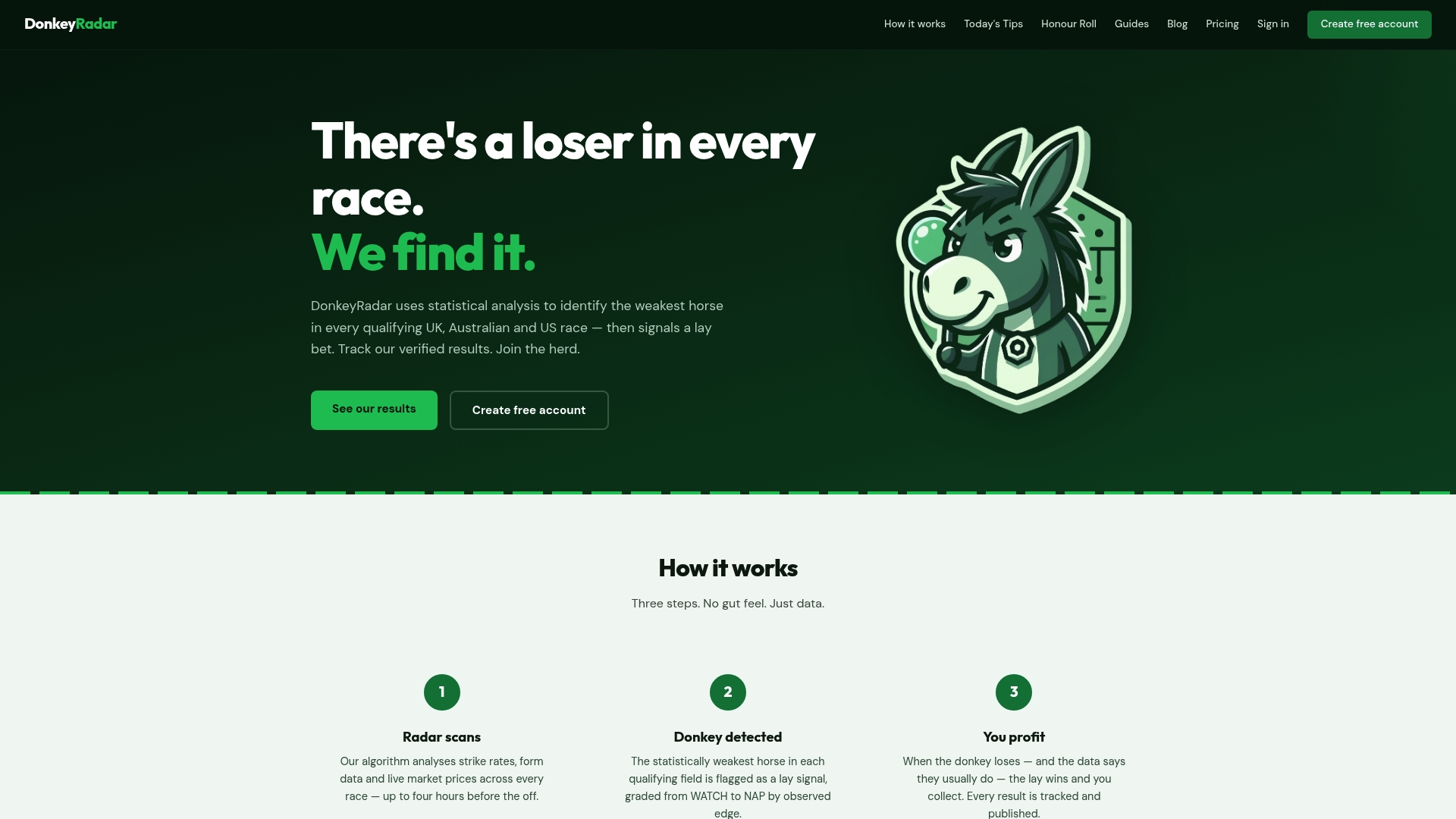
That matters directly for hedging. A signal with a strong verified track record gives you a clearer basis for deciding whether to hold a lay to settlement or hedge out early, rather than relying on gut feel when the price starts moving. The dashboard links straight through to Betfair Exchange, signals are graded into staking tiers so you can size positions consistently, and paid subscribers get real-time alerts by email and Telegram alongside API access for trading software. Combine those signals with the lay betting calculator covered above to compute your hedge stake and liability the moment a price moves in your favour. Start with the free daily signals, or try the seven-day trial to see the full alert and results history in action.
Sources
- How to hedge your bets — Smarkets Help Centre
- Hedging on Betfair: Risk Management with Lay or Back — BetfairSquare
- Back/Lay Hedging Calculator — GamblingCalc
- BeGambleAware