← Blog · 📝 Article · 20 September 2026
Why 70% at 1.40 Still Loses: Lay Betting Strike Rate and Liability

A lay betting strike rate is the percentage of settled lay bets that won, calculated as settled lay wins divided by settled lays, multiplied by 100. On its own, it tells you almost nothing about profit. A bettor laying at odds of 1.40 needs to win more than 71% of the time just to break even, so before you trust any published strike rate, check the odds, the yield, and the sample size behind it.
TL;DR:
- A high lay betting strike rate is not sufficient to ensure profit unless the odds and yield are favorable; always consider the break-even point at specific odds.
- Calculating an accurate strike rate requires excluding voided bets and non-runners and tracking both posted and closing prices for verification.
- Betting at odds between 2.0 and 7.0 with fixed liability staking helps manage risk better, especially since liability increases rapidly at higher odds.
- A sample size of hundreds or thousands of bets is necessary before trusting any performance figures, as small samples are highly affected by luck.
- Proper record-keeping, including odds, stake, and results, combined with review over time, provides a more reliable picture than surface-level strike rates or hot streaks.
Table of Contents
- Understanding lay betting strike rate: the formula and calculation
- Why a high strike rate can still lose you money
- Sample size and variance: how many bets before you can trust the numbers
- Liability and staking: the risk that strike rate never shows you
- Three worked examples you can copy into a spreadsheet
- What to look for in a published strike-rate record
- Key takeaways on reading lay betting strike rate
- Try DonkeyRadar’s pre-published signals for free
- Sources
- FAQ
Understanding lay betting strike rate: the formula and calculation
The formula is simple: strike rate = (settled lay wins ÷ settled lays) × 100. The word “settled” matters more than it sounds. Voided bets, non-runners, and pending selections should never enter the count, because including them either inflates or deflates the true figure depending on how they’re handled.
Here’s how to calculate it properly:
- Total every lay bet that has fully settled, win or lose.
- Exclude voids and non-runners entirely from both sides of the equation.
- Divide winning lays by total settled lays.
- Multiply by 100 to get a percentage.
Say you placed 50 lay bets last month, 8 were voided, and of the remaining 42, you won 33. That’s 33 ÷ 42 × 100, giving a strike rate of 78.6%. Record the posted price, the closing price, and your stake for every bet, because that data is what lets you or anyone else verify the number later.
Why a high strike rate can still lose you money
Strike rate on its own can’t tell you whether you’re profitable, because the odds you lay at determine how often you need to win just to stand still. That threshold is called the break-even strike rate, and it’s calculated as 1 divided by the decimal odds.
- At odds of 1.40, break-even sits at 71.4%. A strike rate around 70% at these odds can lose money, even though it sounds impressive.
- At odds of 3.00, break-even drops to 33.3%, so the same headline strike rate looks very different depending on price.
- Exchange commission, typically 2 to 5% on Betfair depending on your account tier, pushes the true break-even line slightly higher still.
A strike rate around 70% laying at 1.40 can lose money before commission is even applied, because the break-even point at those odds is 71.4%. This is exactly why a tipster boasting “70% strike rate” without stating average odds is giving you half a story. Always ask for yield or ROI alongside average odds, never strike rate in isolation.
Sample size and variance: how many bets before you can trust the numbers
Ten lay bets tell you almost nothing. A run of eight wins from ten looks brilliant, but it’s well within the range you’d expect from pure chance, and it can flip on the next few results. Confidence builds with volume, and published analyses recommend several hundred to a few thousand settled bets before a small edge becomes believable rather than lucky.
Watch for these signs when judging any record, including your own:
- A rolling strike rate that swings wildly month to month usually signals a small sample, not a broken strategy.
- Monthly breakdowns matter more than a single lifetime average, because they show whether performance is stable or driven by one outlier month.
- A full, published archive with no cherry-picked exclusions is worth more than any single headline percentage.
- Sustained trends across hundreds of bets carry far more weight than a hot streak over a few weeks.
Consider strike rate figures based on fewer than 100 bets as preliminary indicators rather than conclusive evidence. Variance is real, and it takes volume to average it out.
Liability and staking: the risk that strike rate never shows you
Strike rate measures how often you win. It says nothing about how much you lose when you don’t, and in lay betting that gap is where bettors get hurt. Liability on a lay bet is calculated as lay stake × (lay odds − 1), meaning your downside grows fast as odds lengthen.
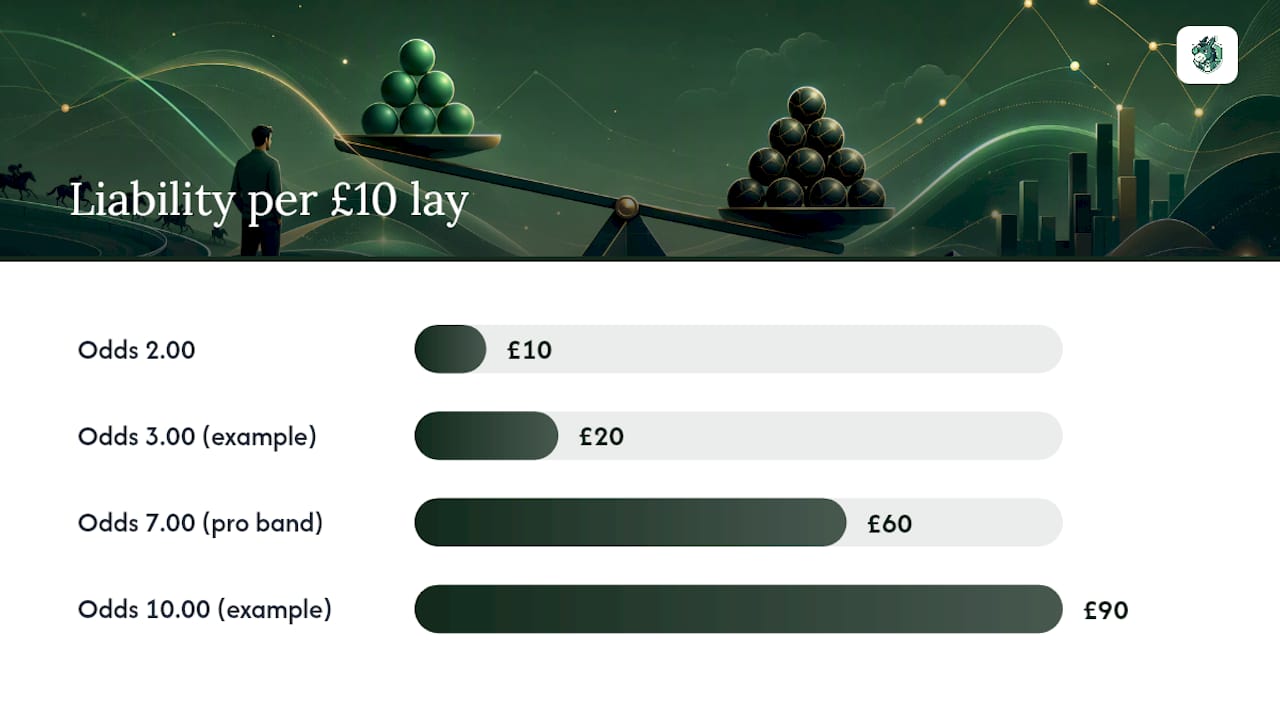
Lay a horse at odds of 3.00 with a £10 stake, and your liability is £20. Lay it at odds of 10.00 with the same £10 stake, and liability jumps to £90. Professional layers tend to concentrate on odds between roughly 2.0 and 7.0, where liability stays proportionate to stake and win-rate requirements are still achievable.
Practical staking rules worth following:
- Set a fixed liability per bet rather than a fixed stake, so every selection carries the same downside regardless of odds.
- Cap total exposure at a small percentage of your bankroll, commonly 1 to 2% per bet.
- Build in an automatic stop-loss for the day or week, so one bad run doesn’t compound.
- Review your average liability across the odds bands you’re laying, not just your average stake.
Pro Tip: Before placing a lay bet, calculate the liability first and ask whether you’d be comfortable losing that amount ten times in a row. If not, the stake is too high, not the strategy too weak.
For a full breakdown of the maths, our guide on Betfair lay liability walks through more scenarios, and fixed liability staking covers the mechanics of keeping every bet’s downside consistent.
Three worked examples you can copy into a spreadsheet
These three calculations cover the maths you’ll use most often.
- Break-even strike rate: 1 ÷ decimal odds × 100. At odds of 4.00, that’s 1 ÷ 4 × 100 = 25%. Win more than a quarter of your lays at that price and you’re ahead before commission.
- Liability on a lay: stake × (odds − 1). A £20 stake at odds of 5.00 gives liability of £20 × 4 = £80.
- Yield projection: (average winning return × win rate) − (average liability × loss rate), divided by total staked, gives your expected yield per bet. Run this across a season, not a single week.
In a spreadsheet, decimal odds maths, liability, and yield all sit as simple cell formulas, so you can update them bet by bet. Whatever you calculate, record the posted price, the closing price, your stake, and the result for every bet. That log is what turns a gut feeling into a verifiable track record, and our lay betting calculator guide shows the full working if you’d rather not build your own sheet. If you’re still getting to grips with the basic mechanics, lay vs back betting is worth reading first.
What to look for in a published strike-rate record
Most tip services lead with strike rate because it’s the easiest number to make look good. What separates a trustworthy record from a marketing figure is what sits underneath it.
- Signals are timestamped and published before the race, not adjusted or added retrospectively.
- A full settled-results archive exists, including losses, with no quiet removal of poor runs.
- Voids and non-runners are explained rather than folded into the win column.
- Posted price and closing price are both recorded, since consistently beating the closing price is one of the more reliable early signs of genuine value.
Signals are published before races begin, results are tracked against those published tips, and the full history is kept available rather than a curated highlight reel. That’s the standard worth holding any provider to. Before trusting any strike rate you see quoted, run it through the lay betting checklist and ask whether the archive backs up the headline.
Key takeaways on reading lay betting strike rate
Three things to act on immediately: log the odds and stake on every bet, cap liability before you place it, and track yield over weeks and months rather than judging any single run. Strike rate is a starting point, not a verdict.
— Donkey
Try DonkeyRadar’s pre-published signals for free
The service’s edge is simple: every signal is published before the race, tracked continuously, and kept in a public archive you can check against posted and closing prices yourself, rather than taking a strike rate on trust. That transparency is the whole point of building a lay betting strategy on data rather than a headline percentage.

A free tier gives daily lay signals with no cost to start, and a paid tier at £29 per month adds real-time alerts, full results history, and API access for anyone running their own trading tools. If you want to see the statistical approach behind the signals before committing, our Betfair lay betting strategy guide breaks down the method in full. Start with the free tier at DonkeyRadar and check today’s published signals against the archive yourself.
Sources
- 70% Strike Rate Can Lose Money: The Break-Even Line
- Laying Horses on Betfair: When and How (2026 Strategy Guide)
FAQ
What is the best lay betting strategy?
There’s no single best strategy, but the strongest approach combines a clear edge, disciplined staking, and a focus on yield rather than strike rate alone. Concentrating lays in the 2.0 to 7.0 odds band keeps liability manageable while still hitting achievable win rates, and pairing that with fixed-liability staking limits downside on any single bet.
What is a good strike rate for a horse trainer?
Trainer strike rates vary enormously by yard size and race class, so there’s no universal benchmark figure. What matters more for lay bettors is whether a trainer’s runners are being backed or laid at odds where the strike rate clears the break-even line for that price.
How do I calculate strike rate?
Divide settled winning bets by total settled bets, then multiply by 100, excluding voids and non-runners from both sides of the sum. For lay betting specifically, that means settled lay wins divided by settled lays, so a bettor who won 33 of 42 settled lays has a strike rate of 78.6%.
How do you calculate a lay bet’s liability?
Liability equals lay stake multiplied by (lay odds minus 1). For example, a £20 stake at odds of 5.00 carries liability of £80, and that figure rises sharply as odds lengthen, which is why most experienced layers stick to shorter and medium-priced selections.