← Blog · 📝 Article · 7 October 2026
Exchange Bettors: Lay the Field With 85% Signals and Liability Caps

Laying the field means betting that a selection, or every runner you target in a race, will not win, and the smartest way to do it is with pre-published, data-driven lay signals paired with strict liability limits. We publish our lay signals before races go off, and our tracked results show a strike rate above 85%. That combination of transparency and discipline is what separates a repeatable approach from a hunch.
TL;DR:
- Using data-driven lay signals with strict liability limits can achieve a strike rate above 85 percent across UK, Australian, and US races.
- Minimum liability requirements of £10 at Starting Price odds on Betfair often challenge new layers with small bank balances, requiring careful stake management.
- Locking in profits through hedging or arbitrage during races can reduce risks and maximize gains compared to simple lay strategies.
- Market liquidity is crucial; large, well-traded races offer better chances of getting matched at the desired price, unlike thin markets.
- Automated staking rules, pre-race signal validation, and continuous result tracking are key to profitable, disciplined lay betting.
Table of Contents
- How data-driven lay signals identify the most likely losing runner
- Risk, staking and the exchange rules every layer must enforce
- Practical pre-bet checklist and execution plan for laying the field
- Strategies for effective lay betting including hedging and arbitrage
- Lay betting versus back betting: when each makes sense
- Examples of lay betting in practice
- Market liquidity and how it shapes which races to lay
- Author perspective: lay the field like a trader, not a punter
- How DonkeyRadar helps you lay the field
- FAQ
- Sources
How data-driven lay signals identify the most likely losing runner
Laying a horse means you take the role of the bookmaker on that selection: you win your stake if the horse loses, and you pay out if it wins. Your exposure is called liability, and it is calculated as liability equals (odds minus one) multiplied by stake. Lay £10 at odds of 6.0 and your liability is £50, money the Betfair Exchange holds from your balance before the bet can be matched.
A few mechanical details decide whether a lay actually pays out the way you expect:
- Unmatched lay offers can either expire or convert to Starting Price, depending on whether you select “keep” or a standard in-play setting.
- Non-runners trigger a reduction factor that recalculates the odds and liability on any matched bet involving that horse.
- SP conversion means your final liability is only fixed once the official starting price is confirmed, not when you placed the bet.
Lay strategies work because markets misprice runners in predictable ways. The favourite-longshot bias, well documented in betting research, shows that favourites tend to be under-bet relative to their true winning chance while longshots are over-bet, which leaves mid-priced and poorly supported runners systematically overpriced in a way that data models can exploit. Exchanges narrow this bias compared with fixed-odds bookmakers, but they do not eliminate it, which is exactly the gap a statistical model hunts for.
Our own signal logic looks at historical strike rates for a horse and its connections, live market drift or steam in the minutes before the off, and pricing anomalies between a horse’s exchange price and its price across other markets.
DonkeyRadar’s published lay signals have returned a strike rate above 85% across tracked UK, Australian and US races, a figure we state as our own claim and keep verifiable through a public results history.

Risk, staking and the exchange rules every layer must enforce
Signal quality only matters if your staking survives contact with reality. The exchange requires your account balance to cover the full liability on any lay bet before it can be matched, and Betfair’s own rules set a minimum liability of £10 for SP-targeted lay bets in UK markets. That single figure catches out more new layers than almost anything else: if your bank cannot absorb a £10 minimum liability per selection, SP laying is not yet the right tool for you.
Three staking approaches cover most sensible approaches to sizing a lay:
- Fixed-liability staking, where every lay risks the same capped amount regardless of odds, which keeps losses predictable and is easiest to automate.
- Cap-every-lay-loss plans, where a hard ceiling per bet protects the bank from one catastrophic result on a big-priced runner.
- Tiered liability staking, where liability scales with your confidence in the signal or the depth of the market, reviewed and adjusted on a schedule rather than bet by bet.
Pro Tip: Automate your staking rules before you place a single lay. Decisions made in the heat of a shortening market are rarely the ones you’d make with a clear head.
Reduction factors matter here too: when a non-runner is declared after you’ve matched a lay, the exchange recalculates the odds on remaining selections, which changes your effective liability without you doing anything. Build a small buffer into your bank for this rather than assuming your liability is fixed the moment a bet matches.
Commission also eats into net winnings, and the exchange landscape has shifted recently: reporting on Betfair’s commission system notes that the premium charge has been dropped in favour of a new model, which changes the real return on high-volume accounts. Check your own commission rate periodically rather than assuming last year’s numbers still apply.
Finally, treat safer-gambling tools as part of your risk management, not an afterthought. Bank gambling blocks are free from most major banks and add a cooling-off period, typically 48 to 72 hours, before you can reverse the block. Remote licence holders are also required to monitor customer activity and act on signs of harm, so expect prompts or checks if your pattern of activity changes sharply. Keeping your own record of every lay, win or lose, is the simplest way to spot a harmful pattern before an exchange does it for you.
Practical pre-bet checklist and execution plan for laying the field
Treat every signal as a draft, not an instruction, until you have run it through a short checklist.
Before you lay:
- Verify the signal’s timestamp and source: a signal published hours before the off carries more market-movement risk than one issued closer to the race.
- Check market liquidity and traded volume on the exchange screen; thin markets are harder to exit from if you need to.
- Set a hard liability cap for the bet before you open the ticket, not after you see the odds.
- Decide whether to use the “keep” setting, which leaves an unmatched offer live, or a standard offer that lapses at the off.
- Confirm your SP limit settings if you intend to rely on Starting Price for any unmatched portion.
When you enter the bet, size by liability first and let the stake fall out of that number: at odds of 4.0, a £20 liability cap means a stake of roughly £6.67, since liability equals (odds minus one) multiplied by stake. Our lay betting calculator does this arithmetic for you and is worth running before every signal you act on.
Contingencies worth planning for:
- A late withdrawal triggers a reduction factor; recheck your liability once it’s declared.
- A partially matched lay leaves you with split exposure, matched at your price and unmatched at whatever happens next.
- An unmatched lay left on “keep” will convert to SP, so only use that setting when you’re comfortable accepting the final starting price.
Strategies for effective lay betting including hedging and arbitrage
A pure lay-and-hold approach is the simplest version of this strategy, but hedging gives you a way to lock in profit or cap a loss before the race finishes. If you’ve laid a horse and its price lengthens as expected, you can back it at the new, higher price for a smaller stake and green up, guaranteeing a profit regardless of the result. The same logic works in reverse if the market moves against you: backing back a portion of your liability at a worse price than you laid still reduces your downside.
Arbitrage opportunities arise less often but are worth knowing. When the same horse is priced differently across two exchanges, or when back and lay prices on the same exchange briefly cross due to a liquidity gap, you can back on one side and lay on the other for a risk-free margin. These windows close quickly once other traders spot them, so they suit readers already comfortable moving fast on the exchange screen rather than beginners.
Combining a data-driven lay signal with a pre-set hedging rule, for example “green up once the lay has moved 1.5 points in my favour”, turns a single bet into a managed position rather than an all-or-nothing outcome. That discipline matters more over a long run of bets than any single clever lay.
Lay betting versus back betting: when each makes sense
Backing a horse means you profit if it wins and lose your stake if it doesn’t, a single, capped risk. Laying flips that: your potential loss is uncapped in principle, since a horse can win at any price, while your profit is capped at the stake you’ve risked. That asymmetry is the first thing any back-only bettor needs to recalibrate when they start laying.

Back betting suits a bettor who has a strong view on a likely winner and wants a defined, limited risk. Laying suits a bettor who has a statistical edge in identifying likely losers, which is a different and arguably easier judgement to make well, since most fields have several horses with little realistic winning chance even when the market overprices them.
In practice, many experienced exchange users do both, backing a fancied runner in one race and laying an overpriced runner in another, depending on which side the data favours. The decision isn’t about preferring one approach over the other on principle; it’s about matching the method to wherever the market has made its biggest pricing error. For a fuller grounding in the mechanics before mixing the two, our lay versus back guide covers the conceptual differences in more detail.
Examples of lay betting in practice
Take a seven-runner handicap where the favourite is trading at 2.5 but a data model flags a different runner, a 7.0 chance with a poor recent strike rate and a jockey change, as overbet by the public. Laying that runner at 7.0 for a £15 stake creates a liability of £90, calculated as (7.0 minus 1) multiplied by £15. If it loses, as the signal suggested, you collect the £15 stake; if it wins, you pay out the £90 liability.
A second, more defensive example: a layer spots a non-runner declared ten minutes before the off in a race where they already held a matched lay on a different horse. The reduction factor recalculates their liability downward because the market’s total probability has shifted, a reminder that a position you thought was fixed can still move without you placing another bet.
A third case involves hedging mid-race: a lay placed at 5.0 pre-race drifts to 8.0 as the horse fades in the betting, and the layer backs a small stake at 8.0 to green up, locking in a partial profit regardless of the final result rather than waiting and hoping the horse loses outright.
None of these examples replace running your own numbers through a lay betting calculator, but they show the shape of the decisions a data-driven layer actually makes race by race.
Market liquidity and how it shapes which races to lay
A sharp signal is worth little in a market nobody is trading. Liquidity, the amount of money matched and available at each price point, determines whether your lay actually gets filled at the price you want and whether you can exit cleanly if the race moves against you.
Major UK, Australian and US races with large fields and strong television coverage tend to carry deep liquidity, meaning large sums can be matched without moving the price much. Smaller, lower-grade meetings can look appealing on paper because the mispricing is often larger, but a thin market can leave part of your lay unmatched or force you to accept a worse price just to get filled.
Practical market selection comes down to a few checks: look at the total matched volume on the race before committing, prefer races where your intended liability is small relative to the volume already traded, and be more cautious with in-running liquidity if you plan to hedge or green up mid-race, since prices can gap sharply with few matched bets behind them. A signal on a near-illiquid market is still worth noting, but it demands a smaller stake and more patience getting matched than the same signal on a well-traded race.
Author perspective: lay the field like a trader, not a punter
The reader who treats lay betting as disciplined trading, rather than a string of hunches, is the one who survives a long losing run intact. Automation, strict staking rules and a record you actually review are what separate a profitable signal-following habit from a lucky month. Pre-published, independently checkable signals matter precisely because they remove the temptation to rewrite history after the fact. Strike-rate transparency isn’t a marketing flourish; it’s the only way you can judge whether a system’s edge is real or a product of selective memory.
— Donkey
How DonkeyRadar helps you lay the field
We built DonkeyRadar around the same discipline this guide has described: pre-published signals, a public results history, and tools that turn a signal into a correctly sized bet rather than a guess. Every pick goes live before the race, so you’re never asked to trust a result you can’t check afterwards.
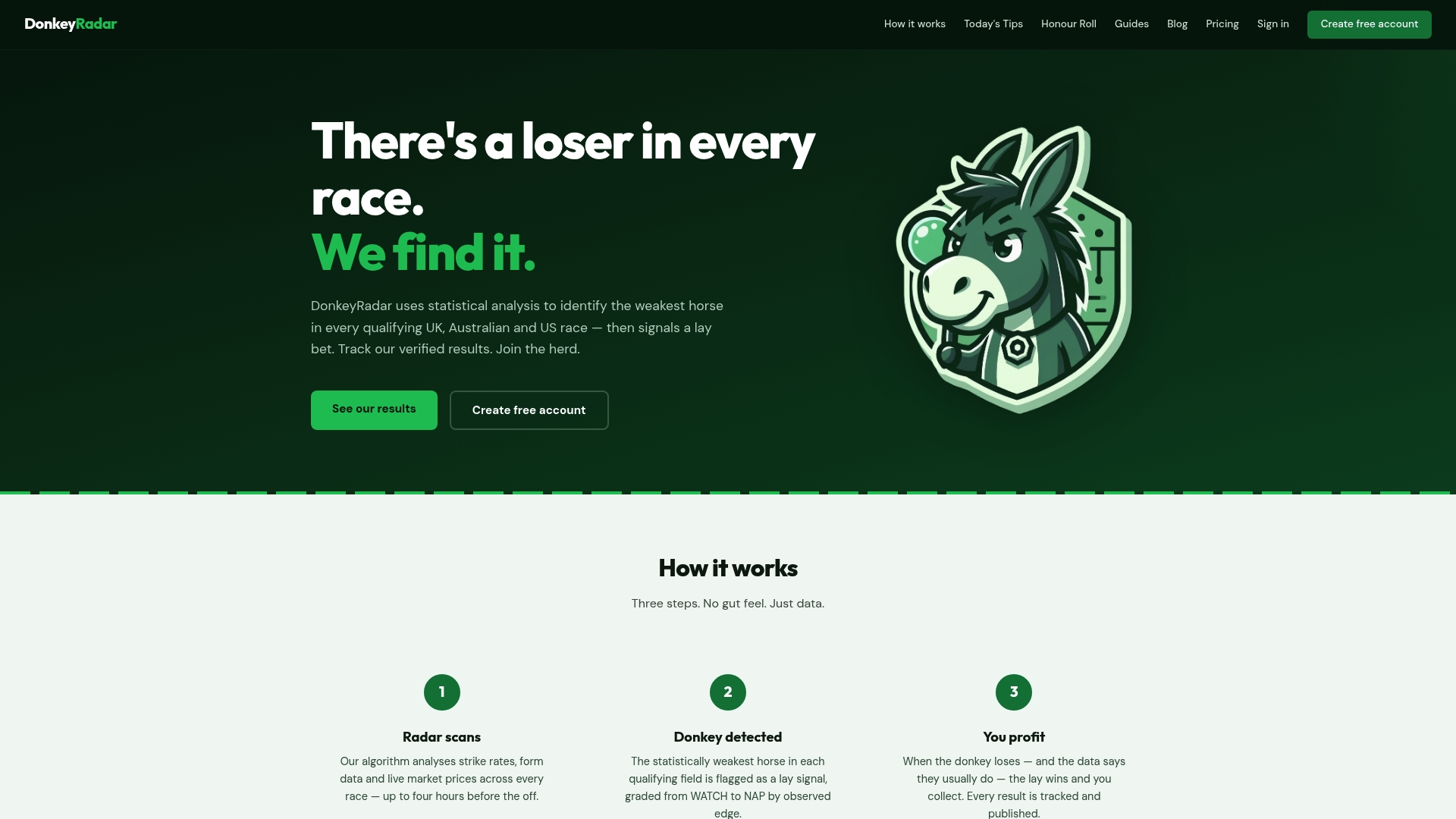
Our dashboard links straight through to the relevant Betfair market, and real-time alerts land by email or Telegram so you’re not refreshing a page waiting for the next signal. Alongside the picks themselves, we offer:
- A step-by-step guide on how to lay a horse on Betfair for anyone still getting comfortable with the exchange screen.
- A verified, continuously updated results history so you can audit our strike rate yourself rather than take it on trust.
| Plan | Price | Includes |
|---|---|---|
| DonkeyRadar Free | No published price | Daily lay betting signals |
| DonkeyRadar Pro | £29 per month | Real-time alerts, full results history, API access |
Start with DonkeyRadar Free to see how the signals read in practice, work through the calculator before you stake anything, and keep a liability cap in place on every single bet regardless of how strong a signal looks.
FAQ
What does it mean to lay the field in horse racing?
Laying the field means placing lay bets against one or more selections in a race, betting that they will lose rather than win. On an exchange, you act as the bookmaker for that bet, collecting the stake if the horse loses and paying the liability if it wins.
How do you calculate liability on a lay bet?
Liability equals (odds minus one) multiplied by your stake, and the exchange holds that amount from your balance before the bet can be matched. For example, laying £10 at odds of 6.0 creates a liability of £50.
What is the minimum liability for a lay bet at Starting Price?
UK markets on the Betfair Exchange require a minimum liability of £10 for lay bets targeted at Starting Price. This applies specifically to SP-targeted lays rather than every lay bet placed on the exchange.
Is DonkeyRadar’s lay strike rate verified?
DonkeyRadar publishes its lay signals before races and keeps a continuously tracked results history available for review, reporting a strike rate above 85% across tracked races. We state this as our own published figure, checkable against our public record rather than taken on trust.
What is the favourite-longshot bias and why does it matter for laying?
The favourite-longshot bias describes how favourites tend to be under-bet and longshots over-bet relative to their true chance of winning. For a layer, this means mid-priced and overbet longshots are often the most reliably mispriced targets, which is part of the rationale behind data-driven lay signals.
Sources
- Exchange: What does the term “Lay” mean and what is a Lay bet?
- Betfair Exchange - Introduction & General Rules
- Customer interaction guidance - for remote gambling licensees (Formal guidance under SR Code 3.4.3) - Introduction
- What is the favourite–longshot bias? — Pinnacle
- Everything you need to know about bank gambling blocks - GamCare