← Blog · 📝 Article · 3 September 2026
3 Rules to Turn Morning Line vs Live Odds Gaps into Lay Signals

Live odds at post time decide what you get paid; the morning line never does. It is an oddsmaker’s early estimate of how the public will bet, published purely as a reference point. Treat the gap between the two not as an error, but as a signal worth investigating before you commit money.
TL;DR:
- The morning line is an early estimate of public betting patterns and does not influence final payouts, which are based solely on live odds at post time.
- Live odds are determined by real-time betting pool activity, changing until betting closes, and directly establish the actual payout for bettors.
- Significant gaps between the morning line and live odds, such as a horse drifting or shortening, often reflect late or sharp money, not necessarily the horse’s true ability.
- Understanding key factors like scratches, weather, and market liquidity explains most odds movements and helps bettors avoid chasing bad prices.
- Relying on pre-race prices and setting strict betting discipline, rather than reacting impulsively to odds shifts, improves long-term betting results.
Table of Contents
- Morning line vs live odds: what the early number is for
- How live odds actually get set (and why they decide payouts)
- Reading the gap: morning line vs live odds side by side
- When to bet the morning line and when to wait for live odds
- What DonkeyRadar’s data shows about odds movement
- Common misconceptions about the morning line
- Where the morning line actually came from
- Real examples of morning line and live odds diverging
- Why scratches and weather can move the market fast
- Author perspective: three rules worth keeping
- Turning odds movement into lay signals with Donkeyradar
- Sources
Morning line vs live odds: what the early number is for
The morning line is the set of prices posted before a race opens for wagering, usually the night before or that same morning. An oddsmaker sets it, and their job isn’t to identify the fastest horse. It’s to predict how the public will actually bet the race, so the tote board doesn’t lurch wildly once betting opens.
To build that estimate, an oddsmaker typically weighs:
- Recent form and class level of each runner
- Trainer and jockey combinations, and how the betting public tends to react to them
- Track conditions, post position bias, and likely pace scenarios
- Which horses the betting public has favoured in similar spots before
There’s a known bias worth knowing about: oddsmakers tend to be conservative at the extremes. They rarely price a horse at huge odds even when the case for it winning is weak, because they’re forecasting betting behaviour, not making a private prediction. That’s precisely why the morning line remains useful. Once you’ve formed your own view of a race, checking it against the morning line works as a sanity check, not a verdict. If your fancy is drifting at 12/1 on the morning line and you think it’s a legitimate contender, that gap is worth digging into before the gates open.
How live odds actually get set (and why they decide payouts)
Live and final odds come from a pari-mutuel pool, not a bookmaker’s opinion. Every wager on a race goes into a shared pool for that bet type, and the odds you see are simply a live readout of how that pool is currently split between runners. More money on a horse pushes its price down; less money lets it drift up.
That price keeps moving right up to when betting closes, driven by:
- Late money arriving in the final few minutes before post
- Large individual stakes that shift a thin pool disproportionately
- Publicity, media picks, or a well-known trainer’s public comments
- The overall size and liquidity of the pool on that particular race
The number that matters: payouts are calculated from the final odds recorded at post time, not from whatever price was showing an hour earlier or on the morning line. A horse can open at 20/1 on the morning line and go off at 6/1. Anyone backing it gets paid on 6/1, full stop.
That’s the practical implication worth sitting with. The morning line can be completely right about which horse the public would like, or completely wrong, and it changes nothing about your payout. The market, not the oddsmaker, has the final word.
Reading the gap: morning line vs live odds side by side
The two numbers exist for different reasons, and confusing them is where most new bettors go wrong.
| Morning line | Live/final odds | |
|---|---|---|
| Set by | A track oddsmaker, in advance | The betting pool itself, in real time |
| Purpose | Predict betting patterns | Reflect actual money wagered |
| Timing | Published before wagering opens | Updates continuously until post |
| Determines payout | No | Yes |
When you see a big drop from the morning line, say a horse posted at 8/1 sitting at 5/2 twenty minutes before post, that’s usually described as a steam move: a sudden influx of money, often from bettors perceived as sharp. A horse drifting the other way, longer than its morning line price, suggests the public isn’t backing it the way the oddsmaker expected.
Run through this quick checklist when you spot a meaningful gap:
- Check for late scratches or a jockey change that would explain the shift.
- Look for fresh information, workout reports, track bias news, that wasn’t public when the morning line was set.
- Consider whether the move reflects one or two large bets rather than broad public sentiment.
- Weigh whether the shift matches or contradicts your own pre-race assessment.
When to bet the morning line and when to wait for live odds
Your best defence against chasing bad prices is deciding your approach before the race, not during it.
Bet early when you’ve found a genuine overlay. If your own price for a horse is 4/1 and the morning line has it at 8/1, and nothing about the field composition explains that gap, you’ve likely found value worth locking in before the crowd catches up. Corroborate it with something concrete: a positive workout report, a leading trainer switching tactics, or a jockey upgrade that the market hasn’t priced in yet. Waiting risks losing that price entirely if the field moves toward your number.
Wait for live odds when the picture is genuinely unclear. First-time starters, small or maiden fields, and races with unresolved pace questions are all situations where the morning line is little more than a guess. Waiting lets the pool absorb information you don’t have yet, particularly insider money that tends to arrive close to post.
Pro Tip: Set your own price for a horse before you glance at the morning line. Comparing your number to the market’s number, rather than anchoring on the oddsmaker’s figure first, keeps you spotting genuine mismatches instead of just following the crowd.
Staking discipline matters as much as timing. Anchoring your decisions to a pre-race number and capping how often you bet live protects you from a market that carries a heavier hold once betting is underway. A few habits worth locking in:
- Set a fixed stake size before the race and don’t scale it up after a bad result
- Cap the number of live or last-minute bets you place per card
- Walk away from a race where the price moved against you rather than chasing it back
- Give yourself 30 to 60 minutes before post to run through scratches, late market moves, and your own price one final time
What DonkeyRadar’s data shows about odds movement
Donkeyradar built its lay signals around exactly this gap between the morning line’s prediction and what the market actually does. The system processes historical strike rates alongside live market prices to flag the weakest runner in a race, publishing every signal before the race starts rather than after the result is known.
A morning line price that looks generous can simply mean the oddsmaker expects little support for that horse, not that it has a real chance. When live money confirms that judgement by pushing the price out further rather than in, that’s a stronger lay case than the morning line figure alone ever suggested.
In one recurring pattern Donkeyradar tracks, a horse posted at a modest morning line price drifts significantly further once trading opens, with no scratch or news to explain it. That combination, public indifference confirmed by the market rather than contradicted by it, is the kind of signal the platform’s staking tiers are built to grade and act on, while capping how often signals fire to keep exposure controlled.
Common misconceptions about the morning line
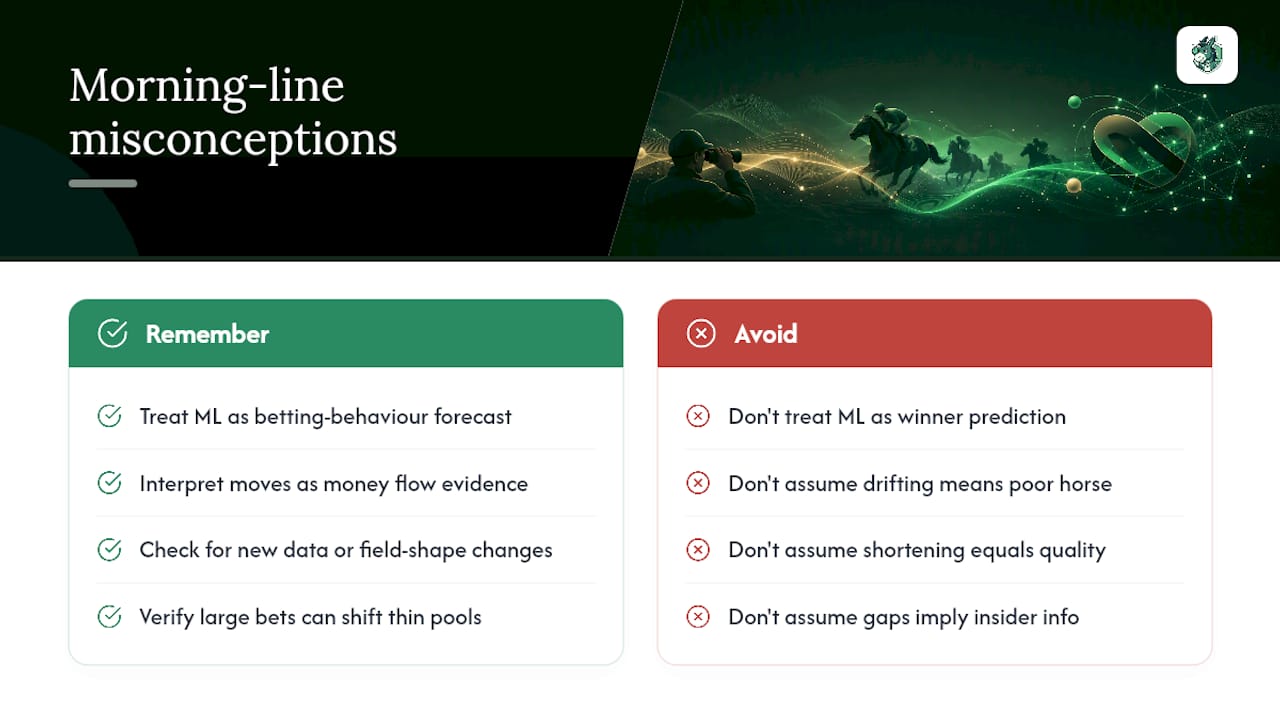
The biggest misconception is that the morning line is a prediction of the winner. It isn’t, and it was never meant to be. An oddsmaker is forecasting betting behaviour, and morning-line favourites do go on to become the post-time favourite in most races, but “usually right about the favourite” is a long way from “reliable form guide.”
A second misconception: that a horse drifting from its morning line price is automatically a bad sign, or that a horse shortening is automatically a good one. Both movements simply reflect where money went. Sometimes that money is sharp and informed. Sometimes it’s a single large recreational bet on a well-known name, or public money following a media tip that has nothing to do with the horse’s actual chance.
Some bettors also assume the morning line is set the same way a bookmaker prices a market, factoring in margin and risk exposure. It isn’t. There’s no book being balanced here; it’s a forecast, published once, with no obligation to honour it once betting opens.
Finally, plenty of recreational bettors treat any gap between morning line and live odds as proof of “inside information.” Most of the time it’s simpler than that: more data became available, the field shape became clearer, or one bettor placed a stake large enough to move a thin pool.
Where the morning line actually came from
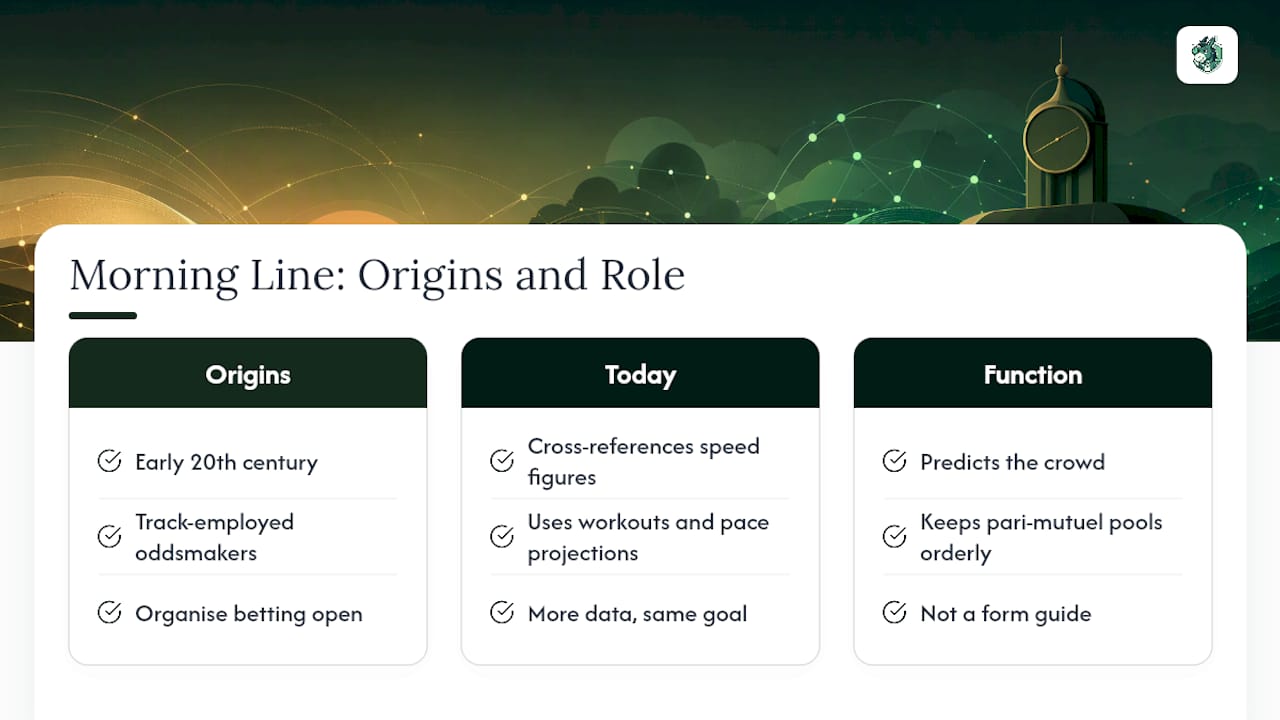
The morning line dates back to the early twentieth century, when tracks needed some way to give bettors a starting reference before wagering windows opened. Without an early price, punters walking up to the track had nothing to gauge a horse’s standing against the field, and betting lines would have opened chaotically once windows did.
Track-employed oddsmakers took on the job of studying past performances, class levels, and public tendencies to produce a line that would keep the pari-mutuel pools reasonably orderly once betting began. The purpose was administrative as much as informational: a smoother open meant fewer wild early swings and a fairer experience for the first bettors through the door.
That original purpose hasn’t really changed. What has changed is how much data feeds into it. Modern oddsmakers cross-reference speed figures, workout times, and pace projections that simply didn’t exist a century ago, but the underlying job remains the same: predict the crowd, not the finish line.
Understanding that history matters practically, because it explains why the morning line has never been held to the standard of a form guide. It was built to organise a betting market, not to hand out winners, and every serious bettor benefits from remembering that distinction before making it the basis of a bet.
Real examples of morning line and live odds diverging
A commonly cited pattern is a horse posted around 15/1 on the morning line that drifts out to 30/1 or beyond by post, usually because it’s a first-time starter facing more experienced rivals, and the crowd simply won’t back an unknown quantity at a short price. That kind of movement is textbook market behaviour, not a mystery.
The reverse case gets more attention. A horse posted around 10/1 on the morning line collapses to 7/2 or shorter in the final ten minutes of betting, with no obvious news to explain it. Reviewing enough of these moves shows the drop usually traces back to informed money, a positive workout, or connections quietly confident enough to bet size, rather than random noise. Bettors who caught the pattern early, before the price collapsed, captured genuine value; anyone piling in after the drop was chasing a price that had already moved.
Favourites tell a steadier story. Most races see the morning-line favourite finish as the betting favourite too, which is exactly what an oddsmaker forecasting public sentiment should get right most of the time. The interesting cases sit further down the field, where a horse quietly overlooked by the oddsmaker attracts far more support than expected once real money starts flowing.
Why scratches and weather can move the market fast
A late scratch reshuffles an entire pool almost instantly. When a leading contender is withdrawn shortly before post, the money already staked on that horse gets refunded, and bettors scrambling to reallocate stakes onto the remaining field can cause sharp, sudden price movement that has nothing to do with form or the morning line.
Weather works more gradually but just as decisively. A track downgraded from firm to soft, or a rail moved out several metres, changes which running styles are advantaged. Bettors who understand pace and track bias react by shifting support toward horses suited to the new conditions, and prices adjust to reflect that shift well before the race goes official.
Equipment changes, blinkers added or removed, a different bit, can also trigger smaller but noticeable moves, particularly when the change is well publicised. None of these factors show up in a morning line set the day before. That’s the core reason live odds diverge from the morning line so often: the morning line is frozen at the moment it’s published, while the live market keeps absorbing information right up to the last second before the gates open.
Author perspective: three rules worth keeping
I treat the morning line as a starting point, never a target. My own price comes first; the market’s number tells me whether I’m early, late, or wrong. Three rules I keep coming back to: anchor to your own pre-race price before checking the market, investigate any gap large enough to matter rather than assuming a cause, and cap how many live bets you place per card so one bad read doesn’t compound into a bad session. I lean toward early bets when the case is backed by something concrete, and I wait when the field is genuinely unclear. Protecting your bankroll from your own impatience does more for long-term results than any single sharp read ever will.
— Donkey
Turning odds movement into lay signals with Donkeyradar
Spotting a drift or a steam move is only useful if you act on it with discipline, and that’s precisely where Donkeyradar earns its place in your routine. Rather than eyeballing the tote board and guessing at causes, Donkeyradar’s algorithm cross-references historical strike rates against live market prices to flag the weakest runner in a race, publishing every signal before the race starts so you can verify the call against results after the fact.

The platform suits exchange bettors who want systemised signals rather than a fresh manual read on every card, complete with staking tiers to grade exposure and real-time alerts so you’re not refreshing a race page every ninety seconds. If you’re already comparing morning-line gaps to live prices by hand, a lay betting calculator will do the liability and break-even maths for you in seconds. New to laying against a horse rather than backing one? Start with the lay betting explained guide, then take Donkeyradar’s seven-day trial to see the published signals against real race results before committing to a subscription.
Sources
For deeper mechanics, see At The Races on tote betting, Equibase on using the morning line, and Donkeyradar’s data analysis guide.
This article is general information, not a substitute for advice from a qualified financial advisor. Consult a qualified financial professional about your own circumstances before acting on anything here.
- At The Races — betting and tote explanations
- AQHA — Morning line odds as a betting tool
- America’s Best Racing — Morning line odds as a betting tool
- Equibase — Use the morning line to your advantage