← Blog · 📝 Article · 28 August 2026
Pre race market analysis for exchange traders

Pre race market analysis means trading price movement and liquidity, not predicting winners. Watch two signals above all else: steam moves (rapid, sustained shortening) and matched-volume thresholds that confirm a market is genuinely liquid. Donkeyradar builds its whole signal workflow around this exact principle, using statistical models rather than hunches to flag the weak side of a race.
TL;DR:
- Focusing on market liquidity and steam moves, such as rapid price drops combined with steady volume, is essential for success in pre-race trading.
- Applying strict filters like race volume, field size, and race type helps avoid thin markets that are prone to slippage and unpredictable moves.
- Proper risk management, including pre-set liability caps, stop-loss orders, and systematic green-up, is crucial to prevent large losses during volatile moves.
- Being aware of market-moving news, weather changes, and scratches, combined with volume checks, prevents reacting to false signals or structural shifts.
- Using data-led signals from tools like Donkeyradar, along with verified historical performance, improves decision-making and reduces emotional biases.
Table of Contents
- Why trader mindset differs from backing
- Core pre-race strategies: steamers, the field, and place lays
- Race selection and liquidity filters that actually matter
- Execution and risk management: liability, stops, and greening up
- What steam and drift actually tell you
- DonkeyRadar’s data-led approach in practice
- Common biases that quietly wreck pre-race analysis
- What a well-run trade actually looks like
- How weather, scratches, and news move the market
- Realistic expectations for the learning curve
- How Donkeyradar puts this into practice for you
- Sources
Why trader mindset differs from backing
Backing a horse is a bet on the result. Trading a market is a bet on how the price will move before the result even happens, and that distinction changes everything about how you should behave at the screen.
Volatility is where the edge lives. A market that swings from 4.0 to 2.6 in the final ten minutes gives a trader two separate opportunities. A market that never moves gives you nothing to work with regardless of who wins. Liquidity determines whether you can actually act on that volatility without your own money shifting the price against you.
Three habits separate traders who last from those who blow up their bank in a month:
- Set your exit price before you place the lay, not after it starts drifting.
- Cap liability on every single trade, no exceptions for “certainties.”
- Log every trade with odds, stake, liability, and outcome, then review weekly.
That journal is the single biggest gap between amateur and professional lay bettors. Without it, you’re guessing whether your strategy works. With it, you have proof.
Core pre-race strategies: steamers, the field, and place lays
Laying the steamers is the bread-and-butter play. You lay a horse whose price is falling fast, betting the drop overextends before the off. A typical sequence runs like this:
- T-30 minutes: Scan the market for a runner that’s shortened more than 20% from its morning price.
- T-20 minutes: Check matched volume is building steadily, not spiking on one bet.
- T-10 minutes: Enter the lay if the price is still moving and liability fits your bankroll rule.
- T-5 minutes: Green up or hold to the off, depending on how far the price has already run.
Lay-the-field is a different animal entirely. Instead of picking one runner, you lay several horses across a race to profit from the natural over-round shrinking as money floods in. It demands deeper pockets and sharper queue management, since you’re managing multiple open positions in the same market simultaneously and matching liquidity across all of them.
Place lays suit races with big fields, typically eight or more runners, where the each-way market offers a wider net. The practical guide to laying in horse racing argues the smartest lays target weakness, not obvious strength, and place markets often expose that weakness more clearly than the win market does.
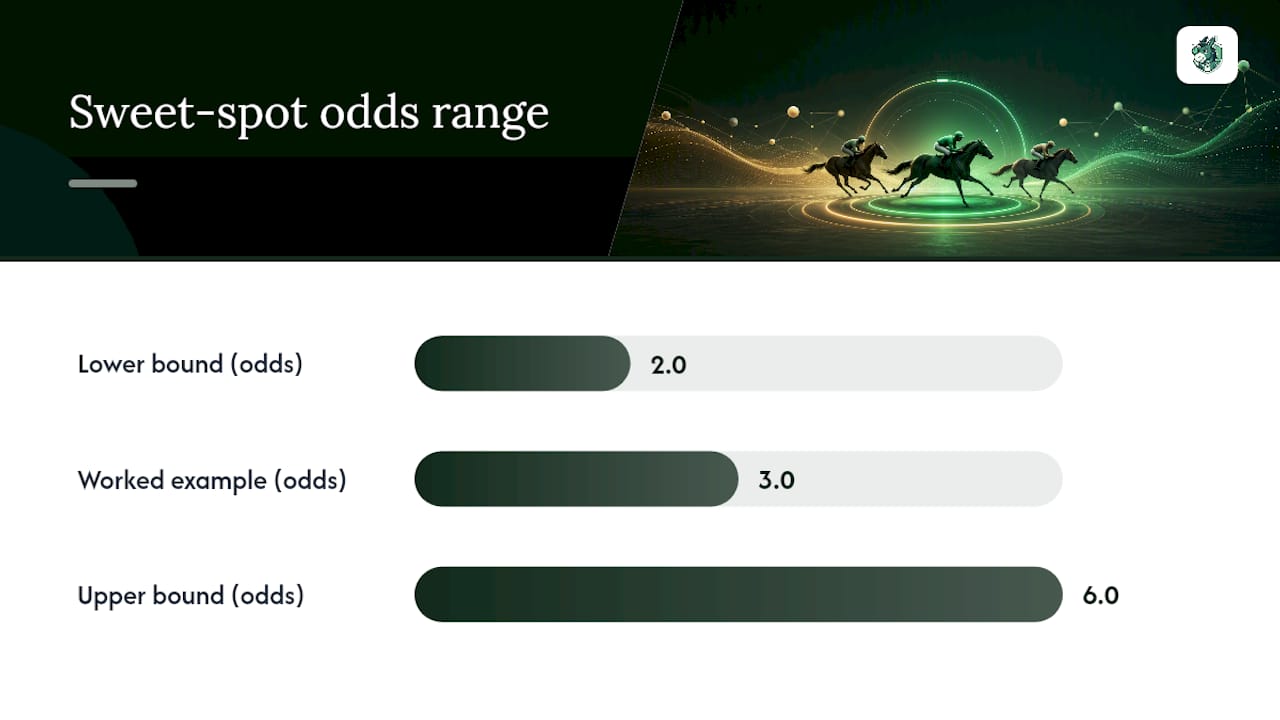
Odds between 2.0 and 6.0 tend to be the sweet spot: liquid enough to trade, volatile enough to move. A worked example: laying at 3.0 with a £10 stake carries £20 liability. If the price steams to 2.2 and you green up, you lock in profit regardless of the result.
Pro Tip: Never lay a horse purely because its price looks high. Check why it’s drifting first. Sometimes the market knows something you don’t.
Race selection and liquidity filters that actually matter
Not every race is worth your attention, and forcing a trade into a thin market is how good strategies bleed money through slippage alone.
Apply hard filters before you even look at prices:
- Skip any race with low total matched volume; the pre-race trading data shows these markets move erratically on single bets rather than genuine sentiment.
- Favour highly liquid markets if you’re running automated or high-frequency strategies, since queue depth needs to absorb your size without moving the price yourself.
- Prioritise handicaps and competitive fields of eight or more runners over small, predictable races.
- Lean towards major meetings and all-weather fixtures, where liquidity concentrates and patterns repeat more reliably, according to course-level volume data referenced in the same dataset.
Field size matters almost as much as total volume. A five-runner race with one odds-on favourite rarely offers tradeable movement because the market’s already made its mind up before the gates open. An eight-plus runner field, by contrast, keeps prices genuinely contested right up to the off, which is exactly the volatility a trader needs. Slippage on a £50k market can eat 5 to 10 ticks off your entry; on a £250k market, it barely registers.
Execution and risk management: liability, stops, and greening up
Every trade needs a liability cap before you place it, not after. A common rule is capping liability at 1 to 2% of your total bank per lay, so a £2,000 bank limits any single trade to £20 to £40 of exposure.
Build your risk framework around these non-negotiables:
- Define your stop-loss in ticks before entry, not as a vague “I’ll get out if it feels wrong.”
- Cap total liability per race, not just per selection, if you’re running multiple lays.
- Green up whenever a move gives you guaranteed profit rather than holding for more.
- Factor Betfair’s commission into every profit calculation before you call a trade a win.
Queue depth is the variable most beginners ignore. Execution-focused guides stress that liability maths and stop discipline count for little if you can’t actually get matched at your intended price, which is why checking available volume at your target odds matters as much as the odds themselves.
Tooling separates disciplined traders from lucky ones. Look for platforms offering simulated or backtest modes, so you can stress-test a strategy before risking real liability, and queue-position visibility, so you know whether your order sits first or fifteenth in line. Traderline’s breakdown of lay-the-field mechanics makes the same point: matching failure, not bad selection, is the most common reason lay strategies fail in practice.
What steam and drift actually tell you
Drift is the reverse: a price lengthening steadily as money moves away from a runner. Both are signals, but only when they’re backed by volume.
The key distinction is matched-volume signature. Informed money tends to build steadily across multiple bets and multiple exchanges. Recreational money tends to spike on a single large bet, then stall. SmartBettingClub’s analysis of Betfair pre-race lays points to regression-based filters as one way to separate the two systematically rather than by feel.
Cross-check every signal before acting on it:
- Compare exchange price against a bookmaker odds aggregator to see if the move is market-wide or isolated to one exchange.
- Watch for late trainer or jockey news breaking at the same time as the price shift.
- Treat a lone spike with no supporting volume as a likely false positive, not a genuine trend.
Pro Tip: If you’re not near the front of the queue at your target price, the move may finish before you get matched. Factor that lag into your entry timing, not just your exit.
DonkeyRadar’s data-led approach in practice
Donkeyradar processes historical strike rates alongside live market prices to flag the weakest horse in a race, publishing every signal before the race starts rather than after the fact. Every result is tracked and verified publicly, and staking tiers grade signal confidence so you can size trades accordingly. Readers can audit the full history themselves rather than taking any strike rate on trust, a transparency standard the wider horse racing data analysis space rarely matches.
Common biases that quietly wreck pre-race analysis
Confirmation bias is the biggest one. Once you’ve laid a horse, it’s tempting to only notice news that confirms it’s weakening, while ignoring signs it’s strengthening. That selective attention keeps you in losing positions longer than the data justifies.
Recency bias runs a close second. A horse that won impressively last time out gets treated as a lock, even when the underlying market data suggests the price has overshot. The false favourites guide covers exactly this pattern: public sentiment inflating a runner well past what its form and market context actually support.
Loss aversion causes the opposite problem at the exit. Traders hold a losing lay too long, hoping for a reversal, rather than accepting a small loss and moving to the next race. That single habit, more than any selection error, is what turns a sound strategy into a losing month.
Anchoring matters too. If you saw a horse at 8.0 in the morning, a move to 5.0 feels dramatic even if 5.0 is still fair value given the field. Judge every price against current market conditions, not your first impression of it.
The fix for all four is the same: write your entry and exit rules down before the race, and follow them mechanically. A structured selection checklist takes the emotion out of the decision, because the rule was set when you were calm, not when the price was moving against you.
What a well-run trade actually looks like
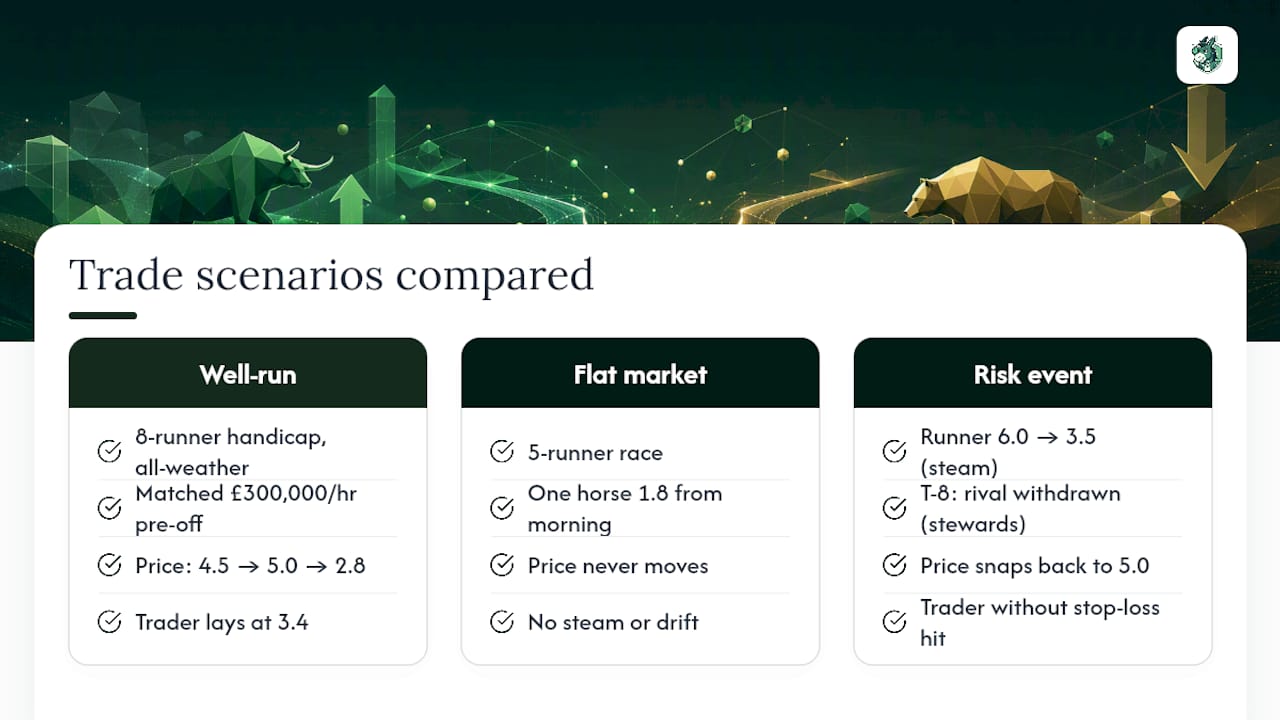
Consider a competitive eight-runner handicap at a major all-weather fixture, where matched volume clears £300,000 an hour before the off. One runner opens at 4.5, drifts briefly to 5.0 on early money, then steams hard to 2.8 in the final fifteen minutes as volume builds steadily across three separate price points rather than one spike.
That steady build is the tell. A trader watching this market lays at 3.4, midway through the move, with a £15 stake and £36 liability. As the price continues to 2.6, they green up rather than holding to the off, banking a modest but certain profit and removing all result risk.
Compare that with a five-runner race where one horse sits at 1.8 from the morning show and never moves. There’s no steam, no drift, nothing to trade, only a bet on the outcome. The lesson isn’t that short-priced favourites can’t be laid. It’s that a market with no volatility offers a trader nothing regardless of the odds.
A third scenario shows the risk side clearly: a runner steaming from 6.0 to 3.5 on what looks like informed money, only for a stewards’ announcement at T-8 minutes to reveal a leading rival has been withdrawn. The price snaps back to 5.0 almost instantly. A trader without a pre-set stop-loss on that lay would have taken a liability hit with no time to react, which is exactly why the stop gets defined before entry, not during the panic.
How weather, scratches, and news move the market
A sudden going change from good to soft can shift an entire market inside minutes, particularly for horses with a proven record on softer ground. Traders who track going forecasts alongside price movement often spot the shift before the wider market fully prices it in.
Late scratches change field dynamics instantly. When a fancied runner withdraws, its money redistributes across the remaining field, and prices across several horses can move simultaneously rather than in response to any single trade. That’s a moment to check volume carefully. A price change driven by a scratch is a structural shift, not a signal about the remaining horses’ chances, and treating it as a trading opportunity without checking the cause is a common way to lose money fast.
Trainer and jockey news, breeding-related travel restrictions, and last-minute booking changes all move prices too, often faster than mainstream racing news sites report them. Cross-checking multiple sources before entering a trade, rather than relying on the exchange price alone, catches most of these before they cost you.
Realistic expectations for the learning curve
Consistent edge typically takes months of paper-trading before real stakes, not days. Common early mistakes are over-leveraging single trades and ignoring liquidity entirely. Keep detailed records and scale up gradually as your data proves the edge is real.
— Donkey
How Donkeyradar puts this into practice for you
Donkeyradar gives you the statistical edge without the hours of manual chart-watching. Rather than eyeballing steam and matched volume across dozens of races yourself, the platform’s algorithm processes historical strike rates and live prices automatically, publishing lay signals before each race with a staking tier attached so you know exactly how much confidence sits behind the call.
The service suits anyone already comfortable with exchange trading who wants a data-led shortlist rather than a full-time job scanning markets. Every past signal is published and verifiable, so you’re never taking a strike rate on faith, and real-time alerts via email or Telegram mean you’re not glued to a screen at T-10 waiting for a move. If you want to see the mechanics for yourself, the lay betting calculator works out liability and break-even before you commit a penny, and profits from UK betting remain tax-free, which sharpens the appeal further. Start with the seven-day trial and check today’s published signals against the filters covered in this guide.
Sources
- Pre-Race Trading: Horse Racing on Betfair (2026)
- The practical guide to profit from laying in horse racing - Matchbook Insights
- Betfair pre race laying and exchange betting insights | SBC Magazine
- Laying horses on Betfair: When and how (2026 strategy guide)