← Blog · 📝 Article · 12 September 2026
500–2,000 Bets: Use Yield Not ROI and Check CLV to Prove an Edge

ROI measures how fast your bankroll grows relative to what you put into it. Yield measures your return per pound staked, stripped of bankroll size. Use Yield to judge whether a strategy or tipster genuinely beats the market; use ROI to track how your own bank is actually growing. Formulas, worked examples and the sample sizes needed to trust either number follow below.
TL;DR:
- Yield provides a more reliable measure of betting skill than ROI, especially when assessing strategies with different stake sizes or turnover rates.
- Professional markets typically see a Yield of 3–5% as strong, while higher yields may indicate data issues or unsustainable edges.
- A small sample size, under 100 bets, makes both ROI and Yield unreliable for drawing long-term conclusions.
- Consistently beating the closing line value is a stronger indicator of skill than short-term positive Yield or ROI figures.
- It takes at least 500 to 2,000 settled bets to accurately evaluate a betting strategy’s genuine edge.
Table of Contents
- ROI vs yield betting: defining ROI and how to calculate it
- ROI vs yield betting: defining Yield and how to calculate it
- ROI vs yield betting: the side-by-side decision guide
- Applying ROI and Yield to track and improve your betting
- Turning a bet log into ROI and Yield: a worked walkthrough
- How many bets before ROI and Yield mean anything?
- The DonkeyRadar perspective on proving an edge with lay signals
- What bettors get wrong about ROI and Yield
- Try a transparent record before you trust a headline number
- Sources
- FAQ
ROI vs yield betting: defining ROI and how to calculate it
ROI, or return on investment, is a standard financial metric borrowed straight from investing. In betting terms:
ROI = (Net Profit ÷ Starting Bankroll) × 100
Say you start a season with a £1,000 bank and finish up £150. Simple enough, but the starting bankroll figure is where things get messy. If you top up your account with an extra £500 partway through, or withdraw winnings to spend elsewhere, your naive ROI calculation no longer reflects reality. You need to adjust the denominator to account for deposits and withdrawals, or track ROI against your average bankroll across the period rather than a single opening figure.
That distortion is exactly why professional bettors rarely lean on ROI alone when judging a strategy’s quality. It answers a different question: not “is this method good?” but “how has my money grown?”
Useful benchmarks for context:
- A recreational bettor breaking even long-term is already doing better than most.
- Professional bettors in efficient markets often report ROI in the low single digits over a full year.
- Anything reported consistently above a high annual percentage warrant scrutiny of the sample, not celebration.
ROI is the number your accountant would care about. It is not the number that tells you whether your selection process actually works.
ROI vs yield betting: defining Yield and how to calculate it
Yield fixes the problem ROI has with turnover. It measures profit against every pound you have actually risked, not against your starting bank:
Yield = (Net Profit ÷ Total Stakes) × 100
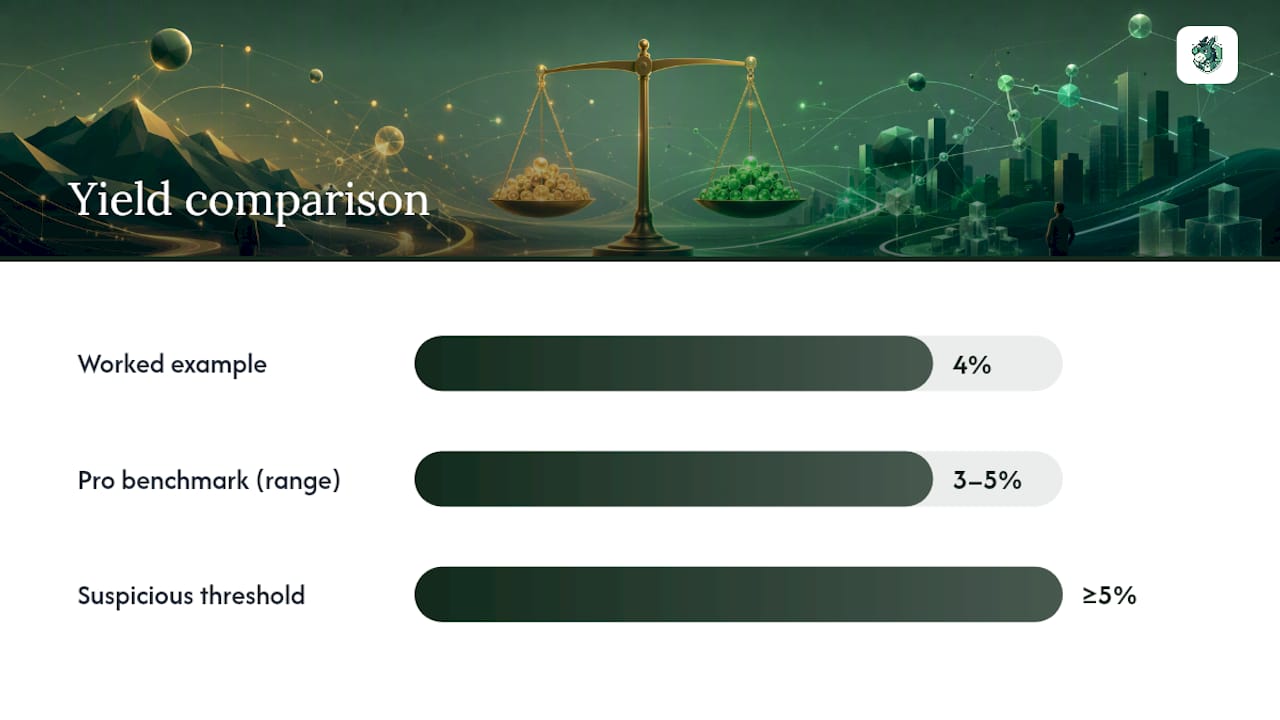
Here’s the worked example. Suppose you place 50 bets, staking £20 each, for total turnover of £1,000. Your net profit across those 50 bets is £40. Yield = (£40 ÷ £1,000) × 100 = 4%. Notice that starting bankroll never enters the equation.
This normalisation is precisely what makes Yield the metric of choice when comparing two tipsters or two strategies that stake differently. A bettor placing £10 stakes and one placing £200 stakes can be judged on equal footing, because Yield cares only about stakes turned over, not bank size.
Benchmarks worth knowing:
- In efficient markets such as English Premier League match odds, a long-run Yield of 3–5% is considered excellent by professional-level standards.
- Niche markets (lower-league football, minor horse racing meetings) can produce higher headline yields, but usually with far less turnover capacity, meaning the edge is harder to scale.
- A Yield that persistently sits well above 5% across large samples in a liquid market is more often a sign of a data or sample problem than genuine skill.
Yield does not tell you how your bankroll is growing. It tells you whether your process finds value.
ROI vs yield betting: the side-by-side decision guide
The core difference comes down to the denominator. ROI divides profit by your starting bankroll; Yield divides profit by total stakes. That single distinction changes what each number is sensitive to.
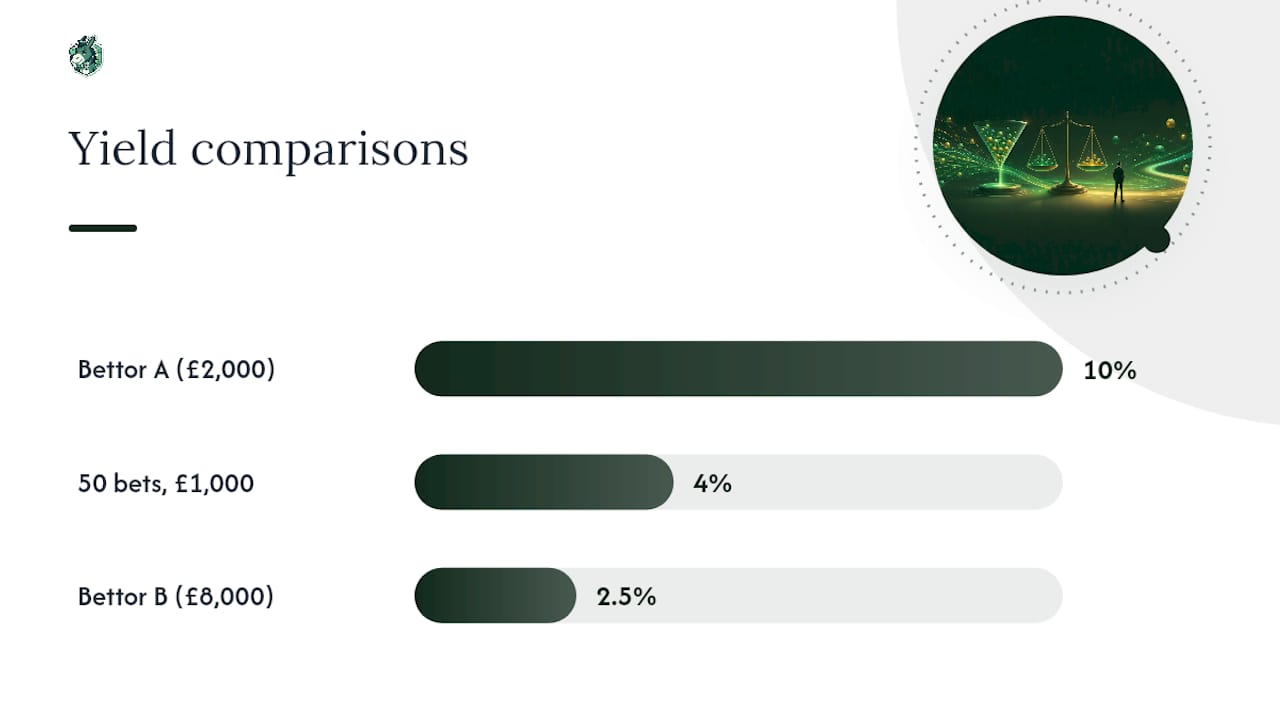
Consider two bettors with identical £200 profit over a month. Bettor A stakes £2,000 in total across the month from a £1,000 bank, producing a 20% ROI and a 10% Yield. Bettor B stakes £8,000 in total from the same £1,000 bank (recycling winnings and staking more aggressively), producing the same 20% ROI but only a 2.5% Yield. Same bankroll growth, wildly different underlying edge.
Use each metric for its own job:
- Prioritise Yield when comparing strategies, evaluating a tipster service, or deciding whether an edge is real.
- Prioritise ROI when tracking personal bankroll growth, planning withdrawals, or reporting overall betting performance as a personal-finance exercise.
- Watch both together when deciding whether to scale a strategy up. A high Yield with low turnover might not scale; a solid ROI built on volatile, high-turnover staking might not survive a downswing.
Neither metric replaces the other. They answer different questions, and conflating them is the single most common analytical mistake bettors make.
Applying ROI and Yield to track and improve your betting
Numbers only help if you log the right inputs from the start. Every bet you place should generate a record with these fields:
- Date and event
- Stake and odds taken
- Closing odds (the price just before the event starts)
- Profit or loss on settlement
- Market type (match odds, handicap, each-way, and so on)
Closing Line Value, or CLV, deserves a place in that log too. If you consistently beat the closing price, that is a stronger signal of skill than a short run of positive Yield on its own, because a positive ROI without positive CLV can simply reflect luck rather than a repeatable edge.
Bankroll rules should be tied directly to what your metrics tell you. A common approach caps individual stakes at 1–2% of your bankroll, scaling down further during a confirmed losing run rather than chasing losses with bigger bets. If your Yield turns negative over a meaningful sample, that is the trigger to cut stake size, not increase it, and a structured plan for reducing stakes during a losing streak removes the emotional decision from that moment.
Pro Tip: Review Yield and CLV together every 100 bets, not every 10. Small samples swing wildly, and reacting to noise is how disciplined bettors talk themselves out of a genuinely working strategy.
Turning a bet log into ROI and Yield: a worked walkthrough
A spreadsheet with twenty logged bets is enough to demonstrate the mechanics, even though it is far too small a sample to draw real conclusions from (more on that below).
- List each bet’s stake, odds, and result (win or loss) in separate columns.
- Calculate profit per bet: for a win, (odds minus 1) multiplied by stake; for a loss, the stake as a negative figure.
- Sum the profit column for total net profit, and sum the stake column for total turnover.
- Divide total net profit by total turnover, multiply by 100, to get Yield.
- Divide total net profit by your starting bankroll, multiply by 100, to get ROI.
If your stakes vary bet to bet rather than staying fixed, Yield still works exactly the same way because it is denominated in total stakes, not bet count. Fixed-stake records are simpler to sanity-check by eye, but variable staking (proportional to edge size, for instance) needs the full stakes column to avoid a misleading average. For a ready-made structure rather than building one from scratch, a dedicated guide to tracking betting results walks through the column layout in more detail.
How many bets before ROI and Yield mean anything?
Twenty bets tell you almost nothing. Yield behaves like any sample mean: it carries a standard error that shrinks only as your bet count grows, and a single unlucky or lucky run of results can swing a small-sample Yield figure by double digits in either direction.
The standard workflow is to treat per-bet profit as your unit, calculate the standard error across your sample, then compute a t-score to build a confidence interval around your observed Yield. If your confidence interval still straddles zero, you cannot yet say your edge is real rather than variance.
In numbers: practitioner guidance recommends 500 to 2,000 or more settled bets before treating a Yield figure as statistically reliable, with the higher end needed in more volatile markets.
- Under 100 bets: treat any Yield figure as anecdotal only.
- 500 to 1,000 bets: a reasonable working confidence level, especially in lower-variance markets.
- 2,000-plus bets: solid ground for judging a long-term strategy, particularly in high-variance markets like each-way horse racing.
Market type matters too. Consistent CLV alongside a positive Yield strengthens the case well before you hit the top end of that range.
The DonkeyRadar perspective on proving an edge with lay signals
A reputable service publishes every lay signal before the race runs, then keeps a verified, timestamped results history that anyone can check against the actual outcome. That matters because ROI and Yield claims are only as trustworthy as the record behind them, and a public log with staking tiers attached gives readers the raw material to run their own Yield and confidence-interval checks rather than take a headline strike rate on trust.
Staking tiers also help separate signal quality from stake sizing when reading the numbers, since grading confidence level alongside each bet keeps the Yield calculation meaningful across a mixed set of selections. One more practical point for UK bettors: profits from betting, lay betting included, are tax-free in the UK, so a net Yield figure is also a net take-home figure.
What bettors get wrong about ROI and Yield
Three mistakes come up again and again. Bettors treat ROI as if it were simply “profit,” when it is profit relative to bankroll, a very different figure once deposits and withdrawals enter the picture. They read meaning into Yield from samples of 50 or 100 bets, when the confidence interval at that size is often wide enough to include zero. And they skip Closing Line Value entirely, missing the one signal that separates a repeatable edge from a lucky run.
The practical priority: validate Yield with CLV and a proper statistical check first, then use ROI to manage what the bankroll is actually doing.
— Donkey
Try a transparent record before you trust a headline number
Some services publish every lay signal ahead of the race, grade each one by staking tier, and keep a verified results history you can check bet by bet rather than trusting a single headline strike rate. That transparency is exactly what you need to run your own Yield and ROI checks properly, because you can pull real stakes, odds and outcomes straight from the public record instead of taking someone’s summary on faith.
If you’re new to the mechanics of betting against a horse rather than backing one, the lay betting explained guide walks through how the strategy works before you start logging results of your own. Once you have even a small sample of signals tracked, run the numbers yourself and see where your Yield and confidence interval actually land.
Sources
- Gambling Commission
- Return on investment — Wikipedia
- Measure strategy performance: ROI and yield — MyBetStrategy
FAQ
What is ROI in betting?
ROI in betting is net profit divided by your starting bankroll, expressed as a percentage. It measures bankroll growth, not the quality of your selection process.
Is a 2% Yield good?
A 2% Yield sits at the lower end of what professional bettors consider strong in efficient markets, where 3 to 5% is generally seen as excellent over a large sample. Whether 2% is genuinely good also depends on sample size and whether it holds alongside positive Closing Line Value.
Is ROI basically profit?
No. ROI is profit expressed as a percentage of your starting bankroll, not the profit figure itself, and it can be distorted by deposits or withdrawals if the bankroll base isn’t adjusted correctly.
How many bets before results are meaningful?
Most practitioner guidance suggests 500 to 2,000 or more settled bets before treating a Yield or ROI figure as statistically reliable, with higher-variance markets needing the larger end of that range.