← Blog · 📝 Article · 8 September 2026
1–2% Liability Rules: Weakest Horse Method for Lay Traders
The weakest horse method is a signals-based approach that combines market pricing with form, trainer, and context data to flag the runner statistically least likely to win. It works because markets misprice outsiders more often than favourites, and it belongs in a lay trader’s toolkit whenever pre-race drift, poor form, and negative context all point the same way. Services like Donkeyradar build entire signal feeds around this logic.
TL;DR:
- The weakest horse method exploits market inefficiencies, especially with outsiders that drift due to low betting volume and overlooked race factors.
- Consistent application involves analyzing market drift, form, and context signals, then acting only when negative indicators align within a specific odds range.
- Managing liability carefully by capping risk at 1-2% of bankroll per lay and working out exact liabilities before placing bets is crucial for sustainability.
- Overfitting, slippage, or scaling mistakes during fast markets can erode profits, highlighting the need for cautious stake management and out-of-sample testing.
- Using a verified signal service like Donkeyradar offers a reliable, data-driven edge without the time investment of building a personal model.
Table of Contents
- What is the weakest horse method in lay betting?
- How do you apply the weakest horse method step by step?
- Which signals matter most, and how do you score them?
- What staking and risk rules keep a lay strategy sustainable?
- What are the limitations and common mistakes?
- How does a verified signal service change the practical picture?
- Try DonkeyRadar’s lay betting tools
- Sources
What is the weakest horse method in lay betting?
The term describes a statistical method, not a training technique or a fitness assessment. It treats each runner as a probability estimate, compares that estimate against the market’s implied price, and looks for the widest gap on the losing side.
That gap exists because horse racing markets are inefficient at the bottom end of the field. Favourites get scrutinised by professional money and tighten up fast. Outsiders drift on thin volume, get overlooked by casual punters, and often carry information (a wide draw, a step up in trip, a jockey booking made late) that the price hasn’t fully absorbed yet. Academic work on race modelling, including the multinomial and running-time approaches described by Bacon-Shone and Lo, shows that statistical models can estimate finishing-order probabilities with enough accuracy to generate a betting edge in some datasets.
The practical version of this, used by exchange traders rather than academics, blends a few inputs rather than relying on one:
- Market-implied probability against a simple form-adjusted model
- Late trading behaviour (who is being backed, who is drifting)
- Non-price context: going suitability, trainer form, jockey changes
Combining this reduces false positives compared with betting on drift alone. A horse can drift for reasons that have nothing to do with ability, so the “weakest horse” label only holds when several independent signals agree.
How do you apply the weakest horse method step by step?
Treat this as a checklist you run through in the same order every time. Consistency is what turns a method into a repeatable process rather than a hunch.
- Pull the base data. Current market price, traded volume, official form figures, and going/distance suitability for every runner inside the top six in the market.
- Check the drift. Note which horses have drifted more than roughly 20% in the last hour and which are sitting on thin unmatched lay depth.
- Score the form. Flag recent finishes outside the frame, a step up in class, or a first-time-out runner with no form overlay.
- Add context. Late jockey bookings, trainer’s recent runners-to-winners ratio, and any stall draw bias specific to that track.
- Total the weakest-score. Give each negative signal a point value (see the scoring section below) and rank runners by total.
- Set the decision threshold. Only act when a horse clears your minimum score AND sits inside your preferred odds band.
- Calculate liability, then place the lay. Confirm the liability figure before you confirm the bet, not after.
- Monitor in-play for the first few furlongs. Visible distress, a horse dropping tail-off early, or a sudden move against your lay are the only reasons to intervene early.
A typical last-30-minutes workflow looks like this: scan the market at T-30, shortlist two or three candidates showing drift plus a form negative, confirm nothing has changed on the racecard (no late vet note, no jockey swap), then place the lay once the price stabilises rather than mid-drift. Placing into a still-moving price often means you lay at a worse level than you intended, an issue Timeform’s exchange guide flags directly when discussing BSP and execution timing.
Pro Tip: Set a hard cut-off, such as T-5 minutes, after which you stop opening new lays regardless of how tempting the price looks. Late moves are the least reliable signals on the racecard.
Which signals matter most, and how do you score them?
Not every signal carries equal weight, and treating them as if they do is one of the fastest ways to misread a race. A workable rubric assigns points to each category and sums them into a single weakest-score you can backtest.
Market signals
- Pre-race drift of 20% or more in decimal odds, measured from the morning price to fifteen minutes before the off
- Thin or absent unmatched lay depth at the top of the book, suggesting professional money is avoiding the runner
- Late traded volume spikes against the horse rather than for it
Form signals
- Two or more finishes outside the first four in the last three runs
- A step up in class or trip with no supporting form line at that level
- First-time-out runners with a stable that rarely wins fresh
Context signals
- Late jockey changes, particularly a booking downgrade
- Unfavourable stall draw on tracks with a known bias
- Any veterinary note or gear change flagged on the racecard
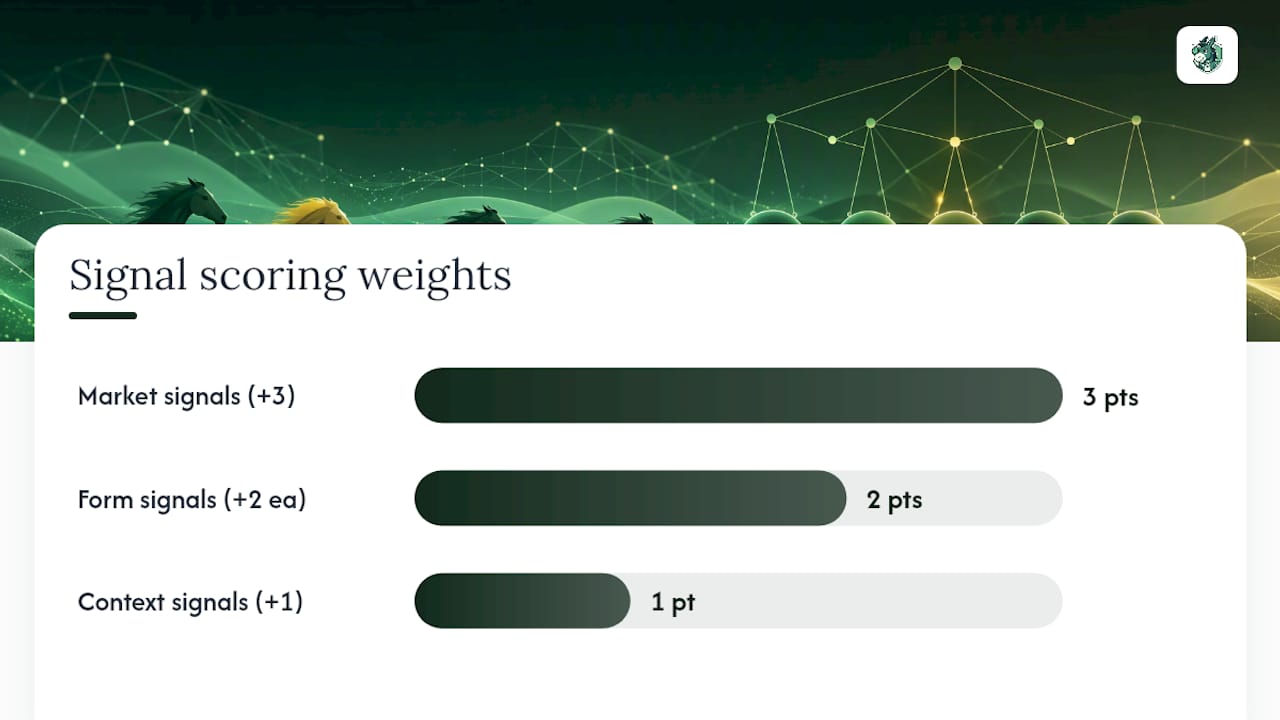
A simple rubric might assign +3 for significant market drift, +2 per negative form line, and +1 for a late jockey or context change, a structure similar to the practitioner scoring approach Donkeyradar uses in its own data analysis. Runners scoring above your chosen threshold, commonly five or six points, become lay candidates. Anything below stays on the shortlist rather than the bet slip.
What staking and risk rules keep a lay strategy sustainable?
Lay betting inverts the usual risk profile: your liability, not your stake, is the number that can wipe out a bankroll. Betfair’s own explanation of lay mechanics makes clear that liability scales with the odds you lay at, so a small stake at long odds can still carry a large downside.
- Cap liability at 1% to 2% of your total bankroll per lay, never the stake itself
- Favour a mid-odds range, roughly 2.5 to 6.0, where liquidity and achievable strike rates balance out, a band widely recommended across exchange strategy guides
- Set a stop-loss in ticks before you place the lay, not after the price starts moving against you
- Log strike rate, ROI per lay, and maximum drawdown weekly rather than relying on memory
Pro Tip: Work out your liability using a calculator before you place anything. A lay at 10.0 on a £10 stake carries £90 of liability, not £10, and that distinction catches out more new traders than any bad selection ever does.
Industry guides consistently point to liability mismanagement, not flawed selection, as the leading cause of blown accounts, a pattern BetfairSquare’s risk management guide documents in detail.
What are the limitations and common mistakes?
Price alone tells you very little. A horse can drift because of weight of money on a rival, not because it’s weak, and building a model on a small sample of races invites overfitting you won’t spot until it costs you.
- Slippage and unmatched lays during fast-moving markets can leave you exposed at a worse price than planned
- Scale creep after a winning run, laying bigger without recalculating liability, undoes months of discipline in one race
- Averaging down on a losing lay rather than accepting the stop-loss is how small losses become account-ending ones
- Skipping out-of-sample testing means a rubric that looked sharp on last month’s data can fail on this month’s fields
How does a verified signal service change the practical picture?
Building and backtesting your own model takes time most traders don’t have between races. That’s the gap a verified signal service fills: Donkeyradar applies statistical analysis, processing historical strike rates against live market prices, to flag the weakest horse before races in the UK, Australia, and the US, detailed further in its guide to picking horses to lay.
The platform publishes signals ahead of the race and tracks results openly, reporting a high strike rate with a verified history available to check. For traders who want the discipline of a data-driven method without maintaining a model themselves, a transparent, track-recorded signal feed is often the more practical route than DIY testing, especially early on.
— Donkey
Try DonkeyRadar’s lay betting tools
If you’d rather apply a tested framework than build a scoring rubric from scratch, Certain services give you both the logic and the numbers behind it, without you having to backtest a single race yourself.
Start with the lay betting explained guide if you want the mechanics laid out plainly, or run your own numbers through the lay betting calculator to see exactly what liability a given lay would carry before you commit anything. Profits from UK betting remain tax-free, which sharpens the appeal of a disciplined, signals-led approach over guesswork. Some services offer free tiers providing daily signals to test the method against your own results, and trials that open up real-time alerts and full results history if you want to go further.
Sources
For deeper mechanics, read Betfair’s own explanation of lay bet liability and Timeform’s exchange execution guide. For the modelling background, see Bacon-Shone and Lo’s report on race handicapping systems. Always check your exchange’s commission structure and market rules before trading, as these vary by jurisdiction.
- Exchange: What does the term ‘Lay’ mean and what is a Lay bet? — Betfair Support
- How to lay bets on the Betfair Exchange — Timeform
- Computer based horse race handicapping and wagering systems: a report — John Bacon‐Shone, V. S. Y. Lo